

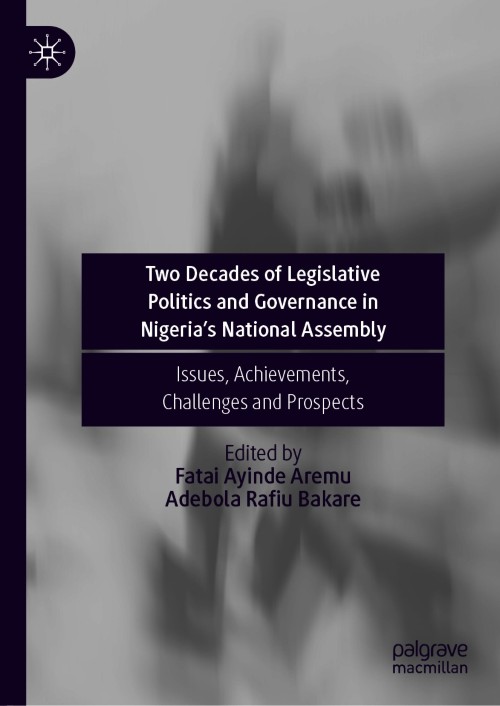
Two Decades of Legislative Politics and Governance in Nigeria’s National Assembly [electronic resource] : Issues, Achievements, Challenges and Prospects / edited by Fatai Ayinde Aremu, Adebola Rafiu Bakare.
Erişim Adresi
ISBN
9789813344556
Dil Kodu
İngilizce
Yer Numarası
DK/17318
Basım Bildirimi
1st ed. 2021.
Yayın Bilgisi
Singapore : Springer Nature Singapore : Imprint: Palgrave Macmillan, 2021.
Fiziksel Niteleme
XXXI, 394 p. 28 illus., 25 illus. in color. online resource.
İçindekiler Notu
Chapter 1. The Place of Legislature in Democratic Governance: An Introduction -- Chapter 2. The Legislature in Nigeria: Origin, Significance and Relationship with other Arms of Government -- Chapter 3. Legislative Politics and Governance in Nigeria’s Fourth Republic -- Chapter 4. Interrogating Voting Patterns in Nigeria’s Legislative Elections under the Fourth Republic -- Chapter 5. Committee System in Nigeria’s National Assembly: Issues and Challenges -- Chapter 6. Evaluating the Nigerian National Assembly’s Lawmaking Output and the Implications for Legislative Effectiveness -- Chapter 7. National Assembly as an Arena of Accountability Bargain: Issues, Challenges and Prospects -- Chapter 8. National Assembly and the Powers of Summons and Appointments Ratification -- Chapter 9. An Assessment of the Oversight Role of the National Assembly, 1999-2019 -- Chapter 10. Leadership Crisis in Nigeria’s 8th Assembly: Implications for Institutional Efficiency and Intra-Organ Stability -- Chapter 11. Legislative-Constituency Relations in Nigeria: How Representative are the Representatives? -- Chapter 12. The Nigerian House of Representatives from 1999-2019: A Performance Assessment -- Chapter 13. The Nigerian Senate, 1999-2019 -- Chapter 14. Giving Voice to the Voiceless: The Challenges of Women Legislators in Nigeria’s National Assembly -- Chapter 15. The National Assembly and the Paradox of Defection Politics in the Nigeria’s Fourth Republic, 1999 – 2019 -- Chapter 16. Twenty Years of Legislative Politics and Governance in Nigeria: how far, how well?.
Özet, vb.
This book unpacks two decades of Nigeria’s National Assembly spanning 4th–8th legislative sessions. It focuses on the core areas of legislative functions – lawmaking, appropriation, oversight and representation – in examining the achievements, challenges and prospects of the legislature. This is particularly important because Nigeria being the most populous country in Africa is a crucial bastion of democratic governance in the region. Therefore, conducting deep diagnostics of the federal legislature as the custodian of popular mandate and the anchor of accountability offered immense opportunity for learning that would catalyze further institutional reforms and democratic consolidation. Fatai Ayinde Aremu is a Professor of Political Science, University of Ilorin, Nigeria.He is presently a Directing Staff at the National Institute for Policy and Strategic Studies (NIPSS), Nigeria’s apex policy think tank. He is the author of Asymmetrical Foreign Policy Behaviour of Japan and China (2011) and co-editor of Introduction to International Relations (2012). Adebola Rafiu Bakare teaches in the Department of Political Science, University of Ilorin, Nigeria. His research interest is on legislative studies, governance institutions, psephology and security studies. He is the founder and Executive Director of Centre for Legislative Research, Documentation and Training (CLRD&T).
Konu
Executive power.
Africa __ Politics and government.
Political leadership.
Executive Politics.
African Politics.
Political Leadership.
Africa __ Politics and government.
Political leadership.
Executive Politics.
African Politics.
Political Leadership.
Diğer Yazarlar
Kurum Adı
Eseri Alıntıla
Referansları kullanmadan önce gözden geçirmeniz ve varsa gerekli düzeltmeleri yapmanız önerilir.
Dijital Kaynak
MARC Görünümü
LEADER 04905nam a22004935i 4500
001 816101
003 TR_AnAIT
005 20260130202912
007 cr nn 008mamaa
008 210319s2021 si | s |||| 0|eng d
020 |a9789813344556|9978-981-33-4455-6
024 7 |a10.1007/978-981-33-4455-6|2doi
041 |aeng
049 |aTürk Tarih Kurumu Kütüphanesi
050 4|aJF251-289
072 7|aJPH|2bicssc
072 7|aPOL028000|2bisacsh
072 7|aJPH|2thema
082 04|a351|223
090 |aDK/17318
245 10|aTwo Decades of Legislative Politics and Governance in Nigeria’s National Assembly|h[electronic resource] :|bIssues, Achievements, Challenges and Prospects /|cedited by Fatai Ayinde Aremu, Adebola Rafiu Bakare.
250 |a1st ed. 2021.
264 1|aSingapore :|bSpringer Nature Singapore :|bImprint: Palgrave Macmillan,|c2021.
300 |aXXXI, 394 p. 28 illus., 25 illus. in color.|bonline resource.
336 |atext|btxt|2rdacontent
337 |acomputer|bc|2rdamedia
338 |aonline resource|bcr|2rdacarrier
347 |atext file|bPDF|2rda
505 0 |aChapter 1. The Place of Legislature in Democratic Governance: An Introduction -- Chapter 2. The Legislature in Nigeria: Origin, Significance and Relationship with other Arms of Government -- Chapter 3. Legislative Politics and Governance in Nigeria’s Fourth Republic -- Chapter 4. Interrogating Voting Patterns in Nigeria’s Legislative Elections under the Fourth Republic -- Chapter 5. Committee System in Nigeria’s National Assembly: Issues and Challenges -- Chapter 6. Evaluating the Nigerian National Assembly’s Lawmaking Output and the Implications for Legislative Effectiveness -- Chapter 7. National Assembly as an Arena of Accountability Bargain: Issues, Challenges and Prospects -- Chapter 8. National Assembly and the Powers of Summons and Appointments Ratification -- Chapter 9. An Assessment of the Oversight Role of the National Assembly, 1999-2019 -- Chapter 10. Leadership Crisis in Nigeria’s 8th Assembly: Implications for Institutional Efficiency and Intra-Organ Stability -- Chapter 11. Legislative-Constituency Relations in Nigeria: How Representative are the Representatives? -- Chapter 12. The Nigerian House of Representatives from 1999-2019: A Performance Assessment -- Chapter 13. The Nigerian Senate, 1999-2019 -- Chapter 14. Giving Voice to the Voiceless: The Challenges of Women Legislators in Nigeria’s National Assembly -- Chapter 15. The National Assembly and the Paradox of Defection Politics in the Nigeria’s Fourth Republic, 1999 – 2019 -- Chapter 16. Twenty Years of Legislative Politics and Governance in Nigeria: how far, how well?.
520 |aThis book unpacks two decades of Nigeria’s National Assembly spanning 4th–8th legislative sessions. It focuses on the core areas of legislative functions – lawmaking, appropriation, oversight and representation – in examining the achievements, challenges and prospects of the legislature. This is particularly important because Nigeria being the most populous country in Africa is a crucial bastion of democratic governance in the region. Therefore, conducting deep diagnostics of the federal legislature as the custodian of popular mandate and the anchor of accountability offered immense opportunity for learning that would catalyze further institutional reforms and democratic consolidation. Fatai Ayinde Aremu is a Professor of Political Science, University of Ilorin, Nigeria.He is presently a Directing Staff at the National Institute for Policy and Strategic Studies (NIPSS), Nigeria’s apex policy think tank. He is the author of Asymmetrical Foreign Policy Behaviour of Japan and China (2011) and co-editor of Introduction to International Relations (2012). Adebola Rafiu Bakare teaches in the Department of Political Science, University of Ilorin, Nigeria. His research interest is on legislative studies, governance institutions, psephology and security studies. He is the founder and Executive Director of Centre for Legislative Research, Documentation and Training (CLRD&T).
650 0|aExecutive power.
650 0|aAfrica|xPolitics and government.
650 0|aPolitical leadership.
650 14|aExecutive Politics.
650 24|aAfrican Politics.
650 24|aPolitical Leadership.
700 1 |aAremu, Fatai Ayinde.|eeditor.|4edt|4http://id.loc.gov/vocabulary/relators/edt
700 1 |aBakare, Adebola Rafiu.|eeditor.|4edt|4http://id.loc.gov/vocabulary/relators/edt
710 2 |aSpringerLink (Online service)
773 0 |tSpringer Nature eBook
776 08|iPrinted edition:|z9789813344549
776 08|iPrinted edition:|z9789813344563
856 40|uhttps://doi.org/10.1007/978-981-33-4455-6
912 |aZDB-2-POS
912 |aZDB-2-SXPI
950 |aPolitical Science and International Studies (SpringerNature-41174)
950 |aPolitical Science and International Studies (R0) (SpringerNature-43724)
001 816101
003 TR_AnAIT
005 20260130202912
007 cr nn 008mamaa
008 210319s2021 si | s |||| 0|eng d
020 |a9789813344556|9978-981-33-4455-6
024 7 |a10.1007/978-981-33-4455-6|2doi
041 |aeng
049 |aTürk Tarih Kurumu Kütüphanesi
050 4|aJF251-289
072 7|aJPH|2bicssc
072 7|aPOL028000|2bisacsh
072 7|aJPH|2thema
082 04|a351|223
090 |aDK/17318
245 10|aTwo Decades of Legislative Politics and Governance in Nigeria’s National Assembly|h[electronic resource] :|bIssues, Achievements, Challenges and Prospects /|cedited by Fatai Ayinde Aremu, Adebola Rafiu Bakare.
250 |a1st ed. 2021.
264 1|aSingapore :|bSpringer Nature Singapore :|bImprint: Palgrave Macmillan,|c2021.
300 |aXXXI, 394 p. 28 illus., 25 illus. in color.|bonline resource.
336 |atext|btxt|2rdacontent
337 |acomputer|bc|2rdamedia
338 |aonline resource|bcr|2rdacarrier
347 |atext file|bPDF|2rda
505 0 |aChapter 1. The Place of Legislature in Democratic Governance: An Introduction -- Chapter 2. The Legislature in Nigeria: Origin, Significance and Relationship with other Arms of Government -- Chapter 3. Legislative Politics and Governance in Nigeria’s Fourth Republic -- Chapter 4. Interrogating Voting Patterns in Nigeria’s Legislative Elections under the Fourth Republic -- Chapter 5. Committee System in Nigeria’s National Assembly: Issues and Challenges -- Chapter 6. Evaluating the Nigerian National Assembly’s Lawmaking Output and the Implications for Legislative Effectiveness -- Chapter 7. National Assembly as an Arena of Accountability Bargain: Issues, Challenges and Prospects -- Chapter 8. National Assembly and the Powers of Summons and Appointments Ratification -- Chapter 9. An Assessment of the Oversight Role of the National Assembly, 1999-2019 -- Chapter 10. Leadership Crisis in Nigeria’s 8th Assembly: Implications for Institutional Efficiency and Intra-Organ Stability -- Chapter 11. Legislative-Constituency Relations in Nigeria: How Representative are the Representatives? -- Chapter 12. The Nigerian House of Representatives from 1999-2019: A Performance Assessment -- Chapter 13. The Nigerian Senate, 1999-2019 -- Chapter 14. Giving Voice to the Voiceless: The Challenges of Women Legislators in Nigeria’s National Assembly -- Chapter 15. The National Assembly and the Paradox of Defection Politics in the Nigeria’s Fourth Republic, 1999 – 2019 -- Chapter 16. Twenty Years of Legislative Politics and Governance in Nigeria: how far, how well?.
520 |aThis book unpacks two decades of Nigeria’s National Assembly spanning 4th–8th legislative sessions. It focuses on the core areas of legislative functions – lawmaking, appropriation, oversight and representation – in examining the achievements, challenges and prospects of the legislature. This is particularly important because Nigeria being the most populous country in Africa is a crucial bastion of democratic governance in the region. Therefore, conducting deep diagnostics of the federal legislature as the custodian of popular mandate and the anchor of accountability offered immense opportunity for learning that would catalyze further institutional reforms and democratic consolidation. Fatai Ayinde Aremu is a Professor of Political Science, University of Ilorin, Nigeria.He is presently a Directing Staff at the National Institute for Policy and Strategic Studies (NIPSS), Nigeria’s apex policy think tank. He is the author of Asymmetrical Foreign Policy Behaviour of Japan and China (2011) and co-editor of Introduction to International Relations (2012). Adebola Rafiu Bakare teaches in the Department of Political Science, University of Ilorin, Nigeria. His research interest is on legislative studies, governance institutions, psephology and security studies. He is the founder and Executive Director of Centre for Legislative Research, Documentation and Training (CLRD&T).
650 0|aExecutive power.
650 0|aAfrica|xPolitics and government.
650 0|aPolitical leadership.
650 14|aExecutive Politics.
650 24|aAfrican Politics.
650 24|aPolitical Leadership.
700 1 |aAremu, Fatai Ayinde.|eeditor.|4edt|4http://id.loc.gov/vocabulary/relators/edt
700 1 |aBakare, Adebola Rafiu.|eeditor.|4edt|4http://id.loc.gov/vocabulary/relators/edt
710 2 |aSpringerLink (Online service)
773 0 |tSpringer Nature eBook
776 08|iPrinted edition:|z9789813344549
776 08|iPrinted edition:|z9789813344563
856 40|uhttps://doi.org/10.1007/978-981-33-4455-6
912 |aZDB-2-POS
912 |aZDB-2-SXPI
950 |aPolitical Science and International Studies (SpringerNature-41174)
950 |aPolitical Science and International Studies (R0) (SpringerNature-43724)
Materyaller
Depodan talep edilen materyal sadece kütüphane içerisinde kullanılmaktadır.
Materyal dışarıya ödünç verilmemektedir.
Materyal dışarıya ödünç verilmemektedir.
