

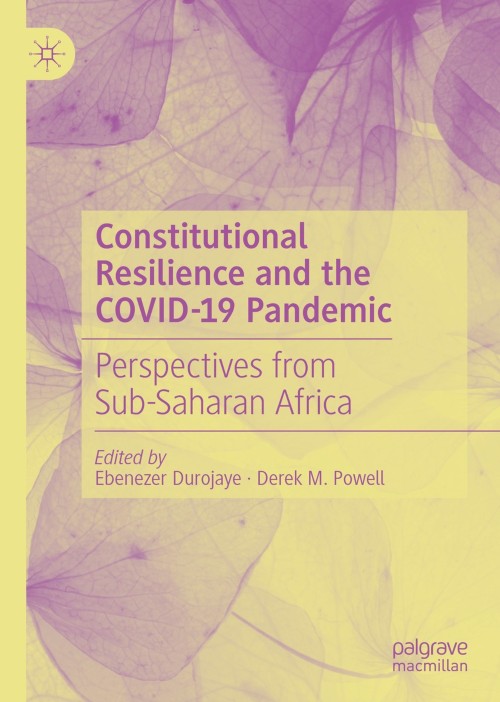
Constitutional Resilience and the COVID-19 Pandemic [electronic resource] : Perspectives from Sub-Saharan Africa / edited by Ebenezer Durojaye, Derek M. Powell.
Erişim Adresi
ISBN
9783031064012
Dil Kodu
İngilizce
Yer Numarası
DK/17325
Basım Bildirimi
1st ed. 2022.
Yayın Bilgisi
Cham : Springer International Publishing : Imprint: Palgrave Macmillan, 2022.
Fiziksel Niteleme
XV, 405 p. 6 illus. online resource.
İçindekiler Notu
Chapter 1. Constitutional Resilience and the Covid-19 Pandemic (Derek Powell and Ebenezer Durojaye) -- Chapter 2. International Human Rights Norms and Standards on Derogation and Limitation of Rights during a Public Emergency (Adetoun Adebanjo and Ebenezer Durojaye) -- Chapter 3. Addressing Covid-19: A Test of Kenya’s Constitutional and Democratic Resilience (Josephat Muuo Kilonzo and Balla Galma) -- Chapter 4. Covid-19 and Zambia’s Constitutional Dilemma (Christopher Phiri) -- Chapter 5. Constitutional Resilience and Limitation of Rights under Covid-19 Response in South Sudan (Joseph Geng Akech) -- Chapter 6. The Covid-19 Pandemic and Constitutional Resilience in The Gambia (Satang Nabaneh and Basiru Bah) -- Chapter 7. Walking a Tightrope: Balancing Human Rights and Public Health Measures during the Covid-19 Pandemic in Nigeria (Olubayo Oluduro) -- Chapter 8. The Constitutionality of Legal Measures Taken by the Government of Mauritius in the Context of the Covid-19 Pandemic (Roopanand Mahadew) -- Chapter 9. Constitutional and Human Rights Issues Arising from Covid-19: Uganda’s Youth in Context (Robert Doya Nanima) -- Chapter 10. The (Il)legality of Ghana’s Covid-19 Emergency Response: A Commentary (Bright Nkrumah) -- Chapter 11. Constitutional and Human Rights Issues Arising from Covid-19 in South Africa (Robert Doya Nanima and Ebenezer Durojaye) -- Chapter 12. Zimbabwe’s Response to Covid-19 and its Socio-economic Impact (Tinotenda Chidhawu).
Özet, vb.
‘This volume is a much-needed piece of the global puzzle of legal responses to the COVID-19 pandemic. The regional focus on constitutional law systems in Sub-Saharan Africa and their linkages to international law obligations offer a unique reference point, which will be of utmost importance for fostering an enhanced preparedness against similar future threats. The book is integral for understanding how the legal determinants of health unfold during pandemics.’ –Pedro A. Villarreal, Senior Research Fellow, Max Planck Institute for Comparative Public Law and International Law, Germany. This book explores the resilience of constitutional government in the wake of the COVID-19 pandemic, connecting and comparing perspectives from ten countries in sub-Saharan Africa to global trends. In emergency situations, such as the COVID-19 pandemic, a state has the right and duty under both international law and domestic constitutional law to take appropriate steps to protect the health and security of its population. Emergency regimes may allow for the suspension or limitation of normal constitutional government and even human rights. Those measures are not a license for authoritarian rule, but they must conform to legal standards of necessity, reasonableness, and proportionality that limit state action in ways appropriate to the maintenance of the rule of law in the context of a public health emergency. Bringing together established and emerging African scholars from ten countries, this book looks at the impact government emergency responses to the pandemic have on the functions of the executive, the legislature, and the judiciary, as well as the protection of human rights. It also considers whether and to what extent government emergency responses were consistent with international human rights law, in particular with the standards of legality, necessity, proportionality, and non-discrimination in the Siracusa Principles. Ebenezer Durojaye is Professor and Head of the Socio-Economic Rights Project in the Dullah Omar Institute for Constitutional Law, Governance and Human Rights, University of the Western Cape, South Africa. Derek M. Powell is Associate Professor of Law and Head of the Applied Constitutional Studies Project in the Dullah Omar Institute for Constitutional Law, Governance and Human Rights, University of the Western Cape, South Africa.
Konu
Africa __ Politics and government.
Constitutional law.
Political science.
Human rights.
African Politics.
Constitutional Law.
Governance and Government.
Human Rights.
Constitutional law.
Political science.
Human rights.
African Politics.
Constitutional Law.
Governance and Government.
Human Rights.
Diğer Yazarlar
Kurum Adı
Eseri Alıntıla
Referansları kullanmadan önce gözden geçirmeniz ve varsa gerekli düzeltmeleri yapmanız önerilir.
Dijital Kaynak
MARC Görünümü
LEADER 07089nam a22006615i 4500
001 816108
003 TR_AnAIT
005 20260130202846
007 cr nn 008mamaa
008 221117s2022 sz | s |||| 0|eng d
020 |a9783031064012|9978-3-031-06401-2
024 7 |a10.1007/978-3-031-06401-2|2doi
041 |aeng
049 |aTürk Tarih Kurumu Kütüphanesi
050 4|aJQ1870-3981
072 7|aJP|2bicssc
072 7|a1H|2bicssc
072 7|aPOL053000|2bisacsh
072 7|aJP|x1H|2thema
082 04|a320.96|223
090 |aDK/17325
245 10|aConstitutional Resilience and the COVID-19 Pandemic|h[electronic resource] :|bPerspectives from Sub-Saharan Africa /|cedited by Ebenezer Durojaye, Derek M. Powell.
250 |a1st ed. 2022.
264 1|aCham :|bSpringer International Publishing :|bImprint: Palgrave Macmillan,|c2022.
300 |aXV, 405 p. 6 illus.|bonline resource.
336 |atext|btxt|2rdacontent
337 |acomputer|bc|2rdamedia
338 |aonline resource|bcr|2rdacarrier
341 0 |bTable of contents navigation|2onix
341 0 |bSingle logical reading order|2onix
341 0 |bShort alternative textual descriptions|2onix
341 0 |bUse of color is not sole means of conveying information|2onix
341 0 |bUse of high contrast between text and background color|2onix
341 0 |bNext / Previous structural navigation|2onix
341 0 |bAll non-decorative content supports reading without sight|2onix
347 |atext file|bPDF|2rda
505 0 |aChapter 1. Constitutional Resilience and the Covid-19 Pandemic (Derek Powell and Ebenezer Durojaye) -- Chapter 2. International Human Rights Norms and Standards on Derogation and Limitation of Rights during a Public Emergency (Adetoun Adebanjo and Ebenezer Durojaye) -- Chapter 3. Addressing Covid-19: A Test of Kenya’s Constitutional and Democratic Resilience (Josephat Muuo Kilonzo and Balla Galma) -- Chapter 4. Covid-19 and Zambia’s Constitutional Dilemma (Christopher Phiri) -- Chapter 5. Constitutional Resilience and Limitation of Rights under Covid-19 Response in South Sudan (Joseph Geng Akech) -- Chapter 6. The Covid-19 Pandemic and Constitutional Resilience in The Gambia (Satang Nabaneh and Basiru Bah) -- Chapter 7. Walking a Tightrope: Balancing Human Rights and Public Health Measures during the Covid-19 Pandemic in Nigeria (Olubayo Oluduro) -- Chapter 8. The Constitutionality of Legal Measures Taken by the Government of Mauritius in the Context of the Covid-19 Pandemic (Roopanand Mahadew) -- Chapter 9. Constitutional and Human Rights Issues Arising from Covid-19: Uganda’s Youth in Context (Robert Doya Nanima) -- Chapter 10. The (Il)legality of Ghana’s Covid-19 Emergency Response: A Commentary (Bright Nkrumah) -- Chapter 11. Constitutional and Human Rights Issues Arising from Covid-19 in South Africa (Robert Doya Nanima and Ebenezer Durojaye) -- Chapter 12. Zimbabwe’s Response to Covid-19 and its Socio-economic Impact (Tinotenda Chidhawu).
520 |a‘This volume is a much-needed piece of the global puzzle of legal responses to the COVID-19 pandemic. The regional focus on constitutional law systems in Sub-Saharan Africa and their linkages to international law obligations offer a unique reference point, which will be of utmost importance for fostering an enhanced preparedness against similar future threats. The book is integral for understanding how the legal determinants of health unfold during pandemics.’ –Pedro A. Villarreal, Senior Research Fellow, Max Planck Institute for Comparative Public Law and International Law, Germany. This book explores the resilience of constitutional government in the wake of the COVID-19 pandemic, connecting and comparing perspectives from ten countries in sub-Saharan Africa to global trends. In emergency situations, such as the COVID-19 pandemic, a state has the right and duty under both international law and domestic constitutional law to take appropriate steps to protect the health and security of its population. Emergency regimes may allow for the suspension or limitation of normal constitutional government and even human rights. Those measures are not a license for authoritarian rule, but they must conform to legal standards of necessity, reasonableness, and proportionality that limit state action in ways appropriate to the maintenance of the rule of law in the context of a public health emergency. Bringing together established and emerging African scholars from ten countries, this book looks at the impact government emergency responses to the pandemic have on the functions of the executive, the legislature, and the judiciary, as well as the protection of human rights. It also considers whether and to what extent government emergency responses were consistent with international human rights law, in particular with the standards of legality, necessity, proportionality, and non-discrimination in the Siracusa Principles. Ebenezer Durojaye is Professor and Head of the Socio-Economic Rights Project in the Dullah Omar Institute for Constitutional Law, Governance and Human Rights, University of the Western Cape, South Africa. Derek M. Powell is Associate Professor of Law and Head of the Applied Constitutional Studies Project in the Dullah Omar Institute for Constitutional Law, Governance and Human Rights, University of the Western Cape, South Africa.
532 8 |aAccessibility summary: This PDF does not fully comply with PDF/UA standards, but does feature limited screen reader support, described non-text content (images, graphs), bookmarks for easy navigation and searchable, selectable text. Users of assistive technologies may experience difficulty navigating or interpreting content in this document. We recognize the importance of accessibility, and we welcome queries about accessibility for any of our products. If you have a question or an access need, please get in touch with us at accessibilitysupport@springernature.com.
532 8 |aNo reading system accessibility options actively disabled
532 8 |aPublisher contact for further accessibility information: accessibilitysupport@springernature.com
650 0|aAfrica|xPolitics and government.
650 0|aConstitutional law.
650 0|aPolitical science.
650 0|aHuman rights.
650 14|aAfrican Politics.
650 24|aConstitutional Law.
650 24|aGovernance and Government.
650 24|aHuman Rights.
700 1 |aDurojaye, Ebenezer.|eeditor.|4edt|4http://id.loc.gov/vocabulary/relators/edt
700 1 |aPowell, Derek M.|eeditor.|4edt|4http://id.loc.gov/vocabulary/relators/edt
710 2 |aSpringerLink (Online service)
773 0 |tSpringer Nature eBook
776 08|iPrinted edition:|z9783031064005
776 08|iPrinted edition:|z9783031064029
776 08|iPrinted edition:|z9783031064036
856 40|uhttps://doi.org/10.1007/978-3-031-06401-2
912 |aZDB-2-POS
912 |aZDB-2-SXPI
950 |aPolitical Science and International Studies (SpringerNature-41174)
950 |aPolitical Science and International Studies (R0) (SpringerNature-43724)
001 816108
003 TR_AnAIT
005 20260130202846
007 cr nn 008mamaa
008 221117s2022 sz | s |||| 0|eng d
020 |a9783031064012|9978-3-031-06401-2
024 7 |a10.1007/978-3-031-06401-2|2doi
041 |aeng
049 |aTürk Tarih Kurumu Kütüphanesi
050 4|aJQ1870-3981
072 7|aJP|2bicssc
072 7|a1H|2bicssc
072 7|aPOL053000|2bisacsh
072 7|aJP|x1H|2thema
082 04|a320.96|223
090 |aDK/17325
245 10|aConstitutional Resilience and the COVID-19 Pandemic|h[electronic resource] :|bPerspectives from Sub-Saharan Africa /|cedited by Ebenezer Durojaye, Derek M. Powell.
250 |a1st ed. 2022.
264 1|aCham :|bSpringer International Publishing :|bImprint: Palgrave Macmillan,|c2022.
300 |aXV, 405 p. 6 illus.|bonline resource.
336 |atext|btxt|2rdacontent
337 |acomputer|bc|2rdamedia
338 |aonline resource|bcr|2rdacarrier
341 0 |bTable of contents navigation|2onix
341 0 |bSingle logical reading order|2onix
341 0 |bShort alternative textual descriptions|2onix
341 0 |bUse of color is not sole means of conveying information|2onix
341 0 |bUse of high contrast between text and background color|2onix
341 0 |bNext / Previous structural navigation|2onix
341 0 |bAll non-decorative content supports reading without sight|2onix
347 |atext file|bPDF|2rda
505 0 |aChapter 1. Constitutional Resilience and the Covid-19 Pandemic (Derek Powell and Ebenezer Durojaye) -- Chapter 2. International Human Rights Norms and Standards on Derogation and Limitation of Rights during a Public Emergency (Adetoun Adebanjo and Ebenezer Durojaye) -- Chapter 3. Addressing Covid-19: A Test of Kenya’s Constitutional and Democratic Resilience (Josephat Muuo Kilonzo and Balla Galma) -- Chapter 4. Covid-19 and Zambia’s Constitutional Dilemma (Christopher Phiri) -- Chapter 5. Constitutional Resilience and Limitation of Rights under Covid-19 Response in South Sudan (Joseph Geng Akech) -- Chapter 6. The Covid-19 Pandemic and Constitutional Resilience in The Gambia (Satang Nabaneh and Basiru Bah) -- Chapter 7. Walking a Tightrope: Balancing Human Rights and Public Health Measures during the Covid-19 Pandemic in Nigeria (Olubayo Oluduro) -- Chapter 8. The Constitutionality of Legal Measures Taken by the Government of Mauritius in the Context of the Covid-19 Pandemic (Roopanand Mahadew) -- Chapter 9. Constitutional and Human Rights Issues Arising from Covid-19: Uganda’s Youth in Context (Robert Doya Nanima) -- Chapter 10. The (Il)legality of Ghana’s Covid-19 Emergency Response: A Commentary (Bright Nkrumah) -- Chapter 11. Constitutional and Human Rights Issues Arising from Covid-19 in South Africa (Robert Doya Nanima and Ebenezer Durojaye) -- Chapter 12. Zimbabwe’s Response to Covid-19 and its Socio-economic Impact (Tinotenda Chidhawu).
520 |a‘This volume is a much-needed piece of the global puzzle of legal responses to the COVID-19 pandemic. The regional focus on constitutional law systems in Sub-Saharan Africa and their linkages to international law obligations offer a unique reference point, which will be of utmost importance for fostering an enhanced preparedness against similar future threats. The book is integral for understanding how the legal determinants of health unfold during pandemics.’ –Pedro A. Villarreal, Senior Research Fellow, Max Planck Institute for Comparative Public Law and International Law, Germany. This book explores the resilience of constitutional government in the wake of the COVID-19 pandemic, connecting and comparing perspectives from ten countries in sub-Saharan Africa to global trends. In emergency situations, such as the COVID-19 pandemic, a state has the right and duty under both international law and domestic constitutional law to take appropriate steps to protect the health and security of its population. Emergency regimes may allow for the suspension or limitation of normal constitutional government and even human rights. Those measures are not a license for authoritarian rule, but they must conform to legal standards of necessity, reasonableness, and proportionality that limit state action in ways appropriate to the maintenance of the rule of law in the context of a public health emergency. Bringing together established and emerging African scholars from ten countries, this book looks at the impact government emergency responses to the pandemic have on the functions of the executive, the legislature, and the judiciary, as well as the protection of human rights. It also considers whether and to what extent government emergency responses were consistent with international human rights law, in particular with the standards of legality, necessity, proportionality, and non-discrimination in the Siracusa Principles. Ebenezer Durojaye is Professor and Head of the Socio-Economic Rights Project in the Dullah Omar Institute for Constitutional Law, Governance and Human Rights, University of the Western Cape, South Africa. Derek M. Powell is Associate Professor of Law and Head of the Applied Constitutional Studies Project in the Dullah Omar Institute for Constitutional Law, Governance and Human Rights, University of the Western Cape, South Africa.
532 8 |aAccessibility summary: This PDF does not fully comply with PDF/UA standards, but does feature limited screen reader support, described non-text content (images, graphs), bookmarks for easy navigation and searchable, selectable text. Users of assistive technologies may experience difficulty navigating or interpreting content in this document. We recognize the importance of accessibility, and we welcome queries about accessibility for any of our products. If you have a question or an access need, please get in touch with us at accessibilitysupport@springernature.com.
532 8 |aNo reading system accessibility options actively disabled
532 8 |aPublisher contact for further accessibility information: accessibilitysupport@springernature.com
650 0|aAfrica|xPolitics and government.
650 0|aConstitutional law.
650 0|aPolitical science.
650 0|aHuman rights.
650 14|aAfrican Politics.
650 24|aConstitutional Law.
650 24|aGovernance and Government.
650 24|aHuman Rights.
700 1 |aDurojaye, Ebenezer.|eeditor.|4edt|4http://id.loc.gov/vocabulary/relators/edt
700 1 |aPowell, Derek M.|eeditor.|4edt|4http://id.loc.gov/vocabulary/relators/edt
710 2 |aSpringerLink (Online service)
773 0 |tSpringer Nature eBook
776 08|iPrinted edition:|z9783031064005
776 08|iPrinted edition:|z9783031064029
776 08|iPrinted edition:|z9783031064036
856 40|uhttps://doi.org/10.1007/978-3-031-06401-2
912 |aZDB-2-POS
912 |aZDB-2-SXPI
950 |aPolitical Science and International Studies (SpringerNature-41174)
950 |aPolitical Science and International Studies (R0) (SpringerNature-43724)
Materyaller
Depodan talep edilen materyal sadece kütüphane içerisinde kullanılmaktadır.
Materyal dışarıya ödünç verilmemektedir.
Materyal dışarıya ödünç verilmemektedir.
