

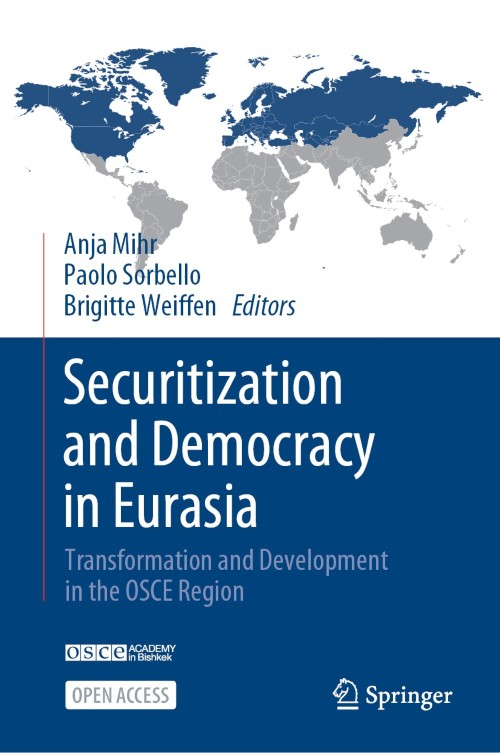
Securitization and Democracy in Eurasia [electronic resource] : Transformation and Development in the OSCE Region / edited by Anja Mihr, Paolo Sorbello, Brigitte Weiffen.
Erişim Adresi
ISBN
9783031166594
Dil Kodu
İngilizce
Yer Numarası
DK/17331
Basım Bildirimi
1st ed. 2023.
Yayın Bilgisi
Cham : Springer International Publishing : Imprint: Springer, 2023.
Fiziksel Niteleme
XVII, 411 p. 15 illus., 12 illus. in color. online resource.
İçindekiler Notu
Part I: Security Architecture in Eurasia: Speaking together: Regular Interaction and State Cooperation with OSCE Bodies -- The Impact of Development Aid on Democratic Progress, Economic Development and Corruption in the OSCE Area -- Placing the OSCE within the Eurasian Regional Integration Trends -- Population-based Study of the Eurasian Integration: Assessing the Anti-Eurasian Sentiment in Kazakhstan -- Development Aid in Central Asia: A ‘Chessboard’ for Great Powers? -- The Afghan Crisis: A Chance to Strengthen Russia’s Security Influence in Central Asia -- Main Securitizing and De-securitizing Actors of the OSCE Debate in the Western Balkan Region -- The Russian Policy in the Western Balkans -- Social Security of the States with Limited Recognition: The Case Study of the Republic of Kosovo -- New Opportunities for Peace and Cooperation in the South Caucasus -- Women’s Transformative Power in the Nagorno-Karabakh Conflict -- Legislating Gender Equality in Kyrgyzstan: Women’s Rights, Neo-Traditionalism and the OSCE -- Ending Gender-Based Violence in Kyrgyzstan: reflections on the Spotlight Initiative -- From Social Media To Social Change Online Platforms’ Impact On Kazakhstan’s Feminist And Civil Activisms -- The political impact of teahouse culture in Central Asia -- Part II: Special Section – China’s Belt and Road Initiative: A Curse or a Blessing for Democracy in Eurasia?: China’s Belt and Road Initiative: Curse or Blessing for Democracy in Eurasia? -- An Overview of China's Belt and Road Initiative and its Development since 2013 -- Official Visions of Democracy in Xi Jinping’s China -- Varieties of Authoritarianism in Eurasia -- The Belt and Road Initiative and Sustainable Urban Development in Central Asia -- A Sceptical Neighbor: Perceptions of Chinese Investments in Kyrgyzstan -- Opportunities and Risks of the Belt and Road Initiative in Ukraine -- Chinese Linkage and Democracy in Pakistan -- Democracy and Human Rights in the Context of the Belt and Road Initiative -- The Belt and Road Initiative and Autocracy Promotion as Elements of China’s Grand Strategy -- Glocal Governance and Anocratic States along the BRI -- Part III: Future Research and Debates: Fracturing Technological Governance across the OSCE Domain and its Political Implications -- Heritage Diplomacy, the Belt and Road Initiative (BRI) and the Balkans: A Soft Practice for Frozen Hardships.
Özet, vb.
This open-access book presents cutting-edge research on securitization and democratic development in the OSCE Region. Gathering contributions by practitioners and researchers from various disciplines, it presents case studies and highlights recent activities of proactive engagement in democratic institution-building and responding to security threats from the Balkans to Central Asia. The volume is divided into three parts, the first of which focuses on security-related matters, armed conflicts, minorities, and women’s safety, as well as the roles that civil society, foreign governments, social media, and external donors play in this area. These contributions illustrate how the OSCE’s informal approach to peace, security, and securitization as norm entrepreneur is closely linked to the level of democracy among its member states. The second part presents a special section on the political implications of China’s Belt and Road Initiative (BRI), assessing the impact of this infrastructural program on the levels of democracy and/or autocracy in Eurasia. The third part consists of short chapters outlining future research and debates. The book will appeal to students and scholars of international relations, security studies, and the human rights-politics nexus. This is the 2022 instalment in a series of books released by the OSCE Academy in Bishkek. The OSCE works to promote Minority Protection, Security, Democratic Development and Human Rights, guided by the Office for Democratic Institutions and Human Rights (ODIHR), and to enhance securitization and development policies in Eurasia, Europe, Central Asia and North America. Since being founded in 1993, the OSCE and its agencies and departments have attracted a wealth of academic research in various fields and disciplines, ranging from economic development and election monitoring to enhancing global principles of human rights and securitization.
Konu
Security, International.
Terrorism.
Political violence.
Human rights.
Economic development.
Comparative government.
International Security Studies.
Terrorism and Political Violence.
Politics and Human Rights.
Development Studies.
Comparative Politics.
Terrorism.
Political violence.
Human rights.
Economic development.
Comparative government.
International Security Studies.
Terrorism and Political Violence.
Politics and Human Rights.
Development Studies.
Comparative Politics.
Diğer Yazarlar
Kurum Adı
Eseri Alıntıla
Referansları kullanmadan önce gözden geçirmeniz ve varsa gerekli düzeltmeleri yapmanız önerilir.
Dijital Kaynak
MARC Görünümü
LEADER 07850nam a22007215i 4500
001 816114
003 TR_AnAIT
005 20260130202811
007 cr nn 008mamaa
008 221208s2023 sz | s |||| 0|eng d
020 |a9783031166594|9978-3-031-16659-4
024 7 |a10.1007/978-3-031-16659-4|2doi
041 |aeng
049 |aTürk Tarih Kurumu Kütüphanesi
050 4|aJZ5587-6009
072 7|aJPS|2bicssc
072 7|aPOL012000|2bisacsh
072 7|aJPS|2thema
082 04|a327.116|223
090 |aDK/17331
245 10|aSecuritization and Democracy in Eurasia|h[electronic resource] :|bTransformation and Development in the OSCE Region /|cedited by Anja Mihr, Paolo Sorbello, Brigitte Weiffen.
250 |a1st ed. 2023.
264 1|aCham :|bSpringer International Publishing :|bImprint: Springer,|c2023.
300 |aXVII, 411 p. 15 illus., 12 illus. in color.|bonline resource.
336 |atext|btxt|2rdacontent
337 |acomputer|bc|2rdamedia
338 |aonline resource|bcr|2rdacarrier
341 0 |bTable of contents navigation|2onix
341 0 |bSingle logical reading order|2onix
341 0 |bShort alternative textual descriptions|2onix
341 0 |bUse of color is not sole means of conveying information|2onix
341 0 |bUse of high contrast between text and background color|2onix
341 0 |bNext / Previous structural navigation|2onix
341 0 |bAll non-decorative content supports reading without sight|2onix
347 |atext file|bPDF|2rda
505 0 |aPart I: Security Architecture in Eurasia: Speaking together: Regular Interaction and State Cooperation with OSCE Bodies -- The Impact of Development Aid on Democratic Progress, Economic Development and Corruption in the OSCE Area -- Placing the OSCE within the Eurasian Regional Integration Trends -- Population-based Study of the Eurasian Integration: Assessing the Anti-Eurasian Sentiment in Kazakhstan -- Development Aid in Central Asia: A ‘Chessboard’ for Great Powers? -- The Afghan Crisis: A Chance to Strengthen Russia’s Security Influence in Central Asia -- Main Securitizing and De-securitizing Actors of the OSCE Debate in the Western Balkan Region -- The Russian Policy in the Western Balkans -- Social Security of the States with Limited Recognition: The Case Study of the Republic of Kosovo -- New Opportunities for Peace and Cooperation in the South Caucasus -- Women’s Transformative Power in the Nagorno-Karabakh Conflict -- Legislating Gender Equality in Kyrgyzstan: Women’s Rights, Neo-Traditionalism and the OSCE -- Ending Gender-Based Violence in Kyrgyzstan: reflections on the Spotlight Initiative -- From Social Media To Social Change Online Platforms’ Impact On Kazakhstan’s Feminist And Civil Activisms -- The political impact of teahouse culture in Central Asia -- Part II: Special Section – China’s Belt and Road Initiative: A Curse or a Blessing for Democracy in Eurasia?: China’s Belt and Road Initiative: Curse or Blessing for Democracy in Eurasia? -- An Overview of China's Belt and Road Initiative and its Development since 2013 -- Official Visions of Democracy in Xi Jinping’s China -- Varieties of Authoritarianism in Eurasia -- The Belt and Road Initiative and Sustainable Urban Development in Central Asia -- A Sceptical Neighbor: Perceptions of Chinese Investments in Kyrgyzstan -- Opportunities and Risks of the Belt and Road Initiative in Ukraine -- Chinese Linkage and Democracy in Pakistan -- Democracy and Human Rights in the Context of the Belt and Road Initiative -- The Belt and Road Initiative and Autocracy Promotion as Elements of China’s Grand Strategy -- Glocal Governance and Anocratic States along the BRI -- Part III: Future Research and Debates: Fracturing Technological Governance across the OSCE Domain and its Political Implications -- Heritage Diplomacy, the Belt and Road Initiative (BRI) and the Balkans: A Soft Practice for Frozen Hardships.
506 0 |aOpen Access
520 |aThis open-access book presents cutting-edge research on securitization and democratic development in the OSCE Region. Gathering contributions by practitioners and researchers from various disciplines, it presents case studies and highlights recent activities of proactive engagement in democratic institution-building and responding to security threats from the Balkans to Central Asia. The volume is divided into three parts, the first of which focuses on security-related matters, armed conflicts, minorities, and women’s safety, as well as the roles that civil society, foreign governments, social media, and external donors play in this area. These contributions illustrate how the OSCE’s informal approach to peace, security, and securitization as norm entrepreneur is closely linked to the level of democracy among its member states. The second part presents a special section on the political implications of China’s Belt and Road Initiative (BRI), assessing the impact of this infrastructural program on the levels of democracy and/or autocracy in Eurasia. The third part consists of short chapters outlining future research and debates. The book will appeal to students and scholars of international relations, security studies, and the human rights-politics nexus. This is the 2022 instalment in a series of books released by the OSCE Academy in Bishkek. The OSCE works to promote Minority Protection, Security, Democratic Development and Human Rights, guided by the Office for Democratic Institutions and Human Rights (ODIHR), and to enhance securitization and development policies in Eurasia, Europe, Central Asia and North America. Since being founded in 1993, the OSCE and its agencies and departments have attracted a wealth of academic research in various fields and disciplines, ranging from economic development and election monitoring to enhancing global principles of human rights and securitization.
532 8 |aAccessibility summary: This PDF does not fully comply with PDF/UA standards, but does feature limited screen reader support, described non-text content (images, graphs), bookmarks for easy navigation and searchable, selectable text. Users of assistive technologies may experience difficulty navigating or interpreting content in this document. We recognize the importance of accessibility, and we welcome queries about accessibility for any of our products. If you have a question or an access need, please get in touch with us at accessibilitysupport@springernature.com.
532 8 |aNo reading system accessibility options actively disabled
532 8 |aPublisher contact for further accessibility information: accessibilitysupport@springernature.com
650 0|aSecurity, International.
650 0|aTerrorism.
650 0|aPolitical violence.
650 0|aHuman rights.
650 0|aEconomic development.
650 0|aComparative government.
650 14|aInternational Security Studies.
650 24|aTerrorism and Political Violence.
650 24|aPolitics and Human Rights.
650 24|aDevelopment Studies.
650 24|aComparative Politics.
700 1 |aMihr, Anja.|eeditor.|4edt|4http://id.loc.gov/vocabulary/relators/edt
700 1 |aSorbello, Paolo.|eeditor.|4edt|4http://id.loc.gov/vocabulary/relators/edt
700 1 |aWeiffen, Brigitte.|eeditor.|4edt|4http://id.loc.gov/vocabulary/relators/edt
710 2 |aSpringerLink (Online service)
773 0 |tSpringer Nature eBook
776 08|iPrinted edition:|z9783031166587
776 08|iPrinted edition:|z9783031166600
776 08|iPrinted edition:|z9783031166617
856 40|uhttps://doi.org/10.1007/978-3-031-16659-4
912 |aZDB-2-POS
912 |aZDB-2-SXPI
912 |aZDB-2-SOB
950 |aPolitical Science and International Studies (SpringerNature-41174)
950 |aPolitical Science and International Studies (R0) (SpringerNature-43724)
001 816114
003 TR_AnAIT
005 20260130202811
007 cr nn 008mamaa
008 221208s2023 sz | s |||| 0|eng d
020 |a9783031166594|9978-3-031-16659-4
024 7 |a10.1007/978-3-031-16659-4|2doi
041 |aeng
049 |aTürk Tarih Kurumu Kütüphanesi
050 4|aJZ5587-6009
072 7|aJPS|2bicssc
072 7|aPOL012000|2bisacsh
072 7|aJPS|2thema
082 04|a327.116|223
090 |aDK/17331
245 10|aSecuritization and Democracy in Eurasia|h[electronic resource] :|bTransformation and Development in the OSCE Region /|cedited by Anja Mihr, Paolo Sorbello, Brigitte Weiffen.
250 |a1st ed. 2023.
264 1|aCham :|bSpringer International Publishing :|bImprint: Springer,|c2023.
300 |aXVII, 411 p. 15 illus., 12 illus. in color.|bonline resource.
336 |atext|btxt|2rdacontent
337 |acomputer|bc|2rdamedia
338 |aonline resource|bcr|2rdacarrier
341 0 |bTable of contents navigation|2onix
341 0 |bSingle logical reading order|2onix
341 0 |bShort alternative textual descriptions|2onix
341 0 |bUse of color is not sole means of conveying information|2onix
341 0 |bUse of high contrast between text and background color|2onix
341 0 |bNext / Previous structural navigation|2onix
341 0 |bAll non-decorative content supports reading without sight|2onix
347 |atext file|bPDF|2rda
505 0 |aPart I: Security Architecture in Eurasia: Speaking together: Regular Interaction and State Cooperation with OSCE Bodies -- The Impact of Development Aid on Democratic Progress, Economic Development and Corruption in the OSCE Area -- Placing the OSCE within the Eurasian Regional Integration Trends -- Population-based Study of the Eurasian Integration: Assessing the Anti-Eurasian Sentiment in Kazakhstan -- Development Aid in Central Asia: A ‘Chessboard’ for Great Powers? -- The Afghan Crisis: A Chance to Strengthen Russia’s Security Influence in Central Asia -- Main Securitizing and De-securitizing Actors of the OSCE Debate in the Western Balkan Region -- The Russian Policy in the Western Balkans -- Social Security of the States with Limited Recognition: The Case Study of the Republic of Kosovo -- New Opportunities for Peace and Cooperation in the South Caucasus -- Women’s Transformative Power in the Nagorno-Karabakh Conflict -- Legislating Gender Equality in Kyrgyzstan: Women’s Rights, Neo-Traditionalism and the OSCE -- Ending Gender-Based Violence in Kyrgyzstan: reflections on the Spotlight Initiative -- From Social Media To Social Change Online Platforms’ Impact On Kazakhstan’s Feminist And Civil Activisms -- The political impact of teahouse culture in Central Asia -- Part II: Special Section – China’s Belt and Road Initiative: A Curse or a Blessing for Democracy in Eurasia?: China’s Belt and Road Initiative: Curse or Blessing for Democracy in Eurasia? -- An Overview of China's Belt and Road Initiative and its Development since 2013 -- Official Visions of Democracy in Xi Jinping’s China -- Varieties of Authoritarianism in Eurasia -- The Belt and Road Initiative and Sustainable Urban Development in Central Asia -- A Sceptical Neighbor: Perceptions of Chinese Investments in Kyrgyzstan -- Opportunities and Risks of the Belt and Road Initiative in Ukraine -- Chinese Linkage and Democracy in Pakistan -- Democracy and Human Rights in the Context of the Belt and Road Initiative -- The Belt and Road Initiative and Autocracy Promotion as Elements of China’s Grand Strategy -- Glocal Governance and Anocratic States along the BRI -- Part III: Future Research and Debates: Fracturing Technological Governance across the OSCE Domain and its Political Implications -- Heritage Diplomacy, the Belt and Road Initiative (BRI) and the Balkans: A Soft Practice for Frozen Hardships.
506 0 |aOpen Access
520 |aThis open-access book presents cutting-edge research on securitization and democratic development in the OSCE Region. Gathering contributions by practitioners and researchers from various disciplines, it presents case studies and highlights recent activities of proactive engagement in democratic institution-building and responding to security threats from the Balkans to Central Asia. The volume is divided into three parts, the first of which focuses on security-related matters, armed conflicts, minorities, and women’s safety, as well as the roles that civil society, foreign governments, social media, and external donors play in this area. These contributions illustrate how the OSCE’s informal approach to peace, security, and securitization as norm entrepreneur is closely linked to the level of democracy among its member states. The second part presents a special section on the political implications of China’s Belt and Road Initiative (BRI), assessing the impact of this infrastructural program on the levels of democracy and/or autocracy in Eurasia. The third part consists of short chapters outlining future research and debates. The book will appeal to students and scholars of international relations, security studies, and the human rights-politics nexus. This is the 2022 instalment in a series of books released by the OSCE Academy in Bishkek. The OSCE works to promote Minority Protection, Security, Democratic Development and Human Rights, guided by the Office for Democratic Institutions and Human Rights (ODIHR), and to enhance securitization and development policies in Eurasia, Europe, Central Asia and North America. Since being founded in 1993, the OSCE and its agencies and departments have attracted a wealth of academic research in various fields and disciplines, ranging from economic development and election monitoring to enhancing global principles of human rights and securitization.
532 8 |aAccessibility summary: This PDF does not fully comply with PDF/UA standards, but does feature limited screen reader support, described non-text content (images, graphs), bookmarks for easy navigation and searchable, selectable text. Users of assistive technologies may experience difficulty navigating or interpreting content in this document. We recognize the importance of accessibility, and we welcome queries about accessibility for any of our products. If you have a question or an access need, please get in touch with us at accessibilitysupport@springernature.com.
532 8 |aNo reading system accessibility options actively disabled
532 8 |aPublisher contact for further accessibility information: accessibilitysupport@springernature.com
650 0|aSecurity, International.
650 0|aTerrorism.
650 0|aPolitical violence.
650 0|aHuman rights.
650 0|aEconomic development.
650 0|aComparative government.
650 14|aInternational Security Studies.
650 24|aTerrorism and Political Violence.
650 24|aPolitics and Human Rights.
650 24|aDevelopment Studies.
650 24|aComparative Politics.
700 1 |aMihr, Anja.|eeditor.|4edt|4http://id.loc.gov/vocabulary/relators/edt
700 1 |aSorbello, Paolo.|eeditor.|4edt|4http://id.loc.gov/vocabulary/relators/edt
700 1 |aWeiffen, Brigitte.|eeditor.|4edt|4http://id.loc.gov/vocabulary/relators/edt
710 2 |aSpringerLink (Online service)
773 0 |tSpringer Nature eBook
776 08|iPrinted edition:|z9783031166587
776 08|iPrinted edition:|z9783031166600
776 08|iPrinted edition:|z9783031166617
856 40|uhttps://doi.org/10.1007/978-3-031-16659-4
912 |aZDB-2-POS
912 |aZDB-2-SXPI
912 |aZDB-2-SOB
950 |aPolitical Science and International Studies (SpringerNature-41174)
950 |aPolitical Science and International Studies (R0) (SpringerNature-43724)
Materyaller
Depodan talep edilen materyal sadece kütüphane içerisinde kullanılmaktadır.
Materyal dışarıya ödünç verilmemektedir.
Materyal dışarıya ödünç verilmemektedir.
