LEADER 03773nam a22005775i 4500
001 816181
003 TR_AnAIT
005 20260130202132
007 cr nn 008mamaa
008 200102s2020 sz | s |||| 0|eng d
020 |a9783030328931|9978-3-030-32893-1
024 7 |a10.1007/978-3-030-32893-1|2doi
041 |aeng
049 |aTürk Tarih Kurumu Kütüphanesi
050 4|aJZ2-6530
072 7|aJPS|2bicssc
072 7|aPOL011000|2bisacsh
072 7|aJPS|2thema
082 04|a327.101|223
090 |aDK/17397
100 1 |aHirsch Ballin, Ernst.|eauthor.|4aut|4http://id.loc.gov/vocabulary/relators/aut
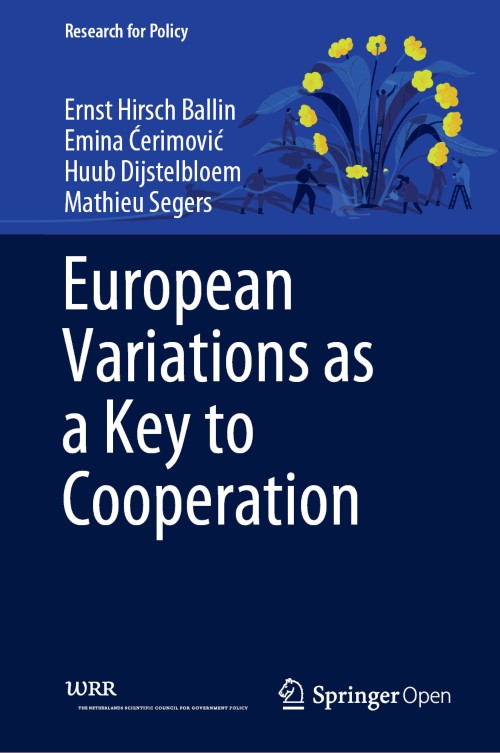
245 10|aEuropean Variations as a Key to Cooperation|h[electronic resource] /|cby Ernst Hirsch Ballin, Emina Ćerimović, Huub Dijstelbloem, Mathieu Segers.
250 |a1st ed. 2020.
264 1|aCham :|bSpringer International Publishing :|bImprint: Springer,|c2020.
300 |aXX, 177 p. 19 illus., 17 illus. in color.|bonline resource.
336 |atext|btxt|2rdacontent
337 |acomputer|bc|2rdamedia
338 |aonline resource|bcr|2rdacarrier
347 |atext file|bPDF|2rda
490 1 |aResearch for Policy, Studies by the Netherlands Scientific Council for Government Policy,|x2662-3692
505 0 |aIntroduction -- The tension between image and reality -- Growing frictions -- Beyond the institutional form: Motivations for collective action -- Variation and the internal market -- Variations in the European Union -- Variation and the euro -- Variation in asylum, migration and border control -- Conclusions.
506 0 |aOpen Access
520 |aThis Open Access book offers a novel view on the benefits of a lasting variation between the member states in the EU. In order to bring together thirty very different European states and their citizens, the EU will have to offer more scope for variation. Unlike the existing differentiation by means of opt-outs and deviations, variation is not a concession intended to resolve impasses in negotiations; it is, rather, a different structuring principle. It takes differences in needs and in democratically supported convictions seriously. A common core remains necessary, specifically concerning the basic principles of democracy, rule of law, fundamental rights and freedoms, and the common market. By taking this approach, the authors remove the pressure to embrace uniformity from the debate about the EU’s future. The book discusses forms of variation that fall both within and outside the current framework of European Union Treaties. The scope for these variations is mapped out in three domains: the internal market; the euro; and asylum, migration and border control.
650 0|aInternational relations.
650 0|aLaw|xEurope.
650 0|aEurope|xEconomic integration.
650 14|aInternational Relations Theory.
650 24|aEuropean Law.
650 24|aEuropean Economic Integration.
700 1 |aĆerimović, Emina.|eauthor.|4aut|4http://id.loc.gov/vocabulary/relators/aut
700 1 |aDijstelbloem, Huub.|eauthor.|4aut|4http://id.loc.gov/vocabulary/relators/aut
700 1 |aSegers, Mathieu.|eauthor.|4aut|4http://id.loc.gov/vocabulary/relators/aut
710 2 |aSpringerLink (Online service)
773 0 |tSpringer Nature eBook
776 08|iPrinted edition:|z9783030328924
776 08|iPrinted edition:|z9783030328948
776 08|iPrinted edition:|z9783030328955
830 0|aResearch for Policy, Studies by the Netherlands Scientific Council for Government Policy,|x2662-3692
856 40|uhttps://doi.org/10.1007/978-3-030-32893-1
912 |aZDB-2-POS
912 |aZDB-2-SXPI
912 |aZDB-2-SOB
950 |aPolitical Science and International Studies (SpringerNature-41174)
950 |aPolitical Science and International Studies (R0) (SpringerNature-43724)