

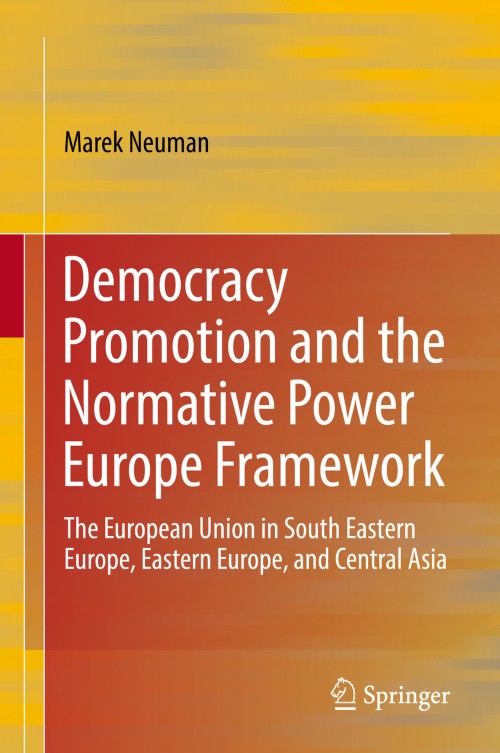
Democracy Promotion and the Normative Power Europe Framework [electronic resource] : The European Union in South Eastern Europe, Eastern Europe, and Central Asia / edited by Marek Neuman.
Erişim Adresi
ISBN
9783319926902
Dil Kodu
İngilizce
Yer Numarası
DK/17459
Basım Bildirimi
1st ed. 2019.
Yayın Bilgisi
Cham : Springer International Publishing : Imprint: Springer, 2019.
Fiziksel Niteleme
XI, 201 p. 4 illus. in color. online resource.
İçindekiler Notu
Introduction: EU Democracy Promotion in its Near (and Further) Abroad Through the Prism of Normative Power Europe -- Chapter 1: Framing the Debate: The Evolution of the European Union as an External Democratization Actor -- Chapter 2: The Role of New Member States in the European Union's External Democratization Policy -- Chapter 3: The Limits of the EU's Normative myth in Armenia and Georgia -- Chapter 4: From Orange Revolution to Euromaidan: Ukraine, The EU and the Transfer of Democracy -- Chapter 5: A Force For Good?: Assessing the EU's Normative Power in the Western Balkans -- Chapter 6: The Emergence of State Capitalism in Central Asia - The Absence of Normative Power Europe -- Chapter 7: The EU's Democratization Policy Successes: Fit Between Internal and External Perception -- Chapter 8: Normative Power Europe, Democratization, and the Challenges of Complexity -- Conclusion: The Relevance of Normative Power in Changing Europe.
Özet, vb.
This book presents a topical, holistic assessment of the European Union’s democracy promotion in South-East Europe, Eastern Europe, and Central Asia, analyzed through the prism of the Normative Power Europe (NPE) framework of transnational policy formation. To do so, it brings together three scholarly domains that traditionally stand apart and are discussed separately. The first addresses the notion of the European Union conducting a normatively-driven foreign policy both near and far abroad. The second is concerned with the legitimacy, operationality, and effectiveness of promoting democracy in third-world countries. The third addresses the quality of the relationship the European Union has been able to establish with some vital – yet often troubled – countries in South-East Europe, Eastern Europe, and Central Asia. Finally, based on the empirical findings presented in each chapter, this volume concludes by rethinking the concept and relevance of NPE to the field’s understanding of the EU’s foreign policy making. This edited volume offers the reader both a theoretically and empirically rich analysis of the European Union’s efforts to promote democracy abroad. As such is scholars and students of EU studies, particularly EU foreign policy, as well as policy makers at EU and national level and civil society representatives responsible for designing/implementing democracy promoting projects on the ground.
Konu
Political science.
Europe __ Politics and government.
Diplomacy.
International relations.
Political Science.
European Politics.
Diplomacy.
Foreign Policy.
Europe __ Politics and government.
Diplomacy.
International relations.
Political Science.
European Politics.
Diplomacy.
Foreign Policy.
Diğer Yazarlar
Kurum Adı
Eseri Alıntıla
Referansları kullanmadan önce gözden geçirmeniz ve varsa gerekli düzeltmeleri yapmanız önerilir.
Dijital Kaynak
MARC Görünümü
LEADER 05496nam a22006375i 4500
001 816243
003 TR_AnAIT
005 20260130201713
007 cr nn 008mamaa
008 180720s2019 sz | s |||| 0|eng d
020 |a9783319926902|9978-3-319-92690-2
024 7 |a10.1007/978-3-319-92690-2|2doi
041 |aeng
049 |aTürk Tarih Kurumu Kütüphanesi
050 4|aJA1-92
072 7|aJPA|2bicssc
072 7|aPOL000000|2bisacsh
072 7|aJPA|2thema
082 04|a320|223
090 |aDK/17459
245 10|aDemocracy Promotion and the Normative Power Europe Framework|h[electronic resource] :|bThe European Union in South Eastern Europe, Eastern Europe, and Central Asia /|cedited by Marek Neuman.
250 |a1st ed. 2019.
264 1|aCham :|bSpringer International Publishing :|bImprint: Springer,|c2019.
300 |aXI, 201 p. 4 illus. in color.|bonline resource.
336 |atext|btxt|2rdacontent
337 |acomputer|bc|2rdamedia
338 |aonline resource|bcr|2rdacarrier
341 0 |bTable of contents navigation|2onix
341 0 |bSingle logical reading order|2onix
341 0 |bShort alternative textual descriptions|2onix
341 0 |bUse of color is not sole means of conveying information|2onix
341 0 |bUse of high contrast between text and background color|2onix
341 0 |bNext / Previous structural navigation|2onix
341 0 |bAll non-decorative content supports reading without sight|2onix
347 |atext file|bPDF|2rda
505 0 |aIntroduction: EU Democracy Promotion in its Near (and Further) Abroad Through the Prism of Normative Power Europe -- Chapter 1: Framing the Debate: The Evolution of the European Union as an External Democratization Actor -- Chapter 2: The Role of New Member States in the European Union's External Democratization Policy -- Chapter 3: The Limits of the EU's Normative myth in Armenia and Georgia -- Chapter 4: From Orange Revolution to Euromaidan: Ukraine, The EU and the Transfer of Democracy -- Chapter 5: A Force For Good?: Assessing the EU's Normative Power in the Western Balkans -- Chapter 6: The Emergence of State Capitalism in Central Asia - The Absence of Normative Power Europe -- Chapter 7: The EU's Democratization Policy Successes: Fit Between Internal and External Perception -- Chapter 8: Normative Power Europe, Democratization, and the Challenges of Complexity -- Conclusion: The Relevance of Normative Power in Changing Europe.
520 |aThis book presents a topical, holistic assessment of the European Union’s democracy promotion in South-East Europe, Eastern Europe, and Central Asia, analyzed through the prism of the Normative Power Europe (NPE) framework of transnational policy formation. To do so, it brings together three scholarly domains that traditionally stand apart and are discussed separately. The first addresses the notion of the European Union conducting a normatively-driven foreign policy both near and far abroad. The second is concerned with the legitimacy, operationality, and effectiveness of promoting democracy in third-world countries. The third addresses the quality of the relationship the European Union has been able to establish with some vital – yet often troubled – countries in South-East Europe, Eastern Europe, and Central Asia. Finally, based on the empirical findings presented in each chapter, this volume concludes by rethinking the concept and relevance of NPE to the field’s understanding of the EU’s foreign policy making. This edited volume offers the reader both a theoretically and empirically rich analysis of the European Union’s efforts to promote democracy abroad. As such is scholars and students of EU studies, particularly EU foreign policy, as well as policy makers at EU and national level and civil society representatives responsible for designing/implementing democracy promoting projects on the ground.
532 8 |aAccessibility summary: This PDF does not fully comply with PDF/UA standards, but does feature limited screen reader support, described non-text content (images, graphs), bookmarks for easy navigation and searchable, selectable text. Users of assistive technologies may experience difficulty navigating or interpreting content in this document. We recognize the importance of accessibility, and we welcome queries about accessibility for any of our products. If you have a question or an access need, please get in touch with us at accessibilitysupport@springernature.com.
532 8 |aNo reading system accessibility options actively disabled
532 8 |aPublisher contact for further accessibility information: accessibilitysupport@springernature.com
650 0|aPolitical science.
650 0|aEurope|xPolitics and government.
650 0|aDiplomacy.
650 0|aInternational relations.
650 14|aPolitical Science.
650 24|aEuropean Politics.
650 24|aDiplomacy.
650 24|aForeign Policy.
700 1 |aNeuman, Marek.|eeditor.|4edt|4http://id.loc.gov/vocabulary/relators/edt
710 2 |aSpringerLink (Online service)
773 0 |tSpringer Nature eBook
776 08|iPrinted edition:|z9783319926896
776 08|iPrinted edition:|z9783319926919
776 08|iPrinted edition:|z9783030064921
856 40|uhttps://doi.org/10.1007/978-3-319-92690-2
912 |aZDB-2-POS
912 |aZDB-2-SXPI
950 |aPolitical Science and International Studies (SpringerNature-41174)
950 |aPolitical Science and International Studies (R0) (SpringerNature-43724)
Materyaller
Depodan talep edilen materyal sadece kütüphane içerisinde kullanılmaktadır.
Materyal dışarıya ödünç verilmemektedir.
Materyal dışarıya ödünç verilmemektedir.
