LEADER 03943nam a22005535i 4500
001 816254
003 TR_AnAIT
005 20260130201625
007 cr nn 008mamaa
008 190308s2019 sz | s |||| 0|eng d
020 |a9783030057374|9978-3-030-05737-4
024 7 |a10.1007/978-3-030-05737-4|2doi
041 |aeng
049 |aTürk Tarih Kurumu Kütüphanesi
050 4|aJQ1870-3981
072 7|aJP|2bicssc
072 7|a1H|2bicssc
072 7|aPOL053000|2bisacsh
072 7|aJP|x1H|2thema
082 04|a320.96|223
090 |aDK/17470
100 1 |aTemitope Faluyi, Olumuyiwa.|eauthor.|4aut|4http://id.loc.gov/vocabulary/relators/aut
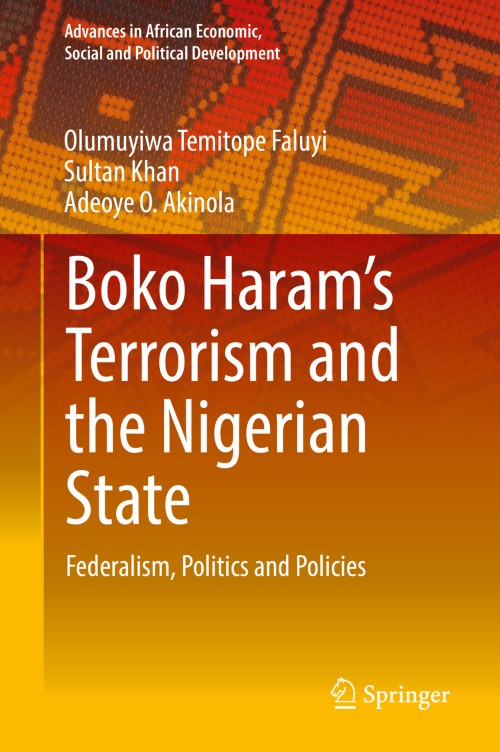
245 10|aBoko Haram’s Terrorism and the Nigerian State|h[electronic resource] :|bFederalism, Politics and Policies /|cby Olumuyiwa Temitope Faluyi, Sultan Khan, Adeoye O. Akinola.
250 |a1st ed. 2019.
264 1|aCham :|bSpringer International Publishing :|bImprint: Springer,|c2019.
300 |aXVII, 157 p. 6 illus.|bonline resource.
336 |atext|btxt|2rdacontent
337 |acomputer|bc|2rdamedia
338 |aonline resource|bcr|2rdacarrier
347 |atext file|bPDF|2rda
490 1 |aAdvances in African Economic, Social and Political Development,|x2198-7270
505 0 |aChapter 1: Nigerian State in Arms: It Begins -- Chapter 2:Terrorism: An Overview -- Chapter 3: Character of the Nigerian State -- Chapter 4: The Resource-State: A Theoretical Reality -- Chapter 5: Boko Haram: A Reign of Terror -- Chapter 6: Nigeria's Counter-Terrorism Strategies -- Chapter 7: Nigeria's Counter-Terrorism Strategies: Implications for Nigerian Federalism -- Chapter 8: Towards the Sustainable De-Securitization of Terrorism.
520 |aThis book assesses the effectiveness of Nigeria’s counterterrorist policies against Boko Haram. It takes a critical review of the interventionist strategies adopted by the Nigerian government, highlights the motivations behind the choice of strategies, and proffers a deeper understanding of the factors responsible for the state’s inability, thus far, to rid the country of terrorism. Specifically, it evaluates the NACTEST policy framework that guides the Nigerian state’s counterterrorist strategies, which contains both hard and soft power approaches. Adopting historical and case study approaches which put the Nigerian state and occurrences of violent conflict in context, it takes cognizance of the politics of ethno-religious diversity which reinforce violent conflicts among groups and against the state, and reviews the socio-economic and political realities that led to the emergence and sustenance of Boko Haram. The volume concludes by suggesting practical policy options for combating Boko Haram and other similar armed insurrection. This book is appropriate for researchers and students interested in African politics, conflict, security, peace studies, terrorism, and counterterrorism, as well as policy makers and government departments dealing with terrorism and counterterrorism.
650 0|aAfrica|xPolitics and government.
650 0|aTerrorism.
650 0|aPolitical violence.
650 0|aPeace.
650 14|aAfrican Politics.
650 24|aTerrorism and Political Violence.
650 24|aPeace and Conflict Studies.
700 1 |aKhan, Sultan.|eauthor.|4aut|4http://id.loc.gov/vocabulary/relators/aut
700 1 |aAkinola, Adeoye O.|eauthor.|4aut|4http://id.loc.gov/vocabulary/relators/aut
710 2 |aSpringerLink (Online service)
773 0 |tSpringer Nature eBook
776 08|iPrinted edition:|z9783030057367
776 08|iPrinted edition:|z9783030057381
830 0|aAdvances in African Economic, Social and Political Development,|x2198-7270
856 40|uhttps://doi.org/10.1007/978-3-030-05737-4
912 |aZDB-2-POS
912 |aZDB-2-SXPI
950 |aPolitical Science and International Studies (SpringerNature-41174)
950 |aPolitical Science and International Studies (R0) (SpringerNature-43724)