

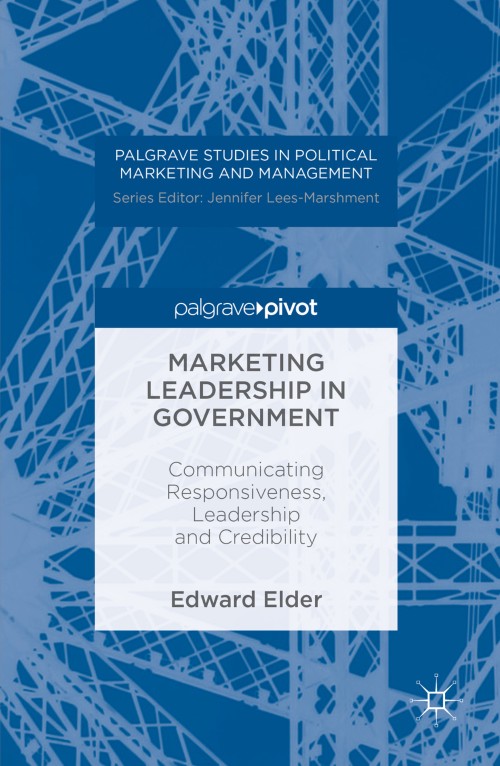
Marketing Leadership in Government [electronic resource] : Communicating Responsiveness, Leadership and Credibility / by Edward Elder.
Erişim Adresi
ISBN
9781349949199
Dil Kodu
İngilizce
Yer Numarası
DK/17551
Yazar
Basım Bildirimi
1st ed. 2016.
Yayın Bilgisi
London : Palgrave Macmillan UK : Imprint: Palgrave Macmillan, 2016.
Fiziksel Niteleme
XI, 148 p. 2 illus. in color. online resource.
Dizi
Palgrave Studies in Political Marketing and Management, 2946-2622
İçindekiler Notu
Chapter 1. Resolving the Listening versus Leadership Dilemma -- Chapter 2. Responsiveness -- Chapter 3. Leadership -- Chapter 4. Credibility -- Chapter 5. Analysing and Advising Governing Leaders.
Özet, vb.
‘A very interesting study of the communication strategies of John Key and Barack Obama, showing both their similarities and their differences. It covers the need for politicians to acknowledge opposing views and show they have listened to the public, even if not ultimately agreeing with them. “ – David Farrar, Former Political Advisor to the Prime Minister of New Zealand ‘The book has two excellent comparative case studies that it uses throughout in Barack Obama and John Key. It's insightful, thoroughly up to date, and suitable for use in classes on comparative politics, political marketing, political management and political communication. Additionally, there are a host of useful insights for practitioners. It's easy to read and engaging, meaning you want to keep reading it until the end. I couldn't put it down. I thought it was fascinating. Highly recommended for general audiences, students, scholars and practitioners. There's truly something for everyone in this wonderful book by this promising scholar.’ – Ken Cosgrove, Associate Professor of Government, Suffolk University, USA This book explores how contemporary governing leaders can overcome the typical trend of losing a public support in power by following more effective communication strategies. It shows how new forms of communication that emphasise acknowledgement and respect for public criticisms and concerns can be used by governing leaders to show the public that they still have the leadership qualities they entered office with, despite the extra challenges that political office presents. The book outlines a new model, The Contemporary Governing Leaders' Communication Model, through which leaders can communicate their positive personal and professional qualities in government. The book illustrates this model in use through the communication of United States President Barack Obama and New Zealand Prime Minister John Key during their first terms in political office. Edward Elder is a recent PhD graduate from Politics and International Relations at the University of Auckland, New Zealand, whose research focuses on political marketing communication. He published a chapter in Political Marketing in the United States (2014) and an article in the Journal of Nonprofit & Public Sector Marketing. .
Konu
Communication in politics.
Comparative government.
America __ Politics and government.
Political planning.
Elections.
Political science.
Political Communication.
Comparative Politics.
American Politics.
Public Policy.
Electoral Politics.
Political Science.
Comparative government.
America __ Politics and government.
Political planning.
Elections.
Political science.
Political Communication.
Comparative Politics.
American Politics.
Public Policy.
Electoral Politics.
Political Science.
Kurum Adı
Eseri Alıntıla
Referansları kullanmadan önce gözden geçirmeniz ve varsa gerekli düzeltmeleri yapmanız önerilir.
Dijital Kaynak
MARC Görünümü
LEADER 04718nam a22006135i 4500
001 816336
003 TR_AnAIT
005 20260130201041
007 cr nn 008mamaa
008 160717s2016 xxk| s |||| 0|eng d
020 |a9781349949199|9978-1-349-94919-9
024 7 |a10.1057/978-1-349-94919-9|2doi
041 |aeng
049 |aTürk Tarih Kurumu Kütüphanesi
050 4|aJA85-85.2
072 7|aJPH|2bicssc
072 7|aGTC|2bicssc
072 7|aPOL000000|2bisacsh
072 7|aJPH|2thema
072 7|aGTC|2thema
082 04|a320.014|223
090 |aDK/17551
100 1 |aElder, Edward.|eauthor.|4aut|4http://id.loc.gov/vocabulary/relators/aut
245 10|aMarketing Leadership in Government|h[electronic resource] :|bCommunicating Responsiveness, Leadership and Credibility /|cby Edward Elder.
250 |a1st ed. 2016.
264 1|aLondon :|bPalgrave Macmillan UK :|bImprint: Palgrave Macmillan,|c2016.
300 |aXI, 148 p. 2 illus. in color.|bonline resource.
336 |atext|btxt|2rdacontent
337 |acomputer|bc|2rdamedia
338 |aonline resource|bcr|2rdacarrier
347 |atext file|bPDF|2rda
490 1 |aPalgrave Studies in Political Marketing and Management,|x2946-2622
505 0 |aChapter 1. Resolving the Listening versus Leadership Dilemma -- Chapter 2. Responsiveness -- Chapter 3. Leadership -- Chapter 4. Credibility -- Chapter 5. Analysing and Advising Governing Leaders.
520 |a‘A very interesting study of the communication strategies of John Key and Barack Obama, showing both their similarities and their differences. It covers the need for politicians to acknowledge opposing views and show they have listened to the public, even if not ultimately agreeing with them. “ – David Farrar, Former Political Advisor to the Prime Minister of New Zealand ‘The book has two excellent comparative case studies that it uses throughout in Barack Obama and John Key. It's insightful, thoroughly up to date, and suitable for use in classes on comparative politics, political marketing, political management and political communication. Additionally, there are a host of useful insights for practitioners. It's easy to read and engaging, meaning you want to keep reading it until the end. I couldn't put it down. I thought it was fascinating. Highly recommended for general audiences, students, scholars and practitioners. There's truly something for everyone in this wonderful book by this promising scholar.’ – Ken Cosgrove, Associate Professor of Government, Suffolk University, USA This book explores how contemporary governing leaders can overcome the typical trend of losing a public support in power by following more effective communication strategies. It shows how new forms of communication that emphasise acknowledgement and respect for public criticisms and concerns can be used by governing leaders to show the public that they still have the leadership qualities they entered office with, despite the extra challenges that political office presents. The book outlines a new model, The Contemporary Governing Leaders' Communication Model, through which leaders can communicate their positive personal and professional qualities in government. The book illustrates this model in use through the communication of United States President Barack Obama and New Zealand Prime Minister John Key during their first terms in political office. Edward Elder is a recent PhD graduate from Politics and International Relations at the University of Auckland, New Zealand, whose research focuses on political marketing communication. He published a chapter in Political Marketing in the United States (2014) and an article in the Journal of Nonprofit & Public Sector Marketing. .
650 0|aCommunication in politics.
650 0|aComparative government.
650 0|aAmerica|xPolitics and government.
650 0|aPolitical planning.
650 0|aElections.
650 0|aPolitical science.
650 14|aPolitical Communication.
650 24|aComparative Politics.
650 24|aAmerican Politics.
650 24|aPublic Policy.
650 24|aElectoral Politics.
650 24|aPolitical Science.
710 2 |aSpringerLink (Online service)
773 0 |tSpringer Nature eBook
776 08|iPrinted edition:|z9781349949182
776 08|iPrinted edition:|z9781349949205
776 08|iPrinted edition:|z9781349956753
830 0|aPalgrave Studies in Political Marketing and Management,|x2946-2622
856 40|uhttps://doi.org/10.1057/978-1-349-94919-9
912 |aZDB-2-POS
912 |aZDB-2-SXPI
950 |aPolitical Science and International Studies (SpringerNature-41174)
950 |aPolitical Science and International Studies (R0) (SpringerNature-43724)
001 816336
003 TR_AnAIT
005 20260130201041
007 cr nn 008mamaa
008 160717s2016 xxk| s |||| 0|eng d
020 |a9781349949199|9978-1-349-94919-9
024 7 |a10.1057/978-1-349-94919-9|2doi
041 |aeng
049 |aTürk Tarih Kurumu Kütüphanesi
050 4|aJA85-85.2
072 7|aJPH|2bicssc
072 7|aGTC|2bicssc
072 7|aPOL000000|2bisacsh
072 7|aJPH|2thema
072 7|aGTC|2thema
082 04|a320.014|223
090 |aDK/17551
100 1 |aElder, Edward.|eauthor.|4aut|4http://id.loc.gov/vocabulary/relators/aut
245 10|aMarketing Leadership in Government|h[electronic resource] :|bCommunicating Responsiveness, Leadership and Credibility /|cby Edward Elder.
250 |a1st ed. 2016.
264 1|aLondon :|bPalgrave Macmillan UK :|bImprint: Palgrave Macmillan,|c2016.
300 |aXI, 148 p. 2 illus. in color.|bonline resource.
336 |atext|btxt|2rdacontent
337 |acomputer|bc|2rdamedia
338 |aonline resource|bcr|2rdacarrier
347 |atext file|bPDF|2rda
490 1 |aPalgrave Studies in Political Marketing and Management,|x2946-2622
505 0 |aChapter 1. Resolving the Listening versus Leadership Dilemma -- Chapter 2. Responsiveness -- Chapter 3. Leadership -- Chapter 4. Credibility -- Chapter 5. Analysing and Advising Governing Leaders.
520 |a‘A very interesting study of the communication strategies of John Key and Barack Obama, showing both their similarities and their differences. It covers the need for politicians to acknowledge opposing views and show they have listened to the public, even if not ultimately agreeing with them. “ – David Farrar, Former Political Advisor to the Prime Minister of New Zealand ‘The book has two excellent comparative case studies that it uses throughout in Barack Obama and John Key. It's insightful, thoroughly up to date, and suitable for use in classes on comparative politics, political marketing, political management and political communication. Additionally, there are a host of useful insights for practitioners. It's easy to read and engaging, meaning you want to keep reading it until the end. I couldn't put it down. I thought it was fascinating. Highly recommended for general audiences, students, scholars and practitioners. There's truly something for everyone in this wonderful book by this promising scholar.’ – Ken Cosgrove, Associate Professor of Government, Suffolk University, USA This book explores how contemporary governing leaders can overcome the typical trend of losing a public support in power by following more effective communication strategies. It shows how new forms of communication that emphasise acknowledgement and respect for public criticisms and concerns can be used by governing leaders to show the public that they still have the leadership qualities they entered office with, despite the extra challenges that political office presents. The book outlines a new model, The Contemporary Governing Leaders' Communication Model, through which leaders can communicate their positive personal and professional qualities in government. The book illustrates this model in use through the communication of United States President Barack Obama and New Zealand Prime Minister John Key during their first terms in political office. Edward Elder is a recent PhD graduate from Politics and International Relations at the University of Auckland, New Zealand, whose research focuses on political marketing communication. He published a chapter in Political Marketing in the United States (2014) and an article in the Journal of Nonprofit & Public Sector Marketing. .
650 0|aCommunication in politics.
650 0|aComparative government.
650 0|aAmerica|xPolitics and government.
650 0|aPolitical planning.
650 0|aElections.
650 0|aPolitical science.
650 14|aPolitical Communication.
650 24|aComparative Politics.
650 24|aAmerican Politics.
650 24|aPublic Policy.
650 24|aElectoral Politics.
650 24|aPolitical Science.
710 2 |aSpringerLink (Online service)
773 0 |tSpringer Nature eBook
776 08|iPrinted edition:|z9781349949182
776 08|iPrinted edition:|z9781349949205
776 08|iPrinted edition:|z9781349956753
830 0|aPalgrave Studies in Political Marketing and Management,|x2946-2622
856 40|uhttps://doi.org/10.1057/978-1-349-94919-9
912 |aZDB-2-POS
912 |aZDB-2-SXPI
950 |aPolitical Science and International Studies (SpringerNature-41174)
950 |aPolitical Science and International Studies (R0) (SpringerNature-43724)
Materyaller
Depodan talep edilen materyal sadece kütüphane içerisinde kullanılmaktadır.
Materyal dışarıya ödünç verilmemektedir.
Materyal dışarıya ödünç verilmemektedir.
