

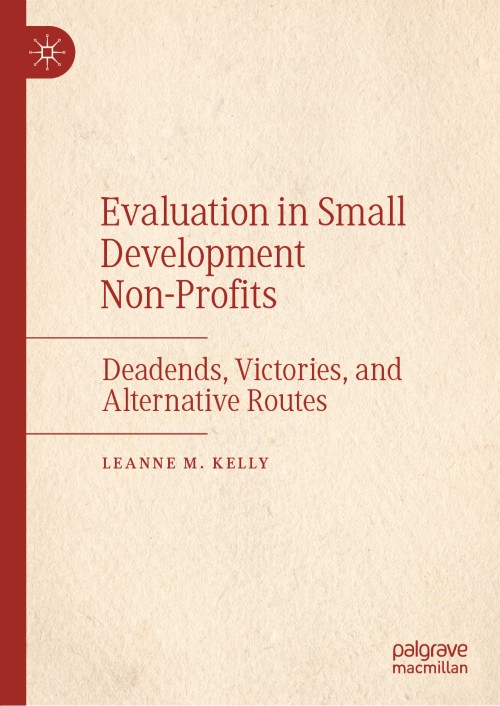
Evaluation in Small Development Non-Profits [electronic resource] : Deadends, Victories, and Alternative Routes / by Leanne M. Kelly.
Erişim Adresi
ISBN
9783030589790
Dil Kodu
İngilizce
Yer Numarası
DK/17613
Yazar
Basım Bildirimi
1st ed. 2021.
Yayın Bilgisi
Cham : Springer International Publishing : Imprint: Palgrave Macmillan, 2021.
Fiziksel Niteleme
XVII, 215 p. 6 illus., 2 illus. in color. online resource.
İçindekiler Notu
1 The nature of the problem -- 2 The story of evaluation -- 3 A framework for community development evaluation -- 4 Small is beautiful -- 5 Overt and hidden practices of small non-profit evaluation -- 6 Forms of evaluation use in small non-profits -- 7 Practitioner perceptions of evaluation in small non-profits -- 8 Alternative routes: so what and now what? -- Index.
Özet, vb.
‘Does size matter? As a first, this volume explains why the scale of a development NGO should determine how it goes about gathering, analysing and applying information to learn about and improve its efforts. It convincingly demonstrates why monitoring and evaluation systems of big NGOs are simply inappropriate for the, by far larger, number of their smaller counterparts. For the NGO majority, before turning to canons in the field, start with this book.’ –Alan Fowler, Co-founder of the International NGO Training and Research Centre (INTRAC), Oxford, UK ‘Leanne Kelly's new book provides a very timely and original insight into the relatively understudied area of evaluation in small NGOs. In particular, her exploration of the disjuncture between methodological rigour and the degree to which evaluation findings are actually used, raises important questions about what we mean by ‘quality’ in the evaluation field. An important read for both evaluators, practitioners and funding agencies.’ –Chris Roche, Professor of Development Practice, La Trobe University, Melbourne, Australia Research on evaluation shows that low-use and non-use of evaluation is common, yet evaluation is hailed as beneficial and worthwhile. The worth of evaluation is tied to its utilisation, presenting a paradox if evaluation is both revered and underutilised. This book investigates this paradox in the under-researched context of small development non-profit organisations, which have specific resource constraints and ‘bottom up’ community development values that complicate their ability to do and use evaluation in line with top down directives. The book examines the utility, meaningfulness, and purpose of evaluation from small non-profit perspectives, and explores whether evaluation has value for these organisations. For development practice, it presents evaluative alternatives that reconceptualise evaluation as part of the active process of development rather than as an interval-based add-on. For evaluation theory, it highlights a historical preoccupation with improving evaluation without assessing its inherent worth, and considers alternative ways to enhance the value of evaluation for small non-profits. Leanne M. Kelly has spent most of the past two decades working in social services and community development not-for-profits across four continents. She has worked for small, medium, and large not-for-profits with the majority of her roles focused on evaluation.
Konu
Economic development.
Nonprofit organizations.
International organization.
Development Studies.
Non-Profit Organizations and Public Enterprises.
International Organization.
Nonprofit organizations.
International organization.
Development Studies.
Non-Profit Organizations and Public Enterprises.
International Organization.
Kurum Adı
Eseri Alıntıla
Referansları kullanmadan önce gözden geçirmeniz ve varsa gerekli düzeltmeleri yapmanız önerilir.
Dijital Kaynak
MARC Görünümü
LEADER 04698nam a22004935i 4500
001 816398
003 TR_AnAIT
005 20260130200610
007 cr nn 008mamaa
008 201030s2021 sz | s |||| 0|eng d
020 |a9783030589790|9978-3-030-58979-0
024 7 |a10.1007/978-3-030-58979-0|2doi
041 |aeng
049 |aTürk Tarih Kurumu Kütüphanesi
050 4|aHD72-88
072 7|aGTF|2bicssc
072 7|aSOC042000|2bisacsh
072 7|aGTP|2thema
082 04|a338.9|223
090 |aDK/17613
100 1 |aKelly, Leanne M.|eauthor.|4aut|4http://id.loc.gov/vocabulary/relators/aut
245 10|aEvaluation in Small Development Non-Profits|h[electronic resource] :|bDeadends, Victories, and Alternative Routes /|cby Leanne M. Kelly.
250 |a1st ed. 2021.
264 1|aCham :|bSpringer International Publishing :|bImprint: Palgrave Macmillan,|c2021.
300 |aXVII, 215 p. 6 illus., 2 illus. in color.|bonline resource.
336 |atext|btxt|2rdacontent
337 |acomputer|bc|2rdamedia
338 |aonline resource|bcr|2rdacarrier
347 |atext file|bPDF|2rda
505 0 |a1 The nature of the problem -- 2 The story of evaluation -- 3 A framework for community development evaluation -- 4 Small is beautiful -- 5 Overt and hidden practices of small non-profit evaluation -- 6 Forms of evaluation use in small non-profits -- 7 Practitioner perceptions of evaluation in small non-profits -- 8 Alternative routes: so what and now what? -- Index.
520 |a‘Does size matter? As a first, this volume explains why the scale of a development NGO should determine how it goes about gathering, analysing and applying information to learn about and improve its efforts. It convincingly demonstrates why monitoring and evaluation systems of big NGOs are simply inappropriate for the, by far larger, number of their smaller counterparts. For the NGO majority, before turning to canons in the field, start with this book.’ –Alan Fowler, Co-founder of the International NGO Training and Research Centre (INTRAC), Oxford, UK ‘Leanne Kelly's new book provides a very timely and original insight into the relatively understudied area of evaluation in small NGOs. In particular, her exploration of the disjuncture between methodological rigour and the degree to which evaluation findings are actually used, raises important questions about what we mean by ‘quality’ in the evaluation field. An important read for both evaluators, practitioners and funding agencies.’ –Chris Roche, Professor of Development Practice, La Trobe University, Melbourne, Australia Research on evaluation shows that low-use and non-use of evaluation is common, yet evaluation is hailed as beneficial and worthwhile. The worth of evaluation is tied to its utilisation, presenting a paradox if evaluation is both revered and underutilised. This book investigates this paradox in the under-researched context of small development non-profit organisations, which have specific resource constraints and ‘bottom up’ community development values that complicate their ability to do and use evaluation in line with top down directives. The book examines the utility, meaningfulness, and purpose of evaluation from small non-profit perspectives, and explores whether evaluation has value for these organisations. For development practice, it presents evaluative alternatives that reconceptualise evaluation as part of the active process of development rather than as an interval-based add-on. For evaluation theory, it highlights a historical preoccupation with improving evaluation without assessing its inherent worth, and considers alternative ways to enhance the value of evaluation for small non-profits. Leanne M. Kelly has spent most of the past two decades working in social services and community development not-for-profits across four continents. She has worked for small, medium, and large not-for-profits with the majority of her roles focused on evaluation.
650 0|aEconomic development.
650 0|aNonprofit organizations.
650 0|aInternational organization.
650 14|aDevelopment Studies.
650 24|aNon-Profit Organizations and Public Enterprises.
650 24|aInternational Organization.
710 2 |aSpringerLink (Online service)
773 0 |tSpringer Nature eBook
776 08|iPrinted edition:|z9783030589783
776 08|iPrinted edition:|z9783030589806
776 08|iPrinted edition:|z9783030589813
856 40|uhttps://doi.org/10.1007/978-3-030-58979-0
912 |aZDB-2-POS
912 |aZDB-2-SXPI
950 |aPolitical Science and International Studies (SpringerNature-41174)
950 |aPolitical Science and International Studies (R0) (SpringerNature-43724)
001 816398
003 TR_AnAIT
005 20260130200610
007 cr nn 008mamaa
008 201030s2021 sz | s |||| 0|eng d
020 |a9783030589790|9978-3-030-58979-0
024 7 |a10.1007/978-3-030-58979-0|2doi
041 |aeng
049 |aTürk Tarih Kurumu Kütüphanesi
050 4|aHD72-88
072 7|aGTF|2bicssc
072 7|aSOC042000|2bisacsh
072 7|aGTP|2thema
082 04|a338.9|223
090 |aDK/17613
100 1 |aKelly, Leanne M.|eauthor.|4aut|4http://id.loc.gov/vocabulary/relators/aut
245 10|aEvaluation in Small Development Non-Profits|h[electronic resource] :|bDeadends, Victories, and Alternative Routes /|cby Leanne M. Kelly.
250 |a1st ed. 2021.
264 1|aCham :|bSpringer International Publishing :|bImprint: Palgrave Macmillan,|c2021.
300 |aXVII, 215 p. 6 illus., 2 illus. in color.|bonline resource.
336 |atext|btxt|2rdacontent
337 |acomputer|bc|2rdamedia
338 |aonline resource|bcr|2rdacarrier
347 |atext file|bPDF|2rda
505 0 |a1 The nature of the problem -- 2 The story of evaluation -- 3 A framework for community development evaluation -- 4 Small is beautiful -- 5 Overt and hidden practices of small non-profit evaluation -- 6 Forms of evaluation use in small non-profits -- 7 Practitioner perceptions of evaluation in small non-profits -- 8 Alternative routes: so what and now what? -- Index.
520 |a‘Does size matter? As a first, this volume explains why the scale of a development NGO should determine how it goes about gathering, analysing and applying information to learn about and improve its efforts. It convincingly demonstrates why monitoring and evaluation systems of big NGOs are simply inappropriate for the, by far larger, number of their smaller counterparts. For the NGO majority, before turning to canons in the field, start with this book.’ –Alan Fowler, Co-founder of the International NGO Training and Research Centre (INTRAC), Oxford, UK ‘Leanne Kelly's new book provides a very timely and original insight into the relatively understudied area of evaluation in small NGOs. In particular, her exploration of the disjuncture between methodological rigour and the degree to which evaluation findings are actually used, raises important questions about what we mean by ‘quality’ in the evaluation field. An important read for both evaluators, practitioners and funding agencies.’ –Chris Roche, Professor of Development Practice, La Trobe University, Melbourne, Australia Research on evaluation shows that low-use and non-use of evaluation is common, yet evaluation is hailed as beneficial and worthwhile. The worth of evaluation is tied to its utilisation, presenting a paradox if evaluation is both revered and underutilised. This book investigates this paradox in the under-researched context of small development non-profit organisations, which have specific resource constraints and ‘bottom up’ community development values that complicate their ability to do and use evaluation in line with top down directives. The book examines the utility, meaningfulness, and purpose of evaluation from small non-profit perspectives, and explores whether evaluation has value for these organisations. For development practice, it presents evaluative alternatives that reconceptualise evaluation as part of the active process of development rather than as an interval-based add-on. For evaluation theory, it highlights a historical preoccupation with improving evaluation without assessing its inherent worth, and considers alternative ways to enhance the value of evaluation for small non-profits. Leanne M. Kelly has spent most of the past two decades working in social services and community development not-for-profits across four continents. She has worked for small, medium, and large not-for-profits with the majority of her roles focused on evaluation.
650 0|aEconomic development.
650 0|aNonprofit organizations.
650 0|aInternational organization.
650 14|aDevelopment Studies.
650 24|aNon-Profit Organizations and Public Enterprises.
650 24|aInternational Organization.
710 2 |aSpringerLink (Online service)
773 0 |tSpringer Nature eBook
776 08|iPrinted edition:|z9783030589783
776 08|iPrinted edition:|z9783030589806
776 08|iPrinted edition:|z9783030589813
856 40|uhttps://doi.org/10.1007/978-3-030-58979-0
912 |aZDB-2-POS
912 |aZDB-2-SXPI
950 |aPolitical Science and International Studies (SpringerNature-41174)
950 |aPolitical Science and International Studies (R0) (SpringerNature-43724)
Materyaller
Depodan talep edilen materyal sadece kütüphane içerisinde kullanılmaktadır.
Materyal dışarıya ödünç verilmemektedir.
Materyal dışarıya ödünç verilmemektedir.
