

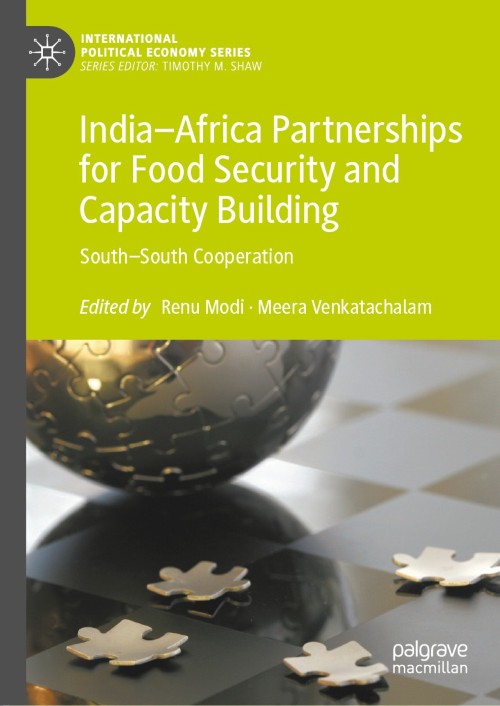
India–Africa Partnerships for Food Security and Capacity Building [electronic resource] : South–South Cooperation / edited by Renu Modi, Meera Venkatachalam.
Erişim Adresi
ISBN
9783030541125
Dil Kodu
İngilizce
Yer Numarası
DK/17614
Basım Bildirimi
1st ed. 2021.
Yayın Bilgisi
Cham : Springer International Publishing : Imprint: Palgrave Macmillan, 2021.
Fiziksel Niteleme
XLIII, 430 p. 33 illus., 29 illus. in color. online resource.
Dizi
International Political Economy Series, 2662-2491
İçindekiler Notu
Chapter 1. Introduction: India and Africa: Partnering for Food Security -- Part I. Collaborations for Food Security -- Chapter 2. India-Africa: Is the Cooperation Sustainable? – Chapter 3. Global Climate Diplomacy. – Part II. Sharing Knowledge -- Chapter 4. Benefiting Smallholder Farmers in Africa: The Role of ICRISAT -- Chapter 5. Food Security and Capacity Development: The ILRI Experience -- Chapter 6. Feed Base Ethiopia: The Role of Database in Developing Livestock Feed -- Chapter 7. Developing Value Chains in Cotton through Public – Private Partnerships: The Role of IL & FS -- Chapter 8. Women to Women Cooperation: Learnings from SEWA -- Part III. Private/Public Partnerships -- Chapter 9. Supporting Indian Trade and Investment for Africa: The International Trade Centre Project -- Chapter 10. Maximising Output: Contract Farming by Corredor Pvt. Ltd in Mozambique -- Part IV. Trading in Pulses -- Chapter 11. Africa’s Pulse Exports to India -- Chapter 12. Ban on Pigeonpeas from Tanzania and its Impacts -- Chapter 13. Production of Pulses in Tanzania: Opportunities and Challenges -- Part V. Financing Mechanisms -- Chapter 14. EXIM Bank’s Support for Food Security and Capacity Building in Africa -- Chapter 15. Lines of Credit and its Impact on the Agricultural Sector in Africa -- Chapter 16. Development Finance: The IBSA Fund and Development Impact Bonds -- Chapter 17. South-South Collaborations in Agriculture: A Concluding Note.
Özet, vb.
This is an empirically rich, theoretically grounded and timely analysis of an important aspect of the political economy of South-South relations. -Seifudein Adem, Professor, Graduate School of Global Studies, Doshisha University, Japan. This book makes a valuable contribution in outlining ways for India and Africa to work together towards ensuring greater food security. -Philani Mthembu, Executive Director, Institute for Global Dialogue, University of South Africa, Pretoria, South Africa. This volume showcases the ongoing trends and challenges in South-South cooperation between India and select countries in Africa, for achieving food security and poverty reduction. Scholars and practitioners share diverse perspectives on the role of India’s development compact; aid, trade, private sector driven Foreign Direct Investments (FDIs), and concessional Lines of Credit (LOCs) to the agricultural and agro-processing sectors in Africa. India- Africa cooperation also underscores that the sharing of knowledge and capabilities -technical and financial, along with North- South partnerships- through trilateral and multilateral mechanisms, can upscale the agriculture and agro-processing sectors, address the food security agenda, and reduce poverty. The axial questions in this volume explore how cooperation between India and countries in Africa impact intra-South trading, capacity building, and the investment landscape. Renu Modi is Professor and former Director at the Centre for African Studies, University of Mumbai Meera Venkatachalam is Research Affiliate at the Indian Diaspora Centre and Centre for African Studies, University of Mumbai.
Konu
International economic relations.
Security, International.
Globalization.
International Political Economy’.
International Security Studies.
Globalization.
Security, International.
Globalization.
International Political Economy’.
International Security Studies.
Globalization.
Diğer Yazarlar
Kurum Adı
Eseri Alıntıla
Referansları kullanmadan önce gözden geçirmeniz ve varsa gerekli düzeltmeleri yapmanız önerilir.
Dijital Kaynak
MARC Görünümü
LEADER 05250nam a22005535i 4500
001 816399
003 TR_AnAIT
005 20260130200607
007 cr nn 008mamaa
008 210308s2021 sz | s |||| 0|eng d
020 |a9783030541125|9978-3-030-54112-5
024 7 |a10.1007/978-3-030-54112-5|2doi
041 |aeng
049 |aTürk Tarih Kurumu Kütüphanesi
050 4|aJZ1252
072 7|aJPS|2bicssc
072 7|aKCP|2bicssc
072 7|aPOL011020|2bisacsh
072 7|aJPS|2thema
072 7|aKCP|2thema
082 04|a327.111|223
090 |aDK/17614
245 10|aIndia–Africa Partnerships for Food Security and Capacity Building|h[electronic resource] :|bSouth–South Cooperation /|cedited by Renu Modi, Meera Venkatachalam.
250 |a1st ed. 2021.
264 1|aCham :|bSpringer International Publishing :|bImprint: Palgrave Macmillan,|c2021.
300 |aXLIII, 430 p. 33 illus., 29 illus. in color.|bonline resource.
336 |atext|btxt|2rdacontent
337 |acomputer|bc|2rdamedia
338 |aonline resource|bcr|2rdacarrier
347 |atext file|bPDF|2rda
490 1 |aInternational Political Economy Series,|x2662-2491
505 0 |aChapter 1. Introduction: India and Africa: Partnering for Food Security -- Part I. Collaborations for Food Security -- Chapter 2. India-Africa: Is the Cooperation Sustainable? – Chapter 3. Global Climate Diplomacy. – Part II. Sharing Knowledge -- Chapter 4. Benefiting Smallholder Farmers in Africa: The Role of ICRISAT -- Chapter 5. Food Security and Capacity Development: The ILRI Experience -- Chapter 6. Feed Base Ethiopia: The Role of Database in Developing Livestock Feed -- Chapter 7. Developing Value Chains in Cotton through Public – Private Partnerships: The Role of IL & FS -- Chapter 8. Women to Women Cooperation: Learnings from SEWA -- Part III. Private/Public Partnerships -- Chapter 9. Supporting Indian Trade and Investment for Africa: The International Trade Centre Project -- Chapter 10. Maximising Output: Contract Farming by Corredor Pvt. Ltd in Mozambique -- Part IV. Trading in Pulses -- Chapter 11. Africa’s Pulse Exports to India -- Chapter 12. Ban on Pigeonpeas from Tanzania and its Impacts -- Chapter 13. Production of Pulses in Tanzania: Opportunities and Challenges -- Part V. Financing Mechanisms -- Chapter 14. EXIM Bank’s Support for Food Security and Capacity Building in Africa -- Chapter 15. Lines of Credit and its Impact on the Agricultural Sector in Africa -- Chapter 16. Development Finance: The IBSA Fund and Development Impact Bonds -- Chapter 17. South-South Collaborations in Agriculture: A Concluding Note.
520 |aThis is an empirically rich, theoretically grounded and timely analysis of an important aspect of the political economy of South-South relations. -Seifudein Adem, Professor, Graduate School of Global Studies, Doshisha University, Japan. This book makes a valuable contribution in outlining ways for India and Africa to work together towards ensuring greater food security. -Philani Mthembu, Executive Director, Institute for Global Dialogue, University of South Africa, Pretoria, South Africa. This volume showcases the ongoing trends and challenges in South-South cooperation between India and select countries in Africa, for achieving food security and poverty reduction. Scholars and practitioners share diverse perspectives on the role of India’s development compact; aid, trade, private sector driven Foreign Direct Investments (FDIs), and concessional Lines of Credit (LOCs) to the agricultural and agro-processing sectors in Africa. India- Africa cooperation also underscores that the sharing of knowledge and capabilities -technical and financial, along with North- South partnerships- through trilateral and multilateral mechanisms, can upscale the agriculture and agro-processing sectors, address the food security agenda, and reduce poverty. The axial questions in this volume explore how cooperation between India and countries in Africa impact intra-South trading, capacity building, and the investment landscape. Renu Modi is Professor and former Director at the Centre for African Studies, University of Mumbai Meera Venkatachalam is Research Affiliate at the Indian Diaspora Centre and Centre for African Studies, University of Mumbai.
650 0|aInternational economic relations.
650 0|aSecurity, International.
650 0|aGlobalization.
650 14|aInternational Political Economy’.
650 24|aInternational Security Studies.
650 24|aGlobalization.
700 1 |aModi, Renu.|eeditor.|4edt|4http://id.loc.gov/vocabulary/relators/edt
700 1 |aVenkatachalam, Meera.|eeditor.|4edt|4http://id.loc.gov/vocabulary/relators/edt
710 2 |aSpringerLink (Online service)
773 0 |tSpringer Nature eBook
776 08|iPrinted edition:|z9783030541118
776 08|iPrinted edition:|z9783030541132
776 08|iPrinted edition:|z9783030541149
830 0|aInternational Political Economy Series,|x2662-2491
856 40|uhttps://doi.org/10.1007/978-3-030-54112-5
912 |aZDB-2-POS
912 |aZDB-2-SXPI
950 |aPolitical Science and International Studies (SpringerNature-41174)
950 |aPolitical Science and International Studies (R0) (SpringerNature-43724)
001 816399
003 TR_AnAIT
005 20260130200607
007 cr nn 008mamaa
008 210308s2021 sz | s |||| 0|eng d
020 |a9783030541125|9978-3-030-54112-5
024 7 |a10.1007/978-3-030-54112-5|2doi
041 |aeng
049 |aTürk Tarih Kurumu Kütüphanesi
050 4|aJZ1252
072 7|aJPS|2bicssc
072 7|aKCP|2bicssc
072 7|aPOL011020|2bisacsh
072 7|aJPS|2thema
072 7|aKCP|2thema
082 04|a327.111|223
090 |aDK/17614
245 10|aIndia–Africa Partnerships for Food Security and Capacity Building|h[electronic resource] :|bSouth–South Cooperation /|cedited by Renu Modi, Meera Venkatachalam.
250 |a1st ed. 2021.
264 1|aCham :|bSpringer International Publishing :|bImprint: Palgrave Macmillan,|c2021.
300 |aXLIII, 430 p. 33 illus., 29 illus. in color.|bonline resource.
336 |atext|btxt|2rdacontent
337 |acomputer|bc|2rdamedia
338 |aonline resource|bcr|2rdacarrier
347 |atext file|bPDF|2rda
490 1 |aInternational Political Economy Series,|x2662-2491
505 0 |aChapter 1. Introduction: India and Africa: Partnering for Food Security -- Part I. Collaborations for Food Security -- Chapter 2. India-Africa: Is the Cooperation Sustainable? – Chapter 3. Global Climate Diplomacy. – Part II. Sharing Knowledge -- Chapter 4. Benefiting Smallholder Farmers in Africa: The Role of ICRISAT -- Chapter 5. Food Security and Capacity Development: The ILRI Experience -- Chapter 6. Feed Base Ethiopia: The Role of Database in Developing Livestock Feed -- Chapter 7. Developing Value Chains in Cotton through Public – Private Partnerships: The Role of IL & FS -- Chapter 8. Women to Women Cooperation: Learnings from SEWA -- Part III. Private/Public Partnerships -- Chapter 9. Supporting Indian Trade and Investment for Africa: The International Trade Centre Project -- Chapter 10. Maximising Output: Contract Farming by Corredor Pvt. Ltd in Mozambique -- Part IV. Trading in Pulses -- Chapter 11. Africa’s Pulse Exports to India -- Chapter 12. Ban on Pigeonpeas from Tanzania and its Impacts -- Chapter 13. Production of Pulses in Tanzania: Opportunities and Challenges -- Part V. Financing Mechanisms -- Chapter 14. EXIM Bank’s Support for Food Security and Capacity Building in Africa -- Chapter 15. Lines of Credit and its Impact on the Agricultural Sector in Africa -- Chapter 16. Development Finance: The IBSA Fund and Development Impact Bonds -- Chapter 17. South-South Collaborations in Agriculture: A Concluding Note.
520 |aThis is an empirically rich, theoretically grounded and timely analysis of an important aspect of the political economy of South-South relations. -Seifudein Adem, Professor, Graduate School of Global Studies, Doshisha University, Japan. This book makes a valuable contribution in outlining ways for India and Africa to work together towards ensuring greater food security. -Philani Mthembu, Executive Director, Institute for Global Dialogue, University of South Africa, Pretoria, South Africa. This volume showcases the ongoing trends and challenges in South-South cooperation between India and select countries in Africa, for achieving food security and poverty reduction. Scholars and practitioners share diverse perspectives on the role of India’s development compact; aid, trade, private sector driven Foreign Direct Investments (FDIs), and concessional Lines of Credit (LOCs) to the agricultural and agro-processing sectors in Africa. India- Africa cooperation also underscores that the sharing of knowledge and capabilities -technical and financial, along with North- South partnerships- through trilateral and multilateral mechanisms, can upscale the agriculture and agro-processing sectors, address the food security agenda, and reduce poverty. The axial questions in this volume explore how cooperation between India and countries in Africa impact intra-South trading, capacity building, and the investment landscape. Renu Modi is Professor and former Director at the Centre for African Studies, University of Mumbai Meera Venkatachalam is Research Affiliate at the Indian Diaspora Centre and Centre for African Studies, University of Mumbai.
650 0|aInternational economic relations.
650 0|aSecurity, International.
650 0|aGlobalization.
650 14|aInternational Political Economy’.
650 24|aInternational Security Studies.
650 24|aGlobalization.
700 1 |aModi, Renu.|eeditor.|4edt|4http://id.loc.gov/vocabulary/relators/edt
700 1 |aVenkatachalam, Meera.|eeditor.|4edt|4http://id.loc.gov/vocabulary/relators/edt
710 2 |aSpringerLink (Online service)
773 0 |tSpringer Nature eBook
776 08|iPrinted edition:|z9783030541118
776 08|iPrinted edition:|z9783030541132
776 08|iPrinted edition:|z9783030541149
830 0|aInternational Political Economy Series,|x2662-2491
856 40|uhttps://doi.org/10.1007/978-3-030-54112-5
912 |aZDB-2-POS
912 |aZDB-2-SXPI
950 |aPolitical Science and International Studies (SpringerNature-41174)
950 |aPolitical Science and International Studies (R0) (SpringerNature-43724)
Materyaller
Depodan talep edilen materyal sadece kütüphane içerisinde kullanılmaktadır.
Materyal dışarıya ödünç verilmemektedir.
Materyal dışarıya ödünç verilmemektedir.
