

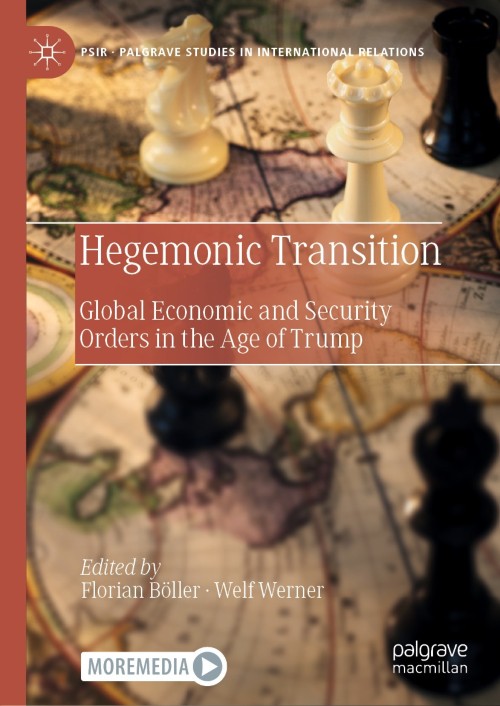
Hegemonic Transition [electronic resource] : Global Economic and Security Orders in the Age of Trump / edited by Florian Böller, Welf Werner.
Erişim Adresi
ISBN
9783030745059
Dil Kodu
İngilizce
Yer Numarası
DK/17616
Basım Bildirimi
1st ed. 2021.
Yayın Bilgisi
Cham : Springer International Publishing : Imprint: Palgrave Macmillan, 2021.
Fiziksel Niteleme
XXI, 298 p. 5 illus., 1 illus. in color. online resource.
Dizi
Palgrave Studies in International Relations, 2946-2681
İçindekiler Notu
Introduction: Hegemony, Contestation and Transition -- Externalizing the Costs of Leadership: The Impact of Changing State-Societal Relations on US Hegemony -- Broken Social Contract: The Domestic Roots of US Hegemonic Decline in the World -- Exit from US Leadership: Global Trade Policy and Trump’s “America First” Doctrine -- Decay of US Economic Hegemony? Intellectual Property Rights, Dollar Centrality, and US Geo-economic Power -- Leading by Example or Extortion? US Leadership Role Transition and the Non-Proliferation Regime -- The End of NATO as We Know It: Reconfiguring Transatlantic Security Relations -- Institutional Contestation: The Trump Administration and International Organizations -- Spoiler State: Russia’s Status Seeking and Hegemonic Ambitions -- Contested Cyberspace: China’s Increasing Role and Power in Technology Governance -- Between a Rock and a Hard Place: India’s Response to the Hegemonic Decline of the West -- Dual Hegemony: Brazil between the United States and China -- Fast-track towards a Hegemonic Transition: Corona and the Decline of US Hegemony -- Conclusion.
Özet, vb.
"This timely contribution to the debate on global order brings together a distinguished group of American and European experts. Highly recommended to everyone who wants to understand how the COVID pandemic, the Trump administration and long-term shifts in global production have undermined US leadership." -- Reinhard Wolf, Professor of International Relations, Goethe University Frankfurt , Germany This book offers an assessment of the ongoing transformation of hegemonic order and its domestic and international politics. The current international order is in crisis. Under the Trump administration, the USA has ceased to unequivocally support the institutions it helped to foster. China’s power surge, contestation by smaller states, and the West’s internal struggle with populism and economic discontent have undermined the liberal order from outside and from within. While the diagnosis of a crisis is hardly new, its sources, scope, and underlying politics are still up for debate. Our reading of hegemony diverges from a static concept, toward a focus on the dynamic politics of hegemonic ordering. This perspective includes the domestic support and demand for specific hegemonic goods, the contestation and backing by other actors within distinct layers of hegemonic orders, and the underlying bargaining between the hegemon and subordinate actors. The case studies in this book thus investigate hegemonic politics across regimes (e.g., trade and security), regions (e.g., Asia, Europe, and Global South), and actors (e.g., major powers and smaller states). Florian Böller is Professor of International Relations at the University of Kaiserslautern, Germany. Previously, he taught at Heidelberg University and held fellowships at the University of Wisconsin-Madison and Harvard University. His research on US foreign policy has appeared in the British Journal of Politics and International Relations, European Political Science Review, Contemporary Security Policy, and other journals. Welf Werner is Professor of American Studies at Heidelberg University, Germany, and director of the Heidelberg Center for American Studies. He was a John F. Kennedy Memorial Fellow at Harvard University and a research fellow at Johns Hopkins University and George Washington University. His research and teaching focus on US domestic and foreign economic policies.
Konu
International relations.
Security, International.
International economic relations.
International Relations Theory.
International Security Studies.
International Political Economy’.
Security, International.
International economic relations.
International Relations Theory.
International Security Studies.
International Political Economy’.
Diğer Yazarlar
Kurum Adı
Eseri Alıntıla
Referansları kullanmadan önce gözden geçirmeniz ve varsa gerekli düzeltmeleri yapmanız önerilir.
Dijital Kaynak
MARC Görünümü
LEADER 05639nam a22005295i 4500
001 816401
003 TR_AnAIT
005 20260130200556
007 cr nn 008mamaa
008 210816s2021 sz | s |||| 0|eng d
020 |a9783030745059|9978-3-030-74505-9
024 7 |a10.1007/978-3-030-74505-9|2doi
041 |aeng
049 |aTürk Tarih Kurumu Kütüphanesi
050 4|aJZ2-6530
072 7|aJPS|2bicssc
072 7|aPOL011000|2bisacsh
072 7|aJPS|2thema
082 04|a327.101|223
090 |aDK/17616
245 10|aHegemonic Transition|h[electronic resource] :|bGlobal Economic and Security Orders in the Age of Trump /|cedited by Florian Böller, Welf Werner.
250 |a1st ed. 2021.
264 1|aCham :|bSpringer International Publishing :|bImprint: Palgrave Macmillan,|c2021.
300 |aXXI, 298 p. 5 illus., 1 illus. in color.|bonline resource.
336 |atext|btxt|2rdacontent
337 |acomputer|bc|2rdamedia
338 |aonline resource|bcr|2rdacarrier
347 |atext file|bPDF|2rda
490 1 |aPalgrave Studies in International Relations,|x2946-2681
505 0 |aIntroduction: Hegemony, Contestation and Transition -- Externalizing the Costs of Leadership: The Impact of Changing State-Societal Relations on US Hegemony -- Broken Social Contract: The Domestic Roots of US Hegemonic Decline in the World -- Exit from US Leadership: Global Trade Policy and Trump’s “America First” Doctrine -- Decay of US Economic Hegemony? Intellectual Property Rights, Dollar Centrality, and US Geo-economic Power -- Leading by Example or Extortion? US Leadership Role Transition and the Non-Proliferation Regime -- The End of NATO as We Know It: Reconfiguring Transatlantic Security Relations -- Institutional Contestation: The Trump Administration and International Organizations -- Spoiler State: Russia’s Status Seeking and Hegemonic Ambitions -- Contested Cyberspace: China’s Increasing Role and Power in Technology Governance -- Between a Rock and a Hard Place: India’s Response to the Hegemonic Decline of the West -- Dual Hegemony: Brazil between the United States and China -- Fast-track towards a Hegemonic Transition: Corona and the Decline of US Hegemony -- Conclusion.
520 |a"This timely contribution to the debate on global order brings together a distinguished group of American and European experts. Highly recommended to everyone who wants to understand how the COVID pandemic, the Trump administration and long-term shifts in global production have undermined US leadership." -- Reinhard Wolf, Professor of International Relations, Goethe University Frankfurt , Germany This book offers an assessment of the ongoing transformation of hegemonic order and its domestic and international politics. The current international order is in crisis. Under the Trump administration, the USA has ceased to unequivocally support the institutions it helped to foster. China’s power surge, contestation by smaller states, and the West’s internal struggle with populism and economic discontent have undermined the liberal order from outside and from within. While the diagnosis of a crisis is hardly new, its sources, scope, and underlying politics are still up for debate. Our reading of hegemony diverges from a static concept, toward a focus on the dynamic politics of hegemonic ordering. This perspective includes the domestic support and demand for specific hegemonic goods, the contestation and backing by other actors within distinct layers of hegemonic orders, and the underlying bargaining between the hegemon and subordinate actors. The case studies in this book thus investigate hegemonic politics across regimes (e.g., trade and security), regions (e.g., Asia, Europe, and Global South), and actors (e.g., major powers and smaller states). Florian Böller is Professor of International Relations at the University of Kaiserslautern, Germany. Previously, he taught at Heidelberg University and held fellowships at the University of Wisconsin-Madison and Harvard University. His research on US foreign policy has appeared in the British Journal of Politics and International Relations, European Political Science Review, Contemporary Security Policy, and other journals. Welf Werner is Professor of American Studies at Heidelberg University, Germany, and director of the Heidelberg Center for American Studies. He was a John F. Kennedy Memorial Fellow at Harvard University and a research fellow at Johns Hopkins University and George Washington University. His research and teaching focus on US domestic and foreign economic policies.
650 0|aInternational relations.
650 0|aSecurity, International.
650 0|aInternational economic relations.
650 14|aInternational Relations Theory.
650 24|aInternational Security Studies.
650 24|aInternational Political Economy’.
700 1 |aBöller, Florian.|eeditor.|0(orcid)0000-0002-0386-4758|1https://orcid.org/0000-0002-0386-4758|4edt|4http://id.loc.gov/vocabulary/relators/edt
700 1 |aWerner, Welf.|eeditor.|4edt|4http://id.loc.gov/vocabulary/relators/edt
710 2 |aSpringerLink (Online service)
773 0 |tSpringer Nature eBook
776 08|iPrinted edition:|z9783030745042
776 08|iPrinted edition:|z9783030745066
776 08|iPrinted edition:|z9783030745073
830 0|aPalgrave Studies in International Relations,|x2946-2681
856 40|uhttps://doi.org/10.1007/978-3-030-74505-9
912 |aZDB-2-POS
912 |aZDB-2-SXPI
950 |aPolitical Science and International Studies (SpringerNature-41174)
950 |aPolitical Science and International Studies (R0) (SpringerNature-43724)
001 816401
003 TR_AnAIT
005 20260130200556
007 cr nn 008mamaa
008 210816s2021 sz | s |||| 0|eng d
020 |a9783030745059|9978-3-030-74505-9
024 7 |a10.1007/978-3-030-74505-9|2doi
041 |aeng
049 |aTürk Tarih Kurumu Kütüphanesi
050 4|aJZ2-6530
072 7|aJPS|2bicssc
072 7|aPOL011000|2bisacsh
072 7|aJPS|2thema
082 04|a327.101|223
090 |aDK/17616
245 10|aHegemonic Transition|h[electronic resource] :|bGlobal Economic and Security Orders in the Age of Trump /|cedited by Florian Böller, Welf Werner.
250 |a1st ed. 2021.
264 1|aCham :|bSpringer International Publishing :|bImprint: Palgrave Macmillan,|c2021.
300 |aXXI, 298 p. 5 illus., 1 illus. in color.|bonline resource.
336 |atext|btxt|2rdacontent
337 |acomputer|bc|2rdamedia
338 |aonline resource|bcr|2rdacarrier
347 |atext file|bPDF|2rda
490 1 |aPalgrave Studies in International Relations,|x2946-2681
505 0 |aIntroduction: Hegemony, Contestation and Transition -- Externalizing the Costs of Leadership: The Impact of Changing State-Societal Relations on US Hegemony -- Broken Social Contract: The Domestic Roots of US Hegemonic Decline in the World -- Exit from US Leadership: Global Trade Policy and Trump’s “America First” Doctrine -- Decay of US Economic Hegemony? Intellectual Property Rights, Dollar Centrality, and US Geo-economic Power -- Leading by Example or Extortion? US Leadership Role Transition and the Non-Proliferation Regime -- The End of NATO as We Know It: Reconfiguring Transatlantic Security Relations -- Institutional Contestation: The Trump Administration and International Organizations -- Spoiler State: Russia’s Status Seeking and Hegemonic Ambitions -- Contested Cyberspace: China’s Increasing Role and Power in Technology Governance -- Between a Rock and a Hard Place: India’s Response to the Hegemonic Decline of the West -- Dual Hegemony: Brazil between the United States and China -- Fast-track towards a Hegemonic Transition: Corona and the Decline of US Hegemony -- Conclusion.
520 |a"This timely contribution to the debate on global order brings together a distinguished group of American and European experts. Highly recommended to everyone who wants to understand how the COVID pandemic, the Trump administration and long-term shifts in global production have undermined US leadership." -- Reinhard Wolf, Professor of International Relations, Goethe University Frankfurt , Germany This book offers an assessment of the ongoing transformation of hegemonic order and its domestic and international politics. The current international order is in crisis. Under the Trump administration, the USA has ceased to unequivocally support the institutions it helped to foster. China’s power surge, contestation by smaller states, and the West’s internal struggle with populism and economic discontent have undermined the liberal order from outside and from within. While the diagnosis of a crisis is hardly new, its sources, scope, and underlying politics are still up for debate. Our reading of hegemony diverges from a static concept, toward a focus on the dynamic politics of hegemonic ordering. This perspective includes the domestic support and demand for specific hegemonic goods, the contestation and backing by other actors within distinct layers of hegemonic orders, and the underlying bargaining between the hegemon and subordinate actors. The case studies in this book thus investigate hegemonic politics across regimes (e.g., trade and security), regions (e.g., Asia, Europe, and Global South), and actors (e.g., major powers and smaller states). Florian Böller is Professor of International Relations at the University of Kaiserslautern, Germany. Previously, he taught at Heidelberg University and held fellowships at the University of Wisconsin-Madison and Harvard University. His research on US foreign policy has appeared in the British Journal of Politics and International Relations, European Political Science Review, Contemporary Security Policy, and other journals. Welf Werner is Professor of American Studies at Heidelberg University, Germany, and director of the Heidelberg Center for American Studies. He was a John F. Kennedy Memorial Fellow at Harvard University and a research fellow at Johns Hopkins University and George Washington University. His research and teaching focus on US domestic and foreign economic policies.
650 0|aInternational relations.
650 0|aSecurity, International.
650 0|aInternational economic relations.
650 14|aInternational Relations Theory.
650 24|aInternational Security Studies.
650 24|aInternational Political Economy’.
700 1 |aBöller, Florian.|eeditor.|0(orcid)0000-0002-0386-4758|1https://orcid.org/0000-0002-0386-4758|4edt|4http://id.loc.gov/vocabulary/relators/edt
700 1 |aWerner, Welf.|eeditor.|4edt|4http://id.loc.gov/vocabulary/relators/edt
710 2 |aSpringerLink (Online service)
773 0 |tSpringer Nature eBook
776 08|iPrinted edition:|z9783030745042
776 08|iPrinted edition:|z9783030745066
776 08|iPrinted edition:|z9783030745073
830 0|aPalgrave Studies in International Relations,|x2946-2681
856 40|uhttps://doi.org/10.1007/978-3-030-74505-9
912 |aZDB-2-POS
912 |aZDB-2-SXPI
950 |aPolitical Science and International Studies (SpringerNature-41174)
950 |aPolitical Science and International Studies (R0) (SpringerNature-43724)
Materyaller
Depodan talep edilen materyal sadece kütüphane içerisinde kullanılmaktadır.
Materyal dışarıya ödünç verilmemektedir.
Materyal dışarıya ödünç verilmemektedir.
