

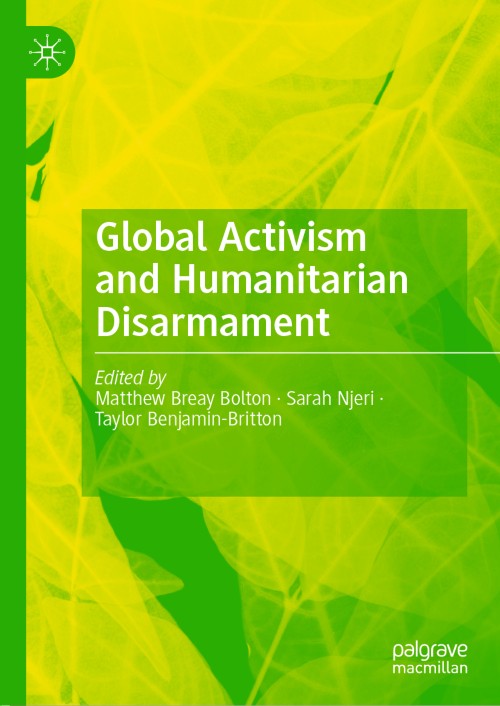
Global Activism and Humanitarian Disarmament [electronic resource] / edited by Matthew Breay Bolton, Sarah Njeri, Taylor Benjamin-Britton.
Erişim Adresi
ISBN
9783030276119
Dil Kodu
İngilizce
Yer Numarası
DK/17685
Basım Bildirimi
1st ed. 2020.
Yayın Bilgisi
Cham : Springer International Publishing : Imprint: Palgrave Macmillan, 2020.
Fiziksel Niteleme
XVII, 272 p. 9 illus., 8 illus. in color. online resource.
İçindekiler Notu
1. The Humanitarian Disarmament Movement: An Assessment and Review -- 2. When Scientists become Activists: The International Committee for Robot Arms Control and the Politics of Killer Robots -- 3. The Agency of International Humanitarian Disarmament Law: The Case of Advocacy for Positive Obligations in the Treaty on the Prohibition of Nuclear Weapons -- 4. Religious Advocacy and Activism for the Treaty on the Prohibition of Nuclear Weapons -- 5. US Arms Control Dynamics in the Era of Humanitarian Disarmament: A Case Study of the Convention on Cluster Munitions -- 6. The Politics of Non-Recognition: Re-evaluating the Apolitical Presentation of the UN Humanitarian Mine Action Programmes in Somaliland -- 7. The Relationship between Humanitarian Disarmament and General and Complete Disarmament -- 8. Assessing the Political Impact of Inclusion and Exclusion in Multilateral Disarmament Forums.
Özet, vb.
This book analyses the politics of the humanitarian disarmament community—a loose coalition of activist and advocacy groups, humanitarian agencies and diplomats—who have successfully achieved international treaties banning landmines, cluster munitions and nuclear weapons, as well as restricting the global arms trade. Two campaigns have won Nobel Peace Prizes. Disarmament has long been a dirty word in the international relations lexicon. But the success of the humanitarian disarmament agenda shows that people often choose to prohibit or limit certain violent technologies, for reasons of security, honour, ethics or humanitarianism. This edited volume showcases interdisciplinary research by scholars and practitioners seeking to understand the dynamics and impact of the new global activism on weapons. While some raise concerns that humanitarian disarmament may be piecemeal and depoliticizing, others see opportunities to breathe new life into moribund arms control policymaking. Foreword by 1997 Nobel Peace Prize Laureate Jody Williams. Matthew Breay Bolton is Associate Professor of Political Science and Director of the International Disarmament Institute at Pace University, USA. Sarah Njeri is Research Associate at King’s College London’s African Leadership Centre, UK. Taylor Benjamin-Britton has taught courses in international relations and international organization in the Department of Political Science at Temple University, as well as the Department of International Relations at Lehigh University, USA.
Konu
Politics and war.
Security, International.
Humanitarian law.
Private international law.
Conflict of laws.
International law.
Comparative law.
Peace.
Political planning.
Military and Defence Studies.
International Security Studies.
International Humanitarian Law, Law of Armed Conflict.
Private International Law, International and Foreign Law, Comparative Law.
Peace and Conflict Studies.
Public Policy.
Security, International.
Humanitarian law.
Private international law.
Conflict of laws.
International law.
Comparative law.
Peace.
Political planning.
Military and Defence Studies.
International Security Studies.
International Humanitarian Law, Law of Armed Conflict.
Private International Law, International and Foreign Law, Comparative Law.
Peace and Conflict Studies.
Public Policy.
Diğer Yazarlar
Kurum Adı
Eseri Alıntıla
Referansları kullanmadan önce gözden geçirmeniz ve varsa gerekli düzeltmeleri yapmanız önerilir.
Dijital Kaynak
MARC Görünümü
LEADER 04847nam a22006255i 4500
001 816470
003 TR_AnAIT
005 20260130200031
007 cr nn 008mamaa
008 191031s2020 sz | s |||| 0|eng d
020 |a9783030276119|9978-3-030-27611-9
024 7 |a10.1007/978-3-030-27611-9|2doi
041 |aeng
049 |aTürk Tarih Kurumu Kütüphanesi
050 4|aJZ6378-6405
072 7|aJW|2bicssc
072 7|aPOL069000|2bisacsh
072 7|aJW|2thema
082 04|a355|223
090 |aDK/17685
245 10|aGlobal Activism and Humanitarian Disarmament|h[electronic resource] /|cedited by Matthew Breay Bolton, Sarah Njeri, Taylor Benjamin-Britton.
250 |a1st ed. 2020.
264 1|aCham :|bSpringer International Publishing :|bImprint: Palgrave Macmillan,|c2020.
300 |aXVII, 272 p. 9 illus., 8 illus. in color.|bonline resource.
336 |atext|btxt|2rdacontent
337 |acomputer|bc|2rdamedia
338 |aonline resource|bcr|2rdacarrier
347 |atext file|bPDF|2rda
505 0 |a1. The Humanitarian Disarmament Movement: An Assessment and Review -- 2. When Scientists become Activists: The International Committee for Robot Arms Control and the Politics of Killer Robots -- 3. The Agency of International Humanitarian Disarmament Law: The Case of Advocacy for Positive Obligations in the Treaty on the Prohibition of Nuclear Weapons -- 4. Religious Advocacy and Activism for the Treaty on the Prohibition of Nuclear Weapons -- 5. US Arms Control Dynamics in the Era of Humanitarian Disarmament: A Case Study of the Convention on Cluster Munitions -- 6. The Politics of Non-Recognition: Re-evaluating the Apolitical Presentation of the UN Humanitarian Mine Action Programmes in Somaliland -- 7. The Relationship between Humanitarian Disarmament and General and Complete Disarmament -- 8. Assessing the Political Impact of Inclusion and Exclusion in Multilateral Disarmament Forums.
520 |aThis book analyses the politics of the humanitarian disarmament community—a loose coalition of activist and advocacy groups, humanitarian agencies and diplomats—who have successfully achieved international treaties banning landmines, cluster munitions and nuclear weapons, as well as restricting the global arms trade. Two campaigns have won Nobel Peace Prizes. Disarmament has long been a dirty word in the international relations lexicon. But the success of the humanitarian disarmament agenda shows that people often choose to prohibit or limit certain violent technologies, for reasons of security, honour, ethics or humanitarianism. This edited volume showcases interdisciplinary research by scholars and practitioners seeking to understand the dynamics and impact of the new global activism on weapons. While some raise concerns that humanitarian disarmament may be piecemeal and depoliticizing, others see opportunities to breathe new life into moribund arms control policymaking. Foreword by 1997 Nobel Peace Prize Laureate Jody Williams. Matthew Breay Bolton is Associate Professor of Political Science and Director of the International Disarmament Institute at Pace University, USA. Sarah Njeri is Research Associate at King’s College London’s African Leadership Centre, UK. Taylor Benjamin-Britton has taught courses in international relations and international organization in the Department of Political Science at Temple University, as well as the Department of International Relations at Lehigh University, USA.
650 0|aPolitics and war.
650 0|aSecurity, International.
650 0|aHumanitarian law.
650 0|aPrivate international law.
650 0|aConflict of laws.
650 0|aInternational law.
650 0|aComparative law.
650 0|aPeace.
650 0|aPolitical planning.
650 14|aMilitary and Defence Studies.
650 24|aInternational Security Studies.
650 24|aInternational Humanitarian Law, Law of Armed Conflict.
650 24|aPrivate International Law, International and Foreign Law, Comparative Law.
650 24|aPeace and Conflict Studies.
650 24|aPublic Policy.
700 1 |aBolton, Matthew Breay.|eeditor.|4edt|4http://id.loc.gov/vocabulary/relators/edt
700 1 |aNjeri, Sarah.|eeditor.|4edt|4http://id.loc.gov/vocabulary/relators/edt
700 1 |aBenjamin-Britton, Taylor.|eeditor.|4edt|4http://id.loc.gov/vocabulary/relators/edt
710 2 |aSpringerLink (Online service)
773 0 |tSpringer Nature eBook
776 08|iPrinted edition:|z9783030276102
776 08|iPrinted edition:|z9783030276126
776 08|iPrinted edition:|z9783030276133
856 40|uhttps://doi.org/10.1007/978-3-030-27611-9
912 |aZDB-2-POS
912 |aZDB-2-SXPI
950 |aPolitical Science and International Studies (SpringerNature-41174)
950 |aPolitical Science and International Studies (R0) (SpringerNature-43724)
001 816470
003 TR_AnAIT
005 20260130200031
007 cr nn 008mamaa
008 191031s2020 sz | s |||| 0|eng d
020 |a9783030276119|9978-3-030-27611-9
024 7 |a10.1007/978-3-030-27611-9|2doi
041 |aeng
049 |aTürk Tarih Kurumu Kütüphanesi
050 4|aJZ6378-6405
072 7|aJW|2bicssc
072 7|aPOL069000|2bisacsh
072 7|aJW|2thema
082 04|a355|223
090 |aDK/17685
245 10|aGlobal Activism and Humanitarian Disarmament|h[electronic resource] /|cedited by Matthew Breay Bolton, Sarah Njeri, Taylor Benjamin-Britton.
250 |a1st ed. 2020.
264 1|aCham :|bSpringer International Publishing :|bImprint: Palgrave Macmillan,|c2020.
300 |aXVII, 272 p. 9 illus., 8 illus. in color.|bonline resource.
336 |atext|btxt|2rdacontent
337 |acomputer|bc|2rdamedia
338 |aonline resource|bcr|2rdacarrier
347 |atext file|bPDF|2rda
505 0 |a1. The Humanitarian Disarmament Movement: An Assessment and Review -- 2. When Scientists become Activists: The International Committee for Robot Arms Control and the Politics of Killer Robots -- 3. The Agency of International Humanitarian Disarmament Law: The Case of Advocacy for Positive Obligations in the Treaty on the Prohibition of Nuclear Weapons -- 4. Religious Advocacy and Activism for the Treaty on the Prohibition of Nuclear Weapons -- 5. US Arms Control Dynamics in the Era of Humanitarian Disarmament: A Case Study of the Convention on Cluster Munitions -- 6. The Politics of Non-Recognition: Re-evaluating the Apolitical Presentation of the UN Humanitarian Mine Action Programmes in Somaliland -- 7. The Relationship between Humanitarian Disarmament and General and Complete Disarmament -- 8. Assessing the Political Impact of Inclusion and Exclusion in Multilateral Disarmament Forums.
520 |aThis book analyses the politics of the humanitarian disarmament community—a loose coalition of activist and advocacy groups, humanitarian agencies and diplomats—who have successfully achieved international treaties banning landmines, cluster munitions and nuclear weapons, as well as restricting the global arms trade. Two campaigns have won Nobel Peace Prizes. Disarmament has long been a dirty word in the international relations lexicon. But the success of the humanitarian disarmament agenda shows that people often choose to prohibit or limit certain violent technologies, for reasons of security, honour, ethics or humanitarianism. This edited volume showcases interdisciplinary research by scholars and practitioners seeking to understand the dynamics and impact of the new global activism on weapons. While some raise concerns that humanitarian disarmament may be piecemeal and depoliticizing, others see opportunities to breathe new life into moribund arms control policymaking. Foreword by 1997 Nobel Peace Prize Laureate Jody Williams. Matthew Breay Bolton is Associate Professor of Political Science and Director of the International Disarmament Institute at Pace University, USA. Sarah Njeri is Research Associate at King’s College London’s African Leadership Centre, UK. Taylor Benjamin-Britton has taught courses in international relations and international organization in the Department of Political Science at Temple University, as well as the Department of International Relations at Lehigh University, USA.
650 0|aPolitics and war.
650 0|aSecurity, International.
650 0|aHumanitarian law.
650 0|aPrivate international law.
650 0|aConflict of laws.
650 0|aInternational law.
650 0|aComparative law.
650 0|aPeace.
650 0|aPolitical planning.
650 14|aMilitary and Defence Studies.
650 24|aInternational Security Studies.
650 24|aInternational Humanitarian Law, Law of Armed Conflict.
650 24|aPrivate International Law, International and Foreign Law, Comparative Law.
650 24|aPeace and Conflict Studies.
650 24|aPublic Policy.
700 1 |aBolton, Matthew Breay.|eeditor.|4edt|4http://id.loc.gov/vocabulary/relators/edt
700 1 |aNjeri, Sarah.|eeditor.|4edt|4http://id.loc.gov/vocabulary/relators/edt
700 1 |aBenjamin-Britton, Taylor.|eeditor.|4edt|4http://id.loc.gov/vocabulary/relators/edt
710 2 |aSpringerLink (Online service)
773 0 |tSpringer Nature eBook
776 08|iPrinted edition:|z9783030276102
776 08|iPrinted edition:|z9783030276126
776 08|iPrinted edition:|z9783030276133
856 40|uhttps://doi.org/10.1007/978-3-030-27611-9
912 |aZDB-2-POS
912 |aZDB-2-SXPI
950 |aPolitical Science and International Studies (SpringerNature-41174)
950 |aPolitical Science and International Studies (R0) (SpringerNature-43724)
Materyaller
Depodan talep edilen materyal sadece kütüphane içerisinde kullanılmaktadır.
Materyal dışarıya ödünç verilmemektedir.
Materyal dışarıya ödünç verilmemektedir.
