

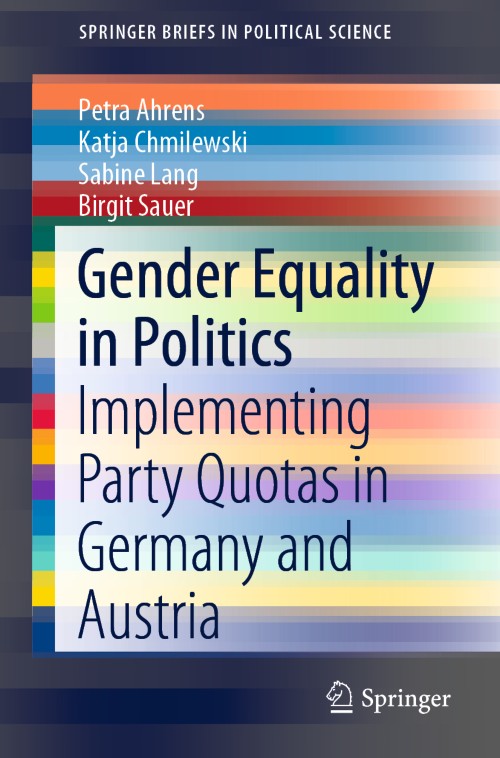
Gender Equality in Politics [electronic resource] : Implementing Party Quotas in Germany and Austria / by Petra Ahrens, Katja Chmilewski, Sabine Lang, Birgit Sauer.
Erişim Adresi
ISBN
9783030348953
Dil Kodu
İngilizce
Yer Numarası
DK/17694
Basım Bildirimi
1st ed. 2020.
Yayın Bilgisi
Cham : Springer International Publishing : Imprint: Springer, 2020.
Fiziksel Niteleme
XI, 136 p. 14 illus. online resource.
Dizi
SpringerBriefs in Political Science, 2191-5474
İçindekiler Notu
Introducing the Cross-National Comparison of Quotas -- Contextualizing Quotas: The Political Systems of Germany and Austria -- The History of Electoral Gender Quotas -- The Post-Quota Gender Gap: Standard Explanations -- Institutional Quota Roadblocks on the Federal Level -- Institutional Quota Roadblocks on the Land Level -- Conclusion: The Long Road to Parity in Politics.
Özet, vb.
This book provides a timely and unique contribution to current debates on how effectively voluntary party quotas address the persistent underrepresentation of women in legislatures. Using a most similar case design and a mixed-methods approach, the authors draw attention to the ways in which electoral systems and party regulations interface with voluntary party quotas in Germany and Austria. All quota parties in these countries support the goal of equal participation of women and men in elected office, and quotas are presented as a means to precisely that end. In order to assess parties’ commitment to their declared goals, and the effectiveness of quotas, the book introduces the concept of the post-quota gender gap and defines it as the difference between a party’s adopted quota and the actual share of women in legislative bodies at the national and regional level. Complementing the existing literature on recruitment and socio-cultural legacies, the authors argue that the problem of voluntary party quotas lies at the intersection of party quota design and electoral law. Either parties need to design quotas that actually work within a given electoral system, or we need legislative action geared toward advancing parity not just in candidate selection, but in the composition of legislatures. The book draws on gendered candidate and election data, on the party statutes of federal and state-level party organizations, and on interviews with party officials and party women’s organizations. .
Konu
Identity politics.
Elections.
Sex.
Comparative government.
Politics and Gender.
Electoral Politics.
Gender Studies.
Comparative Politics.
Elections.
Sex.
Comparative government.
Politics and Gender.
Electoral Politics.
Gender Studies.
Comparative Politics.
Kurum Adı
