

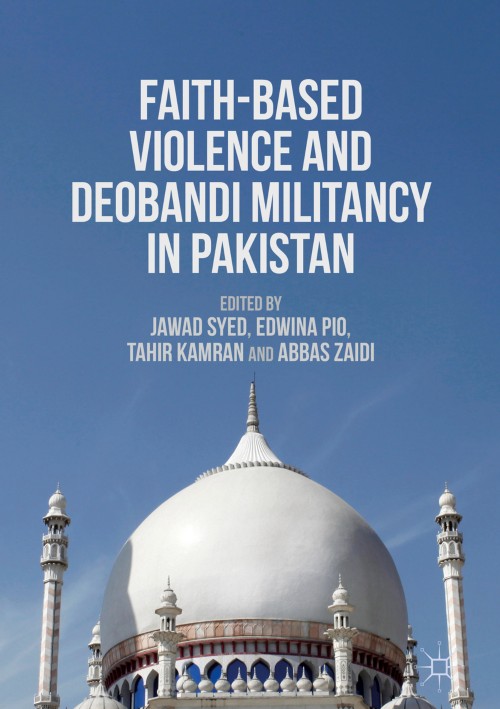
Faith-Based Violence and Deobandi Militancy in Pakistan [electronic resource] / edited by Jawad Syed, Edwina Pio, Tahir Kamran, Abbas Zaidi.
Erişim Adresi
ISBN
9781349949663
Dil Kodu
İngilizce
Yer Numarası
DK/17697
Basım Bildirimi
1st ed. 2016.
Yayın Bilgisi
London : Palgrave Macmillan UK : Imprint: Palgrave Macmillan, 2016.
Fiziksel Niteleme
XXI, 546 p. online resource.
İçindekiler Notu
Introduction -- 1 Contextualising the ascendancy of the Deobandis in Pakistan -- 2 Historical Roots of Deobandi Version of Jihadism: Implications for Violence in Pakistan -- 3 History of militancy in Islam: From Khawarij to Takfiri Deobandism -- 4 Ideological sources of transnational Islamist terrorism -- 5 Discourses of hate in Deobandi curricula, fatwas and books -- 6 Blasphemy, Takfeer, Jihad and Khilafat -- 7 Deobandi roots of extremist violence in Pakistan -- 8 Role of Deobandi extremism in global Salafi Wahabi terrorism -- 9 Could Pakistan have remained pluralistic? -- 10 Media analysis -- 11 Violence against Sunni Sufis and Barelvis -- 12 Violence against Shias; Shia genocide -- 13 Violence against Christians, Hindus, Sikhs, Jews and other communities -- 14 Violence against Ahmadis -- 15 Deobandi militancy in Bangladesh -- 16 Fighting The Takfiris: Pan Islamic Mobilization. Against Militant Anti-Shia Rhetoric inthe USA -- 17 Fanning the Flames: Deobandi Influence within British Islamism -- 18 Intersectionality -- 19 Counter-terrorism and Reform.
Özet, vb.
‘The contributions to this valuable collection provide useful insight into the background of “faith-based militancy and terrorism in Pakistan and across the globe,” distinguishing crucially the Deobandi dimension of radical Islam that has been fostered by Saudi Arabia, with US support in Pakistan particularly in the 1980s during the harsh and brutal Zia-ul-Haq regime. These developments pose a severe threat to Islamic society and beyond, and merit careful attention by those who hope to understand today’s complex and dangerous world.’ -Professor Noam Chomsky, Massachusetts Institute of Technology, USA ‘This is a most timely volume which provides historical depth and nuance to the understanding of Islamic militancy and violence in Pakistan. Such an awareness is often lacking in contemporary analyses. The empirical data provided in a series of incisive and insightful chapters enables an informed account to emerge of the causes and consequences of the growing influence of Deobandi Islam within the country and its transnational linkages. The volume enables the reader to grasp the complex factors which reduce the space for pluralism, despite inherited traditions of tolerance. The book is a must read for everyone seeking to understand contemporary Pakistan and to assess its future trajectory.’ -Professor Ian Talbot, University of Southampton, UK ‘There has long been a need for a study tracing the development of Deobandi school of thought in the South Asian subcontinent in both the colonial and the post-colonial eras. ‘Faith-Based Violence and Deobandi Militancy in Pakistan’ will fill this lacuna through an inter-disciplinary and historically informed study of Deobandi thinking and organization.’ -Professor Ayesha Jalal, Tufts University, USA ‘This book is a landmark in scholarship on Islam, Pakistan and militancy. It will provide necessary insights into the genesis of violence in the name of religion and sect which scholars, ordinary readers and decision-makers can use to understand why Pakistan's name is often in the headlines for the wrong reasons.’ -Professor Tariq Rahman, Beaconhouse National University, Lahore, Pakistan This book documents and highlights the Deobandi dimension of extremism and its implications for faith-based violence and terrorism. This dimension of radical Islam remains largely ignored or misunderstood in mainstream media and academic scholarship. The book addresses this gap. It also covers the Deobandi diaspora in the West and other countries and the role of its radical elements in transnational incidents of violence and terrorism. The specific identification of the radical Deobandi and Salafi identity of militants is useful to isolate them from the majority of peaceful Sunni and Shia Muslims. Such identification provides direction to governmental resources so they focus on those outfits, mosques, madrassas, charities, media and social medial channels that areassociated with these ideologies. This book comes along at a time when there is a dire need for alternative and contextual discourses on terrorism. Jawad Syed, PhD, is Professor of Organisational Behaviour and Diversity Management at the University of Huddersfield, UK. He is the founder and co-director of the Global Centre for Equality and Human Rights (GCEHR), UK. He is also a programme chair of the Gender, Race and Diversity in Organisations SIG of the European Academy of Management. Edwina Pio (PhD, BEd, MNZAC) is Professor of Diversity at the Business & Law School, Auckland University of Technology, New Zealand, and is Visiting Professor at Boston College, USA. She is co-director of the Global Centre for Equality and Human Rights (GCEHR), UK. Tahir Kamran, PhD, is Professor and Head of the Department of History at Government College University Lahore, Pakistan, where he founded the biannual journal The Historian. From 2013-2015, he was IqbalFellow at the University of Cambridge, UK, as Professor in the Centre of South Asian Studies. Abbas Zaidi is Tutor in Media Studies at the School of the Arts & Media, University of New South Wales, Australia. He has worked as a journalist and teacher in Pakistan, Brunei Darussalam, and Australia.
Konu
Terrorism.
Political violence.
Asia __ Politics and government.
Peace.
Terrorism and Political Violence.
Asian Politics.
Peace and Conflict Studies.
Political violence.
Asia __ Politics and government.
Peace.
Terrorism and Political Violence.
Asian Politics.
Peace and Conflict Studies.
Diğer Yazarlar
Kurum Adı
Eseri Alıntıla
Referansları kullanmadan önce gözden geçirmeniz ve varsa gerekli düzeltmeleri yapmanız önerilir.
Dijital Kaynak
MARC Görünümü
LEADER 07370nam a22005535i 4500
001 816482
003 TR_AnAIT
005 20260130195859
007 cr nn 008mamaa
008 161110s2016 xxk| s |||| 0|eng d
020 |a9781349949663|9978-1-349-94966-3
024 7 |a10.1057/978-1-349-94966-3|2doi
041 |aeng
049 |aTürk Tarih Kurumu Kütüphanesi
050 4|aJC328.6-.65
072 7|aJPWL|2bicssc
072 7|aPOL037000|2bisacsh
072 7|aJPWL|2thema
082 04|a327.117|223
082 04|a363.325|223
090 |aDK/17697
245 10|aFaith-Based Violence and Deobandi Militancy in Pakistan|h[electronic resource] /|cedited by Jawad Syed, Edwina Pio, Tahir Kamran, Abbas Zaidi.
250 |a1st ed. 2016.
264 1|aLondon :|bPalgrave Macmillan UK :|bImprint: Palgrave Macmillan,|c2016.
300 |aXXI, 546 p.|bonline resource.
336 |atext|btxt|2rdacontent
337 |acomputer|bc|2rdamedia
338 |aonline resource|bcr|2rdacarrier
347 |atext file|bPDF|2rda
505 0 |aIntroduction -- 1 Contextualising the ascendancy of the Deobandis in Pakistan -- 2 Historical Roots of Deobandi Version of Jihadism: Implications for Violence in Pakistan -- 3 History of militancy in Islam: From Khawarij to Takfiri Deobandism -- 4 Ideological sources of transnational Islamist terrorism -- 5 Discourses of hate in Deobandi curricula, fatwas and books -- 6 Blasphemy, Takfeer, Jihad and Khilafat -- 7 Deobandi roots of extremist violence in Pakistan -- 8 Role of Deobandi extremism in global Salafi Wahabi terrorism -- 9 Could Pakistan have remained pluralistic? -- 10 Media analysis -- 11 Violence against Sunni Sufis and Barelvis -- 12 Violence against Shias; Shia genocide -- 13 Violence against Christians, Hindus, Sikhs, Jews and other communities -- 14 Violence against Ahmadis -- 15 Deobandi militancy in Bangladesh -- 16 Fighting The Takfiris: Pan Islamic Mobilization. Against Militant Anti-Shia Rhetoric inthe USA -- 17 Fanning the Flames: Deobandi Influence within British Islamism -- 18 Intersectionality -- 19 Counter-terrorism and Reform.
520 |a‘The contributions to this valuable collection provide useful insight into the background of “faith-based militancy and terrorism in Pakistan and across the globe,” distinguishing crucially the Deobandi dimension of radical Islam that has been fostered by Saudi Arabia, with US support in Pakistan particularly in the 1980s during the harsh and brutal Zia-ul-Haq regime. These developments pose a severe threat to Islamic society and beyond, and merit careful attention by those who hope to understand today’s complex and dangerous world.’ -Professor Noam Chomsky, Massachusetts Institute of Technology, USA ‘This is a most timely volume which provides historical depth and nuance to the understanding of Islamic militancy and violence in Pakistan. Such an awareness is often lacking in contemporary analyses. The empirical data provided in a series of incisive and insightful chapters enables an informed account to emerge of the causes and consequences of the growing influence of Deobandi Islam within the country and its transnational linkages. The volume enables the reader to grasp the complex factors which reduce the space for pluralism, despite inherited traditions of tolerance. The book is a must read for everyone seeking to understand contemporary Pakistan and to assess its future trajectory.’ -Professor Ian Talbot, University of Southampton, UK ‘There has long been a need for a study tracing the development of Deobandi school of thought in the South Asian subcontinent in both the colonial and the post-colonial eras. ‘Faith-Based Violence and Deobandi Militancy in Pakistan’ will fill this lacuna through an inter-disciplinary and historically informed study of Deobandi thinking and organization.’ -Professor Ayesha Jalal, Tufts University, USA ‘This book is a landmark in scholarship on Islam, Pakistan and militancy. It will provide necessary insights into the genesis of violence in the name of religion and sect which scholars, ordinary readers and decision-makers can use to understand why Pakistan's name is often in the headlines for the wrong reasons.’ -Professor Tariq Rahman, Beaconhouse National University, Lahore, Pakistan This book documents and highlights the Deobandi dimension of extremism and its implications for faith-based violence and terrorism. This dimension of radical Islam remains largely ignored or misunderstood in mainstream media and academic scholarship. The book addresses this gap. It also covers the Deobandi diaspora in the West and other countries and the role of its radical elements in transnational incidents of violence and terrorism. The specific identification of the radical Deobandi and Salafi identity of militants is useful to isolate them from the majority of peaceful Sunni and Shia Muslims. Such identification provides direction to governmental resources so they focus on those outfits, mosques, madrassas, charities, media and social medial channels that areassociated with these ideologies. This book comes along at a time when there is a dire need for alternative and contextual discourses on terrorism. Jawad Syed, PhD, is Professor of Organisational Behaviour and Diversity Management at the University of Huddersfield, UK. He is the founder and co-director of the Global Centre for Equality and Human Rights (GCEHR), UK. He is also a programme chair of the Gender, Race and Diversity in Organisations SIG of the European Academy of Management. Edwina Pio (PhD, BEd, MNZAC) is Professor of Diversity at the Business & Law School, Auckland University of Technology, New Zealand, and is Visiting Professor at Boston College, USA. She is co-director of the Global Centre for Equality and Human Rights (GCEHR), UK. Tahir Kamran, PhD, is Professor and Head of the Department of History at Government College University Lahore, Pakistan, where he founded the biannual journal The Historian. From 2013-2015, he was IqbalFellow at the University of Cambridge, UK, as Professor in the Centre of South Asian Studies. Abbas Zaidi is Tutor in Media Studies at the School of the Arts & Media, University of New South Wales, Australia. He has worked as a journalist and teacher in Pakistan, Brunei Darussalam, and Australia.
650 0|aTerrorism.
650 0|aPolitical violence.
650 0|aAsia|xPolitics and government.
650 0|aPeace.
650 14|aTerrorism and Political Violence.
650 24|aAsian Politics.
650 24|aPeace and Conflict Studies.
700 1 |aSyed, Jawad.|eeditor.|4edt|4http://id.loc.gov/vocabulary/relators/edt
700 1 |aPio, Edwina.|eeditor.|4edt|4http://id.loc.gov/vocabulary/relators/edt
700 1 |aKamran, Tahir.|eeditor.|4edt|4http://id.loc.gov/vocabulary/relators/edt
700 1 |aZaidi, Abbas.|eeditor.|4edt|4http://id.loc.gov/vocabulary/relators/edt
710 2 |aSpringerLink (Online service)
773 0 |tSpringer Nature eBook
776 08|iPrinted edition:|z9781349949656
776 08|iPrinted edition:|z9781349949670
776 08|iPrinted edition:|z9781349956890
856 40|uhttps://doi.org/10.1057/978-1-349-94966-3
912 |aZDB-2-POS
912 |aZDB-2-SXPI
950 |aPolitical Science and International Studies (SpringerNature-41174)
950 |aPolitical Science and International Studies (R0) (SpringerNature-43724)
001 816482
003 TR_AnAIT
005 20260130195859
007 cr nn 008mamaa
008 161110s2016 xxk| s |||| 0|eng d
020 |a9781349949663|9978-1-349-94966-3
024 7 |a10.1057/978-1-349-94966-3|2doi
041 |aeng
049 |aTürk Tarih Kurumu Kütüphanesi
050 4|aJC328.6-.65
072 7|aJPWL|2bicssc
072 7|aPOL037000|2bisacsh
072 7|aJPWL|2thema
082 04|a327.117|223
082 04|a363.325|223
090 |aDK/17697
245 10|aFaith-Based Violence and Deobandi Militancy in Pakistan|h[electronic resource] /|cedited by Jawad Syed, Edwina Pio, Tahir Kamran, Abbas Zaidi.
250 |a1st ed. 2016.
264 1|aLondon :|bPalgrave Macmillan UK :|bImprint: Palgrave Macmillan,|c2016.
300 |aXXI, 546 p.|bonline resource.
336 |atext|btxt|2rdacontent
337 |acomputer|bc|2rdamedia
338 |aonline resource|bcr|2rdacarrier
347 |atext file|bPDF|2rda
505 0 |aIntroduction -- 1 Contextualising the ascendancy of the Deobandis in Pakistan -- 2 Historical Roots of Deobandi Version of Jihadism: Implications for Violence in Pakistan -- 3 History of militancy in Islam: From Khawarij to Takfiri Deobandism -- 4 Ideological sources of transnational Islamist terrorism -- 5 Discourses of hate in Deobandi curricula, fatwas and books -- 6 Blasphemy, Takfeer, Jihad and Khilafat -- 7 Deobandi roots of extremist violence in Pakistan -- 8 Role of Deobandi extremism in global Salafi Wahabi terrorism -- 9 Could Pakistan have remained pluralistic? -- 10 Media analysis -- 11 Violence against Sunni Sufis and Barelvis -- 12 Violence against Shias; Shia genocide -- 13 Violence against Christians, Hindus, Sikhs, Jews and other communities -- 14 Violence against Ahmadis -- 15 Deobandi militancy in Bangladesh -- 16 Fighting The Takfiris: Pan Islamic Mobilization. Against Militant Anti-Shia Rhetoric inthe USA -- 17 Fanning the Flames: Deobandi Influence within British Islamism -- 18 Intersectionality -- 19 Counter-terrorism and Reform.
520 |a‘The contributions to this valuable collection provide useful insight into the background of “faith-based militancy and terrorism in Pakistan and across the globe,” distinguishing crucially the Deobandi dimension of radical Islam that has been fostered by Saudi Arabia, with US support in Pakistan particularly in the 1980s during the harsh and brutal Zia-ul-Haq regime. These developments pose a severe threat to Islamic society and beyond, and merit careful attention by those who hope to understand today’s complex and dangerous world.’ -Professor Noam Chomsky, Massachusetts Institute of Technology, USA ‘This is a most timely volume which provides historical depth and nuance to the understanding of Islamic militancy and violence in Pakistan. Such an awareness is often lacking in contemporary analyses. The empirical data provided in a series of incisive and insightful chapters enables an informed account to emerge of the causes and consequences of the growing influence of Deobandi Islam within the country and its transnational linkages. The volume enables the reader to grasp the complex factors which reduce the space for pluralism, despite inherited traditions of tolerance. The book is a must read for everyone seeking to understand contemporary Pakistan and to assess its future trajectory.’ -Professor Ian Talbot, University of Southampton, UK ‘There has long been a need for a study tracing the development of Deobandi school of thought in the South Asian subcontinent in both the colonial and the post-colonial eras. ‘Faith-Based Violence and Deobandi Militancy in Pakistan’ will fill this lacuna through an inter-disciplinary and historically informed study of Deobandi thinking and organization.’ -Professor Ayesha Jalal, Tufts University, USA ‘This book is a landmark in scholarship on Islam, Pakistan and militancy. It will provide necessary insights into the genesis of violence in the name of religion and sect which scholars, ordinary readers and decision-makers can use to understand why Pakistan's name is often in the headlines for the wrong reasons.’ -Professor Tariq Rahman, Beaconhouse National University, Lahore, Pakistan This book documents and highlights the Deobandi dimension of extremism and its implications for faith-based violence and terrorism. This dimension of radical Islam remains largely ignored or misunderstood in mainstream media and academic scholarship. The book addresses this gap. It also covers the Deobandi diaspora in the West and other countries and the role of its radical elements in transnational incidents of violence and terrorism. The specific identification of the radical Deobandi and Salafi identity of militants is useful to isolate them from the majority of peaceful Sunni and Shia Muslims. Such identification provides direction to governmental resources so they focus on those outfits, mosques, madrassas, charities, media and social medial channels that areassociated with these ideologies. This book comes along at a time when there is a dire need for alternative and contextual discourses on terrorism. Jawad Syed, PhD, is Professor of Organisational Behaviour and Diversity Management at the University of Huddersfield, UK. He is the founder and co-director of the Global Centre for Equality and Human Rights (GCEHR), UK. He is also a programme chair of the Gender, Race and Diversity in Organisations SIG of the European Academy of Management. Edwina Pio (PhD, BEd, MNZAC) is Professor of Diversity at the Business & Law School, Auckland University of Technology, New Zealand, and is Visiting Professor at Boston College, USA. She is co-director of the Global Centre for Equality and Human Rights (GCEHR), UK. Tahir Kamran, PhD, is Professor and Head of the Department of History at Government College University Lahore, Pakistan, where he founded the biannual journal The Historian. From 2013-2015, he was IqbalFellow at the University of Cambridge, UK, as Professor in the Centre of South Asian Studies. Abbas Zaidi is Tutor in Media Studies at the School of the Arts & Media, University of New South Wales, Australia. He has worked as a journalist and teacher in Pakistan, Brunei Darussalam, and Australia.
650 0|aTerrorism.
650 0|aPolitical violence.
650 0|aAsia|xPolitics and government.
650 0|aPeace.
650 14|aTerrorism and Political Violence.
650 24|aAsian Politics.
650 24|aPeace and Conflict Studies.
700 1 |aSyed, Jawad.|eeditor.|4edt|4http://id.loc.gov/vocabulary/relators/edt
700 1 |aPio, Edwina.|eeditor.|4edt|4http://id.loc.gov/vocabulary/relators/edt
700 1 |aKamran, Tahir.|eeditor.|4edt|4http://id.loc.gov/vocabulary/relators/edt
700 1 |aZaidi, Abbas.|eeditor.|4edt|4http://id.loc.gov/vocabulary/relators/edt
710 2 |aSpringerLink (Online service)
773 0 |tSpringer Nature eBook
776 08|iPrinted edition:|z9781349949656
776 08|iPrinted edition:|z9781349949670
776 08|iPrinted edition:|z9781349956890
856 40|uhttps://doi.org/10.1057/978-1-349-94966-3
912 |aZDB-2-POS
912 |aZDB-2-SXPI
950 |aPolitical Science and International Studies (SpringerNature-41174)
950 |aPolitical Science and International Studies (R0) (SpringerNature-43724)
Materyaller
Depodan talep edilen materyal sadece kütüphane içerisinde kullanılmaktadır.
Materyal dışarıya ödünç verilmemektedir.
Materyal dışarıya ödünç verilmemektedir.
