

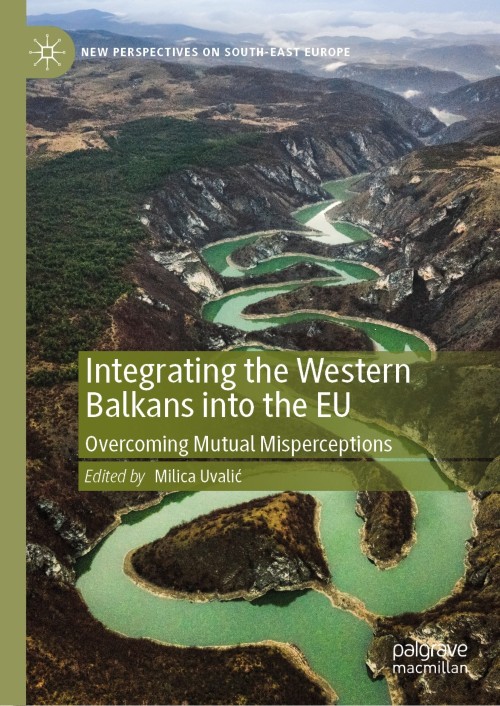
Integrating the Western Balkans into the EU [electronic resource] : Overcoming Mutual Misperceptions / edited by Milica Uvalić.
Erişim Adresi
ISBN
9783031322051
Dil Kodu
İngilizce
Yer Numarası
DK/17935
Basım Bildirimi
1st ed. 2023.
Yayın Bilgisi
Cham : Springer Nature Switzerland : Imprint: Palgrave Macmillan, 2023.
Fiziksel Niteleme
XXIV, 452 p. 26 illus., 25 illus. in color. online resource.
Dizi
New Perspectives on South-East Europe, 2662-5865
İçindekiler Notu
Chapter 1: The perceptions of European Union – Western Balkan integration prospects. Introduction and overview -- Part I: Perceptions From the West -- Chapter 2: The drivers of EU financial assistance to the Western Balkans: economic, altruistic or democracy promotion motives? -- Chapter 3: Moving the Western Balkans towards the European Union: The daunting case of Bosnia and Herzegovina -- Chapter 4: Yugoslav partition and post-war EU integration: the role of Italy, 1990-2022 -- Chapter 5: The Western Balkans, a German view -- Chapter 6: Imagining Europe in a new and small state: the case of Croatia -- Chapter 7: The United States in the Western Balkans: reluctant, late and distant involvement vs. quick radical fix -- Part II: Regional Perceptions -- Chapter 8: The image of the European Union in the Western Balkans -- Chapter 9: Perceptions and misperceptions of EU conditionality in the Western Balkans: a case of a “capability-expectations gap”? -- Chapter 10: European Union – Western Balkan misperceptions and paradoxes -- Chapter 11: Perceptions of regional cooperation in the Western Balkans -- Chapter 12: The foggy future of the Balkans: in or out of the European Union? -- Part III: Perceptions in Individual Countries -- Chapter 13: European Union and the Western Balkans, an endless story. The case of Albania -- Chapter 14: The role of mis-coordinated European integration mechanisms in decelerating progress in Bosnia and Herzegovina’s EU accession -- Chapter 15: Pro-EU, no matter what: European Union (mis)perceptions in Kosovo -- Chapter 16: The perception of the EU and its policies: a view from Montenegro -- Chapter 17: Reinforcing or conflicting? EU conditionality and political socialization during the 2015-2017 political crisis in the Republic of North Macedonia -- Chapter 18: Love and hate relationship: media framing of the official political communication about the EU in Serbia’smedia -- Chapter 19: Bridging the perceptions-based gap between the European Union and the Western Balkan.
Özet, vb.
Only Milica Uvalic could gather such a stellar group of authors on relations between countries in Southeastern Europe and the European Union; their wide range of perspectives is both timely and extremely valuable for scholars and policy makers alike. ---Susan L. Woodward, The Graduate Center, City University of New York, USA This book is crucial reading for anyone who wants to understand why it is taking so long to integrate the Western Balkans countries into the European Union. It addresses the misconceptions on both sides by scholars from a variety of disciplines, providing real understanding and insight. ---Saul Estrin, London School of Economics, UK Among the main stumbling blocks of European Union-Western Balkan integration are the differences in perceptions on both sides. Today, the gap between what the Western Balkan politicians and citizens think about the European Union and what the politicians and citizens in the EU member states think about the Western Balkans is probably wider than ever. This volume offers fresh insights about these misperceptions and how to possibly bridge the gap. It examines perceptions about the region’s “European perspectives” both on the side of the six Western Balkan countries - Albania, Bosnia and Herzegovina, Kosovo, Montenegro, North Macedonia and Serbia – and the key European Union member states (Italy, Germany, Croatia), international donors, USA. An analysis of the diverse views regarding the prospects of EU – Western Balkan integration is today highly relevant, in view of the current uncertainties regarding European Union’s enlargement policy, particularly after the attack of Russia on Ukraine and candidate status granted to Ukraine and Moldova. Milica Uvalic is Professor at the University of Perugia, Italy. She was also member of the UN Committee for Development Policy and Assistant Minister in the first post-Milošević government in FRYugoslavia. Recent publications include Towards Economic Inclusion in the Western Balkans coedited with W. Bartlett (Palgrave, 2022) and The Economic and Investment Plan for the Western Balkans co-authored with W. Bartlett and M. Bonomi (European Parliament, 2022).
Konu
Europe __ Politics and government.
Political planning.
International relations.
European Politics.
Public Policy.
International Relations.
Political planning.
International relations.
European Politics.
Public Policy.
International Relations.
Diğer Yazarlar
Kurum Adı
Eseri Alıntıla
Referansları kullanmadan önce gözden geçirmeniz ve varsa gerekli düzeltmeleri yapmanız önerilir.
Dijital Kaynak
MARC Görünümü
LEADER 07489nam a22006495i 4500
001 816722
003 TR_AnAIT
005 20260130194244
007 cr nn 008mamaa
008 230725s2023 sz | s |||| 0|eng d
020 |a9783031322051|9978-3-031-32205-1
024 7 |a10.1007/978-3-031-32205-1|2doi
041 |aeng
049 |aTürk Tarih Kurumu Kütüphanesi
050 4|aJN1-9692.2
072 7|aJP|2bicssc
072 7|a1D|2bicssc
072 7|aPOL058000|2bisacsh
072 7|aJP|x1D|2thema
082 04|a320.94|223
090 |aDK/17935
245 10|aIntegrating the Western Balkans into the EU|h[electronic resource] :|bOvercoming Mutual Misperceptions /|cedited by Milica Uvalić.
250 |a1st ed. 2023.
264 1|aCham :|bSpringer Nature Switzerland :|bImprint: Palgrave Macmillan,|c2023.
300 |aXXIV, 452 p. 26 illus., 25 illus. in color.|bonline resource.
336 |atext|btxt|2rdacontent
337 |acomputer|bc|2rdamedia
338 |aonline resource|bcr|2rdacarrier
341 0 |bTable of contents navigation|2onix
341 0 |bSingle logical reading order|2onix
341 0 |bShort alternative textual descriptions|2onix
341 0 |bUse of color is not sole means of conveying information|2onix
341 0 |bUse of high contrast between text and background color|2onix
341 0 |bNext / Previous structural navigation|2onix
341 0 |bAll non-decorative content supports reading without sight|2onix
347 |atext file|bPDF|2rda
490 1 |aNew Perspectives on South-East Europe,|x2662-5865
505 0 |aChapter 1: The perceptions of European Union – Western Balkan integration prospects. Introduction and overview -- Part I: Perceptions From the West -- Chapter 2: The drivers of EU financial assistance to the Western Balkans: economic, altruistic or democracy promotion motives? -- Chapter 3: Moving the Western Balkans towards the European Union: The daunting case of Bosnia and Herzegovina -- Chapter 4: Yugoslav partition and post-war EU integration: the role of Italy, 1990-2022 -- Chapter 5: The Western Balkans, a German view -- Chapter 6: Imagining Europe in a new and small state: the case of Croatia -- Chapter 7: The United States in the Western Balkans: reluctant, late and distant involvement vs. quick radical fix -- Part II: Regional Perceptions -- Chapter 8: The image of the European Union in the Western Balkans -- Chapter 9: Perceptions and misperceptions of EU conditionality in the Western Balkans: a case of a “capability-expectations gap”? -- Chapter 10: European Union – Western Balkan misperceptions and paradoxes -- Chapter 11: Perceptions of regional cooperation in the Western Balkans -- Chapter 12: The foggy future of the Balkans: in or out of the European Union? -- Part III: Perceptions in Individual Countries -- Chapter 13: European Union and the Western Balkans, an endless story. The case of Albania -- Chapter 14: The role of mis-coordinated European integration mechanisms in decelerating progress in Bosnia and Herzegovina’s EU accession -- Chapter 15: Pro-EU, no matter what: European Union (mis)perceptions in Kosovo -- Chapter 16: The perception of the EU and its policies: a view from Montenegro -- Chapter 17: Reinforcing or conflicting? EU conditionality and political socialization during the 2015-2017 political crisis in the Republic of North Macedonia -- Chapter 18: Love and hate relationship: media framing of the official political communication about the EU in Serbia’smedia -- Chapter 19: Bridging the perceptions-based gap between the European Union and the Western Balkan.
520 |aOnly Milica Uvalic could gather such a stellar group of authors on relations between countries in Southeastern Europe and the European Union; their wide range of perspectives is both timely and extremely valuable for scholars and policy makers alike. ---Susan L. Woodward, The Graduate Center, City University of New York, USA This book is crucial reading for anyone who wants to understand why it is taking so long to integrate the Western Balkans countries into the European Union. It addresses the misconceptions on both sides by scholars from a variety of disciplines, providing real understanding and insight. ---Saul Estrin, London School of Economics, UK Among the main stumbling blocks of European Union-Western Balkan integration are the differences in perceptions on both sides. Today, the gap between what the Western Balkan politicians and citizens think about the European Union and what the politicians and citizens in the EU member states think about the Western Balkans is probably wider than ever. This volume offers fresh insights about these misperceptions and how to possibly bridge the gap. It examines perceptions about the region’s “European perspectives” both on the side of the six Western Balkan countries - Albania, Bosnia and Herzegovina, Kosovo, Montenegro, North Macedonia and Serbia – and the key European Union member states (Italy, Germany, Croatia), international donors, USA. An analysis of the diverse views regarding the prospects of EU – Western Balkan integration is today highly relevant, in view of the current uncertainties regarding European Union’s enlargement policy, particularly after the attack of Russia on Ukraine and candidate status granted to Ukraine and Moldova. Milica Uvalic is Professor at the University of Perugia, Italy. She was also member of the UN Committee for Development Policy and Assistant Minister in the first post-Milošević government in FRYugoslavia. Recent publications include Towards Economic Inclusion in the Western Balkans coedited with W. Bartlett (Palgrave, 2022) and The Economic and Investment Plan for the Western Balkans co-authored with W. Bartlett and M. Bonomi (European Parliament, 2022).
532 8 |aAccessibility summary: This PDF does not fully comply with PDF/UA standards, but does feature limited screen reader support, described non-text content (images, graphs), bookmarks for easy navigation and searchable, selectable text. Users of assistive technologies may experience difficulty navigating or interpreting content in this document. We recognize the importance of accessibility, and we welcome queries about accessibility for any of our products. If you have a question or an access need, please get in touch with us at accessibilitysupport@springernature.com.
532 8 |aNo reading system accessibility options actively disabled
532 8 |aPublisher contact for further accessibility information: accessibilitysupport@springernature.com
650 0|aEurope|xPolitics and government.
650 0|aPolitical planning.
650 0|aInternational relations.
650 14|aEuropean Politics.
650 24|aPublic Policy.
650 24|aInternational Relations.
700 1 |aUvalić, Milica.|eeditor.|0(orcid)0000-0002-7347-2629|1https://orcid.org/0000-0002-7347-2629|4edt|4http://id.loc.gov/vocabulary/relators/edt
710 2 |aSpringerLink (Online service)
773 0 |tSpringer Nature eBook
776 08|iPrinted edition:|z9783031322044
776 08|iPrinted edition:|z9783031322068
776 08|iPrinted edition:|z9783031322075
830 0|aNew Perspectives on South-East Europe,|x2662-5865
856 40|uhttps://doi.org/10.1007/978-3-031-32205-1
912 |aZDB-2-POS
912 |aZDB-2-SXPI
950 |aPolitical Science and International Studies (SpringerNature-41174)
950 |aPolitical Science and International Studies (R0) (SpringerNature-43724)
001 816722
003 TR_AnAIT
005 20260130194244
007 cr nn 008mamaa
008 230725s2023 sz | s |||| 0|eng d
020 |a9783031322051|9978-3-031-32205-1
024 7 |a10.1007/978-3-031-32205-1|2doi
041 |aeng
049 |aTürk Tarih Kurumu Kütüphanesi
050 4|aJN1-9692.2
072 7|aJP|2bicssc
072 7|a1D|2bicssc
072 7|aPOL058000|2bisacsh
072 7|aJP|x1D|2thema
082 04|a320.94|223
090 |aDK/17935
245 10|aIntegrating the Western Balkans into the EU|h[electronic resource] :|bOvercoming Mutual Misperceptions /|cedited by Milica Uvalić.
250 |a1st ed. 2023.
264 1|aCham :|bSpringer Nature Switzerland :|bImprint: Palgrave Macmillan,|c2023.
300 |aXXIV, 452 p. 26 illus., 25 illus. in color.|bonline resource.
336 |atext|btxt|2rdacontent
337 |acomputer|bc|2rdamedia
338 |aonline resource|bcr|2rdacarrier
341 0 |bTable of contents navigation|2onix
341 0 |bSingle logical reading order|2onix
341 0 |bShort alternative textual descriptions|2onix
341 0 |bUse of color is not sole means of conveying information|2onix
341 0 |bUse of high contrast between text and background color|2onix
341 0 |bNext / Previous structural navigation|2onix
341 0 |bAll non-decorative content supports reading without sight|2onix
347 |atext file|bPDF|2rda
490 1 |aNew Perspectives on South-East Europe,|x2662-5865
505 0 |aChapter 1: The perceptions of European Union – Western Balkan integration prospects. Introduction and overview -- Part I: Perceptions From the West -- Chapter 2: The drivers of EU financial assistance to the Western Balkans: economic, altruistic or democracy promotion motives? -- Chapter 3: Moving the Western Balkans towards the European Union: The daunting case of Bosnia and Herzegovina -- Chapter 4: Yugoslav partition and post-war EU integration: the role of Italy, 1990-2022 -- Chapter 5: The Western Balkans, a German view -- Chapter 6: Imagining Europe in a new and small state: the case of Croatia -- Chapter 7: The United States in the Western Balkans: reluctant, late and distant involvement vs. quick radical fix -- Part II: Regional Perceptions -- Chapter 8: The image of the European Union in the Western Balkans -- Chapter 9: Perceptions and misperceptions of EU conditionality in the Western Balkans: a case of a “capability-expectations gap”? -- Chapter 10: European Union – Western Balkan misperceptions and paradoxes -- Chapter 11: Perceptions of regional cooperation in the Western Balkans -- Chapter 12: The foggy future of the Balkans: in or out of the European Union? -- Part III: Perceptions in Individual Countries -- Chapter 13: European Union and the Western Balkans, an endless story. The case of Albania -- Chapter 14: The role of mis-coordinated European integration mechanisms in decelerating progress in Bosnia and Herzegovina’s EU accession -- Chapter 15: Pro-EU, no matter what: European Union (mis)perceptions in Kosovo -- Chapter 16: The perception of the EU and its policies: a view from Montenegro -- Chapter 17: Reinforcing or conflicting? EU conditionality and political socialization during the 2015-2017 political crisis in the Republic of North Macedonia -- Chapter 18: Love and hate relationship: media framing of the official political communication about the EU in Serbia’smedia -- Chapter 19: Bridging the perceptions-based gap between the European Union and the Western Balkan.
520 |aOnly Milica Uvalic could gather such a stellar group of authors on relations between countries in Southeastern Europe and the European Union; their wide range of perspectives is both timely and extremely valuable for scholars and policy makers alike. ---Susan L. Woodward, The Graduate Center, City University of New York, USA This book is crucial reading for anyone who wants to understand why it is taking so long to integrate the Western Balkans countries into the European Union. It addresses the misconceptions on both sides by scholars from a variety of disciplines, providing real understanding and insight. ---Saul Estrin, London School of Economics, UK Among the main stumbling blocks of European Union-Western Balkan integration are the differences in perceptions on both sides. Today, the gap between what the Western Balkan politicians and citizens think about the European Union and what the politicians and citizens in the EU member states think about the Western Balkans is probably wider than ever. This volume offers fresh insights about these misperceptions and how to possibly bridge the gap. It examines perceptions about the region’s “European perspectives” both on the side of the six Western Balkan countries - Albania, Bosnia and Herzegovina, Kosovo, Montenegro, North Macedonia and Serbia – and the key European Union member states (Italy, Germany, Croatia), international donors, USA. An analysis of the diverse views regarding the prospects of EU – Western Balkan integration is today highly relevant, in view of the current uncertainties regarding European Union’s enlargement policy, particularly after the attack of Russia on Ukraine and candidate status granted to Ukraine and Moldova. Milica Uvalic is Professor at the University of Perugia, Italy. She was also member of the UN Committee for Development Policy and Assistant Minister in the first post-Milošević government in FRYugoslavia. Recent publications include Towards Economic Inclusion in the Western Balkans coedited with W. Bartlett (Palgrave, 2022) and The Economic and Investment Plan for the Western Balkans co-authored with W. Bartlett and M. Bonomi (European Parliament, 2022).
532 8 |aAccessibility summary: This PDF does not fully comply with PDF/UA standards, but does feature limited screen reader support, described non-text content (images, graphs), bookmarks for easy navigation and searchable, selectable text. Users of assistive technologies may experience difficulty navigating or interpreting content in this document. We recognize the importance of accessibility, and we welcome queries about accessibility for any of our products. If you have a question or an access need, please get in touch with us at accessibilitysupport@springernature.com.
532 8 |aNo reading system accessibility options actively disabled
532 8 |aPublisher contact for further accessibility information: accessibilitysupport@springernature.com
650 0|aEurope|xPolitics and government.
650 0|aPolitical planning.
650 0|aInternational relations.
650 14|aEuropean Politics.
650 24|aPublic Policy.
650 24|aInternational Relations.
700 1 |aUvalić, Milica.|eeditor.|0(orcid)0000-0002-7347-2629|1https://orcid.org/0000-0002-7347-2629|4edt|4http://id.loc.gov/vocabulary/relators/edt
710 2 |aSpringerLink (Online service)
773 0 |tSpringer Nature eBook
776 08|iPrinted edition:|z9783031322044
776 08|iPrinted edition:|z9783031322068
776 08|iPrinted edition:|z9783031322075
830 0|aNew Perspectives on South-East Europe,|x2662-5865
856 40|uhttps://doi.org/10.1007/978-3-031-32205-1
912 |aZDB-2-POS
912 |aZDB-2-SXPI
950 |aPolitical Science and International Studies (SpringerNature-41174)
950 |aPolitical Science and International Studies (R0) (SpringerNature-43724)
Materyaller
Depodan talep edilen materyal sadece kütüphane içerisinde kullanılmaktadır.
Materyal dışarıya ödünç verilmemektedir.
Materyal dışarıya ödünç verilmemektedir.
