

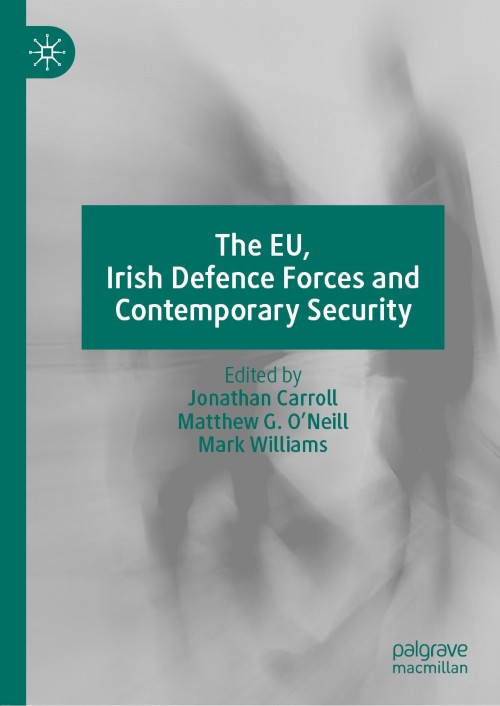
The EU, Irish Defence Forces and Contemporary Security [electronic resource] / edited by Jonathan Carroll, Matthew G. O'Neill, Mark Williams.
Erişim Adresi
ISBN
9783031078125
Dil Kodu
İngilizce
Yer Numarası
DK/18033
Basım Bildirimi
1st ed. 2023.
Yayın Bilgisi
Cham : Springer International Publishing : Imprint: Palgrave Macmillan, 2023.
Fiziksel Niteleme
XXV, 443 p. 8 illus., 7 illus. in color. online resource.
İçindekiler Notu
Introduction -- Theme One: Defence Forces Capabilities & The Threat Environment. Chapter 1. Ensuring the Jungle Doesn’t Grow Back: The Obligations Inherent to Irish Defence Policy -- Chapter 2. The GOC’s Perspective -- Chapter 3. A Critical Analysis of the Intellectual and Communications Culture of the Irish Defence Forces at a time of Emergent/Imminent Domestic and International Threats -- chapter 4. The Irish Naval Service: The Burden of the Minimalist Approach -- Chapter 5. Small Navies: Lessons for the Irish Naval Service -- Theme Two: The Reserve Defence Forces. Chapter 6.Revitalizing the Irish Army Reserve post-Commission on the Defence Forces: Moving from the Single Force Concept to a Total Force Policy -- Chapter 7. The Army Reserves – The Force-multiplier for Irish Defence -- Chapter 8. Ireland’s Naval Service Reserve – An Analysis of Current Capabilities and Role for the Future -- Theme Three: Peacekeeping Operations. Chapter 9. Decolonisation, Conflict, and Independence: The Impact of History on Ireland’s Approach to Peacekeeping -- Chapter 10. Ireland’s Largest Peacekeeping Mission – The Irish Defence Forces in UNIFIL -- Chapter 11. Peacekeeping in the Digital Age: Future Threats and Capability Requirements -- Theme Four: Cyber Security in the Digital Age. Chapter 12. Irish Cyber Security -- Chapter 13. Cyber resilience for Europe’s armed forces in the 21st Century – a German Perspective -- Chapter 14. The Irish Defence Forces in the Drone Age -- Theme Five: Defence Forces Institutional Innovation and Civil-Military Relations. Chapter 15. The Defence Forces Research Technology Initiative -- Chapter 16. Shared Norms but Policy Incoherence: Analysing the Irish Defence Forces’ Marketplace Aspirations -- Chapter 17. Representation, Negotiation, and Frustration. What path lies ahead for civil-military industrial relations -- Theme Six: The Principle of Irish Neutrality. Chapter 18. Ireland, NATO and the “Return of Geopolitics” in Europe -- Chapter 19. Irish Military Neutrality 1924-1945: A Historical Perspective for Modern Consideration -- Chapter 20. Generating More Heat Than Light? The Debate over Ireland’s Neutrality and the “European Army” -- Chapter 21. Conclusion. .
Özet, vb.
“This book is a critical and insightful contribution to the debate on Irish defence and the role of the Defence Forces.” — Ben Tonra, Professor, MRIA, The School of Politics and International Relations (SPIRe), University College Dublin, Ireland “By mainly examining Ireland’s defence policy and the Irish Armed Forces, this edited volume provides valuable knowledge to both practitioners and scholars. Undoubtedly, any reader interested in international relations and/or security studies, and especially those focusing on small states studies and/or comparative strategy, will gain new insights by exploring this book.” — Håkan Edström, Associate Professor in Political Science, Swedish Defence University, Sweden. This book aids any researcher, policymakers and military personnel in researching small states and militaries, European defence and security policy, as well as contemporary and emerging threats. This edited collection gathers academic commentators on Irish defence policy, military leaders from across the service components of the Irish Defence Forces and European defence experts to contribute to the first in-depth conversation and analysis on modern Irish defence and its application within the European Union. The aim of this edited book is to ascertain what capabilities are robust, which are lacking, what future threats need to be catered for, and what action is needed to ensure those threats will be addressed going forward. This book will explore emerging issues and applications of modern and contemporary threats within the context of Ireland, Europe and Western institutions. We have invited submissions from scholars, commentators, policymakers and military practitioners to evaluate the Irish Defence Forces and to illustrate the complexities facing small nations in formulating and resourcing defence and national security policy. Jonathan Carroll is a PhD Candidate in Military History at Texas A&M University, USA. Matthew G. O’Neill is a Leverhulme Interdisciplinary Network on Cybersecurity and Society (LINCS) postgraduate researcher in Political Science at the Senator George J. Mitchell Institute for Global Peace, Security and Justice at Queen’s University Belfast, UK. Mark Williams is a Leverhulme Interdisciplinary Network on Cybersecurity and Society (LINCS) postgraduate researcher at the Senator George J. Mitchell Institute for Global Peace, Security and Justice at Queen’s University Belfast, UK.
Konu
Politics and war.
Security, International.
Military and Defence Studies.
International Security Studies.
Security, International.
Military and Defence Studies.
International Security Studies.
Diğer Yazarlar
Kurum Adı
Eseri Alıntıla
Referansları kullanmadan önce gözden geçirmeniz ve varsa gerekli düzeltmeleri yapmanız önerilir.
Dijital Kaynak
MARC Görünümü
LEADER 07880nam a22006135i 4500
001 816820
003 TR_AnAIT
005 20260130193447
007 cr nn 008mamaa
008 230123s2023 sz | s |||| 0|eng d
020 |a9783031078125|9978-3-031-07812-5
024 7 |a10.1007/978-3-031-07812-5|2doi
041 |aeng
049 |aTürk Tarih Kurumu Kütüphanesi
050 4|aJZ6378-6405
072 7|aJW|2bicssc
072 7|aPOL069000|2bisacsh
072 7|aJW|2thema
082 04|a355|223
090 |aDK/18033
245 14|aThe EU, Irish Defence Forces and Contemporary Security|h[electronic resource] /|cedited by Jonathan Carroll, Matthew G. O'Neill, Mark Williams.
250 |a1st ed. 2023.
264 1|aCham :|bSpringer International Publishing :|bImprint: Palgrave Macmillan,|c2023.
300 |aXXV, 443 p. 8 illus., 7 illus. in color.|bonline resource.
336 |atext|btxt|2rdacontent
337 |acomputer|bc|2rdamedia
338 |aonline resource|bcr|2rdacarrier
341 0 |bTable of contents navigation|2onix
341 0 |bSingle logical reading order|2onix
341 0 |bShort alternative textual descriptions|2onix
341 0 |bUse of color is not sole means of conveying information|2onix
341 0 |bUse of high contrast between text and background color|2onix
341 0 |bNext / Previous structural navigation|2onix
341 0 |bAll non-decorative content supports reading without sight|2onix
347 |atext file|bPDF|2rda
505 0 |aIntroduction -- Theme One: Defence Forces Capabilities & The Threat Environment. Chapter 1. Ensuring the Jungle Doesn’t Grow Back: The Obligations Inherent to Irish Defence Policy -- Chapter 2. The GOC’s Perspective -- Chapter 3. A Critical Analysis of the Intellectual and Communications Culture of the Irish Defence Forces at a time of Emergent/Imminent Domestic and International Threats -- chapter 4. The Irish Naval Service: The Burden of the Minimalist Approach -- Chapter 5. Small Navies: Lessons for the Irish Naval Service -- Theme Two: The Reserve Defence Forces. Chapter 6.Revitalizing the Irish Army Reserve post-Commission on the Defence Forces: Moving from the Single Force Concept to a Total Force Policy -- Chapter 7. The Army Reserves – The Force-multiplier for Irish Defence -- Chapter 8. Ireland’s Naval Service Reserve – An Analysis of Current Capabilities and Role for the Future -- Theme Three: Peacekeeping Operations. Chapter 9. Decolonisation, Conflict, and Independence: The Impact of History on Ireland’s Approach to Peacekeeping -- Chapter 10. Ireland’s Largest Peacekeeping Mission – The Irish Defence Forces in UNIFIL -- Chapter 11. Peacekeeping in the Digital Age: Future Threats and Capability Requirements -- Theme Four: Cyber Security in the Digital Age. Chapter 12. Irish Cyber Security -- Chapter 13. Cyber resilience for Europe’s armed forces in the 21st Century – a German Perspective -- Chapter 14. The Irish Defence Forces in the Drone Age -- Theme Five: Defence Forces Institutional Innovation and Civil-Military Relations. Chapter 15. The Defence Forces Research Technology Initiative -- Chapter 16. Shared Norms but Policy Incoherence: Analysing the Irish Defence Forces’ Marketplace Aspirations -- Chapter 17. Representation, Negotiation, and Frustration. What path lies ahead for civil-military industrial relations -- Theme Six: The Principle of Irish Neutrality. Chapter 18. Ireland, NATO and the “Return of Geopolitics” in Europe -- Chapter 19. Irish Military Neutrality 1924-1945: A Historical Perspective for Modern Consideration -- Chapter 20. Generating More Heat Than Light? The Debate over Ireland’s Neutrality and the “European Army” -- Chapter 21. Conclusion. .
520 |a“This book is a critical and insightful contribution to the debate on Irish defence and the role of the Defence Forces.” — Ben Tonra, Professor, MRIA, The School of Politics and International Relations (SPIRe), University College Dublin, Ireland “By mainly examining Ireland’s defence policy and the Irish Armed Forces, this edited volume provides valuable knowledge to both practitioners and scholars. Undoubtedly, any reader interested in international relations and/or security studies, and especially those focusing on small states studies and/or comparative strategy, will gain new insights by exploring this book.” — Håkan Edström, Associate Professor in Political Science, Swedish Defence University, Sweden. This book aids any researcher, policymakers and military personnel in researching small states and militaries, European defence and security policy, as well as contemporary and emerging threats. This edited collection gathers academic commentators on Irish defence policy, military leaders from across the service components of the Irish Defence Forces and European defence experts to contribute to the first in-depth conversation and analysis on modern Irish defence and its application within the European Union. The aim of this edited book is to ascertain what capabilities are robust, which are lacking, what future threats need to be catered for, and what action is needed to ensure those threats will be addressed going forward. This book will explore emerging issues and applications of modern and contemporary threats within the context of Ireland, Europe and Western institutions. We have invited submissions from scholars, commentators, policymakers and military practitioners to evaluate the Irish Defence Forces and to illustrate the complexities facing small nations in formulating and resourcing defence and national security policy. Jonathan Carroll is a PhD Candidate in Military History at Texas A&M University, USA. Matthew G. O’Neill is a Leverhulme Interdisciplinary Network on Cybersecurity and Society (LINCS) postgraduate researcher in Political Science at the Senator George J. Mitchell Institute for Global Peace, Security and Justice at Queen’s University Belfast, UK. Mark Williams is a Leverhulme Interdisciplinary Network on Cybersecurity and Society (LINCS) postgraduate researcher at the Senator George J. Mitchell Institute for Global Peace, Security and Justice at Queen’s University Belfast, UK.
532 8 |aAccessibility summary: This PDF does not fully comply with PDF/UA standards, but does feature limited screen reader support, described non-text content (images, graphs), bookmarks for easy navigation and searchable, selectable text. Users of assistive technologies may experience difficulty navigating or interpreting content in this document. We recognize the importance of accessibility, and we welcome queries about accessibility for any of our products. If you have a question or an access need, please get in touch with us at accessibilitysupport@springernature.com.
532 8 |aNo reading system accessibility options actively disabled
532 8 |aPublisher contact for further accessibility information: accessibilitysupport@springernature.com
650 0|aPolitics and war.
650 0|aSecurity, International.
650 14|aMilitary and Defence Studies.
650 24|aInternational Security Studies.
700 1 |aCarroll, Jonathan.|eeditor.|4edt|4http://id.loc.gov/vocabulary/relators/edt
700 1 |aO'Neill, Matthew G.|eeditor.|4edt|4http://id.loc.gov/vocabulary/relators/edt
700 1 |aWilliams, Mark.|eeditor.|4edt|4http://id.loc.gov/vocabulary/relators/edt
710 2 |aSpringerLink (Online service)
773 0 |tSpringer Nature eBook
776 08|iPrinted edition:|z9783031078118
776 08|iPrinted edition:|z9783031078132
776 08|iPrinted edition:|z9783031078149
856 40|uhttps://doi.org/10.1007/978-3-031-07812-5
912 |aZDB-2-POS
912 |aZDB-2-SXPI
950 |aPolitical Science and International Studies (SpringerNature-41174)
950 |aPolitical Science and International Studies (R0) (SpringerNature-43724)
001 816820
003 TR_AnAIT
005 20260130193447
007 cr nn 008mamaa
008 230123s2023 sz | s |||| 0|eng d
020 |a9783031078125|9978-3-031-07812-5
024 7 |a10.1007/978-3-031-07812-5|2doi
041 |aeng
049 |aTürk Tarih Kurumu Kütüphanesi
050 4|aJZ6378-6405
072 7|aJW|2bicssc
072 7|aPOL069000|2bisacsh
072 7|aJW|2thema
082 04|a355|223
090 |aDK/18033
245 14|aThe EU, Irish Defence Forces and Contemporary Security|h[electronic resource] /|cedited by Jonathan Carroll, Matthew G. O'Neill, Mark Williams.
250 |a1st ed. 2023.
264 1|aCham :|bSpringer International Publishing :|bImprint: Palgrave Macmillan,|c2023.
300 |aXXV, 443 p. 8 illus., 7 illus. in color.|bonline resource.
336 |atext|btxt|2rdacontent
337 |acomputer|bc|2rdamedia
338 |aonline resource|bcr|2rdacarrier
341 0 |bTable of contents navigation|2onix
341 0 |bSingle logical reading order|2onix
341 0 |bShort alternative textual descriptions|2onix
341 0 |bUse of color is not sole means of conveying information|2onix
341 0 |bUse of high contrast between text and background color|2onix
341 0 |bNext / Previous structural navigation|2onix
341 0 |bAll non-decorative content supports reading without sight|2onix
347 |atext file|bPDF|2rda
505 0 |aIntroduction -- Theme One: Defence Forces Capabilities & The Threat Environment. Chapter 1. Ensuring the Jungle Doesn’t Grow Back: The Obligations Inherent to Irish Defence Policy -- Chapter 2. The GOC’s Perspective -- Chapter 3. A Critical Analysis of the Intellectual and Communications Culture of the Irish Defence Forces at a time of Emergent/Imminent Domestic and International Threats -- chapter 4. The Irish Naval Service: The Burden of the Minimalist Approach -- Chapter 5. Small Navies: Lessons for the Irish Naval Service -- Theme Two: The Reserve Defence Forces. Chapter 6.Revitalizing the Irish Army Reserve post-Commission on the Defence Forces: Moving from the Single Force Concept to a Total Force Policy -- Chapter 7. The Army Reserves – The Force-multiplier for Irish Defence -- Chapter 8. Ireland’s Naval Service Reserve – An Analysis of Current Capabilities and Role for the Future -- Theme Three: Peacekeeping Operations. Chapter 9. Decolonisation, Conflict, and Independence: The Impact of History on Ireland’s Approach to Peacekeeping -- Chapter 10. Ireland’s Largest Peacekeeping Mission – The Irish Defence Forces in UNIFIL -- Chapter 11. Peacekeeping in the Digital Age: Future Threats and Capability Requirements -- Theme Four: Cyber Security in the Digital Age. Chapter 12. Irish Cyber Security -- Chapter 13. Cyber resilience for Europe’s armed forces in the 21st Century – a German Perspective -- Chapter 14. The Irish Defence Forces in the Drone Age -- Theme Five: Defence Forces Institutional Innovation and Civil-Military Relations. Chapter 15. The Defence Forces Research Technology Initiative -- Chapter 16. Shared Norms but Policy Incoherence: Analysing the Irish Defence Forces’ Marketplace Aspirations -- Chapter 17. Representation, Negotiation, and Frustration. What path lies ahead for civil-military industrial relations -- Theme Six: The Principle of Irish Neutrality. Chapter 18. Ireland, NATO and the “Return of Geopolitics” in Europe -- Chapter 19. Irish Military Neutrality 1924-1945: A Historical Perspective for Modern Consideration -- Chapter 20. Generating More Heat Than Light? The Debate over Ireland’s Neutrality and the “European Army” -- Chapter 21. Conclusion. .
520 |a“This book is a critical and insightful contribution to the debate on Irish defence and the role of the Defence Forces.” — Ben Tonra, Professor, MRIA, The School of Politics and International Relations (SPIRe), University College Dublin, Ireland “By mainly examining Ireland’s defence policy and the Irish Armed Forces, this edited volume provides valuable knowledge to both practitioners and scholars. Undoubtedly, any reader interested in international relations and/or security studies, and especially those focusing on small states studies and/or comparative strategy, will gain new insights by exploring this book.” — Håkan Edström, Associate Professor in Political Science, Swedish Defence University, Sweden. This book aids any researcher, policymakers and military personnel in researching small states and militaries, European defence and security policy, as well as contemporary and emerging threats. This edited collection gathers academic commentators on Irish defence policy, military leaders from across the service components of the Irish Defence Forces and European defence experts to contribute to the first in-depth conversation and analysis on modern Irish defence and its application within the European Union. The aim of this edited book is to ascertain what capabilities are robust, which are lacking, what future threats need to be catered for, and what action is needed to ensure those threats will be addressed going forward. This book will explore emerging issues and applications of modern and contemporary threats within the context of Ireland, Europe and Western institutions. We have invited submissions from scholars, commentators, policymakers and military practitioners to evaluate the Irish Defence Forces and to illustrate the complexities facing small nations in formulating and resourcing defence and national security policy. Jonathan Carroll is a PhD Candidate in Military History at Texas A&M University, USA. Matthew G. O’Neill is a Leverhulme Interdisciplinary Network on Cybersecurity and Society (LINCS) postgraduate researcher in Political Science at the Senator George J. Mitchell Institute for Global Peace, Security and Justice at Queen’s University Belfast, UK. Mark Williams is a Leverhulme Interdisciplinary Network on Cybersecurity and Society (LINCS) postgraduate researcher at the Senator George J. Mitchell Institute for Global Peace, Security and Justice at Queen’s University Belfast, UK.
532 8 |aAccessibility summary: This PDF does not fully comply with PDF/UA standards, but does feature limited screen reader support, described non-text content (images, graphs), bookmarks for easy navigation and searchable, selectable text. Users of assistive technologies may experience difficulty navigating or interpreting content in this document. We recognize the importance of accessibility, and we welcome queries about accessibility for any of our products. If you have a question or an access need, please get in touch with us at accessibilitysupport@springernature.com.
532 8 |aNo reading system accessibility options actively disabled
532 8 |aPublisher contact for further accessibility information: accessibilitysupport@springernature.com
650 0|aPolitics and war.
650 0|aSecurity, International.
650 14|aMilitary and Defence Studies.
650 24|aInternational Security Studies.
700 1 |aCarroll, Jonathan.|eeditor.|4edt|4http://id.loc.gov/vocabulary/relators/edt
700 1 |aO'Neill, Matthew G.|eeditor.|4edt|4http://id.loc.gov/vocabulary/relators/edt
700 1 |aWilliams, Mark.|eeditor.|4edt|4http://id.loc.gov/vocabulary/relators/edt
710 2 |aSpringerLink (Online service)
773 0 |tSpringer Nature eBook
776 08|iPrinted edition:|z9783031078118
776 08|iPrinted edition:|z9783031078132
776 08|iPrinted edition:|z9783031078149
856 40|uhttps://doi.org/10.1007/978-3-031-07812-5
912 |aZDB-2-POS
912 |aZDB-2-SXPI
950 |aPolitical Science and International Studies (SpringerNature-41174)
950 |aPolitical Science and International Studies (R0) (SpringerNature-43724)
Materyaller
Depodan talep edilen materyal sadece kütüphane içerisinde kullanılmaktadır.
Materyal dışarıya ödünç verilmemektedir.
Materyal dışarıya ödünç verilmemektedir.
