

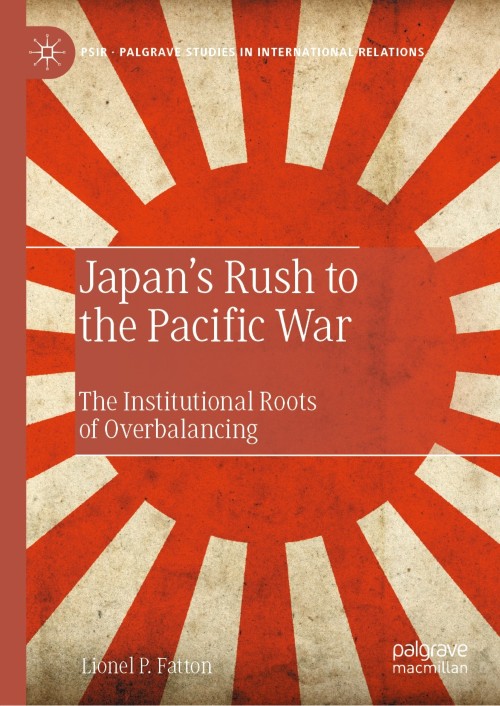
Japan’s Rush to the Pacific War [electronic resource] : The Institutional Roots of Overbalancing / by Lionel P. Fatton.
Erişim Adresi
ISBN
9783031220531
Dil Kodu
İngilizce
Yer Numarası
DK/18040
Yazar
Basım Bildirimi
1st ed. 2023.
Yayın Bilgisi
Cham : Springer International Publishing : Imprint: Palgrave Macmillan, 2023.
Fiziksel Niteleme
XXIII, 313 p. 5 illus., 4 illus. in color. online resource.
Dizi
Palgrave Studies in International Relations, 2946-2681
İçindekiler Notu
1. Overbalancing as a Systemic Pathology -- 2. Explaining Japan’s Rush to the Pacific War -- 3. Appropriate Balancing in the Naval Arms Control Era, 1920-1931 -- 4. The Manchurian Crisis as an Exogenous Shock, 1931-1933 -- 5. Overbalancing and Japan’s Rush to the Pacific War, 1933-1941 -- 6. Beyond Japan and the Pacific War.
Özet, vb.
This book investigates the phenomenon of overbalancing through an analysis of Japan’s foreign policy during the interbellum. In the mid-1930s, Japan withdrew from a naval arms control framework that had restrained military buildup on both sides of the Pacific Ocean since the early 1920s. By doing so, Japan not only triggered a naval arms race with the United States that exhausted its economy, it also destroyed the last institutionalized structure regulating the relationship between the two Pacific powers. Japan and the United States became caught in a spiral of tensions that culminated with the attack on Pearl Harbor in December 1941. Puzzling is the fact that the international environment in the Asia-Pacific was relatively stable in the mid-1930s, while Washington was pursuing a policy of accommodation toward Tokyo. By rejecting arms control and engaging in unfettered naval expansion, Japan overbalanced against the United States and began its rush to the Pacific War. The book explains Japan’s overbalancing with a neoclassical realist model that combines the literatures on threat perception and civil-military relations. Amid the Manchurian crisis of 1931-1933, as the Japanese government collaborated with the military institution to address the situation in China, military influence on the formulation of foreign policy surged. The perceptual and policy biases of the military, which include the tendency to distrust other countries’ intentions, to adopt worst-case analyses of international dynamics and to strive to maximize military power, gradually penetrated the decision-making process. Dysfunctions in the preexisting structure of Japanese civil-military relations, engendered by an over-depoliticization of the military institution, allowed the navy to convince policymakers that the United States was inherently hostile to Japan, hence the necessity to prepare for war. The government was brainstormed, adopting the biased military perspective on international affairs. Japan overbalanced in a myopic but conscious way. Lionel P. Fatton is Assistant Professor of International Relations at Webster University Geneva, Switzerland, and Research Collaborator at the Research Institute for the History of Global Arms Transfer, Meiji University, Japan.
Konu
International relations.
Security, International.
International Relations Theory.
International Security Studies.
Security, International.
International Relations Theory.
International Security Studies.
Kurum Adı
Eseri Alıntıla
Referansları kullanmadan önce gözden geçirmeniz ve varsa gerekli düzeltmeleri yapmanız önerilir.
Dijital Kaynak
MARC Görünümü
LEADER 05732nam a22006135i 4500
001 816827
003 TR_AnAIT
005 20260130193418
007 cr nn 008mamaa
008 230228s2023 sz | s |||| 0|eng d
020 |a9783031220531|9978-3-031-22053-1
024 7 |a10.1007/978-3-031-22053-1|2doi
041 |aeng
049 |aTürk Tarih Kurumu Kütüphanesi
050 4|aJZ2-6530
072 7|aJPS|2bicssc
072 7|aPOL011000|2bisacsh
072 7|aJPS|2thema
082 04|a327.101|223
090 |aDK/18040
100 1 |aFatton, Lionel P.|eauthor.|4aut|4http://id.loc.gov/vocabulary/relators/aut
245 10|aJapan’s Rush to the Pacific War|h[electronic resource] :|bThe Institutional Roots of Overbalancing /|cby Lionel P. Fatton.
250 |a1st ed. 2023.
264 1|aCham :|bSpringer International Publishing :|bImprint: Palgrave Macmillan,|c2023.
300 |aXXIII, 313 p. 5 illus., 4 illus. in color.|bonline resource.
336 |atext|btxt|2rdacontent
337 |acomputer|bc|2rdamedia
338 |aonline resource|bcr|2rdacarrier
341 0 |bTable of contents navigation|2onix
341 0 |bSingle logical reading order|2onix
341 0 |bShort alternative textual descriptions|2onix
341 0 |bUse of color is not sole means of conveying information|2onix
341 0 |bUse of high contrast between text and background color|2onix
341 0 |bNext / Previous structural navigation|2onix
341 0 |bAll non-decorative content supports reading without sight|2onix
347 |atext file|bPDF|2rda
490 1 |aPalgrave Studies in International Relations,|x2946-2681
505 0 |a1. Overbalancing as a Systemic Pathology -- 2. Explaining Japan’s Rush to the Pacific War -- 3. Appropriate Balancing in the Naval Arms Control Era, 1920-1931 -- 4. The Manchurian Crisis as an Exogenous Shock, 1931-1933 -- 5. Overbalancing and Japan’s Rush to the Pacific War, 1933-1941 -- 6. Beyond Japan and the Pacific War.
520 |aThis book investigates the phenomenon of overbalancing through an analysis of Japan’s foreign policy during the interbellum. In the mid-1930s, Japan withdrew from a naval arms control framework that had restrained military buildup on both sides of the Pacific Ocean since the early 1920s. By doing so, Japan not only triggered a naval arms race with the United States that exhausted its economy, it also destroyed the last institutionalized structure regulating the relationship between the two Pacific powers. Japan and the United States became caught in a spiral of tensions that culminated with the attack on Pearl Harbor in December 1941. Puzzling is the fact that the international environment in the Asia-Pacific was relatively stable in the mid-1930s, while Washington was pursuing a policy of accommodation toward Tokyo. By rejecting arms control and engaging in unfettered naval expansion, Japan overbalanced against the United States and began its rush to the Pacific War. The book explains Japan’s overbalancing with a neoclassical realist model that combines the literatures on threat perception and civil-military relations. Amid the Manchurian crisis of 1931-1933, as the Japanese government collaborated with the military institution to address the situation in China, military influence on the formulation of foreign policy surged. The perceptual and policy biases of the military, which include the tendency to distrust other countries’ intentions, to adopt worst-case analyses of international dynamics and to strive to maximize military power, gradually penetrated the decision-making process. Dysfunctions in the preexisting structure of Japanese civil-military relations, engendered by an over-depoliticization of the military institution, allowed the navy to convince policymakers that the United States was inherently hostile to Japan, hence the necessity to prepare for war. The government was brainstormed, adopting the biased military perspective on international affairs. Japan overbalanced in a myopic but conscious way. Lionel P. Fatton is Assistant Professor of International Relations at Webster University Geneva, Switzerland, and Research Collaborator at the Research Institute for the History of Global Arms Transfer, Meiji University, Japan.
532 8 |aAccessibility summary: This PDF does not fully comply with PDF/UA standards, but does feature limited screen reader support, described non-text content (images, graphs), bookmarks for easy navigation and searchable, selectable text. Users of assistive technologies may experience difficulty navigating or interpreting content in this document. We recognize the importance of accessibility, and we welcome queries about accessibility for any of our products. If you have a question or an access need, please get in touch with us at accessibilitysupport@springernature.com.
532 8 |aNo reading system accessibility options actively disabled
532 8 |aPublisher contact for further accessibility information: accessibilitysupport@springernature.com
650 0|aInternational relations.
650 0|aSecurity, International.
650 14|aInternational Relations Theory.
650 24|aInternational Security Studies.
710 2 |aSpringerLink (Online service)
773 0 |tSpringer Nature eBook
776 08|iPrinted edition:|z9783031220524
776 08|iPrinted edition:|z9783031220548
776 08|iPrinted edition:|z9783031220555
830 0|aPalgrave Studies in International Relations,|x2946-2681
856 40|uhttps://doi.org/10.1007/978-3-031-22053-1
912 |aZDB-2-POS
912 |aZDB-2-SXPI
950 |aPolitical Science and International Studies (SpringerNature-41174)
950 |aPolitical Science and International Studies (R0) (SpringerNature-43724)
Materyaller
Depodan talep edilen materyal sadece kütüphane içerisinde kullanılmaktadır.
Materyal dışarıya ödünç verilmemektedir.
Materyal dışarıya ödünç verilmemektedir.
