LEADER 03457nam a22005655i 4500
001 816848
003 TR_AnAIT
005 20260130193149
007 cr nn 008mamaa
008 160512s2016 xxu| s |||| 0|eng d
020 |a9781349918430|9978-1-349-91843-0
024 7 |a10.1007/978-1-349-91843-0|2doi
041 |aeng
049 |aTürk Tarih Kurumu Kütüphanesi
050 4|aJZ6378-6405
072 7|aJW|2bicssc
072 7|aPOL069000|2bisacsh
072 7|aJW|2thema
082 04|a355|223
090 |aDK/18061
100 1 |aMazarr, Michael J.|eauthor.|4aut|4http://id.loc.gov/vocabulary/relators/aut
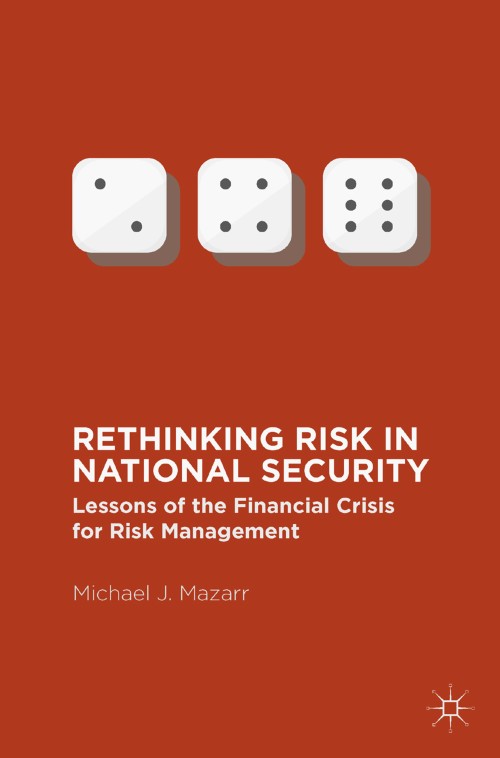
245 10|aRethinking Risk in National Security|h[electronic resource] :|bLessons of the Financial Crisis for Risk Management /|cby Michael J. Mazarr.
250 |a1st ed. 2016.
264 1|aNew York :|bPalgrave Macmillan US :|bImprint: Palgrave Macmillan,|c2016.
300 |aIX, 246 p.|bonline resource.
336 |atext|btxt|2rdacontent
337 |acomputer|bc|2rdamedia
338 |aonline resource|bcr|2rdacarrier
347 |atext file|bPDF|2rda
505 0 |a1. Risk, Judgment and Uncertainty -- 2. Defining Risk -- 3. Approaches to Risk in National Security -- 4. Risk and Uncertainty -- 5. Risk is What We Make of It -- 6. Indifferent to Consequences -- 7. The Swans to Worry About Are Gray -- 8. Risk Becomes Personalized -- 9. What You Don’t Know Can Destroy You: Ignorance and Correlated Risk -- 10. Risk, Incentives and Culture -- 11. The Role of Risk in Strategy -- 12. Outcome Assessment of the Emerging U.S. National Security Strategy -- 13. Principles of Effective Risk Management -- 14. Managing Uncertainty.
520 |aThis book examines the role of risk management in the recent financial crisis and applies lessons from there to the national security realm. It rethinks the way risk contributes to strategy, with insights relevant to practitioners and scholars in national security as well as business. Over the past few years, the concept of risk has become one of the most commonly discussed issues in national security planning. And yet the experiences of the 2007-2008 financial crisis demonstrated critical limitations in institutional efforts to control risk. The most elaborate and complex risk procedures could not cure skewed incentives, cognitive biases, groupthink, and a dozen other human factors that led companies to take excessive risk. By embracing risk management, the national security enterprise may be turning to a discipline just as it has been discredited.
650 0|aPolitics and war.
650 0|aFinancial risk management.
650 0|aPolitical science.
650 0|aComparative government.
650 0|aStatistics .
650 0|aExperimental economics.
650 14|aMilitary and Defence Studies.
650 24|aRisk Management.
650 24|aPolitical Theory.
650 24|aComparative Politics.
650 24|aStatistics in Business, Management, Economics, Finance, Insurance.
650 24|aExperimental Economics.
710 2 |aSpringerLink (Online service)
773 0 |tSpringer Nature eBook
776 08|iPrinted edition:|z9781349918416
776 08|iPrinted edition:|z9781349918744
776 08|iPrinted edition:|z9781349948871
856 40|uhttps://doi.org/10.1007/978-1-349-91843-0
912 |aZDB-2-POS
912 |aZDB-2-SXPI
950 |aPolitical Science and International Studies (SpringerNature-41174)
950 |aPolitical Science and International Studies (R0) (SpringerNature-43724)