

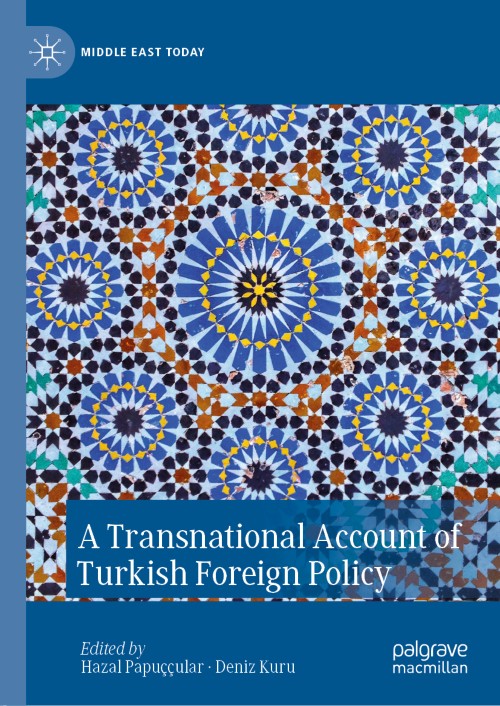
A Transnational Account of Turkish Foreign Policy [electronic resource] / edited by Hazal Papuççular, Deniz Kuru.
Erişim Adresi
ISBN
9783030428976
Dil Kodu
İngilizce
Yer Numarası
DK/18080
Basım Bildirimi
1st ed. 2020.
Yayın Bilgisi
Cham : Springer International Publishing : Imprint: Palgrave Macmillan, 2020.
Fiziksel Niteleme
XV, 297 p. 4 illus., 2 illus. in color. online resource.
Dizi
Middle East Today, 2945-7025
İçindekiler Notu
Chapter 1. Introduction: Transcending the State: A Transnational Account of Turkish Foreign Policy -- Part I. Ideas on Turkish Transnationalism: Theory, Practice, and Intellectual Currents -- Chapter 2. Transnationalized Accounts of Turkish Foreign Policy -- Chapter 3. Transnationality, Foreign Policy Research and the Cosmopolitan Alternative: On the practice of Domestic Global Politics -- Chapter 4. Imperial Transnationalism: Turkish Middle East-Oriented Foreign Policy Expert Apparatus (1998-2011) -- Part II. Transnationalism in Turkish Diplomacy: A Historical Account -- Chapter 5. Transnational Issues, Non-Governmental Organizations and the Genesis of Modern Turkish Diplomacy -- Chapter 6. The Sanjak of Alexandretta (Hatay) in Turkish Foreign Policy: A Case of “Accidental Diaspora” and Kin-State Politics -- Part III. Asset or Liability? Diasporas and Transnational Communities in Turkish Foreign Policy -- Chapter 7. Turkey and Syrian Turkmens in the “New Middle East Cold War”: A CriticalView from the Kin-State -- Chapter 8. Constructing Liberal Subjects? Turkey’s New Diaspora Strategy -- Chapter 9. Jews from Turkey in Israel and Cultural Diplomacy (1996-2006) -- Part IV. NGOs as Transnational Actors in the Formation and Implementation of Turkish Foreign Policy -- Chapter 10. “Humanitarianism” Transformed? Analyzing the Role of Transnational Humanitarian NGOs in Turkish Foreign Policy towards the Middle East in the 2000s -- Chapter 11. Business Actors as Holders of Transnational Relations: What role for them in Turkish Foreign Policy? -- Chapter 12. Conclusion.
Özet, vb.
This book offers an analysis of Turkish foreign policy based on transnational(ist) perspectives. In order to counterbalance the state-centric accounts that dominate this area of study, the authors provide theoretical frameworks as well as historical and contemporary case studies that emphasize transnational dynamics. The content is divided into four complementary sections that explain and exemplify transnational (f)actors in the context of Turkish foreign policy. The first addresses theoretical and ideational frameworks that illustrate the relevance of a transnational account, while the second demonstrates the possibility of developing transnationally oriented approaches even in historical cases, going beyond a presentist focus. In the third and fourth sections, the book focuses on two prominent non-state actors, namely diaspora communities and non-governmental organizations, which operate at the interstices of the domestic and the international. This allows the authors to highlight the significance of transnational dynamics in Turkey’s foreign policy. Hazal Papuççular is an Assistant Professor at the Department of International Relations, Istanbul Kültür University, Turkey. She completed her Ph.D. in Modern Turkish History at Boğaziçi University’s Atatürk Institute for Modern Turkish History and has written several books, articles and book chapters on Turkish foreign policy. She is the author of Türkiye ve Oniki Ada (1912-1947) (Türkiye İş Bankası Yayınları, 2019) and is currently focusing on Turkey’s transnational diplomatic history. Deniz Kuru is a Lecturer of Political Science at Goethe Universität Frankfurt in Frankfurt am Main, Germany. He received his Ph.D. from the University of Southern California. His current research areas include the intellectual history and sociology of International Relations, German and French foreign policies, Turkey’s global position, global intellectual history and globalInternational Relations. He has published articles in Review of International Studies, International Relations, All Azimuth, Global Affairs and Mediterranean Politics.
Konu
Middle East __ Politics and government.
Political science.
Middle Eastern Politics.
Governance and Government.
Political Science.
Political science.
Middle Eastern Politics.
Governance and Government.
Political Science.
Diğer Yazarlar
Kurum Adı
Eseri Alıntıla
Referansları kullanmadan önce gözden geçirmeniz ve varsa gerekli düzeltmeleri yapmanız önerilir.
Dijital Kaynak
MARC Görünümü
LEADER 05708nam a22005295i 4500
001 816867
003 TR_AnAIT
005 20260130193009
007 cr nn 008mamaa
008 200525s2020 sz | s |||| 0|eng d
020 |a9783030428976|9978-3-030-42897-6
024 7 |a10.1007/978-3-030-42897-6|2doi
041 |aeng
049 |aTürk Tarih Kurumu Kütüphanesi
050 4|aJQ1758-1852
072 7|aJP|2bicssc
072 7|a1FB|2bicssc
072 7|aPOL059000|2bisacsh
072 7|aJP|x1FB|2thema
082 04|a320.956|223
090 |aDK/18080
245 12|aA Transnational Account of Turkish Foreign Policy|h[electronic resource] /|cedited by Hazal Papuççular, Deniz Kuru.
250 |a1st ed. 2020.
264 1|aCham :|bSpringer International Publishing :|bImprint: Palgrave Macmillan,|c2020.
300 |aXV, 297 p. 4 illus., 2 illus. in color.|bonline resource.
336 |atext|btxt|2rdacontent
337 |acomputer|bc|2rdamedia
338 |aonline resource|bcr|2rdacarrier
347 |atext file|bPDF|2rda
490 1 |aMiddle East Today,|x2945-7025
505 0 |aChapter 1. Introduction: Transcending the State: A Transnational Account of Turkish Foreign Policy -- Part I. Ideas on Turkish Transnationalism: Theory, Practice, and Intellectual Currents -- Chapter 2. Transnationalized Accounts of Turkish Foreign Policy -- Chapter 3. Transnationality, Foreign Policy Research and the Cosmopolitan Alternative: On the practice of Domestic Global Politics -- Chapter 4. Imperial Transnationalism: Turkish Middle East-Oriented Foreign Policy Expert Apparatus (1998-2011) -- Part II. Transnationalism in Turkish Diplomacy: A Historical Account -- Chapter 5. Transnational Issues, Non-Governmental Organizations and the Genesis of Modern Turkish Diplomacy -- Chapter 6. The Sanjak of Alexandretta (Hatay) in Turkish Foreign Policy: A Case of “Accidental Diaspora” and Kin-State Politics -- Part III. Asset or Liability? Diasporas and Transnational Communities in Turkish Foreign Policy -- Chapter 7. Turkey and Syrian Turkmens in the “New Middle East Cold War”: A CriticalView from the Kin-State -- Chapter 8. Constructing Liberal Subjects? Turkey’s New Diaspora Strategy -- Chapter 9. Jews from Turkey in Israel and Cultural Diplomacy (1996-2006) -- Part IV. NGOs as Transnational Actors in the Formation and Implementation of Turkish Foreign Policy -- Chapter 10. “Humanitarianism” Transformed? Analyzing the Role of Transnational Humanitarian NGOs in Turkish Foreign Policy towards the Middle East in the 2000s -- Chapter 11. Business Actors as Holders of Transnational Relations: What role for them in Turkish Foreign Policy? -- Chapter 12. Conclusion.
520 |aThis book offers an analysis of Turkish foreign policy based on transnational(ist) perspectives. In order to counterbalance the state-centric accounts that dominate this area of study, the authors provide theoretical frameworks as well as historical and contemporary case studies that emphasize transnational dynamics. The content is divided into four complementary sections that explain and exemplify transnational (f)actors in the context of Turkish foreign policy. The first addresses theoretical and ideational frameworks that illustrate the relevance of a transnational account, while the second demonstrates the possibility of developing transnationally oriented approaches even in historical cases, going beyond a presentist focus. In the third and fourth sections, the book focuses on two prominent non-state actors, namely diaspora communities and non-governmental organizations, which operate at the interstices of the domestic and the international. This allows the authors to highlight the significance of transnational dynamics in Turkey’s foreign policy. Hazal Papuççular is an Assistant Professor at the Department of International Relations, Istanbul Kültür University, Turkey. She completed her Ph.D. in Modern Turkish History at Boğaziçi University’s Atatürk Institute for Modern Turkish History and has written several books, articles and book chapters on Turkish foreign policy. She is the author of Türkiye ve Oniki Ada (1912-1947) (Türkiye İş Bankası Yayınları, 2019) and is currently focusing on Turkey’s transnational diplomatic history. Deniz Kuru is a Lecturer of Political Science at Goethe Universität Frankfurt in Frankfurt am Main, Germany. He received his Ph.D. from the University of Southern California. His current research areas include the intellectual history and sociology of International Relations, German and French foreign policies, Turkey’s global position, global intellectual history and globalInternational Relations. He has published articles in Review of International Studies, International Relations, All Azimuth, Global Affairs and Mediterranean Politics.
650 0|aMiddle East|xPolitics and government.
650 0|aPolitical science.
650 14|aMiddle Eastern Politics.
650 24|aGovernance and Government.
650 24|aPolitical Science.
700 1 |aPapuççular, Hazal.|eeditor.|4edt|4http://id.loc.gov/vocabulary/relators/edt
700 1 |aKuru, Deniz.|eeditor.|4edt|4http://id.loc.gov/vocabulary/relators/edt
710 2 |aSpringerLink (Online service)
773 0 |tSpringer Nature eBook
776 08|iPrinted edition:|z9783030428969
776 08|iPrinted edition:|z9783030428983
776 08|iPrinted edition:|z9783030428990
830 0|aMiddle East Today,|x2945-7025
856 40|uhttps://doi.org/10.1007/978-3-030-42897-6
912 |aZDB-2-POS
912 |aZDB-2-SXPI
950 |aPolitical Science and International Studies (SpringerNature-41174)
950 |aPolitical Science and International Studies (R0) (SpringerNature-43724)
001 816867
003 TR_AnAIT
005 20260130193009
007 cr nn 008mamaa
008 200525s2020 sz | s |||| 0|eng d
020 |a9783030428976|9978-3-030-42897-6
024 7 |a10.1007/978-3-030-42897-6|2doi
041 |aeng
049 |aTürk Tarih Kurumu Kütüphanesi
050 4|aJQ1758-1852
072 7|aJP|2bicssc
072 7|a1FB|2bicssc
072 7|aPOL059000|2bisacsh
072 7|aJP|x1FB|2thema
082 04|a320.956|223
090 |aDK/18080
245 12|aA Transnational Account of Turkish Foreign Policy|h[electronic resource] /|cedited by Hazal Papuççular, Deniz Kuru.
250 |a1st ed. 2020.
264 1|aCham :|bSpringer International Publishing :|bImprint: Palgrave Macmillan,|c2020.
300 |aXV, 297 p. 4 illus., 2 illus. in color.|bonline resource.
336 |atext|btxt|2rdacontent
337 |acomputer|bc|2rdamedia
338 |aonline resource|bcr|2rdacarrier
347 |atext file|bPDF|2rda
490 1 |aMiddle East Today,|x2945-7025
505 0 |aChapter 1. Introduction: Transcending the State: A Transnational Account of Turkish Foreign Policy -- Part I. Ideas on Turkish Transnationalism: Theory, Practice, and Intellectual Currents -- Chapter 2. Transnationalized Accounts of Turkish Foreign Policy -- Chapter 3. Transnationality, Foreign Policy Research and the Cosmopolitan Alternative: On the practice of Domestic Global Politics -- Chapter 4. Imperial Transnationalism: Turkish Middle East-Oriented Foreign Policy Expert Apparatus (1998-2011) -- Part II. Transnationalism in Turkish Diplomacy: A Historical Account -- Chapter 5. Transnational Issues, Non-Governmental Organizations and the Genesis of Modern Turkish Diplomacy -- Chapter 6. The Sanjak of Alexandretta (Hatay) in Turkish Foreign Policy: A Case of “Accidental Diaspora” and Kin-State Politics -- Part III. Asset or Liability? Diasporas and Transnational Communities in Turkish Foreign Policy -- Chapter 7. Turkey and Syrian Turkmens in the “New Middle East Cold War”: A CriticalView from the Kin-State -- Chapter 8. Constructing Liberal Subjects? Turkey’s New Diaspora Strategy -- Chapter 9. Jews from Turkey in Israel and Cultural Diplomacy (1996-2006) -- Part IV. NGOs as Transnational Actors in the Formation and Implementation of Turkish Foreign Policy -- Chapter 10. “Humanitarianism” Transformed? Analyzing the Role of Transnational Humanitarian NGOs in Turkish Foreign Policy towards the Middle East in the 2000s -- Chapter 11. Business Actors as Holders of Transnational Relations: What role for them in Turkish Foreign Policy? -- Chapter 12. Conclusion.
520 |aThis book offers an analysis of Turkish foreign policy based on transnational(ist) perspectives. In order to counterbalance the state-centric accounts that dominate this area of study, the authors provide theoretical frameworks as well as historical and contemporary case studies that emphasize transnational dynamics. The content is divided into four complementary sections that explain and exemplify transnational (f)actors in the context of Turkish foreign policy. The first addresses theoretical and ideational frameworks that illustrate the relevance of a transnational account, while the second demonstrates the possibility of developing transnationally oriented approaches even in historical cases, going beyond a presentist focus. In the third and fourth sections, the book focuses on two prominent non-state actors, namely diaspora communities and non-governmental organizations, which operate at the interstices of the domestic and the international. This allows the authors to highlight the significance of transnational dynamics in Turkey’s foreign policy. Hazal Papuççular is an Assistant Professor at the Department of International Relations, Istanbul Kültür University, Turkey. She completed her Ph.D. in Modern Turkish History at Boğaziçi University’s Atatürk Institute for Modern Turkish History and has written several books, articles and book chapters on Turkish foreign policy. She is the author of Türkiye ve Oniki Ada (1912-1947) (Türkiye İş Bankası Yayınları, 2019) and is currently focusing on Turkey’s transnational diplomatic history. Deniz Kuru is a Lecturer of Political Science at Goethe Universität Frankfurt in Frankfurt am Main, Germany. He received his Ph.D. from the University of Southern California. His current research areas include the intellectual history and sociology of International Relations, German and French foreign policies, Turkey’s global position, global intellectual history and globalInternational Relations. He has published articles in Review of International Studies, International Relations, All Azimuth, Global Affairs and Mediterranean Politics.
650 0|aMiddle East|xPolitics and government.
650 0|aPolitical science.
650 14|aMiddle Eastern Politics.
650 24|aGovernance and Government.
650 24|aPolitical Science.
700 1 |aPapuççular, Hazal.|eeditor.|4edt|4http://id.loc.gov/vocabulary/relators/edt
700 1 |aKuru, Deniz.|eeditor.|4edt|4http://id.loc.gov/vocabulary/relators/edt
710 2 |aSpringerLink (Online service)
773 0 |tSpringer Nature eBook
776 08|iPrinted edition:|z9783030428969
776 08|iPrinted edition:|z9783030428983
776 08|iPrinted edition:|z9783030428990
830 0|aMiddle East Today,|x2945-7025
856 40|uhttps://doi.org/10.1007/978-3-030-42897-6
912 |aZDB-2-POS
912 |aZDB-2-SXPI
950 |aPolitical Science and International Studies (SpringerNature-41174)
950 |aPolitical Science and International Studies (R0) (SpringerNature-43724)
Materyaller
Depodan talep edilen materyal sadece kütüphane içerisinde kullanılmaktadır.
Materyal dışarıya ödünç verilmemektedir.
Materyal dışarıya ödünç verilmemektedir.
