

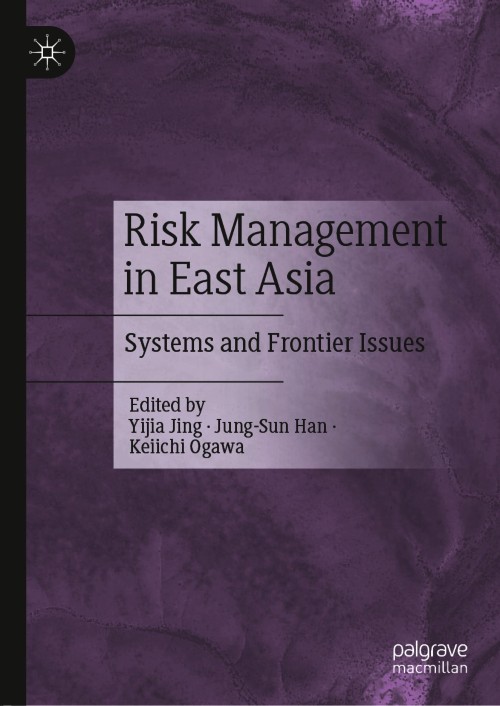
Risk Management in East Asia [electronic resource] : Systems and Frontier Issues / edited by Yijia Jing, Jung-Sun Han, Keiichi Ogawa.
Erişim Adresi
ISBN
9789813345867
Dil Kodu
İngilizce
Yer Numarası
DK/18122
Basım Bildirimi
1st ed. 2021.
Yayın Bilgisi
Singapore : Springer Nature Singapore : Imprint: Palgrave Macmillan, 2021.
Fiziksel Niteleme
XVI, 254 p. 21 illus., 7 illus. in color. online resource.
İçindekiler Notu
Part I. CJK Country systems -- Chapter 1. Build a modern National Emergency Management System in China: achievements and remained challenges -- Chapter 2. Disaster Management in Japan: Characteristics and Challenges -- Chapter 3. Patterns of Risk Management Policies and Systems in South Korea - Special reference to Water-Related Disaster Management -- Part II. Participation in risk management, etc.
Özet, vb.
Risk Management in East Asia presents a path-breaking step toward building a common approach to managing the shared risks that challenge China, Japan, and South Korea. Anchored by education leaders at three universities, the book articulates a view of disaster management as learning to cope with hazards that cross international boundaries. – Louise K. Comfort, Professor, Graduate School of Public and International Affairs, University of Pittsburgh Risk management and regional cooperation tend to be overlooked by national governments. This new book provides practical guide and advice on mitigating risks in a post-modern industrialized world where climate change, industrial revolution, geopolitical forces, and pandemics could further exacerbate the human living environment. Indeed, this is a very timely book. – Xiaoyan Liang, Lead Education Specialist, The World Bank This book is a joint endeavour of the three partner universities of CAMPUS Asia Program (Risk Management Experts in East Asia) to develop a book with in-depth and state-of-art analysis of risk management in East Asia. As a disaster-prone region, East Asia emphasizes building preparedness and resilience for natural disasters and human-induced hazards and emergencies. The experiences of China, Japan, and South Korea in seeking appropriate and robust risk management may shed light on global risk management knowledge and practices. This book will discuss the three systems and frontier issues and will be of interest to policymakers, scholars and the general intellectual community. Yijia Jing is dean of the Institute for Global Public Policy and a professor of the School of International Relations and Public Affairs, Fudan University. Jung-Sun Han is a professor at the Division of International Studies, Korea University. Keiichi Ogawa is a professor at the Graduate School of International Cooperation Studies, Kobe University.
Konu
Asia __ Politics and government.
Political planning.
Financial risk management.
Asian Politics.
Public Policy.
Risk Management.
Political planning.
Financial risk management.
Asian Politics.
Public Policy.
Risk Management.
Kurum Adı
Eseri Alıntıla
Referansları kullanmadan önce gözden geçirmeniz ve varsa gerekli düzeltmeleri yapmanız önerilir.
Dijital Kaynak
MARC Görünümü
LEADER 04380nam a22005295i 4500
001 816909
003 TR_AnAIT
005 20260130192819
007 cr nn 008mamaa
008 210222s2021 si | s |||| 0|eng d
020 |a9789813345867|9978-981-33-4586-7
024 7 |a10.1007/978-981-33-4586-7|2doi
041 |aeng
049 |aTürk Tarih Kurumu Kütüphanesi
050 4|aJQ1-1852
072 7|aJP|2bicssc
072 7|a1F|2bicssc
072 7|aPOL054000|2bisacsh
072 7|aJP|x1F|2thema
082 04|a320.95|223
090 |aDK/18122
245 10|aRisk Management in East Asia|h[electronic resource] :|bSystems and Frontier Issues /|cedited by Yijia Jing, Jung-Sun Han, Keiichi Ogawa.
250 |a1st ed. 2021.
264 1|aSingapore :|bSpringer Nature Singapore :|bImprint: Palgrave Macmillan,|c2021.
300 |aXVI, 254 p. 21 illus., 7 illus. in color.|bonline resource.
336 |atext|btxt|2rdacontent
337 |acomputer|bc|2rdamedia
338 |aonline resource|bcr|2rdacarrier
347 |atext file|bPDF|2rda
505 0 |aPart I. CJK Country systems -- Chapter 1. Build a modern National Emergency Management System in China: achievements and remained challenges -- Chapter 2. Disaster Management in Japan: Characteristics and Challenges -- Chapter 3. Patterns of Risk Management Policies and Systems in South Korea - Special reference to Water-Related Disaster Management -- Part II. Participation in risk management, etc.
520 |aRisk Management in East Asia presents a path-breaking step toward building a common approach to managing the shared risks that challenge China, Japan, and South Korea. Anchored by education leaders at three universities, the book articulates a view of disaster management as learning to cope with hazards that cross international boundaries. – Louise K. Comfort, Professor, Graduate School of Public and International Affairs, University of Pittsburgh Risk management and regional cooperation tend to be overlooked by national governments. This new book provides practical guide and advice on mitigating risks in a post-modern industrialized world where climate change, industrial revolution, geopolitical forces, and pandemics could further exacerbate the human living environment. Indeed, this is a very timely book. – Xiaoyan Liang, Lead Education Specialist, The World Bank This book is a joint endeavour of the three partner universities of CAMPUS Asia Program (Risk Management Experts in East Asia) to develop a book with in-depth and state-of-art analysis of risk management in East Asia. As a disaster-prone region, East Asia emphasizes building preparedness and resilience for natural disasters and human-induced hazards and emergencies. The experiences of China, Japan, and South Korea in seeking appropriate and robust risk management may shed light on global risk management knowledge and practices. This book will discuss the three systems and frontier issues and will be of interest to policymakers, scholars and the general intellectual community. Yijia Jing is dean of the Institute for Global Public Policy and a professor of the School of International Relations and Public Affairs, Fudan University. Jung-Sun Han is a professor at the Division of International Studies, Korea University. Keiichi Ogawa is a professor at the Graduate School of International Cooperation Studies, Kobe University.
650 0|aAsia|xPolitics and government.
650 0|aPolitical planning.
650 0|aFinancial risk management.
650 14|aAsian Politics.
650 24|aPublic Policy.
650 24|aRisk Management.
700 1 |aJing, Yijia.|eeditor.|4edt|4http://id.loc.gov/vocabulary/relators/edt
700 1 |aHan, Jung-Sun.|eeditor.|4edt|4http://id.loc.gov/vocabulary/relators/edt
700 1 |aOgawa, Keiichi.|eeditor.|0(orcid)0000-0002-0089-6471|1https://orcid.org/0000-0002-0089-6471|4edt|4http://id.loc.gov/vocabulary/relators/edt
710 2 |aSpringerLink (Online service)
773 0 |tSpringer Nature eBook
776 08|iPrinted edition:|z9789813345850
776 08|iPrinted edition:|z9789813345874
776 08|iPrinted edition:|z9789813345881
856 40|uhttps://doi.org/10.1007/978-981-33-4586-7
912 |aZDB-2-POS
912 |aZDB-2-SXPI
950 |aPolitical Science and International Studies (SpringerNature-41174)
950 |aPolitical Science and International Studies (R0) (SpringerNature-43724)
001 816909
003 TR_AnAIT
005 20260130192819
007 cr nn 008mamaa
008 210222s2021 si | s |||| 0|eng d
020 |a9789813345867|9978-981-33-4586-7
024 7 |a10.1007/978-981-33-4586-7|2doi
041 |aeng
049 |aTürk Tarih Kurumu Kütüphanesi
050 4|aJQ1-1852
072 7|aJP|2bicssc
072 7|a1F|2bicssc
072 7|aPOL054000|2bisacsh
072 7|aJP|x1F|2thema
082 04|a320.95|223
090 |aDK/18122
245 10|aRisk Management in East Asia|h[electronic resource] :|bSystems and Frontier Issues /|cedited by Yijia Jing, Jung-Sun Han, Keiichi Ogawa.
250 |a1st ed. 2021.
264 1|aSingapore :|bSpringer Nature Singapore :|bImprint: Palgrave Macmillan,|c2021.
300 |aXVI, 254 p. 21 illus., 7 illus. in color.|bonline resource.
336 |atext|btxt|2rdacontent
337 |acomputer|bc|2rdamedia
338 |aonline resource|bcr|2rdacarrier
347 |atext file|bPDF|2rda
505 0 |aPart I. CJK Country systems -- Chapter 1. Build a modern National Emergency Management System in China: achievements and remained challenges -- Chapter 2. Disaster Management in Japan: Characteristics and Challenges -- Chapter 3. Patterns of Risk Management Policies and Systems in South Korea - Special reference to Water-Related Disaster Management -- Part II. Participation in risk management, etc.
520 |aRisk Management in East Asia presents a path-breaking step toward building a common approach to managing the shared risks that challenge China, Japan, and South Korea. Anchored by education leaders at three universities, the book articulates a view of disaster management as learning to cope with hazards that cross international boundaries. – Louise K. Comfort, Professor, Graduate School of Public and International Affairs, University of Pittsburgh Risk management and regional cooperation tend to be overlooked by national governments. This new book provides practical guide and advice on mitigating risks in a post-modern industrialized world where climate change, industrial revolution, geopolitical forces, and pandemics could further exacerbate the human living environment. Indeed, this is a very timely book. – Xiaoyan Liang, Lead Education Specialist, The World Bank This book is a joint endeavour of the three partner universities of CAMPUS Asia Program (Risk Management Experts in East Asia) to develop a book with in-depth and state-of-art analysis of risk management in East Asia. As a disaster-prone region, East Asia emphasizes building preparedness and resilience for natural disasters and human-induced hazards and emergencies. The experiences of China, Japan, and South Korea in seeking appropriate and robust risk management may shed light on global risk management knowledge and practices. This book will discuss the three systems and frontier issues and will be of interest to policymakers, scholars and the general intellectual community. Yijia Jing is dean of the Institute for Global Public Policy and a professor of the School of International Relations and Public Affairs, Fudan University. Jung-Sun Han is a professor at the Division of International Studies, Korea University. Keiichi Ogawa is a professor at the Graduate School of International Cooperation Studies, Kobe University.
650 0|aAsia|xPolitics and government.
650 0|aPolitical planning.
650 0|aFinancial risk management.
650 14|aAsian Politics.
650 24|aPublic Policy.
650 24|aRisk Management.
700 1 |aJing, Yijia.|eeditor.|4edt|4http://id.loc.gov/vocabulary/relators/edt
700 1 |aHan, Jung-Sun.|eeditor.|4edt|4http://id.loc.gov/vocabulary/relators/edt
700 1 |aOgawa, Keiichi.|eeditor.|0(orcid)0000-0002-0089-6471|1https://orcid.org/0000-0002-0089-6471|4edt|4http://id.loc.gov/vocabulary/relators/edt
710 2 |aSpringerLink (Online service)
773 0 |tSpringer Nature eBook
776 08|iPrinted edition:|z9789813345850
776 08|iPrinted edition:|z9789813345874
776 08|iPrinted edition:|z9789813345881
856 40|uhttps://doi.org/10.1007/978-981-33-4586-7
912 |aZDB-2-POS
912 |aZDB-2-SXPI
950 |aPolitical Science and International Studies (SpringerNature-41174)
950 |aPolitical Science and International Studies (R0) (SpringerNature-43724)
Materyaller
Depodan talep edilen materyal sadece kütüphane içerisinde kullanılmaktadır.
Materyal dışarıya ödünç verilmemektedir.
Materyal dışarıya ödünç verilmemektedir.
