

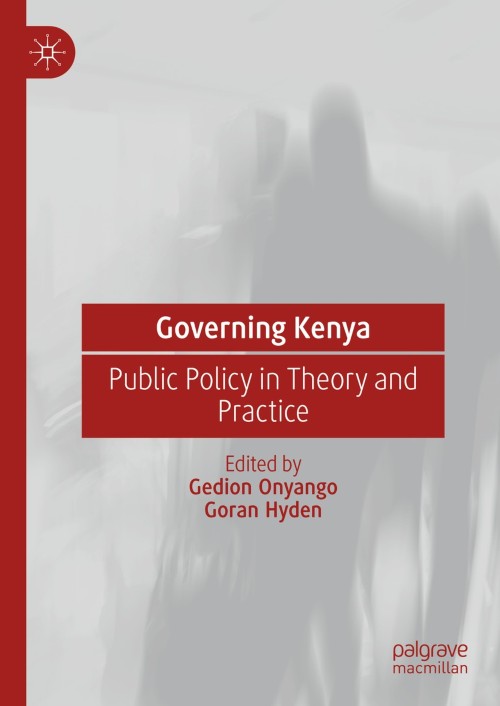
Governing Kenya [electronic resource] : Public Policy in Theory and Practice / edited by Gedion Onyango, Goran Hyden.
Erişim Adresi
ISBN
9783030617844
Dil Kodu
İngilizce
Yer Numarası
DK/18206
Basım Bildirimi
1st ed. 2021.
Yayın Bilgisi
Cham : Springer International Publishing : Imprint: Palgrave Macmillan, 2021.
Fiziksel Niteleme
XVII, 323 p. 9 illus. online resource.
İçindekiler Notu
Chapter One: Introduction, Gedion Onyango and Goran Hyden -- Chapter Two: Africa’s Governance Imperatives:How Kenya has Responded, Goran Hyden -- Chapter Three: The Global Nature of Policy Problems, Jacqueline M. Klopp and Abdullahi Boru Halakhe -- Chapter Four: The Powers of Agenda-Setting: The Role of Politicians and Experts, Winnie V. Mitullah -- Chapter Five: Legislative Policymaking in Kenya, Gedion Onyango -- Chapter Six: Political Parties and Public Policymaking, Solomon Owuoche -- Chapter Seven: The Politics of Implementation at County Level: Realizing Devolution in Kenya, Peter Wanyande -- Chapter Eight: Policy Implementation as Principal-Agent Problem: The Case of Kenya Wildlife Service, Parita Sureshchandra Shah -- Chapter Nine: Public Accountability: State-Society Relations in Kenya, Gedion Onyango -- Chapter Ten: Media and Policymaking in Kenya: Framing in Contested Public Spaces, George Ogola -- Chapter Eleven: The Politics of External Resource Mobilization: From Foreign Aid to Foreign Investment, Fred Jonyo -- Chapter Twelve: Taxation Systems and Public Policy in Kenya: Unpacking the Unwritten Tax Treaty Policy, Attiya Waris and Elvis Oyare -- Chapter Thirteen: Institutions and Policy Reform in Kenya: From State to Regime Focus, Patrick. O. Asingo -- Chapter Fourteen: Building and Reforming Institutions: From Technology Transfer to Policy Networks, Eric E.Otenyo -- Chapter Fifteen: Kenya: A Comparative East African Perspective, Goran Hyden and Gedion Onyango -- Chapter Sixteen: The Evolution of Policy Studies in Kenya, P. Anyang’ Nyong’o.-Chapter Seventeen: Teaching Public Policy in Kenya: Approaches and Current Issues, Patrick O. Alila and Goran Hyden. .
Özet, vb.
‘A major contribution to comparative policy analysis highlighting the commonalities and differences that Kenya shares with other nations in theory and practice. Governing Kenya will remain a key text for years to come’. —Michael Howlett, Burnaby Mountain Chair of Political Science, Simon Fraser University, Canada ‘Governing Kenya integrates public policy theory with extensive examples to provide a valuable portrait of this important African country. An invaluable contribution to the literature on public policy in Africa’. —B. Guy Peters, Professor of Comparative Governance, University of Pittsburgh, USA ‘A superb example of development scholarship which sets aside ‘best practice’ nostrums and focuses on governance challenges specific to time and place while holding on to a comparative perspective. Useful to scholars and practitioners across developing areas!’ Brian Levy, Professor, Mandela School of Public Governance, University of Cape Town, South Africa ‘This book on public policy in Kenya gives the reader theoretical and practical hooks critical to the analysis of how the 2010 Constitution is implemented’. —Willy Mutunga, Chief Justice and President of the Supreme Court, Republic of Kenya, 2011-2016. ‘This book is an exploration of important deliberations that help us understand public policy theories and their application within a specific African setting’. —Wilson Muna, Lecturer of Public Policy, Kenyatta University, Nairobi, Kenya This book is authored by renowned scholars in Africa to understand how Kenya is governed. It addresses three pertinent questions: (1) how are policies made where change is demanded, but institutional legacies resist? (2) how are power and authority shared among institutional actors? and, (3) how do increasingly complex policy problems involving multiple stakeholders affect policymaking? It provides an updated and relevant foundation for teaching public policy in Kenya from a comparative perspective while also serving as a useful guide for politicians, government servants, civil society, and businesses on how Kenya is governed. Gedion Onyango is Lecturer, Department of Political Science and Public Administration, University of Nairobi, Kenya. Goran Hyden is Distinguished Professor Emeritus in Political Science at the University of Florida, USA. .
Konu
Political planning.
Public administration.
Political science.
Comparative government.
Public Policy.
Public Administration.
Governance and Government.
Comparative Public Policy.
Public administration.
Political science.
Comparative government.
Public Policy.
Public Administration.
Governance and Government.
Comparative Public Policy.
Diğer Yazarlar
Kurum Adı
Eseri Alıntıla
Referansları kullanmadan önce gözden geçirmeniz ve varsa gerekli düzeltmeleri yapmanız önerilir.
Dijital Kaynak
MARC Görünümü
LEADER 06062nam a22005295i 4500
001 816993
003 TR_AnAIT
005 20260130192243
007 cr nn 008mamaa
008 210415s2021 sz | s |||| 0|eng d
020 |a9783030617844|9978-3-030-61784-4
024 7 |a10.1007/978-3-030-61784-4|2doi
041 |aeng
049 |aTürk Tarih Kurumu Kütüphanesi
050 4|aJF1525.P6
072 7|aJPP|2bicssc
072 7|aPOL028000|2bisacsh
072 7|aJPP|2thema
082 04|a320.6|223
090 |aDK/18206
245 10|aGoverning Kenya|h[electronic resource] :|bPublic Policy in Theory and Practice /|cedited by Gedion Onyango, Goran Hyden.
250 |a1st ed. 2021.
264 1|aCham :|bSpringer International Publishing :|bImprint: Palgrave Macmillan,|c2021.
300 |aXVII, 323 p. 9 illus.|bonline resource.
336 |atext|btxt|2rdacontent
337 |acomputer|bc|2rdamedia
338 |aonline resource|bcr|2rdacarrier
347 |atext file|bPDF|2rda
505 0 |aChapter One: Introduction, Gedion Onyango and Goran Hyden -- Chapter Two: Africa’s Governance Imperatives:How Kenya has Responded, Goran Hyden -- Chapter Three: The Global Nature of Policy Problems, Jacqueline M. Klopp and Abdullahi Boru Halakhe -- Chapter Four: The Powers of Agenda-Setting: The Role of Politicians and Experts, Winnie V. Mitullah -- Chapter Five: Legislative Policymaking in Kenya, Gedion Onyango -- Chapter Six: Political Parties and Public Policymaking, Solomon Owuoche -- Chapter Seven: The Politics of Implementation at County Level: Realizing Devolution in Kenya, Peter Wanyande -- Chapter Eight: Policy Implementation as Principal-Agent Problem: The Case of Kenya Wildlife Service, Parita Sureshchandra Shah -- Chapter Nine: Public Accountability: State-Society Relations in Kenya, Gedion Onyango -- Chapter Ten: Media and Policymaking in Kenya: Framing in Contested Public Spaces, George Ogola -- Chapter Eleven: The Politics of External Resource Mobilization: From Foreign Aid to Foreign Investment, Fred Jonyo -- Chapter Twelve: Taxation Systems and Public Policy in Kenya: Unpacking the Unwritten Tax Treaty Policy, Attiya Waris and Elvis Oyare -- Chapter Thirteen: Institutions and Policy Reform in Kenya: From State to Regime Focus, Patrick. O. Asingo -- Chapter Fourteen: Building and Reforming Institutions: From Technology Transfer to Policy Networks, Eric E.Otenyo -- Chapter Fifteen: Kenya: A Comparative East African Perspective, Goran Hyden and Gedion Onyango -- Chapter Sixteen: The Evolution of Policy Studies in Kenya, P. Anyang’ Nyong’o.-Chapter Seventeen: Teaching Public Policy in Kenya: Approaches and Current Issues, Patrick O. Alila and Goran Hyden. .
520 |a‘A major contribution to comparative policy analysis highlighting the commonalities and differences that Kenya shares with other nations in theory and practice. Governing Kenya will remain a key text for years to come’. —Michael Howlett, Burnaby Mountain Chair of Political Science, Simon Fraser University, Canada ‘Governing Kenya integrates public policy theory with extensive examples to provide a valuable portrait of this important African country. An invaluable contribution to the literature on public policy in Africa’. —B. Guy Peters, Professor of Comparative Governance, University of Pittsburgh, USA ‘A superb example of development scholarship which sets aside ‘best practice’ nostrums and focuses on governance challenges specific to time and place while holding on to a comparative perspective. Useful to scholars and practitioners across developing areas!’ Brian Levy, Professor, Mandela School of Public Governance, University of Cape Town, South Africa ‘This book on public policy in Kenya gives the reader theoretical and practical hooks critical to the analysis of how the 2010 Constitution is implemented’. —Willy Mutunga, Chief Justice and President of the Supreme Court, Republic of Kenya, 2011-2016. ‘This book is an exploration of important deliberations that help us understand public policy theories and their application within a specific African setting’. —Wilson Muna, Lecturer of Public Policy, Kenyatta University, Nairobi, Kenya This book is authored by renowned scholars in Africa to understand how Kenya is governed. It addresses three pertinent questions: (1) how are policies made where change is demanded, but institutional legacies resist? (2) how are power and authority shared among institutional actors? and, (3) how do increasingly complex policy problems involving multiple stakeholders affect policymaking? It provides an updated and relevant foundation for teaching public policy in Kenya from a comparative perspective while also serving as a useful guide for politicians, government servants, civil society, and businesses on how Kenya is governed. Gedion Onyango is Lecturer, Department of Political Science and Public Administration, University of Nairobi, Kenya. Goran Hyden is Distinguished Professor Emeritus in Political Science at the University of Florida, USA. .
650 0|aPolitical planning.
650 0|aPublic administration.
650 0|aPolitical science.
650 0|aComparative government.
650 14|aPublic Policy.
650 24|aPublic Administration.
650 24|aGovernance and Government.
650 24|aComparative Public Policy.
700 1 |aOnyango, Gedion.|eeditor.|0(orcid)0000-0003-4984-2906|1https://orcid.org/0000-0003-4984-2906|4edt|4http://id.loc.gov/vocabulary/relators/edt
700 1 |aHyden, Goran.|eeditor.|4edt|4http://id.loc.gov/vocabulary/relators/edt
710 2 |aSpringerLink (Online service)
773 0 |tSpringer Nature eBook
776 08|iPrinted edition:|z9783030617837
776 08|iPrinted edition:|z9783030617851
776 08|iPrinted edition:|z9783030617868
856 40|uhttps://doi.org/10.1007/978-3-030-61784-4
912 |aZDB-2-POS
912 |aZDB-2-SXPI
950 |aPolitical Science and International Studies (SpringerNature-41174)
950 |aPolitical Science and International Studies (R0) (SpringerNature-43724)
001 816993
003 TR_AnAIT
005 20260130192243
007 cr nn 008mamaa
008 210415s2021 sz | s |||| 0|eng d
020 |a9783030617844|9978-3-030-61784-4
024 7 |a10.1007/978-3-030-61784-4|2doi
041 |aeng
049 |aTürk Tarih Kurumu Kütüphanesi
050 4|aJF1525.P6
072 7|aJPP|2bicssc
072 7|aPOL028000|2bisacsh
072 7|aJPP|2thema
082 04|a320.6|223
090 |aDK/18206
245 10|aGoverning Kenya|h[electronic resource] :|bPublic Policy in Theory and Practice /|cedited by Gedion Onyango, Goran Hyden.
250 |a1st ed. 2021.
264 1|aCham :|bSpringer International Publishing :|bImprint: Palgrave Macmillan,|c2021.
300 |aXVII, 323 p. 9 illus.|bonline resource.
336 |atext|btxt|2rdacontent
337 |acomputer|bc|2rdamedia
338 |aonline resource|bcr|2rdacarrier
347 |atext file|bPDF|2rda
505 0 |aChapter One: Introduction, Gedion Onyango and Goran Hyden -- Chapter Two: Africa’s Governance Imperatives:How Kenya has Responded, Goran Hyden -- Chapter Three: The Global Nature of Policy Problems, Jacqueline M. Klopp and Abdullahi Boru Halakhe -- Chapter Four: The Powers of Agenda-Setting: The Role of Politicians and Experts, Winnie V. Mitullah -- Chapter Five: Legislative Policymaking in Kenya, Gedion Onyango -- Chapter Six: Political Parties and Public Policymaking, Solomon Owuoche -- Chapter Seven: The Politics of Implementation at County Level: Realizing Devolution in Kenya, Peter Wanyande -- Chapter Eight: Policy Implementation as Principal-Agent Problem: The Case of Kenya Wildlife Service, Parita Sureshchandra Shah -- Chapter Nine: Public Accountability: State-Society Relations in Kenya, Gedion Onyango -- Chapter Ten: Media and Policymaking in Kenya: Framing in Contested Public Spaces, George Ogola -- Chapter Eleven: The Politics of External Resource Mobilization: From Foreign Aid to Foreign Investment, Fred Jonyo -- Chapter Twelve: Taxation Systems and Public Policy in Kenya: Unpacking the Unwritten Tax Treaty Policy, Attiya Waris and Elvis Oyare -- Chapter Thirteen: Institutions and Policy Reform in Kenya: From State to Regime Focus, Patrick. O. Asingo -- Chapter Fourteen: Building and Reforming Institutions: From Technology Transfer to Policy Networks, Eric E.Otenyo -- Chapter Fifteen: Kenya: A Comparative East African Perspective, Goran Hyden and Gedion Onyango -- Chapter Sixteen: The Evolution of Policy Studies in Kenya, P. Anyang’ Nyong’o.-Chapter Seventeen: Teaching Public Policy in Kenya: Approaches and Current Issues, Patrick O. Alila and Goran Hyden. .
520 |a‘A major contribution to comparative policy analysis highlighting the commonalities and differences that Kenya shares with other nations in theory and practice. Governing Kenya will remain a key text for years to come’. —Michael Howlett, Burnaby Mountain Chair of Political Science, Simon Fraser University, Canada ‘Governing Kenya integrates public policy theory with extensive examples to provide a valuable portrait of this important African country. An invaluable contribution to the literature on public policy in Africa’. —B. Guy Peters, Professor of Comparative Governance, University of Pittsburgh, USA ‘A superb example of development scholarship which sets aside ‘best practice’ nostrums and focuses on governance challenges specific to time and place while holding on to a comparative perspective. Useful to scholars and practitioners across developing areas!’ Brian Levy, Professor, Mandela School of Public Governance, University of Cape Town, South Africa ‘This book on public policy in Kenya gives the reader theoretical and practical hooks critical to the analysis of how the 2010 Constitution is implemented’. —Willy Mutunga, Chief Justice and President of the Supreme Court, Republic of Kenya, 2011-2016. ‘This book is an exploration of important deliberations that help us understand public policy theories and their application within a specific African setting’. —Wilson Muna, Lecturer of Public Policy, Kenyatta University, Nairobi, Kenya This book is authored by renowned scholars in Africa to understand how Kenya is governed. It addresses three pertinent questions: (1) how are policies made where change is demanded, but institutional legacies resist? (2) how are power and authority shared among institutional actors? and, (3) how do increasingly complex policy problems involving multiple stakeholders affect policymaking? It provides an updated and relevant foundation for teaching public policy in Kenya from a comparative perspective while also serving as a useful guide for politicians, government servants, civil society, and businesses on how Kenya is governed. Gedion Onyango is Lecturer, Department of Political Science and Public Administration, University of Nairobi, Kenya. Goran Hyden is Distinguished Professor Emeritus in Political Science at the University of Florida, USA. .
650 0|aPolitical planning.
650 0|aPublic administration.
650 0|aPolitical science.
650 0|aComparative government.
650 14|aPublic Policy.
650 24|aPublic Administration.
650 24|aGovernance and Government.
650 24|aComparative Public Policy.
700 1 |aOnyango, Gedion.|eeditor.|0(orcid)0000-0003-4984-2906|1https://orcid.org/0000-0003-4984-2906|4edt|4http://id.loc.gov/vocabulary/relators/edt
700 1 |aHyden, Goran.|eeditor.|4edt|4http://id.loc.gov/vocabulary/relators/edt
710 2 |aSpringerLink (Online service)
773 0 |tSpringer Nature eBook
776 08|iPrinted edition:|z9783030617837
776 08|iPrinted edition:|z9783030617851
776 08|iPrinted edition:|z9783030617868
856 40|uhttps://doi.org/10.1007/978-3-030-61784-4
912 |aZDB-2-POS
912 |aZDB-2-SXPI
950 |aPolitical Science and International Studies (SpringerNature-41174)
950 |aPolitical Science and International Studies (R0) (SpringerNature-43724)
Materyaller
Depodan talep edilen materyal sadece kütüphane içerisinde kullanılmaktadır.
Materyal dışarıya ödünç verilmemektedir.
Materyal dışarıya ödünç verilmemektedir.
