

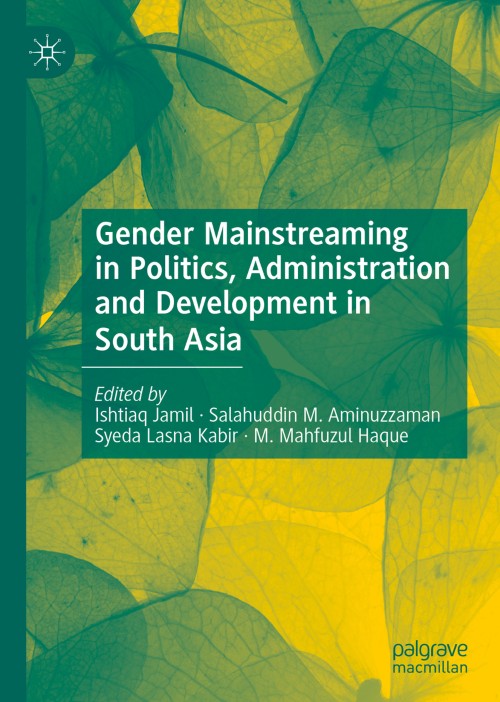
Gender Mainstreaming in Politics, Administration and Development in South Asia [electronic resource] / edited by Ishtiaq Jamil, Salahuddin M. Aminuzzaman, Syeda Lasna Kabir, M. Mahfuzul Haque.
Erişim Adresi
ISBN
9783030360122
Dil Kodu
İngilizce
Yer Numarası
DK/18257
Basım Bildirimi
1st ed. 2020.
Yayın Bilgisi
Cham : Springer International Publishing : Imprint: Palgrave Macmillan, 2020.
Fiziksel Niteleme
XX, 261 p. 15 illus., 5 illus. in color. online resource.
İçindekiler Notu
Chapter 1: Introduction: Gender Mainstreaming in Politics, Administration, and Development in South Asia. Ishtiaq Jamil, Salahuddin M. Aminuzzaman, Syeda Lasna Kabir, M. Mahfuzul Haque -- Chapter 2: Gendered Electoral Financing in Democratic and Democratizing States. Ragnhild Muriaas -- Chapter 3: How Policy Folds Back before Implementation? A Study on Unequal Inheritance Right in Bangladesh. Jinat Hossain -- Chapter 4: Gender-Based Harassment and Violence in Higher Educational Institutions: A Case from Sri Lanka. Janethri B. Liyanage and Kamala Liyanage -- Chapter 5: “Through the Glass Ceiling, over the Glass Cliff”? Women Leaders in Bangladeshi Public Administration. Syeda Lasna Kabir -- Chapter 6: Emerging Leadership Roles of Women in Rural Local Government: Experiences from Bangladesh. Mizanur Rahman -- Chapter 7: Gender Budgeting and Governance Challenges: A Case Study of Bangladesh. Salahuddin M. Aminuzzaman -- Chapter 8: Empowering Women through E-Governance in the Indian Province of Odisha: Capacity Building as an Enabling Measure. Sangita Dhal -- Chapter 9: A Paradigm Shift in Women’s Turnout and Representation in Indian Elections. Sanjay Kumar -- Chapter 10: Achievements and Challenges for Gender Mainstreaming in the Employment Sector of the Maldives. Mohamed Faizal -- Chapter 11: Caught in the Crossfire of Religion, Culture, and Politics: Women’s Sexual and Reproductive Health and Rights in Pakistan. Samreen Shahbaz.
Özet, vb.
This book explores and analyzes gender mainstreaming in South Asia. Gender mainstreaming as a concept is about removing disparities between men and women – about equal access to resources, inclusion and participation in the public sphere, representation in government, and empowerment, all with the aim of achieving equal opportunities for men and women in family life, society, administration, politics, and the economy. The challenges of gender mainstreaming in South Asia are huge, especially in the contexts of patriarchal, religious, and caste-based social norms and values. Men’s dominance in politics, administration, and economic activities is distinctly visible. Women have been subservient to the policy preferences of their male counterparts. However, in recent years, more women are participating in politics at the local and national levels, in administration, and in formal economic activities. Have gender equality and equity been ensured in South Asia? This book focuses on how gender-related issues are incorporated into policy formulation and governance, how they have fared, what challenges they have encountered when these policies were put into practice, and their implications and fate in the context of five South Asian countries. The authors have used varied frameworks to analyze gender mainstreaming at the micro and macro levels. Written from public administration and political science perspectives, the book provides an overview of the possibilities and constraints of gender mainstreaming in a region, which is not only diverse in ethnicity and religion, but also in economic progress, political culture, and the state of governance. Ishtiaq Jamil is Professor at the Department of Administration and Organization Theory, University of Bergen, Norway. Salahuddin M. Aminuzzaman is Professor of Public Administration and Adviser, South Asian Institute of Policy and Governance (SIPG), North South University, Bangladesh. Syeda Lasna Kabir is Professor of Public Administration at the Department of Public Administration, University of Dhaka, Bangladesh. M. Mahfuzul Haque is a former civil servant of the Government of Bangladesh. He is now Assistant Professor, South Asian Institute of Policy and Governance (SIPG) at North South University, Dhaka, Bangladesh.
Konu
Political planning.
Economic development.
Political science.
Executive power.
Comparative government.
Public Policy.
Development Studies.
Governance and Government.
Executive Politics.
Comparative Politics.
Economic development.
Political science.
Executive power.
Comparative government.
Public Policy.
Development Studies.
Governance and Government.
Executive Politics.
Comparative Politics.
Kurum Adı
Eseri Alıntıla
Referansları kullanmadan önce gözden geçirmeniz ve varsa gerekli düzeltmeleri yapmanız önerilir.
Dijital Kaynak
MARC Görünümü
LEADER 06036nam a22005775i 4500
001 817045
003 TR_AnAIT
005 20260130192022
007 cr nn 008mamaa
008 200130s2020 sz | s |||| 0|eng d
020 |a9783030360122|9978-3-030-36012-2
024 7 |a10.1007/978-3-030-36012-2|2doi
041 |aeng
049 |aTürk Tarih Kurumu Kütüphanesi
050 4|aJF1525.P6
072 7|aJPP|2bicssc
072 7|aPOL028000|2bisacsh
072 7|aJPP|2thema
082 04|a320.6|223
090 |aDK/18257
245 10|aGender Mainstreaming in Politics, Administration and Development in South Asia|h[electronic resource] /|cedited by Ishtiaq Jamil, Salahuddin M. Aminuzzaman, Syeda Lasna Kabir, M. Mahfuzul Haque.
250 |a1st ed. 2020.
264 1|aCham :|bSpringer International Publishing :|bImprint: Palgrave Macmillan,|c2020.
300 |aXX, 261 p. 15 illus., 5 illus. in color.|bonline resource.
336 |atext|btxt|2rdacontent
337 |acomputer|bc|2rdamedia
338 |aonline resource|bcr|2rdacarrier
347 |atext file|bPDF|2rda
505 0 |aChapter 1: Introduction: Gender Mainstreaming in Politics, Administration, and Development in South Asia. Ishtiaq Jamil, Salahuddin M. Aminuzzaman, Syeda Lasna Kabir, M. Mahfuzul Haque -- Chapter 2: Gendered Electoral Financing in Democratic and Democratizing States. Ragnhild Muriaas -- Chapter 3: How Policy Folds Back before Implementation? A Study on Unequal Inheritance Right in Bangladesh. Jinat Hossain -- Chapter 4: Gender-Based Harassment and Violence in Higher Educational Institutions: A Case from Sri Lanka. Janethri B. Liyanage and Kamala Liyanage -- Chapter 5: “Through the Glass Ceiling, over the Glass Cliff”? Women Leaders in Bangladeshi Public Administration. Syeda Lasna Kabir -- Chapter 6: Emerging Leadership Roles of Women in Rural Local Government: Experiences from Bangladesh. Mizanur Rahman -- Chapter 7: Gender Budgeting and Governance Challenges: A Case Study of Bangladesh. Salahuddin M. Aminuzzaman -- Chapter 8: Empowering Women through E-Governance in the Indian Province of Odisha: Capacity Building as an Enabling Measure. Sangita Dhal -- Chapter 9: A Paradigm Shift in Women’s Turnout and Representation in Indian Elections. Sanjay Kumar -- Chapter 10: Achievements and Challenges for Gender Mainstreaming in the Employment Sector of the Maldives. Mohamed Faizal -- Chapter 11: Caught in the Crossfire of Religion, Culture, and Politics: Women’s Sexual and Reproductive Health and Rights in Pakistan. Samreen Shahbaz.
520 |aThis book explores and analyzes gender mainstreaming in South Asia. Gender mainstreaming as a concept is about removing disparities between men and women – about equal access to resources, inclusion and participation in the public sphere, representation in government, and empowerment, all with the aim of achieving equal opportunities for men and women in family life, society, administration, politics, and the economy. The challenges of gender mainstreaming in South Asia are huge, especially in the contexts of patriarchal, religious, and caste-based social norms and values. Men’s dominance in politics, administration, and economic activities is distinctly visible. Women have been subservient to the policy preferences of their male counterparts. However, in recent years, more women are participating in politics at the local and national levels, in administration, and in formal economic activities. Have gender equality and equity been ensured in South Asia? This book focuses on how gender-related issues are incorporated into policy formulation and governance, how they have fared, what challenges they have encountered when these policies were put into practice, and their implications and fate in the context of five South Asian countries. The authors have used varied frameworks to analyze gender mainstreaming at the micro and macro levels. Written from public administration and political science perspectives, the book provides an overview of the possibilities and constraints of gender mainstreaming in a region, which is not only diverse in ethnicity and religion, but also in economic progress, political culture, and the state of governance. Ishtiaq Jamil is Professor at the Department of Administration and Organization Theory, University of Bergen, Norway. Salahuddin M. Aminuzzaman is Professor of Public Administration and Adviser, South Asian Institute of Policy and Governance (SIPG), North South University, Bangladesh. Syeda Lasna Kabir is Professor of Public Administration at the Department of Public Administration, University of Dhaka, Bangladesh. M. Mahfuzul Haque is a former civil servant of the Government of Bangladesh. He is now Assistant Professor, South Asian Institute of Policy and Governance (SIPG) at North South University, Dhaka, Bangladesh.
650 0|aPolitical planning.
650 0|aEconomic development.
650 0|aPolitical science.
650 0|aExecutive power.
650 0|aComparative government.
650 14|aPublic Policy.
650 24|aDevelopment Studies.
650 24|aGovernance and Government.
650 24|aExecutive Politics.
650 24|aComparative Politics.
700 1 |aJamil, Ishtiaq.|eeditor.|4edt|4http://id.loc.gov/vocabulary/relators/edt
700 1 |aAminuzzaman, Salahuddin M.|eeditor.|4edt|4http://id.loc.gov/vocabulary/relators/edt
700 1 |aLasna Kabir, Syeda.|eeditor.|4edt|4http://id.loc.gov/vocabulary/relators/edt
700 1 |aHaque, M. Mahfuzul.|eeditor.|4edt|4http://id.loc.gov/vocabulary/relators/edt
710 2 |aSpringerLink (Online service)
773 0 |tSpringer Nature eBook
776 08|iPrinted edition:|z9783030360115
776 08|iPrinted edition:|z9783030360139
776 08|iPrinted edition:|z9783030360146
856 40|uhttps://doi.org/10.1007/978-3-030-36012-2
912 |aZDB-2-POS
912 |aZDB-2-SXPI
950 |aPolitical Science and International Studies (SpringerNature-41174)
950 |aPolitical Science and International Studies (R0) (SpringerNature-43724)
001 817045
003 TR_AnAIT
005 20260130192022
007 cr nn 008mamaa
008 200130s2020 sz | s |||| 0|eng d
020 |a9783030360122|9978-3-030-36012-2
024 7 |a10.1007/978-3-030-36012-2|2doi
041 |aeng
049 |aTürk Tarih Kurumu Kütüphanesi
050 4|aJF1525.P6
072 7|aJPP|2bicssc
072 7|aPOL028000|2bisacsh
072 7|aJPP|2thema
082 04|a320.6|223
090 |aDK/18257
245 10|aGender Mainstreaming in Politics, Administration and Development in South Asia|h[electronic resource] /|cedited by Ishtiaq Jamil, Salahuddin M. Aminuzzaman, Syeda Lasna Kabir, M. Mahfuzul Haque.
250 |a1st ed. 2020.
264 1|aCham :|bSpringer International Publishing :|bImprint: Palgrave Macmillan,|c2020.
300 |aXX, 261 p. 15 illus., 5 illus. in color.|bonline resource.
336 |atext|btxt|2rdacontent
337 |acomputer|bc|2rdamedia
338 |aonline resource|bcr|2rdacarrier
347 |atext file|bPDF|2rda
505 0 |aChapter 1: Introduction: Gender Mainstreaming in Politics, Administration, and Development in South Asia. Ishtiaq Jamil, Salahuddin M. Aminuzzaman, Syeda Lasna Kabir, M. Mahfuzul Haque -- Chapter 2: Gendered Electoral Financing in Democratic and Democratizing States. Ragnhild Muriaas -- Chapter 3: How Policy Folds Back before Implementation? A Study on Unequal Inheritance Right in Bangladesh. Jinat Hossain -- Chapter 4: Gender-Based Harassment and Violence in Higher Educational Institutions: A Case from Sri Lanka. Janethri B. Liyanage and Kamala Liyanage -- Chapter 5: “Through the Glass Ceiling, over the Glass Cliff”? Women Leaders in Bangladeshi Public Administration. Syeda Lasna Kabir -- Chapter 6: Emerging Leadership Roles of Women in Rural Local Government: Experiences from Bangladesh. Mizanur Rahman -- Chapter 7: Gender Budgeting and Governance Challenges: A Case Study of Bangladesh. Salahuddin M. Aminuzzaman -- Chapter 8: Empowering Women through E-Governance in the Indian Province of Odisha: Capacity Building as an Enabling Measure. Sangita Dhal -- Chapter 9: A Paradigm Shift in Women’s Turnout and Representation in Indian Elections. Sanjay Kumar -- Chapter 10: Achievements and Challenges for Gender Mainstreaming in the Employment Sector of the Maldives. Mohamed Faizal -- Chapter 11: Caught in the Crossfire of Religion, Culture, and Politics: Women’s Sexual and Reproductive Health and Rights in Pakistan. Samreen Shahbaz.
520 |aThis book explores and analyzes gender mainstreaming in South Asia. Gender mainstreaming as a concept is about removing disparities between men and women – about equal access to resources, inclusion and participation in the public sphere, representation in government, and empowerment, all with the aim of achieving equal opportunities for men and women in family life, society, administration, politics, and the economy. The challenges of gender mainstreaming in South Asia are huge, especially in the contexts of patriarchal, religious, and caste-based social norms and values. Men’s dominance in politics, administration, and economic activities is distinctly visible. Women have been subservient to the policy preferences of their male counterparts. However, in recent years, more women are participating in politics at the local and national levels, in administration, and in formal economic activities. Have gender equality and equity been ensured in South Asia? This book focuses on how gender-related issues are incorporated into policy formulation and governance, how they have fared, what challenges they have encountered when these policies were put into practice, and their implications and fate in the context of five South Asian countries. The authors have used varied frameworks to analyze gender mainstreaming at the micro and macro levels. Written from public administration and political science perspectives, the book provides an overview of the possibilities and constraints of gender mainstreaming in a region, which is not only diverse in ethnicity and religion, but also in economic progress, political culture, and the state of governance. Ishtiaq Jamil is Professor at the Department of Administration and Organization Theory, University of Bergen, Norway. Salahuddin M. Aminuzzaman is Professor of Public Administration and Adviser, South Asian Institute of Policy and Governance (SIPG), North South University, Bangladesh. Syeda Lasna Kabir is Professor of Public Administration at the Department of Public Administration, University of Dhaka, Bangladesh. M. Mahfuzul Haque is a former civil servant of the Government of Bangladesh. He is now Assistant Professor, South Asian Institute of Policy and Governance (SIPG) at North South University, Dhaka, Bangladesh.
650 0|aPolitical planning.
650 0|aEconomic development.
650 0|aPolitical science.
650 0|aExecutive power.
650 0|aComparative government.
650 14|aPublic Policy.
650 24|aDevelopment Studies.
650 24|aGovernance and Government.
650 24|aExecutive Politics.
650 24|aComparative Politics.
700 1 |aJamil, Ishtiaq.|eeditor.|4edt|4http://id.loc.gov/vocabulary/relators/edt
700 1 |aAminuzzaman, Salahuddin M.|eeditor.|4edt|4http://id.loc.gov/vocabulary/relators/edt
700 1 |aLasna Kabir, Syeda.|eeditor.|4edt|4http://id.loc.gov/vocabulary/relators/edt
700 1 |aHaque, M. Mahfuzul.|eeditor.|4edt|4http://id.loc.gov/vocabulary/relators/edt
710 2 |aSpringerLink (Online service)
773 0 |tSpringer Nature eBook
776 08|iPrinted edition:|z9783030360115
776 08|iPrinted edition:|z9783030360139
776 08|iPrinted edition:|z9783030360146
856 40|uhttps://doi.org/10.1007/978-3-030-36012-2
912 |aZDB-2-POS
912 |aZDB-2-SXPI
950 |aPolitical Science and International Studies (SpringerNature-41174)
950 |aPolitical Science and International Studies (R0) (SpringerNature-43724)
Materyaller
Depodan talep edilen materyal sadece kütüphane içerisinde kullanılmaktadır.
Materyal dışarıya ödünç verilmemektedir.
Materyal dışarıya ödünç verilmemektedir.
