LEADER 04280nam a22006015i 4500
001 817157
003 TR_AnAIT
005 20260130191506
007 cr nn 008mamaa
008 190416s2019 sz | s |||| 0|eng d
020 |a9783030056803|9978-3-030-05680-3
024 7 |a10.1007/978-3-030-05680-3|2doi
041 |aeng
049 |aTürk Tarih Kurumu Kütüphanesi
050 4|aJZ1252
072 7|aJPS|2bicssc
072 7|aKCP|2bicssc
072 7|aPOL011020|2bisacsh
072 7|aJPS|2thema
072 7|aKCP|2thema
082 04|a327.111|223
090 |aDK/18368
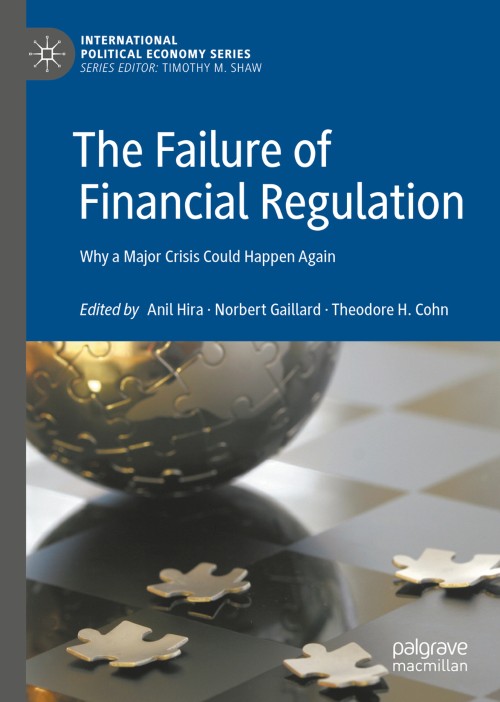
245 14|aThe Failure of Financial Regulation|h[electronic resource] :|bWhy a Major Crisis Could Happen Again /|cedited by Anil Hira, Norbert Gaillard, Theodore H. Cohn.
250 |a1st ed. 2019.
264 1|aCham :|bSpringer International Publishing :|bImprint: Palgrave Macmillan,|c2019.
300 |aXXI, 252 p. 7 illus.|bonline resource.
336 |atext|btxt|2rdacontent
337 |acomputer|bc|2rdamedia
338 |aonline resource|bcr|2rdacarrier
347 |atext file|bPDF|2rda
490 1 |aInternational Political Economy Series,|x2662-2491
505 0 |aChapter 1: Persistent Issues with Financial Regulation -- Chapter 2: Financial Regulation and Monetary Policy: The Spectre of Government Failure -- Chapter 3: The Effects of Regulatory Capture on Banking Regulations: A Level-of-Analysis Approach -- Chapter 4: How and Why Moral Hazard Has Distorted Financial Regulation -- Chapter 5: Remittances, Regulation, and Financial Development in Sub-Saharan Africa -- Chapter 6: Regulatory Mayhem in Offshore Finance: What the Panama Papers Reveal -- Chapter 7: Concluding Remarks.
520 |a“This publication could not be more timely. Little more than a decade after the global financial crisis of 2008, governments are once again loosening the reins over financial markets. The authors of this volume explain why that is a mistake and could invite yet another major crisis.” —Benjamin Cohen, University of California, Santa Barbara, USA “Leading political scientists from several generations here offer historical depth, as well as sensible suggestions about what reforms are needed now.” —John Kirton, University of Toronto, Canada, and Co-founder of the G7 Research Group “A valuable antidote to complacency for policy-makers, scholars and students.” —Timothy J. Sinclair, University of Warwick, UK This book examines the long-term, previously underappreciated breakdowns in financial regulation that fed into the 2008 global financial crash. While most related literature focuses on short-term factors such as the housing bubble, low interest rates, the breakdown of credit rating services and the emergence of new financial instruments, the authors of this volume contend that the larger trends in finance which continue today are most relevant to understanding the crash. Their analysis focuses on regulatory capture, moral hazard and the reflexive challenges of regulatory intervention in order to demonstrate that financial regulation suffers from long-standing, unaddressed and fundamental weaknesses. .
650 0|aInternational economic relations.
650 0|aPolitical planning.
650 0|aAmerica|xPolitics and government.
650 0|aInternational finance.
650 0|aInternational business enterprises.
650 14|aInternational Political Economy’.
650 24|aPublic Policy.
650 24|aAmerican Politics.
650 24|aInternational Finance.
650 24|aInternational Business.
700 1 |aHira, Anil.|eeditor.|4edt|4http://id.loc.gov/vocabulary/relators/edt
700 1 |aGaillard, Norbert.|eeditor.|4edt|4http://id.loc.gov/vocabulary/relators/edt
700 1 |aCohn, Theodore H.|eeditor.|4edt|4http://id.loc.gov/vocabulary/relators/edt
710 2 |aSpringerLink (Online service)
773 0 |tSpringer Nature eBook
776 08|iPrinted edition:|z9783030056797
776 08|iPrinted edition:|z9783030056810
830 0|aInternational Political Economy Series,|x2662-2491
856 40|uhttps://doi.org/10.1007/978-3-030-05680-3
912 |aZDB-2-POS
912 |aZDB-2-SXPI
950 |aPolitical Science and International Studies (SpringerNature-41174)
950 |aPolitical Science and International Studies (R0) (SpringerNature-43724)