

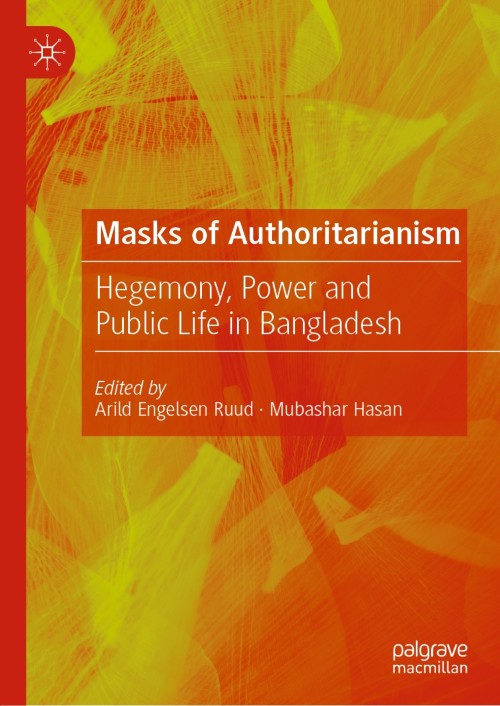
Masks of Authoritarianism [electronic resource] : Hegemony, Power and Public Life in Bangladesh / edited by Arild Engelsen Ruud, Mubashar Hasan.
Erişim Adresi
ISBN
9789811643149
Dil Kodu
İngilizce
Yer Numarası
DK/18396
Basım Bildirimi
1st ed. 2022.
Yayın Bilgisi
Singapore : Springer Nature Singapore : Imprint: Palgrave Macmillan, 2022.
Fiziksel Niteleme
XIII, 250 p. 2 illus. online resource.
İçindekiler Notu
Chapter 1. Introduction -- Part I. The media -- Chapter 2. The everyday politics of rumours and information: local journalism and social media in an authoritarian party-state regime in Bangladesh -- Chapter 3. Working Under the ‘Sword of Damocles’: Experiences of Journalists in a Hybrid Regime -- Part II. Alternative voices – three snapshots -- Chapter 4. The Rebels and the Conformers: Competing Patterns in Bangladeshi Rap Music -- Chapter 5. Life in a Hybrid Regime: Everyday struggles of gay men in Bangladesh -- Chapter 6. Targeted by Militants and Abandoned by the State: The Case of Shuddhashar Publication House -- Part III. The intellectuals -- Chapter 7. Manufacturing Consent, Silencing Dissent: The Case of Academic Freedom in Bangladesh -- Chapter 8. Making Cinema within Authoritarian Codes: The Case of Bangladesh -- Part IV. The unengaged – three snapshots -- Chapter 9. Are mega ‘development’ projects inherently undemocratic?: Field narratives from the projects sites -- Chapter 10. Everyday life in a hybrid regime: The case of health sector in Bangladesh -- Chapter 11. In the borderland: Everyday coping among Rohingya refugees -- Part V. The Political Stratum -- Chapter 12. The win-win game in politics: A study of the student wing of the ruling party in Bangladesh -- Chapter 13. Life of Jamaat e Islami and Its Political Allies in a Hybrid Regime -- Chapter 14. ‘If I am arrested, who will I do politics for?’ Repression and resistance at the base of the Bangladesh Nationalist Party -- Chapter 15. Afterword.
Özet, vb.
“The essays in this volume … argue that it is as a pluralist and democratic society that Bangladesh can flourish, not under restrictions on the public sphere and the political process. An uncomfortable critique, to be taken seriously.” – Hans Harder, Professor, University of Heidelberg, Germany “This important volume unfolds the profound grief and trauma that exist in complex layers of everyday lives; built on rights violations, exclusions and silences.” – Bina D’Costa, Professor, Australian National University, Australia “[The] essays are well-researched, fully documented and academically invulnerable; and they are written with commitment to examine what has been happening in the vital areas of creativity, governance and economy as also the reasons thereof. … The publication is intellectually stimulating and will continue to be useful for understanding Bangladesh.” – Serajul Islam Choudhury, Professor Emeritus, Dhaka University, Bangladesh How are lives affected by the increasingly authoritarian regime of Bangladesh that masks its despotic nature behind democratic rhetoric and economic growth? The chapters here investigate how professionals, officials, artists, opposition activists and ruling party men negotiate the ever-increasing power of an authoritarian regimes and how it affects their public engagement. This volume will interest scholars of democracy, hybrid regimes and authoritarianism. Arild Engelsen Ruud is professor of South Asia Studies at the University of Oslo, Norway. Among his recent publications are Mafia Raj: the Rule of Bossism in South Asia (Stanford UP 2018, co-author) and, as co-editor, South Asian Sovereignty: the Conundrum of Wordly Power (Routledge 2019) and Outrage: the Rise of Religious Offence in South Asia (UCL Press 2019). Mubashar Hasan PhD is an Adjunct Research Fellow at the Humanitarian and Development Research Initiative, Western Sydney University, Australia. He is the author of Islam and Politics in Bangladesh: The Followers of Ummah (Palgrave Macmillan, 2020), and the lead editor of the book Radicalization in South Asia: Context, Trajectories and Implications (Sage, 2020). Previously he was a post-doctoral fellow at Oslo University, Norway. He taught political science in North South University and Journalism in University of Liberal Arts Bangladesh.
Konu
Asia __ Politics and government.
Political science.
Human rights.
Asian Politics.
Governance and Government.
Politics and Human Rights.
Political science.
Human rights.
Asian Politics.
Governance and Government.
Politics and Human Rights.
Kurum Adı
Eseri Alıntıla
Referansları kullanmadan önce gözden geçirmeniz ve varsa gerekli düzeltmeleri yapmanız önerilir.
Dijital Kaynak
MARC Görünümü
LEADER 05884nam a22005175i 4500
001 817185
003 TR_AnAIT
005 20260130191343
007 cr nn 008mamaa
008 211018s2022 si | s |||| 0|eng d
020 |a9789811643149|9978-981-16-4314-9
024 7 |a10.1007/978-981-16-4314-9|2doi
041 |aeng
049 |aTürk Tarih Kurumu Kütüphanesi
050 4|aJQ1-1852
072 7|aJP|2bicssc
072 7|a1F|2bicssc
072 7|aPOL054000|2bisacsh
072 7|aJP|x1F|2thema
082 04|a320.95|223
090 |aDK/18396
245 10|aMasks of Authoritarianism|h[electronic resource] :|bHegemony, Power and Public Life in Bangladesh /|cedited by Arild Engelsen Ruud, Mubashar Hasan.
250 |a1st ed. 2022.
264 1|aSingapore :|bSpringer Nature Singapore :|bImprint: Palgrave Macmillan,|c2022.
300 |aXIII, 250 p. 2 illus.|bonline resource.
336 |atext|btxt|2rdacontent
337 |acomputer|bc|2rdamedia
338 |aonline resource|bcr|2rdacarrier
347 |atext file|bPDF|2rda
505 0 |aChapter 1. Introduction -- Part I. The media -- Chapter 2. The everyday politics of rumours and information: local journalism and social media in an authoritarian party-state regime in Bangladesh -- Chapter 3. Working Under the ‘Sword of Damocles’: Experiences of Journalists in a Hybrid Regime -- Part II. Alternative voices – three snapshots -- Chapter 4. The Rebels and the Conformers: Competing Patterns in Bangladeshi Rap Music -- Chapter 5. Life in a Hybrid Regime: Everyday struggles of gay men in Bangladesh -- Chapter 6. Targeted by Militants and Abandoned by the State: The Case of Shuddhashar Publication House -- Part III. The intellectuals -- Chapter 7. Manufacturing Consent, Silencing Dissent: The Case of Academic Freedom in Bangladesh -- Chapter 8. Making Cinema within Authoritarian Codes: The Case of Bangladesh -- Part IV. The unengaged – three snapshots -- Chapter 9. Are mega ‘development’ projects inherently undemocratic?: Field narratives from the projects sites -- Chapter 10. Everyday life in a hybrid regime: The case of health sector in Bangladesh -- Chapter 11. In the borderland: Everyday coping among Rohingya refugees -- Part V. The Political Stratum -- Chapter 12. The win-win game in politics: A study of the student wing of the ruling party in Bangladesh -- Chapter 13. Life of Jamaat e Islami and Its Political Allies in a Hybrid Regime -- Chapter 14. ‘If I am arrested, who will I do politics for?’ Repression and resistance at the base of the Bangladesh Nationalist Party -- Chapter 15. Afterword.
520 |a“The essays in this volume … argue that it is as a pluralist and democratic society that Bangladesh can flourish, not under restrictions on the public sphere and the political process. An uncomfortable critique, to be taken seriously.” – Hans Harder, Professor, University of Heidelberg, Germany “This important volume unfolds the profound grief and trauma that exist in complex layers of everyday lives; built on rights violations, exclusions and silences.” – Bina D’Costa, Professor, Australian National University, Australia “[The] essays are well-researched, fully documented and academically invulnerable; and they are written with commitment to examine what has been happening in the vital areas of creativity, governance and economy as also the reasons thereof. … The publication is intellectually stimulating and will continue to be useful for understanding Bangladesh.” – Serajul Islam Choudhury, Professor Emeritus, Dhaka University, Bangladesh How are lives affected by the increasingly authoritarian regime of Bangladesh that masks its despotic nature behind democratic rhetoric and economic growth? The chapters here investigate how professionals, officials, artists, opposition activists and ruling party men negotiate the ever-increasing power of an authoritarian regimes and how it affects their public engagement. This volume will interest scholars of democracy, hybrid regimes and authoritarianism. Arild Engelsen Ruud is professor of South Asia Studies at the University of Oslo, Norway. Among his recent publications are Mafia Raj: the Rule of Bossism in South Asia (Stanford UP 2018, co-author) and, as co-editor, South Asian Sovereignty: the Conundrum of Wordly Power (Routledge 2019) and Outrage: the Rise of Religious Offence in South Asia (UCL Press 2019). Mubashar Hasan PhD is an Adjunct Research Fellow at the Humanitarian and Development Research Initiative, Western Sydney University, Australia. He is the author of Islam and Politics in Bangladesh: The Followers of Ummah (Palgrave Macmillan, 2020), and the lead editor of the book Radicalization in South Asia: Context, Trajectories and Implications (Sage, 2020). Previously he was a post-doctoral fellow at Oslo University, Norway. He taught political science in North South University and Journalism in University of Liberal Arts Bangladesh.
650 0|aAsia|xPolitics and government.
650 0|aPolitical science.
650 0|aHuman rights.
650 14|aAsian Politics.
650 24|aGovernance and Government.
650 24|aPolitics and Human Rights.
700 1 |aRuud, Arild Engelsen.|eeditor.|0(orcid)0000-0002-4545-3690|1https://orcid.org/0000-0002-4545-3690|4edt|4http://id.loc.gov/vocabulary/relators/edt
700 1 |aHasan, Mubashar.|eeditor.|4edt|4http://id.loc.gov/vocabulary/relators/edt
710 2 |aSpringerLink (Online service)
773 0 |tSpringer Nature eBook
776 08|iPrinted edition:|z9789811643132
776 08|iPrinted edition:|z9789811643156
776 08|iPrinted edition:|z9789811643163
856 40|uhttps://doi.org/10.1007/978-981-16-4314-9
912 |aZDB-2-POS
912 |aZDB-2-SXPI
950 |aPolitical Science and International Studies (SpringerNature-41174)
950 |aPolitical Science and International Studies (R0) (SpringerNature-43724)
001 817185
003 TR_AnAIT
005 20260130191343
007 cr nn 008mamaa
008 211018s2022 si | s |||| 0|eng d
020 |a9789811643149|9978-981-16-4314-9
024 7 |a10.1007/978-981-16-4314-9|2doi
041 |aeng
049 |aTürk Tarih Kurumu Kütüphanesi
050 4|aJQ1-1852
072 7|aJP|2bicssc
072 7|a1F|2bicssc
072 7|aPOL054000|2bisacsh
072 7|aJP|x1F|2thema
082 04|a320.95|223
090 |aDK/18396
245 10|aMasks of Authoritarianism|h[electronic resource] :|bHegemony, Power and Public Life in Bangladesh /|cedited by Arild Engelsen Ruud, Mubashar Hasan.
250 |a1st ed. 2022.
264 1|aSingapore :|bSpringer Nature Singapore :|bImprint: Palgrave Macmillan,|c2022.
300 |aXIII, 250 p. 2 illus.|bonline resource.
336 |atext|btxt|2rdacontent
337 |acomputer|bc|2rdamedia
338 |aonline resource|bcr|2rdacarrier
347 |atext file|bPDF|2rda
505 0 |aChapter 1. Introduction -- Part I. The media -- Chapter 2. The everyday politics of rumours and information: local journalism and social media in an authoritarian party-state regime in Bangladesh -- Chapter 3. Working Under the ‘Sword of Damocles’: Experiences of Journalists in a Hybrid Regime -- Part II. Alternative voices – three snapshots -- Chapter 4. The Rebels and the Conformers: Competing Patterns in Bangladeshi Rap Music -- Chapter 5. Life in a Hybrid Regime: Everyday struggles of gay men in Bangladesh -- Chapter 6. Targeted by Militants and Abandoned by the State: The Case of Shuddhashar Publication House -- Part III. The intellectuals -- Chapter 7. Manufacturing Consent, Silencing Dissent: The Case of Academic Freedom in Bangladesh -- Chapter 8. Making Cinema within Authoritarian Codes: The Case of Bangladesh -- Part IV. The unengaged – three snapshots -- Chapter 9. Are mega ‘development’ projects inherently undemocratic?: Field narratives from the projects sites -- Chapter 10. Everyday life in a hybrid regime: The case of health sector in Bangladesh -- Chapter 11. In the borderland: Everyday coping among Rohingya refugees -- Part V. The Political Stratum -- Chapter 12. The win-win game in politics: A study of the student wing of the ruling party in Bangladesh -- Chapter 13. Life of Jamaat e Islami and Its Political Allies in a Hybrid Regime -- Chapter 14. ‘If I am arrested, who will I do politics for?’ Repression and resistance at the base of the Bangladesh Nationalist Party -- Chapter 15. Afterword.
520 |a“The essays in this volume … argue that it is as a pluralist and democratic society that Bangladesh can flourish, not under restrictions on the public sphere and the political process. An uncomfortable critique, to be taken seriously.” – Hans Harder, Professor, University of Heidelberg, Germany “This important volume unfolds the profound grief and trauma that exist in complex layers of everyday lives; built on rights violations, exclusions and silences.” – Bina D’Costa, Professor, Australian National University, Australia “[The] essays are well-researched, fully documented and academically invulnerable; and they are written with commitment to examine what has been happening in the vital areas of creativity, governance and economy as also the reasons thereof. … The publication is intellectually stimulating and will continue to be useful for understanding Bangladesh.” – Serajul Islam Choudhury, Professor Emeritus, Dhaka University, Bangladesh How are lives affected by the increasingly authoritarian regime of Bangladesh that masks its despotic nature behind democratic rhetoric and economic growth? The chapters here investigate how professionals, officials, artists, opposition activists and ruling party men negotiate the ever-increasing power of an authoritarian regimes and how it affects their public engagement. This volume will interest scholars of democracy, hybrid regimes and authoritarianism. Arild Engelsen Ruud is professor of South Asia Studies at the University of Oslo, Norway. Among his recent publications are Mafia Raj: the Rule of Bossism in South Asia (Stanford UP 2018, co-author) and, as co-editor, South Asian Sovereignty: the Conundrum of Wordly Power (Routledge 2019) and Outrage: the Rise of Religious Offence in South Asia (UCL Press 2019). Mubashar Hasan PhD is an Adjunct Research Fellow at the Humanitarian and Development Research Initiative, Western Sydney University, Australia. He is the author of Islam and Politics in Bangladesh: The Followers of Ummah (Palgrave Macmillan, 2020), and the lead editor of the book Radicalization in South Asia: Context, Trajectories and Implications (Sage, 2020). Previously he was a post-doctoral fellow at Oslo University, Norway. He taught political science in North South University and Journalism in University of Liberal Arts Bangladesh.
650 0|aAsia|xPolitics and government.
650 0|aPolitical science.
650 0|aHuman rights.
650 14|aAsian Politics.
650 24|aGovernance and Government.
650 24|aPolitics and Human Rights.
700 1 |aRuud, Arild Engelsen.|eeditor.|0(orcid)0000-0002-4545-3690|1https://orcid.org/0000-0002-4545-3690|4edt|4http://id.loc.gov/vocabulary/relators/edt
700 1 |aHasan, Mubashar.|eeditor.|4edt|4http://id.loc.gov/vocabulary/relators/edt
710 2 |aSpringerLink (Online service)
773 0 |tSpringer Nature eBook
776 08|iPrinted edition:|z9789811643132
776 08|iPrinted edition:|z9789811643156
776 08|iPrinted edition:|z9789811643163
856 40|uhttps://doi.org/10.1007/978-981-16-4314-9
912 |aZDB-2-POS
912 |aZDB-2-SXPI
950 |aPolitical Science and International Studies (SpringerNature-41174)
950 |aPolitical Science and International Studies (R0) (SpringerNature-43724)
Materyaller
Depodan talep edilen materyal sadece kütüphane içerisinde kullanılmaktadır.
Materyal dışarıya ödünç verilmemektedir.
Materyal dışarıya ödünç verilmemektedir.
