

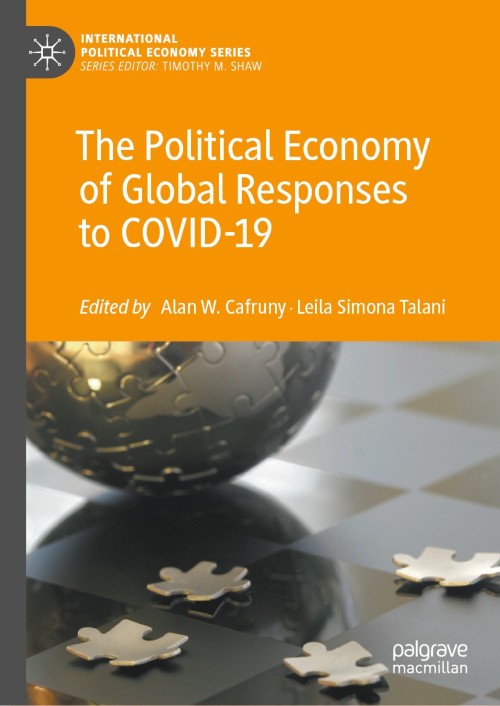
The Political Economy of Global Responses to COVID-19 [electronic resource] / edited by Alan W. Cafruny, Leila Simona Talani.
Erişim Adresi
ISBN
9783031239144
Dil Kodu
İngilizce
Yer Numarası
DK/18433
Basım Bildirimi
1st ed. 2023.
Yayın Bilgisi
Cham : Springer International Publishing : Imprint: Palgrave Macmillan, 2023.
Fiziksel Niteleme
XV, 325 p. 1 illus. online resource.
Dizi
International Political Economy Series, 2662-2491
İçindekiler Notu
Introduction: The Political Economy Of The Covid-19 Crisis: Neo-Liberalism, Populism And Autocracy -- Part 1: Neo-Liberal States -- Chapter 1: Populism, Neoliberalism, And The Pandemic: The Tragedy Of U.S. Policy -- Chapter 2: Risk, Responsibilisation And The Political Economy Of The Pandemic In The Uk -- Chapter 3: The Covid-19 Crisis: Global Competitive (Geo)Politics, Labour Regimes And The Case Of Greece -- Chapter 4: An Exceptional Case: Sweden And The Pandemic -- Part 2: Populist States -- Chapter 5: The Pandemic Politics Of The Bolsonaro Government In Brazil: Covid-19 Denial, The Chloroquine Economy And High Death Rates -- Of Poverty, Salaries, And Hunger.-Chapter 6: The Political Economy Of Pandemic Management In India -- Chapter 7: A Tale Of Two Crises. The Impact Of Eu Response To The Pandemic: The Case Of Italy -- Part 3: Authoritarian States -- Chapter 8: Authoritarian Crisis Response To Covid-19 In China -- Chapter 9: Health And Vaccine Diplomacy In Russia’s Foreign Policy -- Part 4: Global Inequality -- Chapter 10: Covid-19 And Sub-Saharan Africa: Paradoxes And Very Tentative Conclusions On The Pandemic -- Chapter 11: Conversation On Precarity. The Mutation Of The Virus Into A Public Health Risk On Equity -- Chapter 12: Pandemic Co-Pathogenesis: From The Vectors To The Variants Of Neoliberal Disease.
Özet, vb.
This book seeks to identify the reasons why some countries were more efficient and effective than others in responding to the COVID 19 pandemic, and why the global community failed to coalesce. What are the political determinants of the different state responses to the pandemic? Why was scientific advice rejected or ignored in many countries? What has been the role, respectively, of neoliberalism, populism, and authoritarianism in the making of Covid-19 policy? What role have each of these factors played in the uneven and clearly inadequate global response to the pandemic? In an effort to understand why some states failed to handle the pandemic properly, some of the literature suggests that populism is at the root of the current failure of international co-operation. The global financial crisis of 2008-10 triggered significant cooperation within the G-20, led by the combined efforts of the United States and China. These forms of cooperation have clearly disappeared in the context of the pandemic, not only with respect to economic policy but also in public health and management. The authors of this volume link the different state responses to the pandemic-- from its inception to the start of the vaccination campaign, and to the political regimes prevailing in each. In particular, the present volume focuses on a distinction between the responses of neo-liberal regimes, populist regimes and authoritarian ones. Leila Simona Talani has been Professor of International Political Economy in the Department of European and International Studies at King’s College London since 2014. She is the current editor of the Palgrave series: The Politics of Citizenship and Migration. Alan Cafruny (Ph.D.) Cornell (1983) is Henry Platt Bristol Professor of International Affairs at Hamilton College. He is a former series editor (with Herman Schwartz) of the series: Advances in International Political Economy, sponsored by the International PoliticalEconomy Section of the International Studies Association.
Konu
International economic relations.
Political science.
Public health.
International Political Economy’.
Politics and International Studies.
Public Health.
Political science.
Public health.
International Political Economy’.
Politics and International Studies.
Public Health.
Diğer Yazarlar
Kurum Adı
Eseri Alıntıla
Referansları kullanmadan önce gözden geçirmeniz ve varsa gerekli düzeltmeleri yapmanız önerilir.
Dijital Kaynak
MARC Görünümü
LEADER 06557nam a22006615i 4500
001 817222
003 TR_AnAIT
005 20260130191216
007 cr nn 008mamaa
008 230325s2023 sz | s |||| 0|eng d
020 |a9783031239144|9978-3-031-23914-4
024 7 |a10.1007/978-3-031-23914-4|2doi
041 |aeng
049 |aTürk Tarih Kurumu Kütüphanesi
050 4|aJZ1252
072 7|aJPS|2bicssc
072 7|aKCP|2bicssc
072 7|aPOL011020|2bisacsh
072 7|aJPS|2thema
072 7|aKCP|2thema
082 04|a327.111|223
090 |aDK/18433
245 14|aThe Political Economy of Global Responses to COVID-19|h[electronic resource] /|cedited by Alan W. Cafruny, Leila Simona Talani.
250 |a1st ed. 2023.
264 1|aCham :|bSpringer International Publishing :|bImprint: Palgrave Macmillan,|c2023.
300 |aXV, 325 p. 1 illus.|bonline resource.
336 |atext|btxt|2rdacontent
337 |acomputer|bc|2rdamedia
338 |aonline resource|bcr|2rdacarrier
341 0 |bTable of contents navigation|2onix
341 0 |bSingle logical reading order|2onix
341 0 |bUse of color is not sole means of conveying information|2onix
341 0 |bUse of high contrast between text and background color|2onix
341 0 |bNext / Previous structural navigation|2onix
341 0 |bAll non-decorative content supports reading without sight|2onix
347 |atext file|bPDF|2rda
490 1 |aInternational Political Economy Series,|x2662-2491
505 0 |aIntroduction: The Political Economy Of The Covid-19 Crisis: Neo-Liberalism, Populism And Autocracy -- Part 1: Neo-Liberal States -- Chapter 1: Populism, Neoliberalism, And The Pandemic: The Tragedy Of U.S. Policy -- Chapter 2: Risk, Responsibilisation And The Political Economy Of The Pandemic In The Uk -- Chapter 3: The Covid-19 Crisis: Global Competitive (Geo)Politics, Labour Regimes And The Case Of Greece -- Chapter 4: An Exceptional Case: Sweden And The Pandemic -- Part 2: Populist States -- Chapter 5: The Pandemic Politics Of The Bolsonaro Government In Brazil: Covid-19 Denial, The Chloroquine Economy And High Death Rates -- Of Poverty, Salaries, And Hunger.-Chapter 6: The Political Economy Of Pandemic Management In India -- Chapter 7: A Tale Of Two Crises. The Impact Of Eu Response To The Pandemic: The Case Of Italy -- Part 3: Authoritarian States -- Chapter 8: Authoritarian Crisis Response To Covid-19 In China -- Chapter 9: Health And Vaccine Diplomacy In Russia’s Foreign Policy -- Part 4: Global Inequality -- Chapter 10: Covid-19 And Sub-Saharan Africa: Paradoxes And Very Tentative Conclusions On The Pandemic -- Chapter 11: Conversation On Precarity. The Mutation Of The Virus Into A Public Health Risk On Equity -- Chapter 12: Pandemic Co-Pathogenesis: From The Vectors To The Variants Of Neoliberal Disease.
520 |aThis book seeks to identify the reasons why some countries were more efficient and effective than others in responding to the COVID 19 pandemic, and why the global community failed to coalesce. What are the political determinants of the different state responses to the pandemic? Why was scientific advice rejected or ignored in many countries? What has been the role, respectively, of neoliberalism, populism, and authoritarianism in the making of Covid-19 policy? What role have each of these factors played in the uneven and clearly inadequate global response to the pandemic? In an effort to understand why some states failed to handle the pandemic properly, some of the literature suggests that populism is at the root of the current failure of international co-operation. The global financial crisis of 2008-10 triggered significant cooperation within the G-20, led by the combined efforts of the United States and China. These forms of cooperation have clearly disappeared in the context of the pandemic, not only with respect to economic policy but also in public health and management. The authors of this volume link the different state responses to the pandemic-- from its inception to the start of the vaccination campaign, and to the political regimes prevailing in each. In particular, the present volume focuses on a distinction between the responses of neo-liberal regimes, populist regimes and authoritarian ones. Leila Simona Talani has been Professor of International Political Economy in the Department of European and International Studies at King’s College London since 2014. She is the current editor of the Palgrave series: The Politics of Citizenship and Migration. Alan Cafruny (Ph.D.) Cornell (1983) is Henry Platt Bristol Professor of International Affairs at Hamilton College. He is a former series editor (with Herman Schwartz) of the series: Advances in International Political Economy, sponsored by the International PoliticalEconomy Section of the International Studies Association.
532 8 |aAccessibility summary: This PDF does not fully comply with PDF/UA standards, but does feature limited screen reader support, bookmarks for easy navigation and searchable, selectable text. Users of assistive technologies may experience difficulty navigating or interpreting content in this document. We recognize the importance of accessibility, and we welcome queries about accessibility for any of our products. If you have a question or an access need, please get in touch with us at accessibilitysupport@springernature.com.
532 8 |aNo reading system accessibility options actively disabled
532 8 |aPublisher contact for further accessibility information: accessibilitysupport@springernature.com
650 0|aInternational economic relations.
650 0|aPolitical science.
650 0|aPublic health.
650 14|aInternational Political Economy’.
650 24|aPolitics and International Studies.
650 24|aPublic Health.
700 1 |aCafruny, Alan W.|eeditor.|4edt|4http://id.loc.gov/vocabulary/relators/edt
700 1 |aSimona Talani, Leila.|eeditor.|4edt|4http://id.loc.gov/vocabulary/relators/edt
710 2 |aSpringerLink (Online service)
773 0 |tSpringer Nature eBook
776 08|iPrinted edition:|z9783031239137
776 08|iPrinted edition:|z9783031239151
776 08|iPrinted edition:|z9783031239168
830 0|aInternational Political Economy Series,|x2662-2491
856 40|uhttps://doi.org/10.1007/978-3-031-23914-4
912 |aZDB-2-POS
912 |aZDB-2-SXPI
950 |aPolitical Science and International Studies (SpringerNature-41174)
950 |aPolitical Science and International Studies (R0) (SpringerNature-43724)
001 817222
003 TR_AnAIT
005 20260130191216
007 cr nn 008mamaa
008 230325s2023 sz | s |||| 0|eng d
020 |a9783031239144|9978-3-031-23914-4
024 7 |a10.1007/978-3-031-23914-4|2doi
041 |aeng
049 |aTürk Tarih Kurumu Kütüphanesi
050 4|aJZ1252
072 7|aJPS|2bicssc
072 7|aKCP|2bicssc
072 7|aPOL011020|2bisacsh
072 7|aJPS|2thema
072 7|aKCP|2thema
082 04|a327.111|223
090 |aDK/18433
245 14|aThe Political Economy of Global Responses to COVID-19|h[electronic resource] /|cedited by Alan W. Cafruny, Leila Simona Talani.
250 |a1st ed. 2023.
264 1|aCham :|bSpringer International Publishing :|bImprint: Palgrave Macmillan,|c2023.
300 |aXV, 325 p. 1 illus.|bonline resource.
336 |atext|btxt|2rdacontent
337 |acomputer|bc|2rdamedia
338 |aonline resource|bcr|2rdacarrier
341 0 |bTable of contents navigation|2onix
341 0 |bSingle logical reading order|2onix
341 0 |bUse of color is not sole means of conveying information|2onix
341 0 |bUse of high contrast between text and background color|2onix
341 0 |bNext / Previous structural navigation|2onix
341 0 |bAll non-decorative content supports reading without sight|2onix
347 |atext file|bPDF|2rda
490 1 |aInternational Political Economy Series,|x2662-2491
505 0 |aIntroduction: The Political Economy Of The Covid-19 Crisis: Neo-Liberalism, Populism And Autocracy -- Part 1: Neo-Liberal States -- Chapter 1: Populism, Neoliberalism, And The Pandemic: The Tragedy Of U.S. Policy -- Chapter 2: Risk, Responsibilisation And The Political Economy Of The Pandemic In The Uk -- Chapter 3: The Covid-19 Crisis: Global Competitive (Geo)Politics, Labour Regimes And The Case Of Greece -- Chapter 4: An Exceptional Case: Sweden And The Pandemic -- Part 2: Populist States -- Chapter 5: The Pandemic Politics Of The Bolsonaro Government In Brazil: Covid-19 Denial, The Chloroquine Economy And High Death Rates -- Of Poverty, Salaries, And Hunger.-Chapter 6: The Political Economy Of Pandemic Management In India -- Chapter 7: A Tale Of Two Crises. The Impact Of Eu Response To The Pandemic: The Case Of Italy -- Part 3: Authoritarian States -- Chapter 8: Authoritarian Crisis Response To Covid-19 In China -- Chapter 9: Health And Vaccine Diplomacy In Russia’s Foreign Policy -- Part 4: Global Inequality -- Chapter 10: Covid-19 And Sub-Saharan Africa: Paradoxes And Very Tentative Conclusions On The Pandemic -- Chapter 11: Conversation On Precarity. The Mutation Of The Virus Into A Public Health Risk On Equity -- Chapter 12: Pandemic Co-Pathogenesis: From The Vectors To The Variants Of Neoliberal Disease.
520 |aThis book seeks to identify the reasons why some countries were more efficient and effective than others in responding to the COVID 19 pandemic, and why the global community failed to coalesce. What are the political determinants of the different state responses to the pandemic? Why was scientific advice rejected or ignored in many countries? What has been the role, respectively, of neoliberalism, populism, and authoritarianism in the making of Covid-19 policy? What role have each of these factors played in the uneven and clearly inadequate global response to the pandemic? In an effort to understand why some states failed to handle the pandemic properly, some of the literature suggests that populism is at the root of the current failure of international co-operation. The global financial crisis of 2008-10 triggered significant cooperation within the G-20, led by the combined efforts of the United States and China. These forms of cooperation have clearly disappeared in the context of the pandemic, not only with respect to economic policy but also in public health and management. The authors of this volume link the different state responses to the pandemic-- from its inception to the start of the vaccination campaign, and to the political regimes prevailing in each. In particular, the present volume focuses on a distinction between the responses of neo-liberal regimes, populist regimes and authoritarian ones. Leila Simona Talani has been Professor of International Political Economy in the Department of European and International Studies at King’s College London since 2014. She is the current editor of the Palgrave series: The Politics of Citizenship and Migration. Alan Cafruny (Ph.D.) Cornell (1983) is Henry Platt Bristol Professor of International Affairs at Hamilton College. He is a former series editor (with Herman Schwartz) of the series: Advances in International Political Economy, sponsored by the International PoliticalEconomy Section of the International Studies Association.
532 8 |aAccessibility summary: This PDF does not fully comply with PDF/UA standards, but does feature limited screen reader support, bookmarks for easy navigation and searchable, selectable text. Users of assistive technologies may experience difficulty navigating or interpreting content in this document. We recognize the importance of accessibility, and we welcome queries about accessibility for any of our products. If you have a question or an access need, please get in touch with us at accessibilitysupport@springernature.com.
532 8 |aNo reading system accessibility options actively disabled
532 8 |aPublisher contact for further accessibility information: accessibilitysupport@springernature.com
650 0|aInternational economic relations.
650 0|aPolitical science.
650 0|aPublic health.
650 14|aInternational Political Economy’.
650 24|aPolitics and International Studies.
650 24|aPublic Health.
700 1 |aCafruny, Alan W.|eeditor.|4edt|4http://id.loc.gov/vocabulary/relators/edt
700 1 |aSimona Talani, Leila.|eeditor.|4edt|4http://id.loc.gov/vocabulary/relators/edt
710 2 |aSpringerLink (Online service)
773 0 |tSpringer Nature eBook
776 08|iPrinted edition:|z9783031239137
776 08|iPrinted edition:|z9783031239151
776 08|iPrinted edition:|z9783031239168
830 0|aInternational Political Economy Series,|x2662-2491
856 40|uhttps://doi.org/10.1007/978-3-031-23914-4
912 |aZDB-2-POS
912 |aZDB-2-SXPI
950 |aPolitical Science and International Studies (SpringerNature-41174)
950 |aPolitical Science and International Studies (R0) (SpringerNature-43724)
Materyaller
Depodan talep edilen materyal sadece kütüphane içerisinde kullanılmaktadır.
Materyal dışarıya ödünç verilmemektedir.
Materyal dışarıya ödünç verilmemektedir.
