

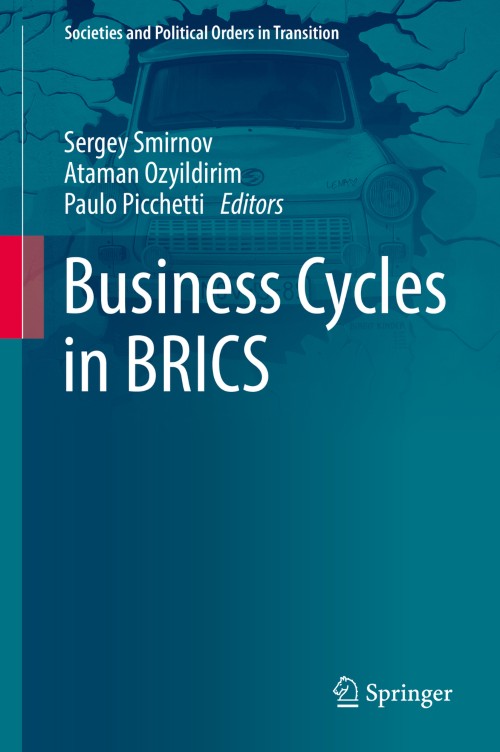
Business Cycles in BRICS [electronic resource] / edited by Sergey Smirnov, Ataman Ozyildirim, Paulo Picchetti.
Erişim Adresi
ISBN
9783319900179
Dil Kodu
İngilizce
Yer Numarası
DK/18451
Basım Bildirimi
1st ed. 2019.
Yayın Bilgisi
Cham : Springer International Publishing : Imprint: Springer, 2019.
Fiziksel Niteleme
XI, 513 p. 137 illus., 78 illus. in color. online resource.
Dizi
Societies and Political Orders in Transition, 2511-221X
İçindekiler Notu
1. Introduction. Part I. The Global Economy and BRICS -- 2. BRICS in the Global Economy -- 3. Institutions, Productivity Change and Growth -- 4. The Connectedness of Business Cycles between the BRICS -- Part II. History and Driving Forces of Economic Cycles in BRICS -- 5. Economic Cycles in Brazil -- 6. Economic Fluctuations and Their Drivers in Russia -- 7. Business Cycle Measurement in India -- 8. Economic Cycles and Crises in New China -- 9. China’s Economic Cycles: Characteristics and Determinant Factors -- 10. A Brief History of Business Cycle Measurement in South Africa -- Part III. Business Tendency Surveys (BTSs) in BRICS -- 11. International Tradition of Tendency Surveys -- 12. Economic Tendency Surveys in Brazil: Main Features and Uses -- 13. Russian Business Tendency Surveys by HSE and Rosstat -- 14. Business Tendency Surveys in India -- 15. Business Tendency Surveys in China -- 16. South Africa: The BER’s Business Tendency Surveys -- Part IV. Composite Cyclical Indicators for Real-Time Monitoring and Forecasting the BRICS Economies -- 17. Compiling Cyclical Composite Indexes: The Conference Board Indicators Approach -- 18. Coincident and Leading Indicators for Brazilian Cycles -- 19. Brazilian Business Cycles as Characterized by CODACE -- 20. A Bayesian Approach to Predicting Cycles Using Composite Indicators -- 21. A Survey of Composite Leading Indices for Russia -- 22. Indices of Regional Economic Activity for Russia -- 23. An Application of the Indicator Approach to Developing Coincident and Leading Economic Indexes for India -- 24. Business Climate Indices in China -- 25. Tracking Business and Growth Cycles in the Chinese Economy Using Composite Indexes -- 26. The SARB’s Composite Business Cycle Indicators -- 27. Alternative Cycle Indicators for the South African Business Cycle -- 28. Forecasting Business Cycles in South Africa -- Part V. Concluding remarks. 29. Measurement, Monitoring, and Forecasting Economic Cycles: BRICS Lessons.
Özet, vb.
This volume focuses on the analysis and measurement of business cycles in Brazil, Russia, India, China and South Africa (BRICS). Divided into five parts, it begins with an overview of the main concepts and problems involved in monitoring and forecasting business cycles. Then it highlights the role of BRICS in the global economy and explores the interrelatedness of business cycles within BRICS. In turn, part two provides studies on the historical development of business cycles in the individual BRICS countries and describes the driving forces behind those cycles. Parts three and four present national business tendency surveys and composite cyclical indices for real-time monitoring and forecasting of various BRICS economies, while the final part discusses how the lessons learned in the BRICS countries can be used for the analysis of business cycles and their socio-political consequences in other emerging countries.
Konu
International economic integration.
Globalization.
Macroeconomics.
Economic history.
Statistics .
Econometrics.
Economic development.
Emerging Markets and Globalization.
Macroeconomics and Monetary Economics.
Economic History.
Statistics in Business, Management, Economics, Finance, Insurance.
Econometrics.
Economic Growth.
Globalization.
Macroeconomics.
Economic history.
Statistics .
Econometrics.
Economic development.
Emerging Markets and Globalization.
Macroeconomics and Monetary Economics.
Economic History.
Statistics in Business, Management, Economics, Finance, Insurance.
Econometrics.
Economic Growth.
Diğer Yazarlar
Kurum Adı
Eseri Alıntıla
Referansları kullanmadan önce gözden geçirmeniz ve varsa gerekli düzeltmeleri yapmanız önerilir.
Dijital Kaynak
MARC Görünümü
LEADER 06601nam a22007695i 4500
001 817240
003 TR_AnAIT
005 20260130191130
007 cr nn 008mamaa
008 180815s2019 sz | s |||| 0|eng d
020 |a9783319900179|9978-3-319-90017-9
024 7 |a10.1007/978-3-319-90017-9|2doi
041 |aeng
049 |aTürk Tarih Kurumu Kütüphanesi
050 4|aHF1365
050 4|aHF1418.5
072 7|aKCM|2bicssc
072 7|aBUS113000|2bisacsh
072 7|aKCM|2thema
082 04|a337|223
082 04|a303.482|223
090 |aDK/18451
245 10|aBusiness Cycles in BRICS|h[electronic resource] /|cedited by Sergey Smirnov, Ataman Ozyildirim, Paulo Picchetti.
250 |a1st ed. 2019.
264 1|aCham :|bSpringer International Publishing :|bImprint: Springer,|c2019.
300 |aXI, 513 p. 137 illus., 78 illus. in color.|bonline resource.
336 |atext|btxt|2rdacontent
337 |acomputer|bc|2rdamedia
338 |aonline resource|bcr|2rdacarrier
341 0 |bTable of contents navigation|2onix
341 0 |bSingle logical reading order|2onix
341 0 |bShort alternative textual descriptions|2onix
341 0 |bUse of color is not sole means of conveying information|2onix
341 0 |bUse of high contrast between text and background color|2onix
341 0 |bNext / Previous structural navigation|2onix
341 0 |bAll non-decorative content supports reading without sight|2onix
347 |atext file|bPDF|2rda
490 1 |aSocieties and Political Orders in Transition,|x2511-221X
505 0 |a1. Introduction. Part I. The Global Economy and BRICS -- 2. BRICS in the Global Economy -- 3. Institutions, Productivity Change and Growth -- 4. The Connectedness of Business Cycles between the BRICS -- Part II. History and Driving Forces of Economic Cycles in BRICS -- 5. Economic Cycles in Brazil -- 6. Economic Fluctuations and Their Drivers in Russia -- 7. Business Cycle Measurement in India -- 8. Economic Cycles and Crises in New China -- 9. China’s Economic Cycles: Characteristics and Determinant Factors -- 10. A Brief History of Business Cycle Measurement in South Africa -- Part III. Business Tendency Surveys (BTSs) in BRICS -- 11. International Tradition of Tendency Surveys -- 12. Economic Tendency Surveys in Brazil: Main Features and Uses -- 13. Russian Business Tendency Surveys by HSE and Rosstat -- 14. Business Tendency Surveys in India -- 15. Business Tendency Surveys in China -- 16. South Africa: The BER’s Business Tendency Surveys -- Part IV. Composite Cyclical Indicators for Real-Time Monitoring and Forecasting the BRICS Economies -- 17. Compiling Cyclical Composite Indexes: The Conference Board Indicators Approach -- 18. Coincident and Leading Indicators for Brazilian Cycles -- 19. Brazilian Business Cycles as Characterized by CODACE -- 20. A Bayesian Approach to Predicting Cycles Using Composite Indicators -- 21. A Survey of Composite Leading Indices for Russia -- 22. Indices of Regional Economic Activity for Russia -- 23. An Application of the Indicator Approach to Developing Coincident and Leading Economic Indexes for India -- 24. Business Climate Indices in China -- 25. Tracking Business and Growth Cycles in the Chinese Economy Using Composite Indexes -- 26. The SARB’s Composite Business Cycle Indicators -- 27. Alternative Cycle Indicators for the South African Business Cycle -- 28. Forecasting Business Cycles in South Africa -- Part V. Concluding remarks. 29. Measurement, Monitoring, and Forecasting Economic Cycles: BRICS Lessons.
520 |aThis volume focuses on the analysis and measurement of business cycles in Brazil, Russia, India, China and South Africa (BRICS). Divided into five parts, it begins with an overview of the main concepts and problems involved in monitoring and forecasting business cycles. Then it highlights the role of BRICS in the global economy and explores the interrelatedness of business cycles within BRICS. In turn, part two provides studies on the historical development of business cycles in the individual BRICS countries and describes the driving forces behind those cycles. Parts three and four present national business tendency surveys and composite cyclical indices for real-time monitoring and forecasting of various BRICS economies, while the final part discusses how the lessons learned in the BRICS countries can be used for the analysis of business cycles and their socio-political consequences in other emerging countries.
532 8 |aAccessibility summary: This PDF does not fully comply with PDF/UA standards, but does feature limited screen reader support, described non-text content (images, graphs), bookmarks for easy navigation and searchable, selectable text. Users of assistive technologies may experience difficulty navigating or interpreting content in this document. We recognize the importance of accessibility, and we welcome queries about accessibility for any of our products. If you have a question or an access need, please get in touch with us at accessibilitysupport@springernature.com.
532 8 |aNo reading system accessibility options actively disabled
532 8 |aPublisher contact for further accessibility information: accessibilitysupport@springernature.com
650 0|aInternational economic integration.
650 0|aGlobalization.
650 0|aMacroeconomics.
650 0|aEconomic history.
650 0|aStatistics .
650 0|aEconometrics.
650 0|aEconomic development.
650 14|aEmerging Markets and Globalization.
650 24|aMacroeconomics and Monetary Economics.
650 24|aEconomic History.
650 24|aStatistics in Business, Management, Economics, Finance, Insurance.
650 24|aEconometrics.
650 24|aEconomic Growth.
700 1 |aSmirnov, Sergey.|eeditor.|4edt|4http://id.loc.gov/vocabulary/relators/edt
700 1 |aOzyildirim, Ataman.|eeditor.|4edt|4http://id.loc.gov/vocabulary/relators/edt
700 1 |aPicchetti, Paulo.|eeditor.|4edt|4http://id.loc.gov/vocabulary/relators/edt
710 2 |aSpringerLink (Online service)
773 0 |tSpringer Nature eBook
776 08|iPrinted edition:|z9783319900162
776 08|iPrinted edition:|z9783319900186
776 08|iPrinted edition:|z9783030079154
830 0|aSocieties and Political Orders in Transition,|x2511-221X
856 40|uhttps://doi.org/10.1007/978-3-319-90017-9
912 |aZDB-2-POS
912 |aZDB-2-SXPI
950 |aPolitical Science and International Studies (SpringerNature-41174)
950 |aPolitical Science and International Studies (R0) (SpringerNature-43724)
001 817240
003 TR_AnAIT
005 20260130191130
007 cr nn 008mamaa
008 180815s2019 sz | s |||| 0|eng d
020 |a9783319900179|9978-3-319-90017-9
024 7 |a10.1007/978-3-319-90017-9|2doi
041 |aeng
049 |aTürk Tarih Kurumu Kütüphanesi
050 4|aHF1365
050 4|aHF1418.5
072 7|aKCM|2bicssc
072 7|aBUS113000|2bisacsh
072 7|aKCM|2thema
082 04|a337|223
082 04|a303.482|223
090 |aDK/18451
245 10|aBusiness Cycles in BRICS|h[electronic resource] /|cedited by Sergey Smirnov, Ataman Ozyildirim, Paulo Picchetti.
250 |a1st ed. 2019.
264 1|aCham :|bSpringer International Publishing :|bImprint: Springer,|c2019.
300 |aXI, 513 p. 137 illus., 78 illus. in color.|bonline resource.
336 |atext|btxt|2rdacontent
337 |acomputer|bc|2rdamedia
338 |aonline resource|bcr|2rdacarrier
341 0 |bTable of contents navigation|2onix
341 0 |bSingle logical reading order|2onix
341 0 |bShort alternative textual descriptions|2onix
341 0 |bUse of color is not sole means of conveying information|2onix
341 0 |bUse of high contrast between text and background color|2onix
341 0 |bNext / Previous structural navigation|2onix
341 0 |bAll non-decorative content supports reading without sight|2onix
347 |atext file|bPDF|2rda
490 1 |aSocieties and Political Orders in Transition,|x2511-221X
505 0 |a1. Introduction. Part I. The Global Economy and BRICS -- 2. BRICS in the Global Economy -- 3. Institutions, Productivity Change and Growth -- 4. The Connectedness of Business Cycles between the BRICS -- Part II. History and Driving Forces of Economic Cycles in BRICS -- 5. Economic Cycles in Brazil -- 6. Economic Fluctuations and Their Drivers in Russia -- 7. Business Cycle Measurement in India -- 8. Economic Cycles and Crises in New China -- 9. China’s Economic Cycles: Characteristics and Determinant Factors -- 10. A Brief History of Business Cycle Measurement in South Africa -- Part III. Business Tendency Surveys (BTSs) in BRICS -- 11. International Tradition of Tendency Surveys -- 12. Economic Tendency Surveys in Brazil: Main Features and Uses -- 13. Russian Business Tendency Surveys by HSE and Rosstat -- 14. Business Tendency Surveys in India -- 15. Business Tendency Surveys in China -- 16. South Africa: The BER’s Business Tendency Surveys -- Part IV. Composite Cyclical Indicators for Real-Time Monitoring and Forecasting the BRICS Economies -- 17. Compiling Cyclical Composite Indexes: The Conference Board Indicators Approach -- 18. Coincident and Leading Indicators for Brazilian Cycles -- 19. Brazilian Business Cycles as Characterized by CODACE -- 20. A Bayesian Approach to Predicting Cycles Using Composite Indicators -- 21. A Survey of Composite Leading Indices for Russia -- 22. Indices of Regional Economic Activity for Russia -- 23. An Application of the Indicator Approach to Developing Coincident and Leading Economic Indexes for India -- 24. Business Climate Indices in China -- 25. Tracking Business and Growth Cycles in the Chinese Economy Using Composite Indexes -- 26. The SARB’s Composite Business Cycle Indicators -- 27. Alternative Cycle Indicators for the South African Business Cycle -- 28. Forecasting Business Cycles in South Africa -- Part V. Concluding remarks. 29. Measurement, Monitoring, and Forecasting Economic Cycles: BRICS Lessons.
520 |aThis volume focuses on the analysis and measurement of business cycles in Brazil, Russia, India, China and South Africa (BRICS). Divided into five parts, it begins with an overview of the main concepts and problems involved in monitoring and forecasting business cycles. Then it highlights the role of BRICS in the global economy and explores the interrelatedness of business cycles within BRICS. In turn, part two provides studies on the historical development of business cycles in the individual BRICS countries and describes the driving forces behind those cycles. Parts three and four present national business tendency surveys and composite cyclical indices for real-time monitoring and forecasting of various BRICS economies, while the final part discusses how the lessons learned in the BRICS countries can be used for the analysis of business cycles and their socio-political consequences in other emerging countries.
532 8 |aAccessibility summary: This PDF does not fully comply with PDF/UA standards, but does feature limited screen reader support, described non-text content (images, graphs), bookmarks for easy navigation and searchable, selectable text. Users of assistive technologies may experience difficulty navigating or interpreting content in this document. We recognize the importance of accessibility, and we welcome queries about accessibility for any of our products. If you have a question or an access need, please get in touch with us at accessibilitysupport@springernature.com.
532 8 |aNo reading system accessibility options actively disabled
532 8 |aPublisher contact for further accessibility information: accessibilitysupport@springernature.com
650 0|aInternational economic integration.
650 0|aGlobalization.
650 0|aMacroeconomics.
650 0|aEconomic history.
650 0|aStatistics .
650 0|aEconometrics.
650 0|aEconomic development.
650 14|aEmerging Markets and Globalization.
650 24|aMacroeconomics and Monetary Economics.
650 24|aEconomic History.
650 24|aStatistics in Business, Management, Economics, Finance, Insurance.
650 24|aEconometrics.
650 24|aEconomic Growth.
700 1 |aSmirnov, Sergey.|eeditor.|4edt|4http://id.loc.gov/vocabulary/relators/edt
700 1 |aOzyildirim, Ataman.|eeditor.|4edt|4http://id.loc.gov/vocabulary/relators/edt
700 1 |aPicchetti, Paulo.|eeditor.|4edt|4http://id.loc.gov/vocabulary/relators/edt
710 2 |aSpringerLink (Online service)
773 0 |tSpringer Nature eBook
776 08|iPrinted edition:|z9783319900162
776 08|iPrinted edition:|z9783319900186
776 08|iPrinted edition:|z9783030079154
830 0|aSocieties and Political Orders in Transition,|x2511-221X
856 40|uhttps://doi.org/10.1007/978-3-319-90017-9
912 |aZDB-2-POS
912 |aZDB-2-SXPI
950 |aPolitical Science and International Studies (SpringerNature-41174)
950 |aPolitical Science and International Studies (R0) (SpringerNature-43724)
Materyaller
Depodan talep edilen materyal sadece kütüphane içerisinde kullanılmaktadır.
Materyal dışarıya ödünç verilmemektedir.
Materyal dışarıya ödünç verilmemektedir.
