

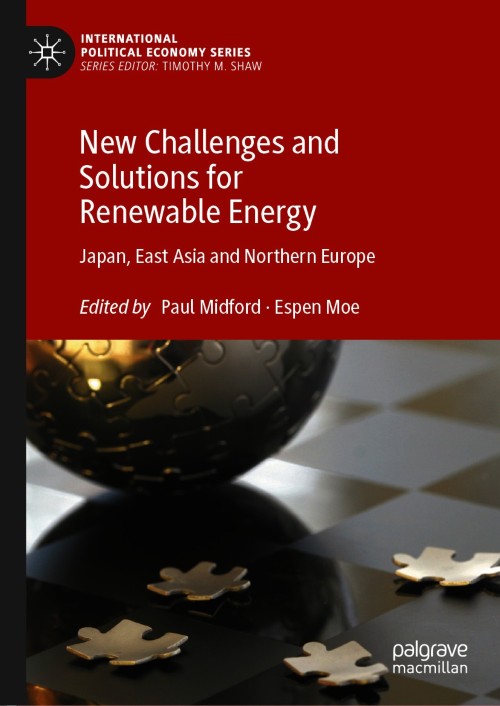
New Challenges and Solutions for Renewable Energy [electronic resource] : Japan, East Asia and Northern Europe / edited by Paul Midford, Espen Moe.
Erişim Adresi
ISBN
9783030545147
Dil Kodu
İngilizce
Yer Numarası
DK/18498
Basım Bildirimi
1st ed. 2021.
Yayın Bilgisi
Cham : Springer International Publishing : Imprint: Palgrave Macmillan, 2021.
Fiziksel Niteleme
XXXI, 412 p. 43 illus., 41 illus. in color. online resource.
Dizi
International Political Economy Series, 2662-2491
İçindekiler Notu
Chapter 1. Introduction -- Part I. New Challenges and Opportunities in Japan -- Chapter 2. Japan’s Energy Policy and Community Power Movement after the Fukushima Nuclear Accident -- Chapter 3. Why Japan is No-longer a Front-runner: Domestic Politics, Renewable Energy and Climate Change Policy -- Chapter 4. Reforming Japan’s Nuclear Regulation After 3/11 -- Chapter 5. The Politics of Nuclear Power Plant Restarts versus Renewable Energy Promotion -- Chapter 6. Renewable Energy as a New Choice for Consumers: The Case of Minna Denryoku -- Chapter 7. Betting on Hydrogen: Japan’s Green Industrial Policy -- Part II. New Challenges and Opportunities in East Asia -- Chapter 8. Between Rhetoric and Reality: Renewable Energy Promotion versus. Adoption in South Korea -- Chapter 9. China’s Promotion of Wind and Solar Power: Supportive Policies, Geographical Challenges and Market Competition -- Chapter 10. Solar PV in Singapore in the Absence of Subsidies -- Chapter 11. Renewable Energy Policy in Vietnam -- PartIII. New Challenges and Opportunities in Norden -- Chapter 12. Why Norway as a Green Battery to Europe is Still to Happen, and Probably Will Not -- Chapter 13. Beyond Wind: New Challenges to the Expansion of Renewables in Denmark -- Chapter 14. Renewable Energy in Finland: from a Production-Centric to a Consumption-Centric System -- Chapter 15. Conclusions: New Challenges to Renewables in Comparative Perspective.
Özet, vb.
This book identifies second stage challenges and opportunities for expanding renewable energy into a mainstay of electricity generation that can replace fossil fuels and nuclear power, comparing Japan with several countries in East Asia and Northern Europe. Environmentally sustainable renewable energy technologies have now overtaken fossil fuel and nuclear technologies in terms of total global investment, and the costs of these technologies and related ones (e.g. storage batteries) are rapidly falling. Yet renewable energy use varies greatly from country to country. Major second stage obstacles to replacing fossil and nuclear-fueled electricity generation include the lack of electricity grid capacity and storage assets. Opportunities and solutions include expanding grids regionally and internationally, building flexible smart grids that offer better demand management, and policies that promote the expansion of storage assets, especially grid batteries and hydrogen. In addition, two keyfactors – electricity market restructuring through unbundling transmission from electricity generating companies; and electricity market liberalization, especially for retail customers – allow consumers to choose power companies based not only on price, but also on method of generation, especially fossil or nuclear generation versus renewable energy. Paul Midford is Professor of Political Science and Director of the NTNU Japan Program, Norwegian University of Science and Technology (NTNU). Espen Moe is Professor of Political Science and Chair of the NTNU Japan Council at the Norwegian University of Science and Technology (NTNU).
Konu
International economic relations.
Economic development.
Sustainability.
Asia __ Politics and government.
Europe __ Politics and government.
International Political Economy’.
Development Studies.
Sustainability.
Asian Politics.
European Politics.
Economic development.
Sustainability.
Asia __ Politics and government.
Europe __ Politics and government.
International Political Economy’.
Development Studies.
Sustainability.
Asian Politics.
European Politics.
Diğer Yazarlar
Kurum Adı
Eseri Alıntıla
Referansları kullanmadan önce gözden geçirmeniz ve varsa gerekli düzeltmeleri yapmanız önerilir.
Dijital Kaynak
MARC Görünümü
LEADER 05409nam a22006015i 4500
001 817287
003 TR_AnAIT
005 20260130190933
007 cr nn 008mamaa
008 210212s2021 sz | s |||| 0|eng d
020 |a9783030545147|9978-3-030-54514-7
024 7 |a10.1007/978-3-030-54514-7|2doi
041 |aeng
049 |aTürk Tarih Kurumu Kütüphanesi
050 4|aJZ1252
072 7|aJPS|2bicssc
072 7|aKCP|2bicssc
072 7|aPOL011020|2bisacsh
072 7|aJPS|2thema
072 7|aKCP|2thema
082 04|a327.111|223
090 |aDK/18498
245 10|aNew Challenges and Solutions for Renewable Energy|h[electronic resource] :|bJapan, East Asia and Northern Europe /|cedited by Paul Midford, Espen Moe.
250 |a1st ed. 2021.
264 1|aCham :|bSpringer International Publishing :|bImprint: Palgrave Macmillan,|c2021.
300 |aXXXI, 412 p. 43 illus., 41 illus. in color.|bonline resource.
336 |atext|btxt|2rdacontent
337 |acomputer|bc|2rdamedia
338 |aonline resource|bcr|2rdacarrier
347 |atext file|bPDF|2rda
490 1 |aInternational Political Economy Series,|x2662-2491
505 0 |aChapter 1. Introduction -- Part I. New Challenges and Opportunities in Japan -- Chapter 2. Japan’s Energy Policy and Community Power Movement after the Fukushima Nuclear Accident -- Chapter 3. Why Japan is No-longer a Front-runner: Domestic Politics, Renewable Energy and Climate Change Policy -- Chapter 4. Reforming Japan’s Nuclear Regulation After 3/11 -- Chapter 5. The Politics of Nuclear Power Plant Restarts versus Renewable Energy Promotion -- Chapter 6. Renewable Energy as a New Choice for Consumers: The Case of Minna Denryoku -- Chapter 7. Betting on Hydrogen: Japan’s Green Industrial Policy -- Part II. New Challenges and Opportunities in East Asia -- Chapter 8. Between Rhetoric and Reality: Renewable Energy Promotion versus. Adoption in South Korea -- Chapter 9. China’s Promotion of Wind and Solar Power: Supportive Policies, Geographical Challenges and Market Competition -- Chapter 10. Solar PV in Singapore in the Absence of Subsidies -- Chapter 11. Renewable Energy Policy in Vietnam -- PartIII. New Challenges and Opportunities in Norden -- Chapter 12. Why Norway as a Green Battery to Europe is Still to Happen, and Probably Will Not -- Chapter 13. Beyond Wind: New Challenges to the Expansion of Renewables in Denmark -- Chapter 14. Renewable Energy in Finland: from a Production-Centric to a Consumption-Centric System -- Chapter 15. Conclusions: New Challenges to Renewables in Comparative Perspective.
520 |aThis book identifies second stage challenges and opportunities for expanding renewable energy into a mainstay of electricity generation that can replace fossil fuels and nuclear power, comparing Japan with several countries in East Asia and Northern Europe. Environmentally sustainable renewable energy technologies have now overtaken fossil fuel and nuclear technologies in terms of total global investment, and the costs of these technologies and related ones (e.g. storage batteries) are rapidly falling. Yet renewable energy use varies greatly from country to country. Major second stage obstacles to replacing fossil and nuclear-fueled electricity generation include the lack of electricity grid capacity and storage assets. Opportunities and solutions include expanding grids regionally and internationally, building flexible smart grids that offer better demand management, and policies that promote the expansion of storage assets, especially grid batteries and hydrogen. In addition, two keyfactors – electricity market restructuring through unbundling transmission from electricity generating companies; and electricity market liberalization, especially for retail customers – allow consumers to choose power companies based not only on price, but also on method of generation, especially fossil or nuclear generation versus renewable energy. Paul Midford is Professor of Political Science and Director of the NTNU Japan Program, Norwegian University of Science and Technology (NTNU). Espen Moe is Professor of Political Science and Chair of the NTNU Japan Council at the Norwegian University of Science and Technology (NTNU).
650 0|aInternational economic relations.
650 0|aEconomic development.
650 0|aSustainability.
650 0|aAsia|xPolitics and government.
650 0|aEurope|xPolitics and government.
650 14|aInternational Political Economy’.
650 24|aDevelopment Studies.
650 24|aSustainability.
650 24|aAsian Politics.
650 24|aEuropean Politics.
700 1 |aMidford, Paul.|eeditor.|4edt|4http://id.loc.gov/vocabulary/relators/edt
700 1 |aMoe, Espen.|eeditor.|0(orcid)0000-0001-8909-3714|1https://orcid.org/0000-0001-8909-3714|4edt|4http://id.loc.gov/vocabulary/relators/edt
710 2 |aSpringerLink (Online service)
773 0 |tSpringer Nature eBook
776 08|iPrinted edition:|z9783030545130
776 08|iPrinted edition:|z9783030545154
776 08|iPrinted edition:|z9783030545161
830 0|aInternational Political Economy Series,|x2662-2491
856 40|uhttps://doi.org/10.1007/978-3-030-54514-7
912 |aZDB-2-POS
912 |aZDB-2-SXPI
950 |aPolitical Science and International Studies (SpringerNature-41174)
950 |aPolitical Science and International Studies (R0) (SpringerNature-43724)
001 817287
003 TR_AnAIT
005 20260130190933
007 cr nn 008mamaa
008 210212s2021 sz | s |||| 0|eng d
020 |a9783030545147|9978-3-030-54514-7
024 7 |a10.1007/978-3-030-54514-7|2doi
041 |aeng
049 |aTürk Tarih Kurumu Kütüphanesi
050 4|aJZ1252
072 7|aJPS|2bicssc
072 7|aKCP|2bicssc
072 7|aPOL011020|2bisacsh
072 7|aJPS|2thema
072 7|aKCP|2thema
082 04|a327.111|223
090 |aDK/18498
245 10|aNew Challenges and Solutions for Renewable Energy|h[electronic resource] :|bJapan, East Asia and Northern Europe /|cedited by Paul Midford, Espen Moe.
250 |a1st ed. 2021.
264 1|aCham :|bSpringer International Publishing :|bImprint: Palgrave Macmillan,|c2021.
300 |aXXXI, 412 p. 43 illus., 41 illus. in color.|bonline resource.
336 |atext|btxt|2rdacontent
337 |acomputer|bc|2rdamedia
338 |aonline resource|bcr|2rdacarrier
347 |atext file|bPDF|2rda
490 1 |aInternational Political Economy Series,|x2662-2491
505 0 |aChapter 1. Introduction -- Part I. New Challenges and Opportunities in Japan -- Chapter 2. Japan’s Energy Policy and Community Power Movement after the Fukushima Nuclear Accident -- Chapter 3. Why Japan is No-longer a Front-runner: Domestic Politics, Renewable Energy and Climate Change Policy -- Chapter 4. Reforming Japan’s Nuclear Regulation After 3/11 -- Chapter 5. The Politics of Nuclear Power Plant Restarts versus Renewable Energy Promotion -- Chapter 6. Renewable Energy as a New Choice for Consumers: The Case of Minna Denryoku -- Chapter 7. Betting on Hydrogen: Japan’s Green Industrial Policy -- Part II. New Challenges and Opportunities in East Asia -- Chapter 8. Between Rhetoric and Reality: Renewable Energy Promotion versus. Adoption in South Korea -- Chapter 9. China’s Promotion of Wind and Solar Power: Supportive Policies, Geographical Challenges and Market Competition -- Chapter 10. Solar PV in Singapore in the Absence of Subsidies -- Chapter 11. Renewable Energy Policy in Vietnam -- PartIII. New Challenges and Opportunities in Norden -- Chapter 12. Why Norway as a Green Battery to Europe is Still to Happen, and Probably Will Not -- Chapter 13. Beyond Wind: New Challenges to the Expansion of Renewables in Denmark -- Chapter 14. Renewable Energy in Finland: from a Production-Centric to a Consumption-Centric System -- Chapter 15. Conclusions: New Challenges to Renewables in Comparative Perspective.
520 |aThis book identifies second stage challenges and opportunities for expanding renewable energy into a mainstay of electricity generation that can replace fossil fuels and nuclear power, comparing Japan with several countries in East Asia and Northern Europe. Environmentally sustainable renewable energy technologies have now overtaken fossil fuel and nuclear technologies in terms of total global investment, and the costs of these technologies and related ones (e.g. storage batteries) are rapidly falling. Yet renewable energy use varies greatly from country to country. Major second stage obstacles to replacing fossil and nuclear-fueled electricity generation include the lack of electricity grid capacity and storage assets. Opportunities and solutions include expanding grids regionally and internationally, building flexible smart grids that offer better demand management, and policies that promote the expansion of storage assets, especially grid batteries and hydrogen. In addition, two keyfactors – electricity market restructuring through unbundling transmission from electricity generating companies; and electricity market liberalization, especially for retail customers – allow consumers to choose power companies based not only on price, but also on method of generation, especially fossil or nuclear generation versus renewable energy. Paul Midford is Professor of Political Science and Director of the NTNU Japan Program, Norwegian University of Science and Technology (NTNU). Espen Moe is Professor of Political Science and Chair of the NTNU Japan Council at the Norwegian University of Science and Technology (NTNU).
650 0|aInternational economic relations.
650 0|aEconomic development.
650 0|aSustainability.
650 0|aAsia|xPolitics and government.
650 0|aEurope|xPolitics and government.
650 14|aInternational Political Economy’.
650 24|aDevelopment Studies.
650 24|aSustainability.
650 24|aAsian Politics.
650 24|aEuropean Politics.
700 1 |aMidford, Paul.|eeditor.|4edt|4http://id.loc.gov/vocabulary/relators/edt
700 1 |aMoe, Espen.|eeditor.|0(orcid)0000-0001-8909-3714|1https://orcid.org/0000-0001-8909-3714|4edt|4http://id.loc.gov/vocabulary/relators/edt
710 2 |aSpringerLink (Online service)
773 0 |tSpringer Nature eBook
776 08|iPrinted edition:|z9783030545130
776 08|iPrinted edition:|z9783030545154
776 08|iPrinted edition:|z9783030545161
830 0|aInternational Political Economy Series,|x2662-2491
856 40|uhttps://doi.org/10.1007/978-3-030-54514-7
912 |aZDB-2-POS
912 |aZDB-2-SXPI
950 |aPolitical Science and International Studies (SpringerNature-41174)
950 |aPolitical Science and International Studies (R0) (SpringerNature-43724)
Materyaller
Depodan talep edilen materyal sadece kütüphane içerisinde kullanılmaktadır.
Materyal dışarıya ödünç verilmemektedir.
Materyal dışarıya ödünç verilmemektedir.
