

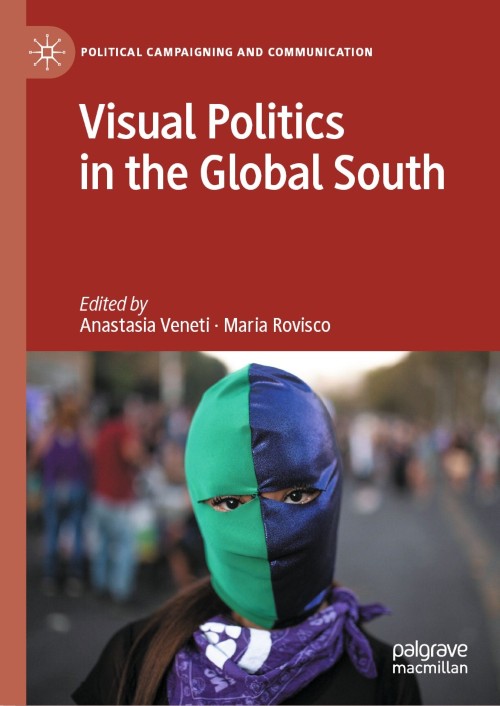
Visual Politics in the Global South [electronic resource] / edited by Anastasia Veneti, Maria Rovisco.
Erişim Adresi
ISBN
9783031227820
Dil Kodu
İngilizce
Yer Numarası
DK/18538
Basım Bildirimi
1st ed. 2023.
Yayın Bilgisi
Cham : Springer International Publishing : Imprint: Palgrave Macmillan, 2023.
Fiziksel Niteleme
XXIII, 331 p. 47 illus., 26 illus. in color. online resource.
Dizi
Political Campaigning and Communication, 2662-5903
İçindekiler Notu
Chapter 1- Introduction to Visual Politics in the Global South -- Part One- Campaigns, governance, and visual politics -- Chapter 2- Playing with accents in the Khede Kasra campaign in Lebanon: Multimodality in visual politics -- Chapter 3- Elections and social media cultures: politics, women and visuals in West Bengal, India -- Chapter 4- Visualising Hegemony and Resistance: A Multimodal Critical Discourse Analysis of “Covid-19 Hero” on Chinese Social Media -- Chapter 5- The visual construction of Andrés Manuel López Obrador’s populist communication on Facebook -- Chapter 6- Los Pinos, a Presidential Residence: Farándula politics and populism 2.0 in Mexican visual culture -- Chapter 7- Representing Change and Continuity. A Visual Analysis of Television Political Advertising for the 2020 Constitutional Plebiscite in Chile -- Chapter 8- Mapping the formats and significance of signs and meaning in political campaigns in Ghanaian elections -- Part Two- Activism, citizenship and citizen-led visual communication -- Chapter 9- The “Capuchas” Revolution: a performative icon of the Chilean Feminist Movement -- Chapter 10- Visualizing the transversal, parochial, and naïve – the artist as citizen’s trope -- Chapter 11- The visual politics of extractivism -- Chapter 12- ‘Abaixando a Máquina 2’/ Lowering the Camera 2: the power of professional photojournalism in changing the course of the 2013 mass protests in Rio de Janeiro -- Chapter 13- Protest Images of the 2014 Gaza war in the South Africa media -- Chapter 14- The appropriation of visual campaigns by the Laklãnõ people (Brazil). .
Özet, vb.
This collection is an essential contribution to the growing field of visual political communication, encouraging scholarly dialogue and recognition for a variety of ‘global-south approaches’ to visual politics. The editors bring together a diverse set of essays on both official political campaigning and grassroots protest politics, with each study examining a specific kind of visuality or visibility across varied cultural contexts. Katy Parry, Associate Professor in Media and Communication, University of Leeds, UK Visuals take centre stage in this thorough, timely and telling volume that captures all we need to know about how images are shaping the development of politics in the Global South. Long overdue, the editors ought to be congratulated for their outstanding vision in choosing non-Western societies as a focus of their study on political phenomena in the era of visual imagery. Bruce Mutsvairo, Professor and Chair, Media, Politics and the Global South, Utrecht University, the Netherlands. This is an urgently needed book that pushes for the de-Westernisation and decolonisation of the study of visual politics. What makes the collection especially compelling is how it, well, makes visible the rich diversity of visual politics research in the global South. Jason Vincent A. Cabañes, Professor of Communication, De La Salle University, Philippines It is widely acknowledged that the production, dissemination and consumption of visual products in the Global South is powerfully shaped by geo-politics and a power dynamics in which the Global North dominates the South. However, little is known about the ways in which scholarship in the Global South might challenge and resist western approaches to the study of the visual. Against this background, this book examines visual politics in the Global South through theoretically driven, and empirically grounded case studies, which focus onthe role of the visual in formal politics (e.g., political campaigns) and everyday politics (e.g grassroots politics, civil society initiatives). It will be of interest to both researchers and students interested in the study of visual politics from various disciplinary lens (media and communication, anthropology, politics, and sociology). Anastasia Veneti is Principal Academic at the Faculty of Media and Communication, Bournemouth University, UK. Maria Rovisco is Associate Professor in Sociology at the School at the School of Sociology and Social Policy at the University of Leeds, UK.
Konu
Comparative government.
Communication in politics.
Economic development.
Comparative Politics.
Political Communication.
Development Studies.
Communication in politics.
Economic development.
Comparative Politics.
Political Communication.
Development Studies.
Diğer Yazarlar
Kurum Adı
Eseri Alıntıla
Referansları kullanmadan önce gözden geçirmeniz ve varsa gerekli düzeltmeleri yapmanız önerilir.
Dijital Kaynak
MARC Görünümü
LEADER 07371nam a22006495i 4500
001 817327
003 TR_AnAIT
005 20260130190710
007 cr nn 008mamaa
008 230401s2023 sz | s |||| 0|eng d
020 |a9783031227820|9978-3-031-22782-0
024 7 |a10.1007/978-3-031-22782-0|2doi
041 |aeng
049 |aTürk Tarih Kurumu Kütüphanesi
050 4|aJF20-1177
072 7|aJPB|2bicssc
072 7|aPOL009000|2bisacsh
072 7|aJPB|2thema
082 04|a320.3|223
090 |aDK/18538
245 10|aVisual Politics in the Global South|h[electronic resource] /|cedited by Anastasia Veneti, Maria Rovisco.
250 |a1st ed. 2023.
264 1|aCham :|bSpringer International Publishing :|bImprint: Palgrave Macmillan,|c2023.
300 |aXXIII, 331 p. 47 illus., 26 illus. in color.|bonline resource.
336 |atext|btxt|2rdacontent
337 |acomputer|bc|2rdamedia
338 |aonline resource|bcr|2rdacarrier
341 0 |bTable of contents navigation|2onix
341 0 |bSingle logical reading order|2onix
341 0 |bShort alternative textual descriptions|2onix
341 0 |bUse of color is not sole means of conveying information|2onix
341 0 |bUse of high contrast between text and background color|2onix
341 0 |bNext / Previous structural navigation|2onix
341 0 |bAll non-decorative content supports reading without sight|2onix
347 |atext file|bPDF|2rda
490 1 |aPolitical Campaigning and Communication,|x2662-5903
505 0 |aChapter 1- Introduction to Visual Politics in the Global South -- Part One- Campaigns, governance, and visual politics -- Chapter 2- Playing with accents in the Khede Kasra campaign in Lebanon: Multimodality in visual politics -- Chapter 3- Elections and social media cultures: politics, women and visuals in West Bengal, India -- Chapter 4- Visualising Hegemony and Resistance: A Multimodal Critical Discourse Analysis of “Covid-19 Hero” on Chinese Social Media -- Chapter 5- The visual construction of Andrés Manuel López Obrador’s populist communication on Facebook -- Chapter 6- Los Pinos, a Presidential Residence: Farándula politics and populism 2.0 in Mexican visual culture -- Chapter 7- Representing Change and Continuity. A Visual Analysis of Television Political Advertising for the 2020 Constitutional Plebiscite in Chile -- Chapter 8- Mapping the formats and significance of signs and meaning in political campaigns in Ghanaian elections -- Part Two- Activism, citizenship and citizen-led visual communication -- Chapter 9- The “Capuchas” Revolution: a performative icon of the Chilean Feminist Movement -- Chapter 10- Visualizing the transversal, parochial, and naïve – the artist as citizen’s trope -- Chapter 11- The visual politics of extractivism -- Chapter 12- ‘Abaixando a Máquina 2’/ Lowering the Camera 2: the power of professional photojournalism in changing the course of the 2013 mass protests in Rio de Janeiro -- Chapter 13- Protest Images of the 2014 Gaza war in the South Africa media -- Chapter 14- The appropriation of visual campaigns by the Laklãnõ people (Brazil). .
520 |aThis collection is an essential contribution to the growing field of visual political communication, encouraging scholarly dialogue and recognition for a variety of ‘global-south approaches’ to visual politics. The editors bring together a diverse set of essays on both official political campaigning and grassroots protest politics, with each study examining a specific kind of visuality or visibility across varied cultural contexts. Katy Parry, Associate Professor in Media and Communication, University of Leeds, UK Visuals take centre stage in this thorough, timely and telling volume that captures all we need to know about how images are shaping the development of politics in the Global South. Long overdue, the editors ought to be congratulated for their outstanding vision in choosing non-Western societies as a focus of their study on political phenomena in the era of visual imagery. Bruce Mutsvairo, Professor and Chair, Media, Politics and the Global South, Utrecht University, the Netherlands. This is an urgently needed book that pushes for the de-Westernisation and decolonisation of the study of visual politics. What makes the collection especially compelling is how it, well, makes visible the rich diversity of visual politics research in the global South. Jason Vincent A. Cabañes, Professor of Communication, De La Salle University, Philippines It is widely acknowledged that the production, dissemination and consumption of visual products in the Global South is powerfully shaped by geo-politics and a power dynamics in which the Global North dominates the South. However, little is known about the ways in which scholarship in the Global South might challenge and resist western approaches to the study of the visual. Against this background, this book examines visual politics in the Global South through theoretically driven, and empirically grounded case studies, which focus onthe role of the visual in formal politics (e.g., political campaigns) and everyday politics (e.g grassroots politics, civil society initiatives). It will be of interest to both researchers and students interested in the study of visual politics from various disciplinary lens (media and communication, anthropology, politics, and sociology). Anastasia Veneti is Principal Academic at the Faculty of Media and Communication, Bournemouth University, UK. Maria Rovisco is Associate Professor in Sociology at the School at the School of Sociology and Social Policy at the University of Leeds, UK.
532 8 |aAccessibility summary: This PDF does not fully comply with PDF/UA standards, but does feature limited screen reader support, described non-text content (images, graphs), bookmarks for easy navigation and searchable, selectable text. Users of assistive technologies may experience difficulty navigating or interpreting content in this document. We recognize the importance of accessibility, and we welcome queries about accessibility for any of our products. If you have a question or an access need, please get in touch with us at accessibilitysupport@springernature.com.
532 8 |aNo reading system accessibility options actively disabled
532 8 |aPublisher contact for further accessibility information: accessibilitysupport@springernature.com
650 0|aComparative government.
650 0|aCommunication in politics.
650 0|aEconomic development.
650 14|aComparative Politics.
650 24|aPolitical Communication.
650 24|aDevelopment Studies.
700 1 |aVeneti, Anastasia.|eeditor.|4edt|4http://id.loc.gov/vocabulary/relators/edt
700 1 |aRovisco, Maria.|eeditor.|4edt|4http://id.loc.gov/vocabulary/relators/edt
710 2 |aSpringerLink (Online service)
773 0 |tSpringer Nature eBook
776 08|iPrinted edition:|z9783031227813
776 08|iPrinted edition:|z9783031227837
776 08|iPrinted edition:|z9783031227844
830 0|aPolitical Campaigning and Communication,|x2662-5903
856 40|uhttps://doi.org/10.1007/978-3-031-22782-0
912 |aZDB-2-POS
912 |aZDB-2-SXPI
950 |aPolitical Science and International Studies (SpringerNature-41174)
950 |aPolitical Science and International Studies (R0) (SpringerNature-43724)
001 817327
003 TR_AnAIT
005 20260130190710
007 cr nn 008mamaa
008 230401s2023 sz | s |||| 0|eng d
020 |a9783031227820|9978-3-031-22782-0
024 7 |a10.1007/978-3-031-22782-0|2doi
041 |aeng
049 |aTürk Tarih Kurumu Kütüphanesi
050 4|aJF20-1177
072 7|aJPB|2bicssc
072 7|aPOL009000|2bisacsh
072 7|aJPB|2thema
082 04|a320.3|223
090 |aDK/18538
245 10|aVisual Politics in the Global South|h[electronic resource] /|cedited by Anastasia Veneti, Maria Rovisco.
250 |a1st ed. 2023.
264 1|aCham :|bSpringer International Publishing :|bImprint: Palgrave Macmillan,|c2023.
300 |aXXIII, 331 p. 47 illus., 26 illus. in color.|bonline resource.
336 |atext|btxt|2rdacontent
337 |acomputer|bc|2rdamedia
338 |aonline resource|bcr|2rdacarrier
341 0 |bTable of contents navigation|2onix
341 0 |bSingle logical reading order|2onix
341 0 |bShort alternative textual descriptions|2onix
341 0 |bUse of color is not sole means of conveying information|2onix
341 0 |bUse of high contrast between text and background color|2onix
341 0 |bNext / Previous structural navigation|2onix
341 0 |bAll non-decorative content supports reading without sight|2onix
347 |atext file|bPDF|2rda
490 1 |aPolitical Campaigning and Communication,|x2662-5903
505 0 |aChapter 1- Introduction to Visual Politics in the Global South -- Part One- Campaigns, governance, and visual politics -- Chapter 2- Playing with accents in the Khede Kasra campaign in Lebanon: Multimodality in visual politics -- Chapter 3- Elections and social media cultures: politics, women and visuals in West Bengal, India -- Chapter 4- Visualising Hegemony and Resistance: A Multimodal Critical Discourse Analysis of “Covid-19 Hero” on Chinese Social Media -- Chapter 5- The visual construction of Andrés Manuel López Obrador’s populist communication on Facebook -- Chapter 6- Los Pinos, a Presidential Residence: Farándula politics and populism 2.0 in Mexican visual culture -- Chapter 7- Representing Change and Continuity. A Visual Analysis of Television Political Advertising for the 2020 Constitutional Plebiscite in Chile -- Chapter 8- Mapping the formats and significance of signs and meaning in political campaigns in Ghanaian elections -- Part Two- Activism, citizenship and citizen-led visual communication -- Chapter 9- The “Capuchas” Revolution: a performative icon of the Chilean Feminist Movement -- Chapter 10- Visualizing the transversal, parochial, and naïve – the artist as citizen’s trope -- Chapter 11- The visual politics of extractivism -- Chapter 12- ‘Abaixando a Máquina 2’/ Lowering the Camera 2: the power of professional photojournalism in changing the course of the 2013 mass protests in Rio de Janeiro -- Chapter 13- Protest Images of the 2014 Gaza war in the South Africa media -- Chapter 14- The appropriation of visual campaigns by the Laklãnõ people (Brazil). .
520 |aThis collection is an essential contribution to the growing field of visual political communication, encouraging scholarly dialogue and recognition for a variety of ‘global-south approaches’ to visual politics. The editors bring together a diverse set of essays on both official political campaigning and grassroots protest politics, with each study examining a specific kind of visuality or visibility across varied cultural contexts. Katy Parry, Associate Professor in Media and Communication, University of Leeds, UK Visuals take centre stage in this thorough, timely and telling volume that captures all we need to know about how images are shaping the development of politics in the Global South. Long overdue, the editors ought to be congratulated for their outstanding vision in choosing non-Western societies as a focus of their study on political phenomena in the era of visual imagery. Bruce Mutsvairo, Professor and Chair, Media, Politics and the Global South, Utrecht University, the Netherlands. This is an urgently needed book that pushes for the de-Westernisation and decolonisation of the study of visual politics. What makes the collection especially compelling is how it, well, makes visible the rich diversity of visual politics research in the global South. Jason Vincent A. Cabañes, Professor of Communication, De La Salle University, Philippines It is widely acknowledged that the production, dissemination and consumption of visual products in the Global South is powerfully shaped by geo-politics and a power dynamics in which the Global North dominates the South. However, little is known about the ways in which scholarship in the Global South might challenge and resist western approaches to the study of the visual. Against this background, this book examines visual politics in the Global South through theoretically driven, and empirically grounded case studies, which focus onthe role of the visual in formal politics (e.g., political campaigns) and everyday politics (e.g grassroots politics, civil society initiatives). It will be of interest to both researchers and students interested in the study of visual politics from various disciplinary lens (media and communication, anthropology, politics, and sociology). Anastasia Veneti is Principal Academic at the Faculty of Media and Communication, Bournemouth University, UK. Maria Rovisco is Associate Professor in Sociology at the School at the School of Sociology and Social Policy at the University of Leeds, UK.
532 8 |aAccessibility summary: This PDF does not fully comply with PDF/UA standards, but does feature limited screen reader support, described non-text content (images, graphs), bookmarks for easy navigation and searchable, selectable text. Users of assistive technologies may experience difficulty navigating or interpreting content in this document. We recognize the importance of accessibility, and we welcome queries about accessibility for any of our products. If you have a question or an access need, please get in touch with us at accessibilitysupport@springernature.com.
532 8 |aNo reading system accessibility options actively disabled
532 8 |aPublisher contact for further accessibility information: accessibilitysupport@springernature.com
650 0|aComparative government.
650 0|aCommunication in politics.
650 0|aEconomic development.
650 14|aComparative Politics.
650 24|aPolitical Communication.
650 24|aDevelopment Studies.
700 1 |aVeneti, Anastasia.|eeditor.|4edt|4http://id.loc.gov/vocabulary/relators/edt
700 1 |aRovisco, Maria.|eeditor.|4edt|4http://id.loc.gov/vocabulary/relators/edt
710 2 |aSpringerLink (Online service)
773 0 |tSpringer Nature eBook
776 08|iPrinted edition:|z9783031227813
776 08|iPrinted edition:|z9783031227837
776 08|iPrinted edition:|z9783031227844
830 0|aPolitical Campaigning and Communication,|x2662-5903
856 40|uhttps://doi.org/10.1007/978-3-031-22782-0
912 |aZDB-2-POS
912 |aZDB-2-SXPI
950 |aPolitical Science and International Studies (SpringerNature-41174)
950 |aPolitical Science and International Studies (R0) (SpringerNature-43724)
Materyaller
Depodan talep edilen materyal sadece kütüphane içerisinde kullanılmaktadır.
Materyal dışarıya ödünç verilmemektedir.
Materyal dışarıya ödünç verilmemektedir.
