

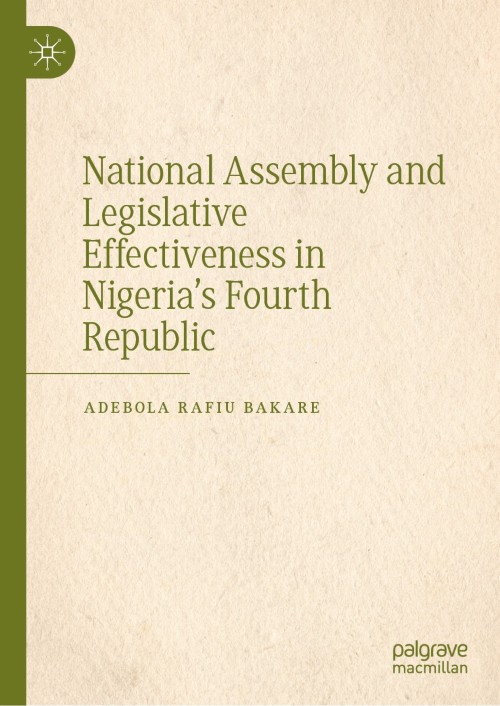
National Assembly and Legislative Effectiveness in Nigeria’s Fourth Republic [electronic resource] / by Adebola Rafiu BAKARE.
Erişim Adresi
ISBN
9789819907809
Dil Kodu
İngilizce
Yer Numarası
DK/18540
Yazar
Basım Bildirimi
1st ed. 2023.
Yayın Bilgisi
Singapore : Springer Nature Singapore : Imprint: Palgrave Macmillan, 2023.
Fiziksel Niteleme
XXII, 256 p. 22 illus., 3 illus. in color. online resource.
İçindekiler Notu
Chapter One: Concept, Origin and Significance of Legislature in Democratic Governance -- Chapter Two: Historical Development and the Institutional Framework of the Nigerian National Assembly -- Chapter Three: Legislative Powers and Lawmaking Process in the Nigerian National Assembly -- Chapter Four: Legislative Effectiveness: A Discourse on Measuring Toolkits, Benchmarks and Indicators -- Chapter Five: Measuring Legislative Effectiveness in the Nigerian National Assembly: The Birth of ILES Model -- Chapter Six: Comparative Analysis of Legislative Effectiveness of the 4th - 8th National Assemblies -- Chapter Seven: Assessing the Legislative Effectiveness of the National Assembly: The ILES Model Approach -- Chapter Eight: Interpreting the Lawmaking Performance and Determinants of Legislative Effectiveness of the National Assembly -- Chapter Nine: Legislative Impact on the People and the Challenges facing the National Assembly -- Chapter Ten: Budgetary Process and other major Issues that have affected the National Assembly in the Fourth Republic -- Chapter Eleven: Interrogating Membership Distribution and the Cost of Running the National Assembly -- Chapter Twelve: Towards Reforming the National Assembly: A Discourse of Issues, Constraints and Way-Forward.
Özet, vb.
This book evaluates the legislative effectiveness of Nigeria’s National Assembly under the Fourth Republic. The assessment covers five Assemblies (4th–8th) and focuses specifically on lawmaking, cost of running the National Assembly, and the budget making process. It empirically assesses the effectiveness of the Nigerian national legislature beyond previous emotional and sentimental evaluations of the institution. It has developed a model ‘Institutional Legislative Effectiveness Score’ used in assessing the institutional performance of the National Assembly from two perspectives: first, by comparing the performances of the two chambers in the same Assembly; and second, by comparing the performances of the institution across Assemblies. Aside lawmaking, the book also covers the major topical issues that characterized public evaluation of the institution. These include: size of the institution, budgeting process, cost of funding the institution, and the debate on the appropriate way in reforming the National Assembly. Adebola Rafiu BAKARE is a lecturer and currently Head of the Department of Political Science, University of Ilorin, Ilorin, Nigeria.
Konu
Africa __ Politics and government.
Legislation.
World politics.
Political science.
African Politics.
Legislative Politics.
Political History.
Political Science.
Legislation.
World politics.
Political science.
African Politics.
Legislative Politics.
Political History.
Political Science.
Kurum Adı
Eseri Alıntıla
Referansları kullanmadan önce gözden geçirmeniz ve varsa gerekli düzeltmeleri yapmanız önerilir.
Dijital Kaynak
MARC Görünümü
LEADER 05520nam a22006375i 4500
001 817329
003 TR_AnAIT
005 20260130190701
007 cr nn 008mamaa
008 230728s2023 si | s |||| 0|eng d
020 |a9789819907809|9978-981-99-0780-9
024 7 |a10.1007/978-981-99-0780-9|2doi
041 |aeng
049 |aTürk Tarih Kurumu Kütüphanesi
050 4|aJQ1870-3981
072 7|aJP|2bicssc
072 7|a1H|2bicssc
072 7|aPOL053000|2bisacsh
072 7|aJP|x1H|2thema
082 04|a320.96|223
090 |aDK/18540
100 1 |aBAKARE, Adebola Rafiu.|eauthor.|4aut|4http://id.loc.gov/vocabulary/relators/aut
245 10|aNational Assembly and Legislative Effectiveness in Nigeria’s Fourth Republic|h[electronic resource] /|cby Adebola Rafiu BAKARE.
250 |a1st ed. 2023.
264 1|aSingapore :|bSpringer Nature Singapore :|bImprint: Palgrave Macmillan,|c2023.
300 |aXXII, 256 p. 22 illus., 3 illus. in color.|bonline resource.
336 |atext|btxt|2rdacontent
337 |acomputer|bc|2rdamedia
338 |aonline resource|bcr|2rdacarrier
341 0 |bTable of contents navigation|2onix
341 0 |bSingle logical reading order|2onix
341 0 |bShort alternative textual descriptions|2onix
341 0 |bUse of color is not sole means of conveying information|2onix
341 0 |bUse of high contrast between text and background color|2onix
341 0 |bNext / Previous structural navigation|2onix
341 0 |bAll non-decorative content supports reading without sight|2onix
347 |atext file|bPDF|2rda
505 0 |aChapter One: Concept, Origin and Significance of Legislature in Democratic Governance -- Chapter Two: Historical Development and the Institutional Framework of the Nigerian National Assembly -- Chapter Three: Legislative Powers and Lawmaking Process in the Nigerian National Assembly -- Chapter Four: Legislative Effectiveness: A Discourse on Measuring Toolkits, Benchmarks and Indicators -- Chapter Five: Measuring Legislative Effectiveness in the Nigerian National Assembly: The Birth of ILES Model -- Chapter Six: Comparative Analysis of Legislative Effectiveness of the 4th - 8th National Assemblies -- Chapter Seven: Assessing the Legislative Effectiveness of the National Assembly: The ILES Model Approach -- Chapter Eight: Interpreting the Lawmaking Performance and Determinants of Legislative Effectiveness of the National Assembly -- Chapter Nine: Legislative Impact on the People and the Challenges facing the National Assembly -- Chapter Ten: Budgetary Process and other major Issues that have affected the National Assembly in the Fourth Republic -- Chapter Eleven: Interrogating Membership Distribution and the Cost of Running the National Assembly -- Chapter Twelve: Towards Reforming the National Assembly: A Discourse of Issues, Constraints and Way-Forward.
520 |aThis book evaluates the legislative effectiveness of Nigeria’s National Assembly under the Fourth Republic. The assessment covers five Assemblies (4th–8th) and focuses specifically on lawmaking, cost of running the National Assembly, and the budget making process. It empirically assesses the effectiveness of the Nigerian national legislature beyond previous emotional and sentimental evaluations of the institution. It has developed a model ‘Institutional Legislative Effectiveness Score’ used in assessing the institutional performance of the National Assembly from two perspectives: first, by comparing the performances of the two chambers in the same Assembly; and second, by comparing the performances of the institution across Assemblies. Aside lawmaking, the book also covers the major topical issues that characterized public evaluation of the institution. These include: size of the institution, budgeting process, cost of funding the institution, and the debate on the appropriate way in reforming the National Assembly. Adebola Rafiu BAKARE is a lecturer and currently Head of the Department of Political Science, University of Ilorin, Ilorin, Nigeria.
532 8 |aAccessibility summary: This PDF does not fully comply with PDF/UA standards, but does feature limited screen reader support, described non-text content (images, graphs), bookmarks for easy navigation and searchable, selectable text. Users of assistive technologies may experience difficulty navigating or interpreting content in this document. We recognize the importance of accessibility, and we welcome queries about accessibility for any of our products. If you have a question or an access need, please get in touch with us at accessibilitysupport@springernature.com.
532 8 |aNo reading system accessibility options actively disabled
532 8 |aPublisher contact for further accessibility information: accessibilitysupport@springernature.com
650 0|aAfrica|xPolitics and government.
650 0|aLegislation.
650 0|aWorld politics.
650 0|aPolitical science.
650 14|aAfrican Politics.
650 24|aLegislative Politics.
650 24|aPolitical History.
650 24|aPolitical Science.
710 2 |aSpringerLink (Online service)
773 0 |tSpringer Nature eBook
776 08|iPrinted edition:|z9789819907793
776 08|iPrinted edition:|z9789819907816
856 40|uhttps://doi.org/10.1007/978-981-99-0780-9
912 |aZDB-2-POS
912 |aZDB-2-SXPI
950 |aPolitical Science and International Studies (SpringerNature-41174)
950 |aPolitical Science and International Studies (R0) (SpringerNature-43724)
001 817329
003 TR_AnAIT
005 20260130190701
007 cr nn 008mamaa
008 230728s2023 si | s |||| 0|eng d
020 |a9789819907809|9978-981-99-0780-9
024 7 |a10.1007/978-981-99-0780-9|2doi
041 |aeng
049 |aTürk Tarih Kurumu Kütüphanesi
050 4|aJQ1870-3981
072 7|aJP|2bicssc
072 7|a1H|2bicssc
072 7|aPOL053000|2bisacsh
072 7|aJP|x1H|2thema
082 04|a320.96|223
090 |aDK/18540
100 1 |aBAKARE, Adebola Rafiu.|eauthor.|4aut|4http://id.loc.gov/vocabulary/relators/aut
245 10|aNational Assembly and Legislative Effectiveness in Nigeria’s Fourth Republic|h[electronic resource] /|cby Adebola Rafiu BAKARE.
250 |a1st ed. 2023.
264 1|aSingapore :|bSpringer Nature Singapore :|bImprint: Palgrave Macmillan,|c2023.
300 |aXXII, 256 p. 22 illus., 3 illus. in color.|bonline resource.
336 |atext|btxt|2rdacontent
337 |acomputer|bc|2rdamedia
338 |aonline resource|bcr|2rdacarrier
341 0 |bTable of contents navigation|2onix
341 0 |bSingle logical reading order|2onix
341 0 |bShort alternative textual descriptions|2onix
341 0 |bUse of color is not sole means of conveying information|2onix
341 0 |bUse of high contrast between text and background color|2onix
341 0 |bNext / Previous structural navigation|2onix
341 0 |bAll non-decorative content supports reading without sight|2onix
347 |atext file|bPDF|2rda
505 0 |aChapter One: Concept, Origin and Significance of Legislature in Democratic Governance -- Chapter Two: Historical Development and the Institutional Framework of the Nigerian National Assembly -- Chapter Three: Legislative Powers and Lawmaking Process in the Nigerian National Assembly -- Chapter Four: Legislative Effectiveness: A Discourse on Measuring Toolkits, Benchmarks and Indicators -- Chapter Five: Measuring Legislative Effectiveness in the Nigerian National Assembly: The Birth of ILES Model -- Chapter Six: Comparative Analysis of Legislative Effectiveness of the 4th - 8th National Assemblies -- Chapter Seven: Assessing the Legislative Effectiveness of the National Assembly: The ILES Model Approach -- Chapter Eight: Interpreting the Lawmaking Performance and Determinants of Legislative Effectiveness of the National Assembly -- Chapter Nine: Legislative Impact on the People and the Challenges facing the National Assembly -- Chapter Ten: Budgetary Process and other major Issues that have affected the National Assembly in the Fourth Republic -- Chapter Eleven: Interrogating Membership Distribution and the Cost of Running the National Assembly -- Chapter Twelve: Towards Reforming the National Assembly: A Discourse of Issues, Constraints and Way-Forward.
520 |aThis book evaluates the legislative effectiveness of Nigeria’s National Assembly under the Fourth Republic. The assessment covers five Assemblies (4th–8th) and focuses specifically on lawmaking, cost of running the National Assembly, and the budget making process. It empirically assesses the effectiveness of the Nigerian national legislature beyond previous emotional and sentimental evaluations of the institution. It has developed a model ‘Institutional Legislative Effectiveness Score’ used in assessing the institutional performance of the National Assembly from two perspectives: first, by comparing the performances of the two chambers in the same Assembly; and second, by comparing the performances of the institution across Assemblies. Aside lawmaking, the book also covers the major topical issues that characterized public evaluation of the institution. These include: size of the institution, budgeting process, cost of funding the institution, and the debate on the appropriate way in reforming the National Assembly. Adebola Rafiu BAKARE is a lecturer and currently Head of the Department of Political Science, University of Ilorin, Ilorin, Nigeria.
532 8 |aAccessibility summary: This PDF does not fully comply with PDF/UA standards, but does feature limited screen reader support, described non-text content (images, graphs), bookmarks for easy navigation and searchable, selectable text. Users of assistive technologies may experience difficulty navigating or interpreting content in this document. We recognize the importance of accessibility, and we welcome queries about accessibility for any of our products. If you have a question or an access need, please get in touch with us at accessibilitysupport@springernature.com.
532 8 |aNo reading system accessibility options actively disabled
532 8 |aPublisher contact for further accessibility information: accessibilitysupport@springernature.com
650 0|aAfrica|xPolitics and government.
650 0|aLegislation.
650 0|aWorld politics.
650 0|aPolitical science.
650 14|aAfrican Politics.
650 24|aLegislative Politics.
650 24|aPolitical History.
650 24|aPolitical Science.
710 2 |aSpringerLink (Online service)
773 0 |tSpringer Nature eBook
776 08|iPrinted edition:|z9789819907793
776 08|iPrinted edition:|z9789819907816
856 40|uhttps://doi.org/10.1007/978-981-99-0780-9
912 |aZDB-2-POS
912 |aZDB-2-SXPI
950 |aPolitical Science and International Studies (SpringerNature-41174)
950 |aPolitical Science and International Studies (R0) (SpringerNature-43724)
Materyaller
Depodan talep edilen materyal sadece kütüphane içerisinde kullanılmaktadır.
Materyal dışarıya ödünç verilmemektedir.
Materyal dışarıya ödünç verilmemektedir.
