

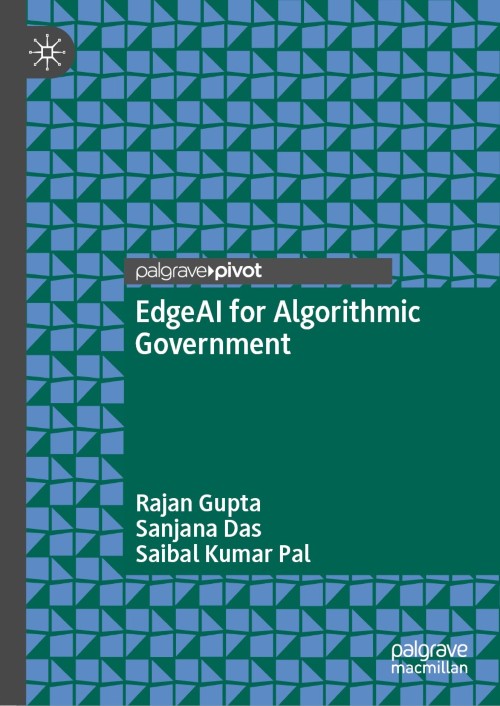
EdgeAI for Algorithmic Government [electronic resource] / by Rajan Gupta, Sanjana Das, Saibal Kumar Pal.
Erişim Adresi
ISBN
9789811997983
Dil Kodu
İngilizce
Yer Numarası
DK/18628
Basım Bildirimi
1st ed. 2023.
Yayın Bilgisi
Singapore : Springer Nature Singapore : Imprint: Palgrave Macmillan, 2023.
Fiziksel Niteleme
XXI, 92 p. 15 illus., 12 illus. in color. online resource.
İçindekiler Notu
Chapter 1: Algorithmic Government -- Chapter 2: Edge Computing -- Chapter 3: EdgeAI -- Chapter 4: EdgeAI Cases for Algorithmic Government -- Chapter 5: Design Challenges & Future Scope.
Özet, vb.
The book provides various EdgeAI concepts related to its architecture, key performance indicators, and enabling technologies after introducing algorithmic government, large-scale decision-making, and computing issues in the cloud and fog. With advancements in technology, artificial intelligence has permeated our personal lives and the fields of economy, socio-culture, and politics. The integration of artificial intelligence (AI) into decision-making for public services is changing how governments operate worldwide. This book discusses how algorithms help the government in various ways, including virtual assistants for busy civil servants, automated public services, and algorithmic decision-making processes. In such cases, the implementation of algorithms will occur on a massive scale and possibly affect the lives of entire communities. The cloud-centric architecture of artificial intelligence brings out challenges of latency, overhead communication, and significant privacy risks. Due to the sheer volume of data generated by IoT devices, the data analysis must be performed at the forefront of the network. This introduces the need for edge computing in algorithmic government. EdgeAI, the confluence of edge computing and AI, is the primary focus of this book. It also discusses how one can incorporate these concepts in algorithmic government through conceptual framework and decision points. Finally, the research work emphasizes some design challenges in edge computing from applications viewpoint. This book will be helpful for data engineers, data scientists, cloud engineers, data management experts, public policymakers, administrators, research scholars and academicians. Dr. Rajan Gupta is Vice President and Head of Research and Analytics Division at Analyttica Datalab, India, and has done Postdoc in Data Science and Modelling from CITAM Lab, UNG Slovenia. He has authored 4 books and more than 75 papers in the area of e-governance, algorithmic government, information systems, security and data science. Ms. Sanjana Das is an AI enthusiast currently enrolled with Deen Dayal Upadhyaya College, University of Delhi, India, for research work. Her research area includes data science, edge computing, and artificial intelligence. Dr. Saibal K. Pal is a Senior Scientist at Scientific Analysis Group, Defence Research & Development Organization (DRDO), Delhi. He has formerly served as Director of IT and Cyber Security at National Level for DRDO, India, and has authored more than 200 publications in the area of e-governance, algorithmic government, information systems, security and data science.
Konu
Political science.
Artificial intelligence.
Computer science.
Legislation.
Economic development.
Governance and Government.
Artificial Intelligence.
Theory and Algorithms for Application Domains.
Legislative Politics.
Development Studies.
Artificial intelligence.
Computer science.
Legislation.
Economic development.
Governance and Government.
Artificial Intelligence.
Theory and Algorithms for Application Domains.
Legislative Politics.
Development Studies.
Diğer Yazarlar
Kurum Adı
Eseri Alıntıla
Referansları kullanmadan önce gözden geçirmeniz ve varsa gerekli düzeltmeleri yapmanız önerilir.
Dijital Kaynak
MARC Görünümü
LEADER 06178nam a22006735i 4500
001 817417
003 TR_AnAIT
005 20260130190215
007 cr nn 008mamaa
008 230326s2023 si | s |||| 0|eng d
020 |a9789811997983|9978-981-19-9798-3
024 7 |a10.1007/978-981-19-9798-3|2doi
041 |aeng
049 |aTürk Tarih Kurumu Kütüphanesi
050 4|aJF20-2112
072 7|aJPQ|2bicssc
072 7|aPOL028000|2bisacsh
072 7|aJPQ|2thema
082 04|a320.4|223
090 |aDK/18628
100 1 |aGupta, Rajan.|eauthor.|0(orcid)0000-0002-9851-4047|1https://orcid.org/0000-0002-9851-4047|4aut|4http://id.loc.gov/vocabulary/relators/aut
245 10|aEdgeAI for Algorithmic Government|h[electronic resource] /|cby Rajan Gupta, Sanjana Das, Saibal Kumar Pal.
250 |a1st ed. 2023.
264 1|aSingapore :|bSpringer Nature Singapore :|bImprint: Palgrave Macmillan,|c2023.
300 |aXXI, 92 p. 15 illus., 12 illus. in color.|bonline resource.
336 |atext|btxt|2rdacontent
337 |acomputer|bc|2rdamedia
338 |aonline resource|bcr|2rdacarrier
341 0 |bTable of contents navigation|2onix
341 0 |bSingle logical reading order|2onix
341 0 |bShort alternative textual descriptions|2onix
341 0 |bUse of color is not sole means of conveying information|2onix
341 0 |bUse of high contrast between text and background color|2onix
341 0 |bNext / Previous structural navigation|2onix
341 0 |bAll non-decorative content supports reading without sight|2onix
347 |atext file|bPDF|2rda
505 0 |aChapter 1: Algorithmic Government -- Chapter 2: Edge Computing -- Chapter 3: EdgeAI -- Chapter 4: EdgeAI Cases for Algorithmic Government -- Chapter 5: Design Challenges & Future Scope.
520 |aThe book provides various EdgeAI concepts related to its architecture, key performance indicators, and enabling technologies after introducing algorithmic government, large-scale decision-making, and computing issues in the cloud and fog. With advancements in technology, artificial intelligence has permeated our personal lives and the fields of economy, socio-culture, and politics. The integration of artificial intelligence (AI) into decision-making for public services is changing how governments operate worldwide. This book discusses how algorithms help the government in various ways, including virtual assistants for busy civil servants, automated public services, and algorithmic decision-making processes. In such cases, the implementation of algorithms will occur on a massive scale and possibly affect the lives of entire communities. The cloud-centric architecture of artificial intelligence brings out challenges of latency, overhead communication, and significant privacy risks. Due to the sheer volume of data generated by IoT devices, the data analysis must be performed at the forefront of the network. This introduces the need for edge computing in algorithmic government. EdgeAI, the confluence of edge computing and AI, is the primary focus of this book. It also discusses how one can incorporate these concepts in algorithmic government through conceptual framework and decision points. Finally, the research work emphasizes some design challenges in edge computing from applications viewpoint. This book will be helpful for data engineers, data scientists, cloud engineers, data management experts, public policymakers, administrators, research scholars and academicians. Dr. Rajan Gupta is Vice President and Head of Research and Analytics Division at Analyttica Datalab, India, and has done Postdoc in Data Science and Modelling from CITAM Lab, UNG Slovenia. He has authored 4 books and more than 75 papers in the area of e-governance, algorithmic government, information systems, security and data science. Ms. Sanjana Das is an AI enthusiast currently enrolled with Deen Dayal Upadhyaya College, University of Delhi, India, for research work. Her research area includes data science, edge computing, and artificial intelligence. Dr. Saibal K. Pal is a Senior Scientist at Scientific Analysis Group, Defence Research & Development Organization (DRDO), Delhi. He has formerly served as Director of IT and Cyber Security at National Level for DRDO, India, and has authored more than 200 publications in the area of e-governance, algorithmic government, information systems, security and data science.
532 8 |aAccessibility summary: This PDF does not fully comply with PDF/UA standards, but does feature limited screen reader support, described non-text content (images, graphs), bookmarks for easy navigation and searchable, selectable text. Users of assistive technologies may experience difficulty navigating or interpreting content in this document. We recognize the importance of accessibility, and we welcome queries about accessibility for any of our products. If you have a question or an access need, please get in touch with us at accessibilitysupport@springernature.com.
532 8 |aNo reading system accessibility options actively disabled
532 8 |aPublisher contact for further accessibility information: accessibilitysupport@springernature.com
650 0|aPolitical science.
650 0|aArtificial intelligence.
650 0|aComputer science.
650 0|aLegislation.
650 0|aEconomic development.
650 14|aGovernance and Government.
650 24|aArtificial Intelligence.
650 24|aTheory and Algorithms for Application Domains.
650 24|aLegislative Politics.
650 24|aDevelopment Studies.
700 1 |aDas, Sanjana.|eauthor.|4aut|4http://id.loc.gov/vocabulary/relators/aut
700 1 |aPal, Saibal Kumar.|eauthor.|4aut|4http://id.loc.gov/vocabulary/relators/aut
710 2 |aSpringerLink (Online service)
773 0 |tSpringer Nature eBook
776 08|iPrinted edition:|z9789811997976
776 08|iPrinted edition:|z9789811997990
856 40|uhttps://doi.org/10.1007/978-981-19-9798-3
912 |aZDB-2-POS
912 |aZDB-2-SXPI
950 |aPolitical Science and International Studies (SpringerNature-41174)
950 |aPolitical Science and International Studies (R0) (SpringerNature-43724)
001 817417
003 TR_AnAIT
005 20260130190215
007 cr nn 008mamaa
008 230326s2023 si | s |||| 0|eng d
020 |a9789811997983|9978-981-19-9798-3
024 7 |a10.1007/978-981-19-9798-3|2doi
041 |aeng
049 |aTürk Tarih Kurumu Kütüphanesi
050 4|aJF20-2112
072 7|aJPQ|2bicssc
072 7|aPOL028000|2bisacsh
072 7|aJPQ|2thema
082 04|a320.4|223
090 |aDK/18628
100 1 |aGupta, Rajan.|eauthor.|0(orcid)0000-0002-9851-4047|1https://orcid.org/0000-0002-9851-4047|4aut|4http://id.loc.gov/vocabulary/relators/aut
245 10|aEdgeAI for Algorithmic Government|h[electronic resource] /|cby Rajan Gupta, Sanjana Das, Saibal Kumar Pal.
250 |a1st ed. 2023.
264 1|aSingapore :|bSpringer Nature Singapore :|bImprint: Palgrave Macmillan,|c2023.
300 |aXXI, 92 p. 15 illus., 12 illus. in color.|bonline resource.
336 |atext|btxt|2rdacontent
337 |acomputer|bc|2rdamedia
338 |aonline resource|bcr|2rdacarrier
341 0 |bTable of contents navigation|2onix
341 0 |bSingle logical reading order|2onix
341 0 |bShort alternative textual descriptions|2onix
341 0 |bUse of color is not sole means of conveying information|2onix
341 0 |bUse of high contrast between text and background color|2onix
341 0 |bNext / Previous structural navigation|2onix
341 0 |bAll non-decorative content supports reading without sight|2onix
347 |atext file|bPDF|2rda
505 0 |aChapter 1: Algorithmic Government -- Chapter 2: Edge Computing -- Chapter 3: EdgeAI -- Chapter 4: EdgeAI Cases for Algorithmic Government -- Chapter 5: Design Challenges & Future Scope.
520 |aThe book provides various EdgeAI concepts related to its architecture, key performance indicators, and enabling technologies after introducing algorithmic government, large-scale decision-making, and computing issues in the cloud and fog. With advancements in technology, artificial intelligence has permeated our personal lives and the fields of economy, socio-culture, and politics. The integration of artificial intelligence (AI) into decision-making for public services is changing how governments operate worldwide. This book discusses how algorithms help the government in various ways, including virtual assistants for busy civil servants, automated public services, and algorithmic decision-making processes. In such cases, the implementation of algorithms will occur on a massive scale and possibly affect the lives of entire communities. The cloud-centric architecture of artificial intelligence brings out challenges of latency, overhead communication, and significant privacy risks. Due to the sheer volume of data generated by IoT devices, the data analysis must be performed at the forefront of the network. This introduces the need for edge computing in algorithmic government. EdgeAI, the confluence of edge computing and AI, is the primary focus of this book. It also discusses how one can incorporate these concepts in algorithmic government through conceptual framework and decision points. Finally, the research work emphasizes some design challenges in edge computing from applications viewpoint. This book will be helpful for data engineers, data scientists, cloud engineers, data management experts, public policymakers, administrators, research scholars and academicians. Dr. Rajan Gupta is Vice President and Head of Research and Analytics Division at Analyttica Datalab, India, and has done Postdoc in Data Science and Modelling from CITAM Lab, UNG Slovenia. He has authored 4 books and more than 75 papers in the area of e-governance, algorithmic government, information systems, security and data science. Ms. Sanjana Das is an AI enthusiast currently enrolled with Deen Dayal Upadhyaya College, University of Delhi, India, for research work. Her research area includes data science, edge computing, and artificial intelligence. Dr. Saibal K. Pal is a Senior Scientist at Scientific Analysis Group, Defence Research & Development Organization (DRDO), Delhi. He has formerly served as Director of IT and Cyber Security at National Level for DRDO, India, and has authored more than 200 publications in the area of e-governance, algorithmic government, information systems, security and data science.
532 8 |aAccessibility summary: This PDF does not fully comply with PDF/UA standards, but does feature limited screen reader support, described non-text content (images, graphs), bookmarks for easy navigation and searchable, selectable text. Users of assistive technologies may experience difficulty navigating or interpreting content in this document. We recognize the importance of accessibility, and we welcome queries about accessibility for any of our products. If you have a question or an access need, please get in touch with us at accessibilitysupport@springernature.com.
532 8 |aNo reading system accessibility options actively disabled
532 8 |aPublisher contact for further accessibility information: accessibilitysupport@springernature.com
650 0|aPolitical science.
650 0|aArtificial intelligence.
650 0|aComputer science.
650 0|aLegislation.
650 0|aEconomic development.
650 14|aGovernance and Government.
650 24|aArtificial Intelligence.
650 24|aTheory and Algorithms for Application Domains.
650 24|aLegislative Politics.
650 24|aDevelopment Studies.
700 1 |aDas, Sanjana.|eauthor.|4aut|4http://id.loc.gov/vocabulary/relators/aut
700 1 |aPal, Saibal Kumar.|eauthor.|4aut|4http://id.loc.gov/vocabulary/relators/aut
710 2 |aSpringerLink (Online service)
773 0 |tSpringer Nature eBook
776 08|iPrinted edition:|z9789811997976
776 08|iPrinted edition:|z9789811997990
856 40|uhttps://doi.org/10.1007/978-981-19-9798-3
912 |aZDB-2-POS
912 |aZDB-2-SXPI
950 |aPolitical Science and International Studies (SpringerNature-41174)
950 |aPolitical Science and International Studies (R0) (SpringerNature-43724)
Materyaller
Depodan talep edilen materyal sadece kütüphane içerisinde kullanılmaktadır.
Materyal dışarıya ödünç verilmemektedir.
Materyal dışarıya ödünç verilmemektedir.
