

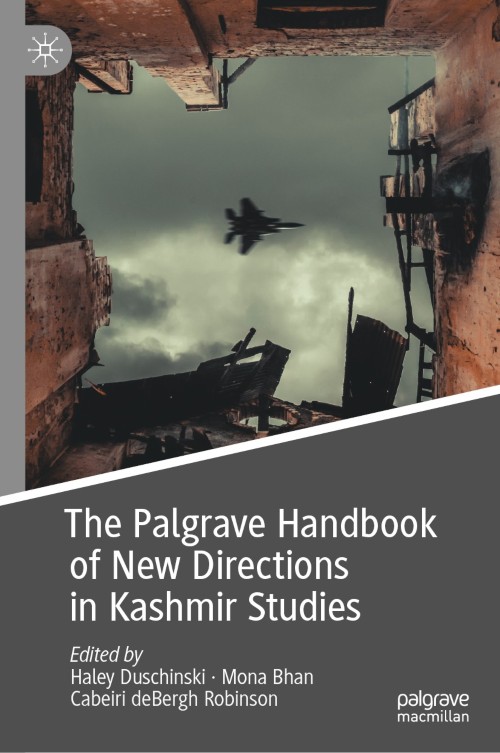
The Palgrave Handbook of New Directions in Kashmir Studies [electronic resource] / edited by Haley Duschinski, Mona Bhan, Cabeiri deBergh Robinson.
Erişim Adresi
ISBN
9783031285202
Dil Kodu
İngilizce
Yer Numarası
DK/18639
Basım Bildirimi
1st ed. 2023.
Yayın Bilgisi
Cham : Springer International Publishing : Imprint: Palgrave Macmillan, 2023.
Fiziksel Niteleme
XIX, 498 p. 3 illus., 2 illus. in color. online resource.
İçindekiler Notu
Chapter 1: New Directions in Kashmir Studies: Unsettling State Power, Military Violence, and Border Regimes Across Kashmir -- Part I: The Princely State and the End of Empire -- Chapter 2: Locating Jammu and Kashmir -- Chapter 3: Locating Azad Kashmir -- Chapter 4: Locating Gilgit-Baltistan -- Part II: Unequal Sovereignties and Contestations for Power Across Kashmir -- Chapter 5: Azad Kashmir and Gilgit-Baltistan: Politics of Power Sharing and Status Quo -- Chapter 6: Power, Parties and Politics in the Liminal Spaces of Gilgit-Baltistan -- Chapter 7: Peoples’ Struggle for Participatory Governance in Gilgit-Baltistan -- Chapter 8: “Democracy”: Making Sense of Grassroots Politics in Kashmir -- Chapter 9: From Incorporation to Elimination: Interlocution as an Apparatus of Occupation in Kashmir -- Part III: Kashmir in Transnational Context and International Law from Below -- Chapter 10: International Law and the Kashmir Dispute: A Critical Reflection -- Chapter 11: Critical Interventions: Human Rights and International Justice in Kashmir -- Chapter 12: Creating Archives of Memory: The Landscapes of Human Rights Documentation in Kashmir -- Chapter 13: Grieving Kashmir: Counter-memory, Accountability and A People’s Tribunal -- Chapter 14: British Kashmiri Workers: Solidarity Networks and Dreams for “Home” and Freedom -- Part IV: Islam, Embodiment, and the Politics of the Human -- Chapter 15: Looking Beyond “Human”: Animal and the Kashmiri Resistance Movement -- Chapter 16: The Logics of Counterinsurgency Education and Resistance in Thirdspace -- Chapter 17: On Kashmiri Men: Disappearance, Nonbeing, Islam -- Chapter 18: Intrusion into the Intimate: Home and the Gendered Anatomy of Crackdowns in Kashmir -- Chapter 19: “Men Had Turned Brutes”: Refugees, Recovery, and Rehabilitation Processes in the State of Jammu and Kashmir, 1947-1952 -- Part V: Belonging, Borders, and Contested Sovereignties -- Chapter 20: Humanitarian Internationalism and Funding Relief for Refugees from Jammu and Kashmir in Pakistan, 1947-1951 -- Chapter 21: Sectarianism or Separatism: Iran, Pakistan and the Dynamics of Shia Politics in Kashmir -- Chapter 22: The Blank Space between Nationalisms: Locating the Kashmiri Pandits in Liberal and Hindu Nationalist Politics in Relation to Kashmir and India -- Chapter 23: Making State Space: The Symbolic Reorganization of Borders in the Kashmir Borderland -- Chapter 24: Peace for Kashmir? The (Non-) Politics of “Civilian Peacebuilding” across the Line of Control -- Chapter 25: Ecumenical Voices: Deterritorializing Kashmir -- Part VI: Technology, Power, and Transformative Landscapes -- Chapter 26: Women, Roads and Development: Infrastructures of State-Making in Gilgit-Baltistan -- Chapter 27: The Economic Mal-Development of Jammu and Kashmir: Uncovering the Myth of Lagging Behind -- Chapter 28: An Ecopoetics of Refusal: Crisis Epistemologies and Environmental Violence in Pakistan-administered Kashmir -- Chapter 29: Chinese Infrastructure and the Pakistani Military State in Gilgit Baltistan. .
Özet, vb.
The Palgrave Handbook of New Directions in Kashmir Studies provides a comprehensive, interdisciplinary and transregional perspective on the Kashmir dispute. Spanning South and Central Asia, Kashmir has been at the center of geopolitical conflicts and rivalries among India, Pakistan and China for decades, with members of heterogeneous local communities negotiating the complexities of regional state formations, national power assertions and geopolitical competitions. Taken together, the chapters in this handbook examine diverse people’s struggles to establish processes of democratic accountability in relation to the colonial-era state consolidations, postcolonial military occupations, interstate wars, intrastate armed conflicts and cold war and post-cold war politics that have shaped and transformed social and political identities in the region. Contributors chart out varied and bold new directions by attending to local constellations of situated knowledges and practices through which people living in different parts of the disputed region make sense of the conditions and contingencies of their political lives. The handbook further initiates a dialogue on the ways in which state power and border regimes have shaped scholarship and undermined the pursuit of shared intellectual and political projects across physical and epistemological boundaries. Haley Duschinski is Associate Professor of Anthropology and Faculty Affiliate of the Center for Law, Justice & Culture at Ohio University, USA. Mona Bhan is Associate Professor of Anthropology and Ford Maxwell Professor of South Asia at Syracuse University, USA. Cabeiri deBergh Robinson is Associate Professor of International Studies and Director of the Interdisciplinary Ph.D. Program in Near and Middle Eastern Studies at the University of Washington, USA.
Konu
Asia __ Politics and government.
Political science.
Economic development.
Regionalism.
Asian Politics.
Governance and Government.
Development Studies.
Regionalism.
Political science.
Economic development.
Regionalism.
Asian Politics.
Governance and Government.
Development Studies.
Regionalism.
Diğer Yazarlar
Kurum Adı
Eseri Alıntıla
Referansları kullanmadan önce gözden geçirmeniz ve varsa gerekli düzeltmeleri yapmanız önerilir.
Dijital Kaynak
MARC Görünümü
LEADER 08227nam a22006735i 4500
001 817428
003 TR_AnAIT
005 20260130190154
007 cr nn 008mamaa
008 230601s2023 sz | s |||| 0|eng d
020 |a9783031285202|9978-3-031-28520-2
024 7 |a10.1007/978-3-031-28520-2|2doi
041 |aeng
049 |aTürk Tarih Kurumu Kütüphanesi
050 4|aJQ1-1852
072 7|aJP|2bicssc
072 7|a1F|2bicssc
072 7|aPOL054000|2bisacsh
072 7|aJP|x1F|2thema
082 04|a320.95|223
090 |aDK/18639
245 14|aThe Palgrave Handbook of New Directions in Kashmir Studies|h[electronic resource] /|cedited by Haley Duschinski, Mona Bhan, Cabeiri deBergh Robinson.
250 |a1st ed. 2023.
264 1|aCham :|bSpringer International Publishing :|bImprint: Palgrave Macmillan,|c2023.
300 |aXIX, 498 p. 3 illus., 2 illus. in color.|bonline resource.
336 |atext|btxt|2rdacontent
337 |acomputer|bc|2rdamedia
338 |aonline resource|bcr|2rdacarrier
341 0 |bTable of contents navigation|2onix
341 0 |bSingle logical reading order|2onix
341 0 |bShort alternative textual descriptions|2onix
341 0 |bUse of color is not sole means of conveying information|2onix
341 0 |bUse of high contrast between text and background color|2onix
341 0 |bNext / Previous structural navigation|2onix
341 0 |bAll non-decorative content supports reading without sight|2onix
347 |atext file|bPDF|2rda
505 0 |aChapter 1: New Directions in Kashmir Studies: Unsettling State Power, Military Violence, and Border Regimes Across Kashmir -- Part I: The Princely State and the End of Empire -- Chapter 2: Locating Jammu and Kashmir -- Chapter 3: Locating Azad Kashmir -- Chapter 4: Locating Gilgit-Baltistan -- Part II: Unequal Sovereignties and Contestations for Power Across Kashmir -- Chapter 5: Azad Kashmir and Gilgit-Baltistan: Politics of Power Sharing and Status Quo -- Chapter 6: Power, Parties and Politics in the Liminal Spaces of Gilgit-Baltistan -- Chapter 7: Peoples’ Struggle for Participatory Governance in Gilgit-Baltistan -- Chapter 8: “Democracy”: Making Sense of Grassroots Politics in Kashmir -- Chapter 9: From Incorporation to Elimination: Interlocution as an Apparatus of Occupation in Kashmir -- Part III: Kashmir in Transnational Context and International Law from Below -- Chapter 10: International Law and the Kashmir Dispute: A Critical Reflection -- Chapter 11: Critical Interventions: Human Rights and International Justice in Kashmir -- Chapter 12: Creating Archives of Memory: The Landscapes of Human Rights Documentation in Kashmir -- Chapter 13: Grieving Kashmir: Counter-memory, Accountability and A People’s Tribunal -- Chapter 14: British Kashmiri Workers: Solidarity Networks and Dreams for “Home” and Freedom -- Part IV: Islam, Embodiment, and the Politics of the Human -- Chapter 15: Looking Beyond “Human”: Animal and the Kashmiri Resistance Movement -- Chapter 16: The Logics of Counterinsurgency Education and Resistance in Thirdspace -- Chapter 17: On Kashmiri Men: Disappearance, Nonbeing, Islam -- Chapter 18: Intrusion into the Intimate: Home and the Gendered Anatomy of Crackdowns in Kashmir -- Chapter 19: “Men Had Turned Brutes”: Refugees, Recovery, and Rehabilitation Processes in the State of Jammu and Kashmir, 1947-1952 -- Part V: Belonging, Borders, and Contested Sovereignties -- Chapter 20: Humanitarian Internationalism and Funding Relief for Refugees from Jammu and Kashmir in Pakistan, 1947-1951 -- Chapter 21: Sectarianism or Separatism: Iran, Pakistan and the Dynamics of Shia Politics in Kashmir -- Chapter 22: The Blank Space between Nationalisms: Locating the Kashmiri Pandits in Liberal and Hindu Nationalist Politics in Relation to Kashmir and India -- Chapter 23: Making State Space: The Symbolic Reorganization of Borders in the Kashmir Borderland -- Chapter 24: Peace for Kashmir? The (Non-) Politics of “Civilian Peacebuilding” across the Line of Control -- Chapter 25: Ecumenical Voices: Deterritorializing Kashmir -- Part VI: Technology, Power, and Transformative Landscapes -- Chapter 26: Women, Roads and Development: Infrastructures of State-Making in Gilgit-Baltistan -- Chapter 27: The Economic Mal-Development of Jammu and Kashmir: Uncovering the Myth of Lagging Behind -- Chapter 28: An Ecopoetics of Refusal: Crisis Epistemologies and Environmental Violence in Pakistan-administered Kashmir -- Chapter 29: Chinese Infrastructure and the Pakistani Military State in Gilgit Baltistan. .
520 |aThe Palgrave Handbook of New Directions in Kashmir Studies provides a comprehensive, interdisciplinary and transregional perspective on the Kashmir dispute. Spanning South and Central Asia, Kashmir has been at the center of geopolitical conflicts and rivalries among India, Pakistan and China for decades, with members of heterogeneous local communities negotiating the complexities of regional state formations, national power assertions and geopolitical competitions. Taken together, the chapters in this handbook examine diverse people’s struggles to establish processes of democratic accountability in relation to the colonial-era state consolidations, postcolonial military occupations, interstate wars, intrastate armed conflicts and cold war and post-cold war politics that have shaped and transformed social and political identities in the region. Contributors chart out varied and bold new directions by attending to local constellations of situated knowledges and practices through which people living in different parts of the disputed region make sense of the conditions and contingencies of their political lives. The handbook further initiates a dialogue on the ways in which state power and border regimes have shaped scholarship and undermined the pursuit of shared intellectual and political projects across physical and epistemological boundaries. Haley Duschinski is Associate Professor of Anthropology and Faculty Affiliate of the Center for Law, Justice & Culture at Ohio University, USA. Mona Bhan is Associate Professor of Anthropology and Ford Maxwell Professor of South Asia at Syracuse University, USA. Cabeiri deBergh Robinson is Associate Professor of International Studies and Director of the Interdisciplinary Ph.D. Program in Near and Middle Eastern Studies at the University of Washington, USA.
532 8 |aAccessibility summary: This PDF does not fully comply with PDF/UA standards, but does feature limited screen reader support, described non-text content (images, graphs), bookmarks for easy navigation and searchable, selectable text. Users of assistive technologies may experience difficulty navigating or interpreting content in this document. We recognize the importance of accessibility, and we welcome queries about accessibility for any of our products. If you have a question or an access need, please get in touch with us at accessibilitysupport@springernature.com.
532 8 |aNo reading system accessibility options actively disabled
532 8 |aPublisher contact for further accessibility information: accessibilitysupport@springernature.com
650 0|aAsia|xPolitics and government.
650 0|aPolitical science.
650 0|aEconomic development.
650 0|aRegionalism.
650 14|aAsian Politics.
650 24|aGovernance and Government.
650 24|aDevelopment Studies.
650 24|aRegionalism.
700 1 |aDuschinski, Haley.|eeditor.|4edt|4http://id.loc.gov/vocabulary/relators/edt
700 1 |aBhan, Mona.|eeditor.|4edt|4http://id.loc.gov/vocabulary/relators/edt
700 1 |aRobinson, Cabeiri deBergh.|eeditor.|4edt|4http://id.loc.gov/vocabulary/relators/edt
710 2 |aSpringerLink (Online service)
773 0 |tSpringer Nature eBook
776 08|iPrinted edition:|z9783031285196
776 08|iPrinted edition:|z9783031285219
776 08|iPrinted edition:|z9783031285226
856 40|uhttps://doi.org/10.1007/978-3-031-28520-2
912 |aZDB-2-POS
912 |aZDB-2-SXPI
950 |aPolitical Science and International Studies (SpringerNature-41174)
950 |aPolitical Science and International Studies (R0) (SpringerNature-43724)
001 817428
003 TR_AnAIT
005 20260130190154
007 cr nn 008mamaa
008 230601s2023 sz | s |||| 0|eng d
020 |a9783031285202|9978-3-031-28520-2
024 7 |a10.1007/978-3-031-28520-2|2doi
041 |aeng
049 |aTürk Tarih Kurumu Kütüphanesi
050 4|aJQ1-1852
072 7|aJP|2bicssc
072 7|a1F|2bicssc
072 7|aPOL054000|2bisacsh
072 7|aJP|x1F|2thema
082 04|a320.95|223
090 |aDK/18639
245 14|aThe Palgrave Handbook of New Directions in Kashmir Studies|h[electronic resource] /|cedited by Haley Duschinski, Mona Bhan, Cabeiri deBergh Robinson.
250 |a1st ed. 2023.
264 1|aCham :|bSpringer International Publishing :|bImprint: Palgrave Macmillan,|c2023.
300 |aXIX, 498 p. 3 illus., 2 illus. in color.|bonline resource.
336 |atext|btxt|2rdacontent
337 |acomputer|bc|2rdamedia
338 |aonline resource|bcr|2rdacarrier
341 0 |bTable of contents navigation|2onix
341 0 |bSingle logical reading order|2onix
341 0 |bShort alternative textual descriptions|2onix
341 0 |bUse of color is not sole means of conveying information|2onix
341 0 |bUse of high contrast between text and background color|2onix
341 0 |bNext / Previous structural navigation|2onix
341 0 |bAll non-decorative content supports reading without sight|2onix
347 |atext file|bPDF|2rda
505 0 |aChapter 1: New Directions in Kashmir Studies: Unsettling State Power, Military Violence, and Border Regimes Across Kashmir -- Part I: The Princely State and the End of Empire -- Chapter 2: Locating Jammu and Kashmir -- Chapter 3: Locating Azad Kashmir -- Chapter 4: Locating Gilgit-Baltistan -- Part II: Unequal Sovereignties and Contestations for Power Across Kashmir -- Chapter 5: Azad Kashmir and Gilgit-Baltistan: Politics of Power Sharing and Status Quo -- Chapter 6: Power, Parties and Politics in the Liminal Spaces of Gilgit-Baltistan -- Chapter 7: Peoples’ Struggle for Participatory Governance in Gilgit-Baltistan -- Chapter 8: “Democracy”: Making Sense of Grassroots Politics in Kashmir -- Chapter 9: From Incorporation to Elimination: Interlocution as an Apparatus of Occupation in Kashmir -- Part III: Kashmir in Transnational Context and International Law from Below -- Chapter 10: International Law and the Kashmir Dispute: A Critical Reflection -- Chapter 11: Critical Interventions: Human Rights and International Justice in Kashmir -- Chapter 12: Creating Archives of Memory: The Landscapes of Human Rights Documentation in Kashmir -- Chapter 13: Grieving Kashmir: Counter-memory, Accountability and A People’s Tribunal -- Chapter 14: British Kashmiri Workers: Solidarity Networks and Dreams for “Home” and Freedom -- Part IV: Islam, Embodiment, and the Politics of the Human -- Chapter 15: Looking Beyond “Human”: Animal and the Kashmiri Resistance Movement -- Chapter 16: The Logics of Counterinsurgency Education and Resistance in Thirdspace -- Chapter 17: On Kashmiri Men: Disappearance, Nonbeing, Islam -- Chapter 18: Intrusion into the Intimate: Home and the Gendered Anatomy of Crackdowns in Kashmir -- Chapter 19: “Men Had Turned Brutes”: Refugees, Recovery, and Rehabilitation Processes in the State of Jammu and Kashmir, 1947-1952 -- Part V: Belonging, Borders, and Contested Sovereignties -- Chapter 20: Humanitarian Internationalism and Funding Relief for Refugees from Jammu and Kashmir in Pakistan, 1947-1951 -- Chapter 21: Sectarianism or Separatism: Iran, Pakistan and the Dynamics of Shia Politics in Kashmir -- Chapter 22: The Blank Space between Nationalisms: Locating the Kashmiri Pandits in Liberal and Hindu Nationalist Politics in Relation to Kashmir and India -- Chapter 23: Making State Space: The Symbolic Reorganization of Borders in the Kashmir Borderland -- Chapter 24: Peace for Kashmir? The (Non-) Politics of “Civilian Peacebuilding” across the Line of Control -- Chapter 25: Ecumenical Voices: Deterritorializing Kashmir -- Part VI: Technology, Power, and Transformative Landscapes -- Chapter 26: Women, Roads and Development: Infrastructures of State-Making in Gilgit-Baltistan -- Chapter 27: The Economic Mal-Development of Jammu and Kashmir: Uncovering the Myth of Lagging Behind -- Chapter 28: An Ecopoetics of Refusal: Crisis Epistemologies and Environmental Violence in Pakistan-administered Kashmir -- Chapter 29: Chinese Infrastructure and the Pakistani Military State in Gilgit Baltistan. .
520 |aThe Palgrave Handbook of New Directions in Kashmir Studies provides a comprehensive, interdisciplinary and transregional perspective on the Kashmir dispute. Spanning South and Central Asia, Kashmir has been at the center of geopolitical conflicts and rivalries among India, Pakistan and China for decades, with members of heterogeneous local communities negotiating the complexities of regional state formations, national power assertions and geopolitical competitions. Taken together, the chapters in this handbook examine diverse people’s struggles to establish processes of democratic accountability in relation to the colonial-era state consolidations, postcolonial military occupations, interstate wars, intrastate armed conflicts and cold war and post-cold war politics that have shaped and transformed social and political identities in the region. Contributors chart out varied and bold new directions by attending to local constellations of situated knowledges and practices through which people living in different parts of the disputed region make sense of the conditions and contingencies of their political lives. The handbook further initiates a dialogue on the ways in which state power and border regimes have shaped scholarship and undermined the pursuit of shared intellectual and political projects across physical and epistemological boundaries. Haley Duschinski is Associate Professor of Anthropology and Faculty Affiliate of the Center for Law, Justice & Culture at Ohio University, USA. Mona Bhan is Associate Professor of Anthropology and Ford Maxwell Professor of South Asia at Syracuse University, USA. Cabeiri deBergh Robinson is Associate Professor of International Studies and Director of the Interdisciplinary Ph.D. Program in Near and Middle Eastern Studies at the University of Washington, USA.
532 8 |aAccessibility summary: This PDF does not fully comply with PDF/UA standards, but does feature limited screen reader support, described non-text content (images, graphs), bookmarks for easy navigation and searchable, selectable text. Users of assistive technologies may experience difficulty navigating or interpreting content in this document. We recognize the importance of accessibility, and we welcome queries about accessibility for any of our products. If you have a question or an access need, please get in touch with us at accessibilitysupport@springernature.com.
532 8 |aNo reading system accessibility options actively disabled
532 8 |aPublisher contact for further accessibility information: accessibilitysupport@springernature.com
650 0|aAsia|xPolitics and government.
650 0|aPolitical science.
650 0|aEconomic development.
650 0|aRegionalism.
650 14|aAsian Politics.
650 24|aGovernance and Government.
650 24|aDevelopment Studies.
650 24|aRegionalism.
700 1 |aDuschinski, Haley.|eeditor.|4edt|4http://id.loc.gov/vocabulary/relators/edt
700 1 |aBhan, Mona.|eeditor.|4edt|4http://id.loc.gov/vocabulary/relators/edt
700 1 |aRobinson, Cabeiri deBergh.|eeditor.|4edt|4http://id.loc.gov/vocabulary/relators/edt
710 2 |aSpringerLink (Online service)
773 0 |tSpringer Nature eBook
776 08|iPrinted edition:|z9783031285196
776 08|iPrinted edition:|z9783031285219
776 08|iPrinted edition:|z9783031285226
856 40|uhttps://doi.org/10.1007/978-3-031-28520-2
912 |aZDB-2-POS
912 |aZDB-2-SXPI
950 |aPolitical Science and International Studies (SpringerNature-41174)
950 |aPolitical Science and International Studies (R0) (SpringerNature-43724)
Materyaller
Depodan talep edilen materyal sadece kütüphane içerisinde kullanılmaktadır.
Materyal dışarıya ödünç verilmemektedir.
Materyal dışarıya ödünç verilmemektedir.
