

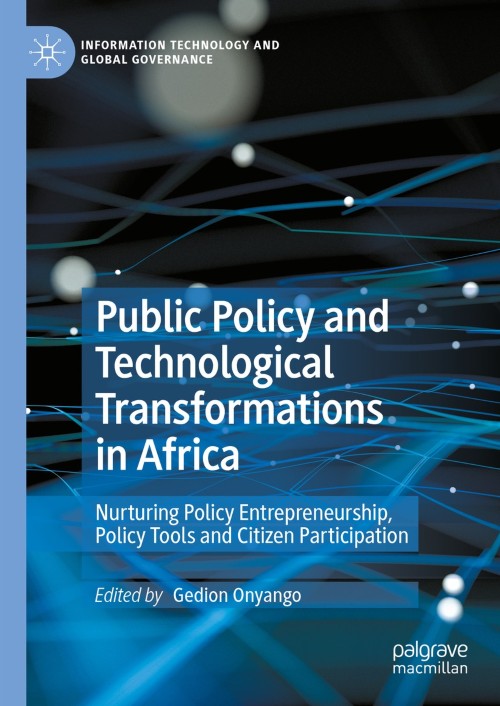
Public Policy and Technological Transformations in Africa [electronic resource] : Nurturing Policy Entrepreneurship, Policy Tools and Citizen Participation / edited by Gedion Onyango.
Erişim Adresi
ISBN
9783031187049
Dil Kodu
İngilizce
Yer Numarası
DK/18640
Basım Bildirimi
1st ed. 2023.
Yayın Bilgisi
Cham : Springer International Publishing : Imprint: Palgrave Macmillan, 2023.
Fiziksel Niteleme
XXVI, 417 p. 43 illus. online resource.
Dizi
Information Technology and Global Governance, 2946-3300
İçindekiler Notu
Chapter 1: Crafting Policy Technologies (PolicyTechs) from FinTechs, CivicTechs, GovTechs: An Introduction -- Part 1: TECHNOLOGIES AS PUBLIC POLICY TOOLS AND VENUES -- Chapter 2: State Entrepreneurship in Africa: Realising digital transformation for Policy effectiveness in selected countries -- Chapter 3: Technological Leapfrogging and Innovation: Re-Imagining Evaluation Approaches and Practice in Africa -- Chapter 4: Digital Technologies, Data Commons and Rights in Africa: The Case of DigitalTransport4Africa -- Chapter 5: Biometric turn and the quest of public interest. Assessing the National Identification policy in Cameroon -- Chapter 6: Digital Participatory Budgeting and Policymaking in Botswana -- Part 2: TECHNOLOGIES NURTURING POLICY ENTREPRENEURSHIP AND PEFORMANCE -- Chapter 7: The Digital Economy and Youth Employment in Africa -- Chapter 8: Digitalisation of agricultural policy and policy performance in Tanzania -- Chapter 9: Information Technology, The Complexity of Joint Action, and Child Protection Policy implementation in Kenya -- Chapter 10: Mobilising and Securing Private Financial Flows from Digital Business Platforms and Curbing Tech Enabled IFFs to Finance SDGs in Africa -- Part 3: TECHNOLOGIES AS SPACES FOR CITIZEN PARTICIPATION -- Chapter 11: Strengthening citizen agencies in policymaking through Social media -- Chapter 12: Social media and public policymaking in Southern Africa -- Chapter 13: Technology-mediated Transparency, Accountability, and Participation in the realisation of Citizen-centred Health Interventions: Case Study of MobiSAfAIDS in Southern Africa -- Chapter 14: Digitalising Decentralisation Policy across regions in Africa -- Part 4: EMERGING CHALLENGES -- Chapter 15: Regulatory issues for the promotion of entrepreneurship in electronic money in the CEMAC sub-region -- Chapter 16: Ethical dilemmas in Public Innovations and ICT solutions during COVID-19 in Kenya.
Özet, vb.
This is a hands-on volume that develops insightful analysis and frameworks for understanding the roles of various electronic and digital products in Africa’s transformation. -Eric E. Otenyo, Professor, Northern Arizona University, United States In light of technologically driven revolutions that are already taking place in Africa, this book is an important source of policy insights. -Artwell Nhemachena, Research Fellow, University of South Africa, South Africa Through empirically grounded analysis, authors provide an uncommon window into how African states are leveraging 4IR technologies. -E. Remi Aiyede, Professor, University of Ibadan, Nigeria This book is highly recommended for anyone who wants to know what is at stake, what has recently been done in Africa, and how to proceed from here. -Nitesh Bharosa, Academic Director, Digicampus, the Netherlands This book examines the links between public policy and Fourth Industrial Revolution (4IR) technological developments in Africa. It broadly assesses three key areas – policy entrepreneurship, policy tools and citizen participation – in order to better understand the interfaces between public policy and technological transformations in African countries. The book presents incisive case studies on topics including AI policies, mobile money, e-budgeting, digital economy, digital agriculture and digital ethical dilemmas in order to illuminate technological proliferation in African policy systems. Its analysis considers the broader contexts of African state politics and governance. It will appeal to students, instructors, researchers and practitioners interested in governance and digital transformations in developing countries. Gedion Onyango is a Researcher at the Firoz Lalji Institute for Africa, London School of Economics and Political Science, UK.
Konu
Political planning.
Digital media.
Africa __ Politics and government.
Public Policy.
Digital and New Media.
African Politics.
Digital media.
Africa __ Politics and government.
Public Policy.
Digital and New Media.
African Politics.
Diğer Yazarlar
Kurum Adı
Eseri Alıntıla
Referansları kullanmadan önce gözden geçirmeniz ve varsa gerekli düzeltmeleri yapmanız önerilir.
Dijital Kaynak
MARC Görünümü
LEADER 07032nam a22006375i 4500
001 817429
003 TR_AnAIT
005 20260130190153
007 cr nn 008mamaa
008 230731s2023 sz | s |||| 0|eng d
020 |a9783031187049|9978-3-031-18704-9
024 7 |a10.1007/978-3-031-18704-9|2doi
041 |aeng
049 |aTürk Tarih Kurumu Kütüphanesi
050 4|aJF1525.P6
072 7|aJPP|2bicssc
072 7|aPOL028000|2bisacsh
072 7|aJPP|2thema
082 04|a320.6|223
090 |aDK/18640
245 10|aPublic Policy and Technological Transformations in Africa|h[electronic resource] :|bNurturing Policy Entrepreneurship, Policy Tools and Citizen Participation /|cedited by Gedion Onyango.
250 |a1st ed. 2023.
264 1|aCham :|bSpringer International Publishing :|bImprint: Palgrave Macmillan,|c2023.
300 |aXXVI, 417 p. 43 illus.|bonline resource.
336 |atext|btxt|2rdacontent
337 |acomputer|bc|2rdamedia
338 |aonline resource|bcr|2rdacarrier
341 0 |bTable of contents navigation|2onix
341 0 |bSingle logical reading order|2onix
341 0 |bShort alternative textual descriptions|2onix
341 0 |bUse of color is not sole means of conveying information|2onix
341 0 |bUse of high contrast between text and background color|2onix
341 0 |bNext / Previous structural navigation|2onix
341 0 |bAll non-decorative content supports reading without sight|2onix
347 |atext file|bPDF|2rda
490 1 |aInformation Technology and Global Governance,|x2946-3300
505 0 |aChapter 1: Crafting Policy Technologies (PolicyTechs) from FinTechs, CivicTechs, GovTechs: An Introduction -- Part 1: TECHNOLOGIES AS PUBLIC POLICY TOOLS AND VENUES -- Chapter 2: State Entrepreneurship in Africa: Realising digital transformation for Policy effectiveness in selected countries -- Chapter 3: Technological Leapfrogging and Innovation: Re-Imagining Evaluation Approaches and Practice in Africa -- Chapter 4: Digital Technologies, Data Commons and Rights in Africa: The Case of DigitalTransport4Africa -- Chapter 5: Biometric turn and the quest of public interest. Assessing the National Identification policy in Cameroon -- Chapter 6: Digital Participatory Budgeting and Policymaking in Botswana -- Part 2: TECHNOLOGIES NURTURING POLICY ENTREPRENEURSHIP AND PEFORMANCE -- Chapter 7: The Digital Economy and Youth Employment in Africa -- Chapter 8: Digitalisation of agricultural policy and policy performance in Tanzania -- Chapter 9: Information Technology, The Complexity of Joint Action, and Child Protection Policy implementation in Kenya -- Chapter 10: Mobilising and Securing Private Financial Flows from Digital Business Platforms and Curbing Tech Enabled IFFs to Finance SDGs in Africa -- Part 3: TECHNOLOGIES AS SPACES FOR CITIZEN PARTICIPATION -- Chapter 11: Strengthening citizen agencies in policymaking through Social media -- Chapter 12: Social media and public policymaking in Southern Africa -- Chapter 13: Technology-mediated Transparency, Accountability, and Participation in the realisation of Citizen-centred Health Interventions: Case Study of MobiSAfAIDS in Southern Africa -- Chapter 14: Digitalising Decentralisation Policy across regions in Africa -- Part 4: EMERGING CHALLENGES -- Chapter 15: Regulatory issues for the promotion of entrepreneurship in electronic money in the CEMAC sub-region -- Chapter 16: Ethical dilemmas in Public Innovations and ICT solutions during COVID-19 in Kenya.
520 |aThis is a hands-on volume that develops insightful analysis and frameworks for understanding the roles of various electronic and digital products in Africa’s transformation. -Eric E. Otenyo, Professor, Northern Arizona University, United States In light of technologically driven revolutions that are already taking place in Africa, this book is an important source of policy insights. -Artwell Nhemachena, Research Fellow, University of South Africa, South Africa Through empirically grounded analysis, authors provide an uncommon window into how African states are leveraging 4IR technologies. -E. Remi Aiyede, Professor, University of Ibadan, Nigeria This book is highly recommended for anyone who wants to know what is at stake, what has recently been done in Africa, and how to proceed from here. -Nitesh Bharosa, Academic Director, Digicampus, the Netherlands This book examines the links between public policy and Fourth Industrial Revolution (4IR) technological developments in Africa. It broadly assesses three key areas – policy entrepreneurship, policy tools and citizen participation – in order to better understand the interfaces between public policy and technological transformations in African countries. The book presents incisive case studies on topics including AI policies, mobile money, e-budgeting, digital economy, digital agriculture and digital ethical dilemmas in order to illuminate technological proliferation in African policy systems. Its analysis considers the broader contexts of African state politics and governance. It will appeal to students, instructors, researchers and practitioners interested in governance and digital transformations in developing countries. Gedion Onyango is a Researcher at the Firoz Lalji Institute for Africa, London School of Economics and Political Science, UK.
532 8 |aAccessibility summary: This PDF does not fully comply with PDF/UA standards, but does feature limited screen reader support, described non-text content (images, graphs), bookmarks for easy navigation and searchable, selectable text. Users of assistive technologies may experience difficulty navigating or interpreting content in this document. We recognize the importance of accessibility, and we welcome queries about accessibility for any of our products. If you have a question or an access need, please get in touch with us at accessibilitysupport@springernature.com.
532 8 |aNo reading system accessibility options actively disabled
532 8 |aPublisher contact for further accessibility information: accessibilitysupport@springernature.com
650 0|aPolitical planning.
650 0|aDigital media.
650 0|aAfrica|xPolitics and government.
650 14|aPublic Policy.
650 24|aDigital and New Media.
650 24|aAfrican Politics.
700 1 |aOnyango, Gedion.|eeditor.|0(orcid)0000-0003-4984-2906|1https://orcid.org/0000-0003-4984-2906|4edt|4http://id.loc.gov/vocabulary/relators/edt
710 2 |aSpringerLink (Online service)
773 0 |tSpringer Nature eBook
776 08|iPrinted edition:|z9783031187032
776 08|iPrinted edition:|z9783031187056
776 08|iPrinted edition:|z9783031187063
830 0|aInformation Technology and Global Governance,|x2946-3300
856 40|uhttps://doi.org/10.1007/978-3-031-18704-9
912 |aZDB-2-POS
912 |aZDB-2-SXPI
950 |aPolitical Science and International Studies (SpringerNature-41174)
950 |aPolitical Science and International Studies (R0) (SpringerNature-43724)
001 817429
003 TR_AnAIT
005 20260130190153
007 cr nn 008mamaa
008 230731s2023 sz | s |||| 0|eng d
020 |a9783031187049|9978-3-031-18704-9
024 7 |a10.1007/978-3-031-18704-9|2doi
041 |aeng
049 |aTürk Tarih Kurumu Kütüphanesi
050 4|aJF1525.P6
072 7|aJPP|2bicssc
072 7|aPOL028000|2bisacsh
072 7|aJPP|2thema
082 04|a320.6|223
090 |aDK/18640
245 10|aPublic Policy and Technological Transformations in Africa|h[electronic resource] :|bNurturing Policy Entrepreneurship, Policy Tools and Citizen Participation /|cedited by Gedion Onyango.
250 |a1st ed. 2023.
264 1|aCham :|bSpringer International Publishing :|bImprint: Palgrave Macmillan,|c2023.
300 |aXXVI, 417 p. 43 illus.|bonline resource.
336 |atext|btxt|2rdacontent
337 |acomputer|bc|2rdamedia
338 |aonline resource|bcr|2rdacarrier
341 0 |bTable of contents navigation|2onix
341 0 |bSingle logical reading order|2onix
341 0 |bShort alternative textual descriptions|2onix
341 0 |bUse of color is not sole means of conveying information|2onix
341 0 |bUse of high contrast between text and background color|2onix
341 0 |bNext / Previous structural navigation|2onix
341 0 |bAll non-decorative content supports reading without sight|2onix
347 |atext file|bPDF|2rda
490 1 |aInformation Technology and Global Governance,|x2946-3300
505 0 |aChapter 1: Crafting Policy Technologies (PolicyTechs) from FinTechs, CivicTechs, GovTechs: An Introduction -- Part 1: TECHNOLOGIES AS PUBLIC POLICY TOOLS AND VENUES -- Chapter 2: State Entrepreneurship in Africa: Realising digital transformation for Policy effectiveness in selected countries -- Chapter 3: Technological Leapfrogging and Innovation: Re-Imagining Evaluation Approaches and Practice in Africa -- Chapter 4: Digital Technologies, Data Commons and Rights in Africa: The Case of DigitalTransport4Africa -- Chapter 5: Biometric turn and the quest of public interest. Assessing the National Identification policy in Cameroon -- Chapter 6: Digital Participatory Budgeting and Policymaking in Botswana -- Part 2: TECHNOLOGIES NURTURING POLICY ENTREPRENEURSHIP AND PEFORMANCE -- Chapter 7: The Digital Economy and Youth Employment in Africa -- Chapter 8: Digitalisation of agricultural policy and policy performance in Tanzania -- Chapter 9: Information Technology, The Complexity of Joint Action, and Child Protection Policy implementation in Kenya -- Chapter 10: Mobilising and Securing Private Financial Flows from Digital Business Platforms and Curbing Tech Enabled IFFs to Finance SDGs in Africa -- Part 3: TECHNOLOGIES AS SPACES FOR CITIZEN PARTICIPATION -- Chapter 11: Strengthening citizen agencies in policymaking through Social media -- Chapter 12: Social media and public policymaking in Southern Africa -- Chapter 13: Technology-mediated Transparency, Accountability, and Participation in the realisation of Citizen-centred Health Interventions: Case Study of MobiSAfAIDS in Southern Africa -- Chapter 14: Digitalising Decentralisation Policy across regions in Africa -- Part 4: EMERGING CHALLENGES -- Chapter 15: Regulatory issues for the promotion of entrepreneurship in electronic money in the CEMAC sub-region -- Chapter 16: Ethical dilemmas in Public Innovations and ICT solutions during COVID-19 in Kenya.
520 |aThis is a hands-on volume that develops insightful analysis and frameworks for understanding the roles of various electronic and digital products in Africa’s transformation. -Eric E. Otenyo, Professor, Northern Arizona University, United States In light of technologically driven revolutions that are already taking place in Africa, this book is an important source of policy insights. -Artwell Nhemachena, Research Fellow, University of South Africa, South Africa Through empirically grounded analysis, authors provide an uncommon window into how African states are leveraging 4IR technologies. -E. Remi Aiyede, Professor, University of Ibadan, Nigeria This book is highly recommended for anyone who wants to know what is at stake, what has recently been done in Africa, and how to proceed from here. -Nitesh Bharosa, Academic Director, Digicampus, the Netherlands This book examines the links between public policy and Fourth Industrial Revolution (4IR) technological developments in Africa. It broadly assesses three key areas – policy entrepreneurship, policy tools and citizen participation – in order to better understand the interfaces between public policy and technological transformations in African countries. The book presents incisive case studies on topics including AI policies, mobile money, e-budgeting, digital economy, digital agriculture and digital ethical dilemmas in order to illuminate technological proliferation in African policy systems. Its analysis considers the broader contexts of African state politics and governance. It will appeal to students, instructors, researchers and practitioners interested in governance and digital transformations in developing countries. Gedion Onyango is a Researcher at the Firoz Lalji Institute for Africa, London School of Economics and Political Science, UK.
532 8 |aAccessibility summary: This PDF does not fully comply with PDF/UA standards, but does feature limited screen reader support, described non-text content (images, graphs), bookmarks for easy navigation and searchable, selectable text. Users of assistive technologies may experience difficulty navigating or interpreting content in this document. We recognize the importance of accessibility, and we welcome queries about accessibility for any of our products. If you have a question or an access need, please get in touch with us at accessibilitysupport@springernature.com.
532 8 |aNo reading system accessibility options actively disabled
532 8 |aPublisher contact for further accessibility information: accessibilitysupport@springernature.com
650 0|aPolitical planning.
650 0|aDigital media.
650 0|aAfrica|xPolitics and government.
650 14|aPublic Policy.
650 24|aDigital and New Media.
650 24|aAfrican Politics.
700 1 |aOnyango, Gedion.|eeditor.|0(orcid)0000-0003-4984-2906|1https://orcid.org/0000-0003-4984-2906|4edt|4http://id.loc.gov/vocabulary/relators/edt
710 2 |aSpringerLink (Online service)
773 0 |tSpringer Nature eBook
776 08|iPrinted edition:|z9783031187032
776 08|iPrinted edition:|z9783031187056
776 08|iPrinted edition:|z9783031187063
830 0|aInformation Technology and Global Governance,|x2946-3300
856 40|uhttps://doi.org/10.1007/978-3-031-18704-9
912 |aZDB-2-POS
912 |aZDB-2-SXPI
950 |aPolitical Science and International Studies (SpringerNature-41174)
950 |aPolitical Science and International Studies (R0) (SpringerNature-43724)
Materyaller
Depodan talep edilen materyal sadece kütüphane içerisinde kullanılmaktadır.
Materyal dışarıya ödünç verilmemektedir.
Materyal dışarıya ödünç verilmemektedir.
