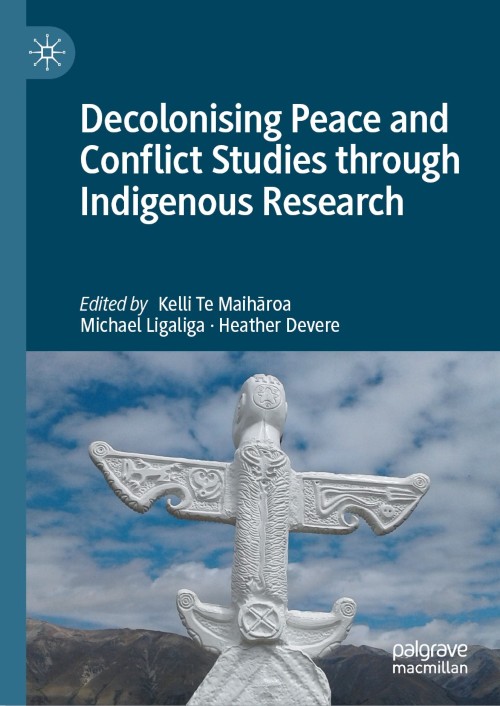
Decolonising Peace and Conflict Studies through Indigenous Research [electronic resource] / edited by Kelli Te Maihāroa, Michael Ligaliga, Heather Devere.
Erişim Adresi
ISBN
9789811667794
Dil Kodu
İngilizce
Yer Numarası
DK/18699
Basım Bildirimi
1st ed. 2022.
Yayın Bilgisi
Singapore : Springer Nature Singapore : Imprint: Palgrave Macmillan, 2022.
Fiziksel Niteleme
XVII, 372 p. 4 illus., 2 illus. in color. online resource.
İçindekiler Notu
Chapter 1: Introduction -- PART 1: Indigenous epistemologies, methodologies and method -- Chapter 2: Decolonising Peacebuilding Research through Indigenous Knowledge Systems: Experience of Igbo Speaking group of Niger-Delta Region, Nigeria -- Chapter 3: Restoring Balance and Harmony to Peace and Conflict Studies: Engaging Indigenous Paradigm Research in Collaborations of Integrity -- Chapter 4: Affirming an Indigenous Approach within Peace and Conflict Studies -- Chapter 5: When an Indigenous Researcher Sees, Speaks and Writes: The Experience of Palestinian Research in Israel -- Chapter 6: Liming and Ole Talk: A Site of Negotiation, Contestation and Relationships -- Chapter 7: Exploring Indigenous Peace Traditions Collaboratively -- PART 2: Peace Education and Indigenous Research -- Chapter 8: Beloved Community: Teacher reflection on Hawaiʻi-based teaching and learning framework, Nā Hopena Aʻo (HĀ), and possible implications for decolonisation in peace studies and peace education -- Chapter 9: The Path of Education in Mexico goes back to its roots -- Chapter 10: Te Ao o Rongomaraeroa: Decolonising Research in a Space for Peace -- PART 3: Indigenous Perspectives on Peace Development and Peace Processes -- Chapter 11: Decolonising the (Indonesian) ‘Peace Concept’ in West-Papua -- Chapter 12: Indigenous Conflict Resolution: A Samoan Perspective -- Chapter 13: Treaty Making (Makarrata) and An ‘Invisible’ People: Seeking a Just Peace after Conflict -- Chapter 14: Appreciative Accompaniment and Storywork in the Philippines: Bridging Peace and Conflict Studies and Indigenous Research -- PART 4: Conclusion -- Chapter 15: Conclusion: From Decolonisation to Ethical Restoration.
Özet, vb.
This book focuses on how Indigenous knowledge and methodologies can contribute towards the decolonisation of peace and conflict studies (PACS). It shows how Indigenous knowledge is essential to ensure that PACS research is relevant, respectful, accurate, and non-exploitative of Indigenous Peoples, in an effort to reposition Indigenous perspectives and contexts through Indigenous experiences, voices, and research processes, to provide balance to the power structures within this discipline. It includes critiques of ethnocentrism within PACS scholarship, and how both research areas can be brought together to challenge the violence of colonialism, and the colonialism of the institutions and structures within which decolonising researchers are working. Contributions in the book cover Indigenous research in Aotearoa, Australia, The Caribbean, Hawai'i, Israel, Mexico, Nigeria, Palestine, Philippines, Samoa, USA, and West Papua. Dr. Kelli TeMaihāroa (Waitaha, Ngāti Rārua, Te Ātiawa) has held leadership roles at the Otago Polytechnic as Tumuaki: Rakahau Māori / Director of Māori Research and Kaihautū: Te Kāhui Whetū Lead / Capable Māori, working with Iwi Māori throughout Aotearoa, New Zealand. She is an active member within her whānau, Iwi and local Māori community. She is a mokopuna of Te Maihāroa, the last southern Māori prophet and tohuka (expert tribal specialist). Dr. Michael Fusi Ligaliga is a lecturer and researcher in the School of Māori and Pacific Indigenous Studies at the University of Otago in Dunedin, Aotearoa, New Zealand. He teaches Pacific Island issues, indigenous leadership and peace and conflict in the Pacific. He has acted as Interim Director of the David O. McKay Centre for Intercultural Understanding at Brightham Young University Hawai’i. Dr. Heather Devere is Director of Practice at the Te Ao o Rongomaraeroa/The National Centre for Peace and ConflictStudies, University of Otago in Aotearoa, New Zealand. She has written widely on issues related to the politics of friendship, Indigenous peace traditions and peacebuilding, peace journalism, restorative justice, and social justice. She is Secretary of Parihaka Network: Ngā Manu Korihi, involved in community mediation, refugee settlement, human rights, and social justice issues.
Konu
Peace.
Philosophy.
Postcolonialism.
Peace and Conflict Studies.
Postcolonial Philosophy.
Philosophy.
Postcolonialism.
Peace and Conflict Studies.
Postcolonial Philosophy.
Diğer Yazarlar
Kurum Adı

Eseri Alıntıla
Referansları kullanmadan önce gözden geçirmeniz ve varsa gerekli düzeltmeleri yapmanız önerilir.
Dijital Kaynak
MARC Görünümü
LEADER 05955nam a22005055i 4500
001 817488
003 TR_AnAIT
005 20260130185843
007 cr nn 008mamaa
008 220307s2022 si | s |||| 0|eng d
020 |a9789811667794|9978-981-16-6779-4
024 7 |a10.1007/978-981-16-6779-4|2doi
041 |aeng
049 |aTürk Tarih Kurumu Kütüphanesi
050 4|aJZ5509.2-6300
072 7|aGTJ|2bicssc
072 7|aPOL034000|2bisacsh
072 7|aGTU|2thema
082 04|a327.1|223
090 |aDK/18699
245 10|aDecolonising Peace and Conflict Studies through Indigenous Research|h[electronic resource] /|cedited by Kelli Te Maihāroa, Michael Ligaliga, Heather Devere.
250 |a1st ed. 2022.
264 1|aSingapore :|bSpringer Nature Singapore :|bImprint: Palgrave Macmillan,|c2022.
300 |aXVII, 372 p. 4 illus., 2 illus. in color.|bonline resource.
336 |atext|btxt|2rdacontent
337 |acomputer|bc|2rdamedia
338 |aonline resource|bcr|2rdacarrier
347 |atext file|bPDF|2rda
505 0 |aChapter 1: Introduction -- PART 1: Indigenous epistemologies, methodologies and method -- Chapter 2: Decolonising Peacebuilding Research through Indigenous Knowledge Systems: Experience of Igbo Speaking group of Niger-Delta Region, Nigeria -- Chapter 3: Restoring Balance and Harmony to Peace and Conflict Studies: Engaging Indigenous Paradigm Research in Collaborations of Integrity -- Chapter 4: Affirming an Indigenous Approach within Peace and Conflict Studies -- Chapter 5: When an Indigenous Researcher Sees, Speaks and Writes: The Experience of Palestinian Research in Israel -- Chapter 6: Liming and Ole Talk: A Site of Negotiation, Contestation and Relationships -- Chapter 7: Exploring Indigenous Peace Traditions Collaboratively -- PART 2: Peace Education and Indigenous Research -- Chapter 8: Beloved Community: Teacher reflection on Hawaiʻi-based teaching and learning framework, Nā Hopena Aʻo (HĀ), and possible implications for decolonisation in peace studies and peace education -- Chapter 9: The Path of Education in Mexico goes back to its roots -- Chapter 10: Te Ao o Rongomaraeroa: Decolonising Research in a Space for Peace -- PART 3: Indigenous Perspectives on Peace Development and Peace Processes -- Chapter 11: Decolonising the (Indonesian) ‘Peace Concept’ in West-Papua -- Chapter 12: Indigenous Conflict Resolution: A Samoan Perspective -- Chapter 13: Treaty Making (Makarrata) and An ‘Invisible’ People: Seeking a Just Peace after Conflict -- Chapter 14: Appreciative Accompaniment and Storywork in the Philippines: Bridging Peace and Conflict Studies and Indigenous Research -- PART 4: Conclusion -- Chapter 15: Conclusion: From Decolonisation to Ethical Restoration.
520 |aThis book focuses on how Indigenous knowledge and methodologies can contribute towards the decolonisation of peace and conflict studies (PACS). It shows how Indigenous knowledge is essential to ensure that PACS research is relevant, respectful, accurate, and non-exploitative of Indigenous Peoples, in an effort to reposition Indigenous perspectives and contexts through Indigenous experiences, voices, and research processes, to provide balance to the power structures within this discipline. It includes critiques of ethnocentrism within PACS scholarship, and how both research areas can be brought together to challenge the violence of colonialism, and the colonialism of the institutions and structures within which decolonising researchers are working. Contributions in the book cover Indigenous research in Aotearoa, Australia, The Caribbean, Hawai'i, Israel, Mexico, Nigeria, Palestine, Philippines, Samoa, USA, and West Papua. Dr. Kelli TeMaihāroa (Waitaha, Ngāti Rārua, Te Ātiawa) has held leadership roles at the Otago Polytechnic as Tumuaki: Rakahau Māori / Director of Māori Research and Kaihautū: Te Kāhui Whetū Lead / Capable Māori, working with Iwi Māori throughout Aotearoa, New Zealand. She is an active member within her whānau, Iwi and local Māori community. She is a mokopuna of Te Maihāroa, the last southern Māori prophet and tohuka (expert tribal specialist). Dr. Michael Fusi Ligaliga is a lecturer and researcher in the School of Māori and Pacific Indigenous Studies at the University of Otago in Dunedin, Aotearoa, New Zealand. He teaches Pacific Island issues, indigenous leadership and peace and conflict in the Pacific. He has acted as Interim Director of the David O. McKay Centre for Intercultural Understanding at Brightham Young University Hawai’i. Dr. Heather Devere is Director of Practice at the Te Ao o Rongomaraeroa/The National Centre for Peace and ConflictStudies, University of Otago in Aotearoa, New Zealand. She has written widely on issues related to the politics of friendship, Indigenous peace traditions and peacebuilding, peace journalism, restorative justice, and social justice. She is Secretary of Parihaka Network: Ngā Manu Korihi, involved in community mediation, refugee settlement, human rights, and social justice issues.
650 0|aPeace.
650 0|aPhilosophy.
650 0|aPostcolonialism.
650 14|aPeace and Conflict Studies.
650 24|aPostcolonial Philosophy.
700 1 |aTe Maihāroa, Kelli.|eeditor.|4edt|4http://id.loc.gov/vocabulary/relators/edt
700 1 |aLigaliga, Michael.|eeditor.|4edt|4http://id.loc.gov/vocabulary/relators/edt
700 1 |aDevere, Heather.|eeditor.|4edt|4http://id.loc.gov/vocabulary/relators/edt
710 2 |aSpringerLink (Online service)
773 0 |tSpringer Nature eBook
776 08|iPrinted edition:|z9789811667787
776 08|iPrinted edition:|z9789811667800
776 08|iPrinted edition:|z9789811667817
856 40|uhttps://doi.org/10.1007/978-981-16-6779-4
912 |aZDB-2-POS
912 |aZDB-2-SXPI
950 |aPolitical Science and International Studies (SpringerNature-41174)
950 |aPolitical Science and International Studies (R0) (SpringerNature-43724)
001 817488
003 TR_AnAIT
005 20260130185843
007 cr nn 008mamaa
008 220307s2022 si | s |||| 0|eng d
020 |a9789811667794|9978-981-16-6779-4
024 7 |a10.1007/978-981-16-6779-4|2doi
041 |aeng
049 |aTürk Tarih Kurumu Kütüphanesi
050 4|aJZ5509.2-6300
072 7|aGTJ|2bicssc
072 7|aPOL034000|2bisacsh
072 7|aGTU|2thema
082 04|a327.1|223
090 |aDK/18699
245 10|aDecolonising Peace and Conflict Studies through Indigenous Research|h[electronic resource] /|cedited by Kelli Te Maihāroa, Michael Ligaliga, Heather Devere.
250 |a1st ed. 2022.
264 1|aSingapore :|bSpringer Nature Singapore :|bImprint: Palgrave Macmillan,|c2022.
300 |aXVII, 372 p. 4 illus., 2 illus. in color.|bonline resource.
336 |atext|btxt|2rdacontent
337 |acomputer|bc|2rdamedia
338 |aonline resource|bcr|2rdacarrier
347 |atext file|bPDF|2rda
505 0 |aChapter 1: Introduction -- PART 1: Indigenous epistemologies, methodologies and method -- Chapter 2: Decolonising Peacebuilding Research through Indigenous Knowledge Systems: Experience of Igbo Speaking group of Niger-Delta Region, Nigeria -- Chapter 3: Restoring Balance and Harmony to Peace and Conflict Studies: Engaging Indigenous Paradigm Research in Collaborations of Integrity -- Chapter 4: Affirming an Indigenous Approach within Peace and Conflict Studies -- Chapter 5: When an Indigenous Researcher Sees, Speaks and Writes: The Experience of Palestinian Research in Israel -- Chapter 6: Liming and Ole Talk: A Site of Negotiation, Contestation and Relationships -- Chapter 7: Exploring Indigenous Peace Traditions Collaboratively -- PART 2: Peace Education and Indigenous Research -- Chapter 8: Beloved Community: Teacher reflection on Hawaiʻi-based teaching and learning framework, Nā Hopena Aʻo (HĀ), and possible implications for decolonisation in peace studies and peace education -- Chapter 9: The Path of Education in Mexico goes back to its roots -- Chapter 10: Te Ao o Rongomaraeroa: Decolonising Research in a Space for Peace -- PART 3: Indigenous Perspectives on Peace Development and Peace Processes -- Chapter 11: Decolonising the (Indonesian) ‘Peace Concept’ in West-Papua -- Chapter 12: Indigenous Conflict Resolution: A Samoan Perspective -- Chapter 13: Treaty Making (Makarrata) and An ‘Invisible’ People: Seeking a Just Peace after Conflict -- Chapter 14: Appreciative Accompaniment and Storywork in the Philippines: Bridging Peace and Conflict Studies and Indigenous Research -- PART 4: Conclusion -- Chapter 15: Conclusion: From Decolonisation to Ethical Restoration.
520 |aThis book focuses on how Indigenous knowledge and methodologies can contribute towards the decolonisation of peace and conflict studies (PACS). It shows how Indigenous knowledge is essential to ensure that PACS research is relevant, respectful, accurate, and non-exploitative of Indigenous Peoples, in an effort to reposition Indigenous perspectives and contexts through Indigenous experiences, voices, and research processes, to provide balance to the power structures within this discipline. It includes critiques of ethnocentrism within PACS scholarship, and how both research areas can be brought together to challenge the violence of colonialism, and the colonialism of the institutions and structures within which decolonising researchers are working. Contributions in the book cover Indigenous research in Aotearoa, Australia, The Caribbean, Hawai'i, Israel, Mexico, Nigeria, Palestine, Philippines, Samoa, USA, and West Papua. Dr. Kelli TeMaihāroa (Waitaha, Ngāti Rārua, Te Ātiawa) has held leadership roles at the Otago Polytechnic as Tumuaki: Rakahau Māori / Director of Māori Research and Kaihautū: Te Kāhui Whetū Lead / Capable Māori, working with Iwi Māori throughout Aotearoa, New Zealand. She is an active member within her whānau, Iwi and local Māori community. She is a mokopuna of Te Maihāroa, the last southern Māori prophet and tohuka (expert tribal specialist). Dr. Michael Fusi Ligaliga is a lecturer and researcher in the School of Māori and Pacific Indigenous Studies at the University of Otago in Dunedin, Aotearoa, New Zealand. He teaches Pacific Island issues, indigenous leadership and peace and conflict in the Pacific. He has acted as Interim Director of the David O. McKay Centre for Intercultural Understanding at Brightham Young University Hawai’i. Dr. Heather Devere is Director of Practice at the Te Ao o Rongomaraeroa/The National Centre for Peace and ConflictStudies, University of Otago in Aotearoa, New Zealand. She has written widely on issues related to the politics of friendship, Indigenous peace traditions and peacebuilding, peace journalism, restorative justice, and social justice. She is Secretary of Parihaka Network: Ngā Manu Korihi, involved in community mediation, refugee settlement, human rights, and social justice issues.
650 0|aPeace.
650 0|aPhilosophy.
650 0|aPostcolonialism.
650 14|aPeace and Conflict Studies.
650 24|aPostcolonial Philosophy.
700 1 |aTe Maihāroa, Kelli.|eeditor.|4edt|4http://id.loc.gov/vocabulary/relators/edt
700 1 |aLigaliga, Michael.|eeditor.|4edt|4http://id.loc.gov/vocabulary/relators/edt
700 1 |aDevere, Heather.|eeditor.|4edt|4http://id.loc.gov/vocabulary/relators/edt
710 2 |aSpringerLink (Online service)
773 0 |tSpringer Nature eBook
776 08|iPrinted edition:|z9789811667787
776 08|iPrinted edition:|z9789811667800
776 08|iPrinted edition:|z9789811667817
856 40|uhttps://doi.org/10.1007/978-981-16-6779-4
912 |aZDB-2-POS
912 |aZDB-2-SXPI
950 |aPolitical Science and International Studies (SpringerNature-41174)
950 |aPolitical Science and International Studies (R0) (SpringerNature-43724)
Materyaller
Depodan talep edilen materyal sadece kütüphane içerisinde kullanılmaktadır.
Materyal dışarıya ödünç verilmemektedir.
