

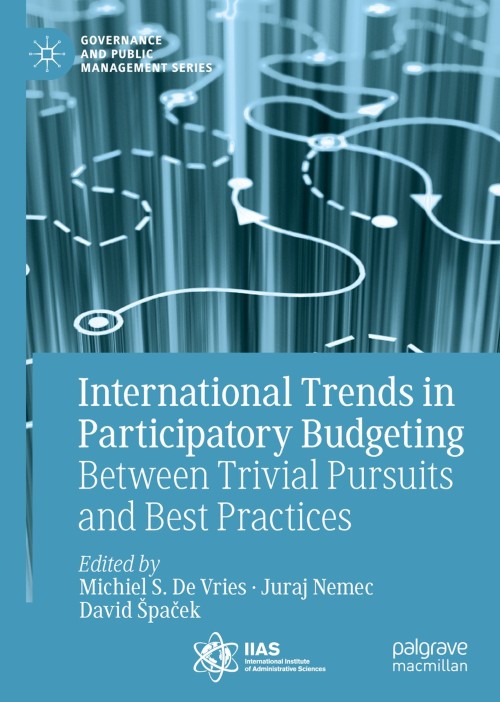
International Trends in Participatory Budgeting [electronic resource] : Between Trivial Pursuits and Best Practices / edited by Michiel S. De Vries, Juraj Nemec, David Špaček.
Erişim Adresi
ISBN
9783030799304
Dil Kodu
İngilizce
Yer Numarası
DK/18783
Basım Bildirimi
1st ed. 2022.
Yayın Bilgisi
Cham : Springer International Publishing : Imprint: Palgrave Macmillan, 2022.
Fiziksel Niteleme
XVIII, 317 p. 17 illus. online resource.
Dizi
Governance and Public Management, 2524-7298
İçindekiler Notu
Chapter 1. The diffusion of participatory budgeting: an introduction to this volume: With an intermezzo by Tarso Genro, the mayor of Porto Alegre between 1992 and 1996 -- Chapter 2. Participatory Budgeting in Germany – Increasing Transparency in Times of Fiscal Stress.-Chapter 3. Participatory Budgeting in Italy: A Phoenix Rising from the Ashes -- Chapter 4. Participatory Budgeting in Sweden -- Chapter 5: Participatory Budgeting in Belarus -- Chapter 6. Participatory Budgeting in Croatia: A Mixed Bag of Good, Bad, and Indifferent -- Chapter 7. Project-oriented participatory budgeting in the Czech Republic -- Chapter 8. The Beginning of a Beautiful Friendship? Participatory Budgeting in Hungary -- Chapter 9. Participatory budgeting in Poland -- Chapter 10. Participatory Budgeting in Romania -- Chapter 11. Participatory (Initiative) budgeting in the Russian Federation -- Chapter 12. Participatory Budgeting in Serbia -- Chapter 13. Participatory budgeting in Slovakia – recent development, presentstate and interesting cases -- Chapter 14. Participatory Budgeting in Slovenia -- Chapter 15. Unraveled practices of participatory budgeting in European democracies.
Özet, vb.
This book analyses the participatory budgeting practice as it has evolved in evaluated countries, focusing on what is substantially at stake concerning the budget and issues involved, the actual participation, the way such processes are organised and administered, and the outcomes of such processes. It concludes that participatory budgeting in selected European countries is far away from the level of ‘best practice’, but that all experiences are not just trivial pursuits. The information collected serves to check, to what extent participatory budgeting as practiced in the countries involved presents a real attempt to change municipal budgets towards addressing the needs of marginalized groups and to improve decision-making based on local democracy and participation, or whether these processes as such are to be judged to be more important than any output and outcomes. The practices can neither be seen as a process of policy diffusion nor as a process of policy mimesis. The terminology of participatory budgeting remains, but the tools to achieve the goals resulted only in marginal changes in the status quo in municipalities in European countries practicing participatory budgeting, instead of resulting in radical changes to increase spending in favor of marginalized groups. Chapter 15 'Unraveled Practices of Participatory Budgeting in European Democracies' is available open access under a CC BY 4.0 license. Michiel S. de Vries is Full Professor of Public Administration at the Radboud University of Nijmegen, the Netherlands. Juraj Nemec is Professor of Public Finance and Public Management at the Faculty of Economics and Administration at Masaryk University in Brno, Czech Republic. David Špaček is Associate Professor at the Department of Public Economics, Faculty of Economics and Administration, Masaryk University, Brno, Czech Republic.
Konu
Public administration.
Political planning.
Comparative government.
Public Administration.
Policy Formulation.
Comparative Public Policy.
Political planning.
Comparative government.
Public Administration.
Policy Formulation.
Comparative Public Policy.
Kurum Adı
Eseri Alıntıla
Referansları kullanmadan önce gözden geçirmeniz ve varsa gerekli düzeltmeleri yapmanız önerilir.
Dijital Kaynak
MARC Görünümü
LEADER 05251nam a22005415i 4500
001 817572
003 TR_AnAIT
005 20260130185307
007 cr nn 008mamaa
008 211126s2022 sz | s |||| 0|eng d
020 |a9783030799304|9978-3-030-79930-4
024 7 |a10.1007/978-3-030-79930-4|2doi
041 |aeng
049 |aTürk Tarih Kurumu Kütüphanesi
050 4|aJF1315.2-2112
072 7|aJPP|2bicssc
072 7|aPOL017000|2bisacsh
072 7|aJPP|2thema
082 04|a351|223
090 |aDK/18783
245 10|aInternational Trends in Participatory Budgeting|h[electronic resource] :|bBetween Trivial Pursuits and Best Practices /|cedited by Michiel S. De Vries, Juraj Nemec, David Špaček.
250 |a1st ed. 2022.
264 1|aCham :|bSpringer International Publishing :|bImprint: Palgrave Macmillan,|c2022.
300 |aXVIII, 317 p. 17 illus.|bonline resource.
336 |atext|btxt|2rdacontent
337 |acomputer|bc|2rdamedia
338 |aonline resource|bcr|2rdacarrier
347 |atext file|bPDF|2rda
490 1 |aGovernance and Public Management,|x2524-7298
505 0 |aChapter 1. The diffusion of participatory budgeting: an introduction to this volume: With an intermezzo by Tarso Genro, the mayor of Porto Alegre between 1992 and 1996 -- Chapter 2. Participatory Budgeting in Germany – Increasing Transparency in Times of Fiscal Stress.-Chapter 3. Participatory Budgeting in Italy: A Phoenix Rising from the Ashes -- Chapter 4. Participatory Budgeting in Sweden -- Chapter 5: Participatory Budgeting in Belarus -- Chapter 6. Participatory Budgeting in Croatia: A Mixed Bag of Good, Bad, and Indifferent -- Chapter 7. Project-oriented participatory budgeting in the Czech Republic -- Chapter 8. The Beginning of a Beautiful Friendship? Participatory Budgeting in Hungary -- Chapter 9. Participatory budgeting in Poland -- Chapter 10. Participatory Budgeting in Romania -- Chapter 11. Participatory (Initiative) budgeting in the Russian Federation -- Chapter 12. Participatory Budgeting in Serbia -- Chapter 13. Participatory budgeting in Slovakia – recent development, presentstate and interesting cases -- Chapter 14. Participatory Budgeting in Slovenia -- Chapter 15. Unraveled practices of participatory budgeting in European democracies.
520 |aThis book analyses the participatory budgeting practice as it has evolved in evaluated countries, focusing on what is substantially at stake concerning the budget and issues involved, the actual participation, the way such processes are organised and administered, and the outcomes of such processes. It concludes that participatory budgeting in selected European countries is far away from the level of ‘best practice’, but that all experiences are not just trivial pursuits. The information collected serves to check, to what extent participatory budgeting as practiced in the countries involved presents a real attempt to change municipal budgets towards addressing the needs of marginalized groups and to improve decision-making based on local democracy and participation, or whether these processes as such are to be judged to be more important than any output and outcomes. The practices can neither be seen as a process of policy diffusion nor as a process of policy mimesis. The terminology of participatory budgeting remains, but the tools to achieve the goals resulted only in marginal changes in the status quo in municipalities in European countries practicing participatory budgeting, instead of resulting in radical changes to increase spending in favor of marginalized groups. Chapter 15 'Unraveled Practices of Participatory Budgeting in European Democracies' is available open access under a CC BY 4.0 license. Michiel S. de Vries is Full Professor of Public Administration at the Radboud University of Nijmegen, the Netherlands. Juraj Nemec is Professor of Public Finance and Public Management at the Faculty of Economics and Administration at Masaryk University in Brno, Czech Republic. David Špaček is Associate Professor at the Department of Public Economics, Faculty of Economics and Administration, Masaryk University, Brno, Czech Republic.
650 0|aPublic administration.
650 0|aPolitical planning.
650 0|aComparative government.
650 14|aPublic Administration.
650 24|aPolicy Formulation.
650 24|aComparative Public Policy.
700 1 |aDe Vries, Michiel S.|eeditor.|4edt|4http://id.loc.gov/vocabulary/relators/edt
700 1 |aNemec, Juraj.|eeditor.|0(orcid)0000-0002-5881-7422|1https://orcid.org/0000-0002-5881-7422|4edt|4http://id.loc.gov/vocabulary/relators/edt
700 1 |aŠpaček, David.|eeditor.|4edt|4http://id.loc.gov/vocabulary/relators/edt
710 2 |aSpringerLink (Online service)
773 0 |tSpringer Nature eBook
776 08|iPrinted edition:|z9783030799298
776 08|iPrinted edition:|z9783030799311
776 08|iPrinted edition:|z9783030799328
830 0|aGovernance and Public Management,|x2524-7298
856 40|uhttps://doi.org/10.1007/978-3-030-79930-4
912 |aZDB-2-POS
912 |aZDB-2-SXPI
950 |aPolitical Science and International Studies (SpringerNature-41174)
950 |aPolitical Science and International Studies (R0) (SpringerNature-43724)
001 817572
003 TR_AnAIT
005 20260130185307
007 cr nn 008mamaa
008 211126s2022 sz | s |||| 0|eng d
020 |a9783030799304|9978-3-030-79930-4
024 7 |a10.1007/978-3-030-79930-4|2doi
041 |aeng
049 |aTürk Tarih Kurumu Kütüphanesi
050 4|aJF1315.2-2112
072 7|aJPP|2bicssc
072 7|aPOL017000|2bisacsh
072 7|aJPP|2thema
082 04|a351|223
090 |aDK/18783
245 10|aInternational Trends in Participatory Budgeting|h[electronic resource] :|bBetween Trivial Pursuits and Best Practices /|cedited by Michiel S. De Vries, Juraj Nemec, David Špaček.
250 |a1st ed. 2022.
264 1|aCham :|bSpringer International Publishing :|bImprint: Palgrave Macmillan,|c2022.
300 |aXVIII, 317 p. 17 illus.|bonline resource.
336 |atext|btxt|2rdacontent
337 |acomputer|bc|2rdamedia
338 |aonline resource|bcr|2rdacarrier
347 |atext file|bPDF|2rda
490 1 |aGovernance and Public Management,|x2524-7298
505 0 |aChapter 1. The diffusion of participatory budgeting: an introduction to this volume: With an intermezzo by Tarso Genro, the mayor of Porto Alegre between 1992 and 1996 -- Chapter 2. Participatory Budgeting in Germany – Increasing Transparency in Times of Fiscal Stress.-Chapter 3. Participatory Budgeting in Italy: A Phoenix Rising from the Ashes -- Chapter 4. Participatory Budgeting in Sweden -- Chapter 5: Participatory Budgeting in Belarus -- Chapter 6. Participatory Budgeting in Croatia: A Mixed Bag of Good, Bad, and Indifferent -- Chapter 7. Project-oriented participatory budgeting in the Czech Republic -- Chapter 8. The Beginning of a Beautiful Friendship? Participatory Budgeting in Hungary -- Chapter 9. Participatory budgeting in Poland -- Chapter 10. Participatory Budgeting in Romania -- Chapter 11. Participatory (Initiative) budgeting in the Russian Federation -- Chapter 12. Participatory Budgeting in Serbia -- Chapter 13. Participatory budgeting in Slovakia – recent development, presentstate and interesting cases -- Chapter 14. Participatory Budgeting in Slovenia -- Chapter 15. Unraveled practices of participatory budgeting in European democracies.
520 |aThis book analyses the participatory budgeting practice as it has evolved in evaluated countries, focusing on what is substantially at stake concerning the budget and issues involved, the actual participation, the way such processes are organised and administered, and the outcomes of such processes. It concludes that participatory budgeting in selected European countries is far away from the level of ‘best practice’, but that all experiences are not just trivial pursuits. The information collected serves to check, to what extent participatory budgeting as practiced in the countries involved presents a real attempt to change municipal budgets towards addressing the needs of marginalized groups and to improve decision-making based on local democracy and participation, or whether these processes as such are to be judged to be more important than any output and outcomes. The practices can neither be seen as a process of policy diffusion nor as a process of policy mimesis. The terminology of participatory budgeting remains, but the tools to achieve the goals resulted only in marginal changes in the status quo in municipalities in European countries practicing participatory budgeting, instead of resulting in radical changes to increase spending in favor of marginalized groups. Chapter 15 'Unraveled Practices of Participatory Budgeting in European Democracies' is available open access under a CC BY 4.0 license. Michiel S. de Vries is Full Professor of Public Administration at the Radboud University of Nijmegen, the Netherlands. Juraj Nemec is Professor of Public Finance and Public Management at the Faculty of Economics and Administration at Masaryk University in Brno, Czech Republic. David Špaček is Associate Professor at the Department of Public Economics, Faculty of Economics and Administration, Masaryk University, Brno, Czech Republic.
650 0|aPublic administration.
650 0|aPolitical planning.
650 0|aComparative government.
650 14|aPublic Administration.
650 24|aPolicy Formulation.
650 24|aComparative Public Policy.
700 1 |aDe Vries, Michiel S.|eeditor.|4edt|4http://id.loc.gov/vocabulary/relators/edt
700 1 |aNemec, Juraj.|eeditor.|0(orcid)0000-0002-5881-7422|1https://orcid.org/0000-0002-5881-7422|4edt|4http://id.loc.gov/vocabulary/relators/edt
700 1 |aŠpaček, David.|eeditor.|4edt|4http://id.loc.gov/vocabulary/relators/edt
710 2 |aSpringerLink (Online service)
773 0 |tSpringer Nature eBook
776 08|iPrinted edition:|z9783030799298
776 08|iPrinted edition:|z9783030799311
776 08|iPrinted edition:|z9783030799328
830 0|aGovernance and Public Management,|x2524-7298
856 40|uhttps://doi.org/10.1007/978-3-030-79930-4
912 |aZDB-2-POS
912 |aZDB-2-SXPI
950 |aPolitical Science and International Studies (SpringerNature-41174)
950 |aPolitical Science and International Studies (R0) (SpringerNature-43724)
Materyaller
Depodan talep edilen materyal sadece kütüphane içerisinde kullanılmaktadır.
Materyal dışarıya ödünç verilmemektedir.
Materyal dışarıya ödünç verilmemektedir.
