

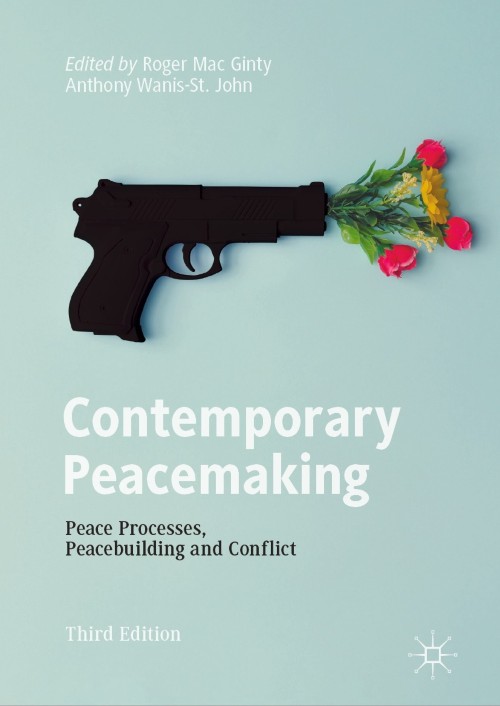
Contemporary Peacemaking [electronic resource] : Peace Processes, Peacebuilding and Conflict / edited by Roger Mac Ginty, Anthony Wanis-St. John.
Erişim Adresi
ISBN
9783030829629
Dil Kodu
İngilizce
Yer Numarası
DK/18806
Basım Bildirimi
3rd ed. 2022.
Yayın Bilgisi
Cham : Springer International Publishing : Imprint: Palgrave Macmillan, 2022.
Fiziksel Niteleme
XXVII, 623 p. 6 illus., 3 illus. in color. online resource.
İçindekiler Notu
1. Understanding Ripeness: Making and Using Hurting Stalemates -- 2. Cultivating Peace: A Practitioner's View of Deadly Conflict -- 3. Conflict Analysis: A System's Approach -- 4. The United Nations and Peacemaking -- 5. Women's Participating in Peace Processes -- 6. Indigenous Approaches to Peacemaking -- 7. Peacemaking Referendums: Advantages and Challenges for Peace Processes -- 8. Refugees, Peacemaking and Durable Solutions to Displacement -- 9. Time, Sequencing and Peace Processes -- 10. Mediation and Ending of Conflicts -- 11. Diffusion vs. Coherence: The Competitive Environment of Multiparty Mediation -- 12. Inclusivity in Peace Processes: Civil Society and Armed Groups -- 13. Negotiating Peace in the Shadows -- 14. Violence and Peace Processes -- 15. Peacemaking and Election Violence -- 16. Disarmament, Demobilisation and Reintegration of Ex-Combatants -- 17. Security Sector Reforms -- 18. Peace Processes and their Agreements -- 19. Power Sharing after Civil Wars: Matching Problems to Solutions -- 20. Peace Accords and Human Rights -- 21. The Post-Conflict Constitution as a Peace Agreement -- 22. Transitional Justice and Peacemaking/Peacebuilding -- 23. Peace Education as a Peacemaking Tool in Conflict Zones -- 24. Post Accord Violence. 26. Everyday Economic Experiences and Peace Processes.
Özet, vb.
“This is without doubt a ‘go to’ book for students, scholars, diplomats, and NGO practitioners as well as those people whose lives have been torn apart by conflict and who are working to change the opportunities for their communities.” —Jonathan Cohen, Executive Director, Conciliation Resources “Contemporary Peacemaking offers an overview that is comprehensive in both sweep and detail. It shows how understanding that power lies at the heart of the peacemaking enterprise, just as it is in the core of conflict, can open the way for a peaceful settlement.” —Dan Smith, Director, Stockholm International Peace Research Institute (SIPRI) “This multi-perspective book gives us the state of the art tools we need to understand the problems and the possibilities of effective peacemaking. Bringing new voices and issues into the discussion of peacemaking, this volume makes a vital contribution in explaining the state of the contemporary field.It will be of great value to those new to peacemaking and those who have long-term interests in it.” —Joanna Spear, Director, FAO Regional Skill Sustainment Initiative & Associate Professor, The George Washington University, USA This fully updated third edition of Contemporary Peacemaking is a state of the art overview of peacemaking in relation to contemporary civil wars. It examines best (and worst) practice in relation to peace processes and peace accords. The contributing authors are a mix of leading academics and practitioners with expert knowledge of a wide array of cases and techniques. The book provides a mix of theory and concept-building along with insights into ongoing cases of peace processes and post-accord peacebuilding. The chapters make clear that peacemaking is a dynamic field, with new practices in peacemaking techniques, changes to the international peace support architecture, and greater awareness of key issues such as gender and development after peace accords. The book is mindful of the intersection between top-down and bottom-up approaches to peace and how formal and institutionalized peace accords need to be lived and enacted by communities on the ground. Roger Mac Ginty is Professor at the School of Government and International Affairs, and Director of the Durham Global Security Institute, both at Durham University, UK. Anthony Wanis-St. John is Associate Professor at the School of International Service at American University, USA, where he directed the International Peace and Conflict Resolution program.
Konu
International relations.
Politics and war.
International Relations.
Military and Defence Studies.
International Relations.
International Relations.
Politics and war.
International Relations.
Military and Defence Studies.
International Relations.
International Relations.
Kurum Adı
Eseri Alıntıla
Referansları kullanmadan önce gözden geçirmeniz ve varsa gerekli düzeltmeleri yapmanız önerilir.
Dijital Kaynak
MARC Görünümü
LEADER 05993nam a22005895i 4500
001 817595
003 TR_AnAIT
005 20260130185211
007 cr nn 008mamaa
008 220112s2022 sz | s |||| 0|eng d
020 |a9783030829629|9978-3-030-82962-9
024 7 |a10.1007/978-3-030-82962-9|2doi
041 |aeng
049 |aTürk Tarih Kurumu Kütüphanesi
050 4|aJZ2-6530
050 4|aJZ2-6530
050 4|aJZ2-6530
072 7|aJPS|2bicssc
072 7|aJPS|2bicssc
072 7|aJPS|2bicssc
072 7|aPOL011000|2bisacsh
072 7|aJPS|2thema
072 7|aJPS|2thema
072 7|aJPS|2thema
082 04|a327|223
082 04|a327|223
082 04|a327|223
090 |aDK/18806
245 10|aContemporary Peacemaking|h[electronic resource] :|bPeace Processes, Peacebuilding and Conflict /|cedited by Roger Mac Ginty, Anthony Wanis-St. John.
250 |a3rd ed. 2022.
264 1|aCham :|bSpringer International Publishing :|bImprint: Palgrave Macmillan,|c2022.
300 |aXXVII, 623 p. 6 illus., 3 illus. in color.|bonline resource.
336 |atext|btxt|2rdacontent
337 |acomputer|bc|2rdamedia
338 |aonline resource|bcr|2rdacarrier
347 |atext file|bPDF|2rda
505 0 |a1. Understanding Ripeness: Making and Using Hurting Stalemates -- 2. Cultivating Peace: A Practitioner's View of Deadly Conflict -- 3. Conflict Analysis: A System's Approach -- 4. The United Nations and Peacemaking -- 5. Women's Participating in Peace Processes -- 6. Indigenous Approaches to Peacemaking -- 7. Peacemaking Referendums: Advantages and Challenges for Peace Processes -- 8. Refugees, Peacemaking and Durable Solutions to Displacement -- 9. Time, Sequencing and Peace Processes -- 10. Mediation and Ending of Conflicts -- 11. Diffusion vs. Coherence: The Competitive Environment of Multiparty Mediation -- 12. Inclusivity in Peace Processes: Civil Society and Armed Groups -- 13. Negotiating Peace in the Shadows -- 14. Violence and Peace Processes -- 15. Peacemaking and Election Violence -- 16. Disarmament, Demobilisation and Reintegration of Ex-Combatants -- 17. Security Sector Reforms -- 18. Peace Processes and their Agreements -- 19. Power Sharing after Civil Wars: Matching Problems to Solutions -- 20. Peace Accords and Human Rights -- 21. The Post-Conflict Constitution as a Peace Agreement -- 22. Transitional Justice and Peacemaking/Peacebuilding -- 23. Peace Education as a Peacemaking Tool in Conflict Zones -- 24. Post Accord Violence. 26. Everyday Economic Experiences and Peace Processes.
520 |a“This is without doubt a ‘go to’ book for students, scholars, diplomats, and NGO practitioners as well as those people whose lives have been torn apart by conflict and who are working to change the opportunities for their communities.” —Jonathan Cohen, Executive Director, Conciliation Resources “Contemporary Peacemaking offers an overview that is comprehensive in both sweep and detail. It shows how understanding that power lies at the heart of the peacemaking enterprise, just as it is in the core of conflict, can open the way for a peaceful settlement.” —Dan Smith, Director, Stockholm International Peace Research Institute (SIPRI) “This multi-perspective book gives us the state of the art tools we need to understand the problems and the possibilities of effective peacemaking. Bringing new voices and issues into the discussion of peacemaking, this volume makes a vital contribution in explaining the state of the contemporary field.It will be of great value to those new to peacemaking and those who have long-term interests in it.” —Joanna Spear, Director, FAO Regional Skill Sustainment Initiative & Associate Professor, The George Washington University, USA This fully updated third edition of Contemporary Peacemaking is a state of the art overview of peacemaking in relation to contemporary civil wars. It examines best (and worst) practice in relation to peace processes and peace accords. The contributing authors are a mix of leading academics and practitioners with expert knowledge of a wide array of cases and techniques. The book provides a mix of theory and concept-building along with insights into ongoing cases of peace processes and post-accord peacebuilding. The chapters make clear that peacemaking is a dynamic field, with new practices in peacemaking techniques, changes to the international peace support architecture, and greater awareness of key issues such as gender and development after peace accords. The book is mindful of the intersection between top-down and bottom-up approaches to peace and how formal and institutionalized peace accords need to be lived and enacted by communities on the ground. Roger Mac Ginty is Professor at the School of Government and International Affairs, and Director of the Durham Global Security Institute, both at Durham University, UK. Anthony Wanis-St. John is Associate Professor at the School of International Service at American University, USA, where he directed the International Peace and Conflict Resolution program.
650 0|aInternational relations.
650 0|aPolitics and war.
650 14|aInternational Relations.
650 24|aMilitary and Defence Studies.
650 24|aInternational Relations.
650 24|aInternational Relations.
700 1 |aMac Ginty, Roger.|eeditor.|0(orcid)0000-0002-6411-5507|1https://orcid.org/0000-0002-6411-5507|4edt|4http://id.loc.gov/vocabulary/relators/edt
700 1 |aWanis-St. John, Anthony.|eeditor.|4edt|4http://id.loc.gov/vocabulary/relators/edt
710 2 |aSpringerLink (Online service)
773 0 |tSpringer Nature eBook
776 08|iPrinted edition:|z9783030829612
776 08|iPrinted edition:|z9783030829636
856 40|uhttps://doi.org/10.1007/978-3-030-82962-9
912 |aZDB-2-POS
912 |aZDB-2-SXPI
950 |aPolitical Science and International Studies (SpringerNature-41174)
950 |aPolitical Science and International Studies (R0) (SpringerNature-43724)
001 817595
003 TR_AnAIT
005 20260130185211
007 cr nn 008mamaa
008 220112s2022 sz | s |||| 0|eng d
020 |a9783030829629|9978-3-030-82962-9
024 7 |a10.1007/978-3-030-82962-9|2doi
041 |aeng
049 |aTürk Tarih Kurumu Kütüphanesi
050 4|aJZ2-6530
050 4|aJZ2-6530
050 4|aJZ2-6530
072 7|aJPS|2bicssc
072 7|aJPS|2bicssc
072 7|aJPS|2bicssc
072 7|aPOL011000|2bisacsh
072 7|aJPS|2thema
072 7|aJPS|2thema
072 7|aJPS|2thema
082 04|a327|223
082 04|a327|223
082 04|a327|223
090 |aDK/18806
245 10|aContemporary Peacemaking|h[electronic resource] :|bPeace Processes, Peacebuilding and Conflict /|cedited by Roger Mac Ginty, Anthony Wanis-St. John.
250 |a3rd ed. 2022.
264 1|aCham :|bSpringer International Publishing :|bImprint: Palgrave Macmillan,|c2022.
300 |aXXVII, 623 p. 6 illus., 3 illus. in color.|bonline resource.
336 |atext|btxt|2rdacontent
337 |acomputer|bc|2rdamedia
338 |aonline resource|bcr|2rdacarrier
347 |atext file|bPDF|2rda
505 0 |a1. Understanding Ripeness: Making and Using Hurting Stalemates -- 2. Cultivating Peace: A Practitioner's View of Deadly Conflict -- 3. Conflict Analysis: A System's Approach -- 4. The United Nations and Peacemaking -- 5. Women's Participating in Peace Processes -- 6. Indigenous Approaches to Peacemaking -- 7. Peacemaking Referendums: Advantages and Challenges for Peace Processes -- 8. Refugees, Peacemaking and Durable Solutions to Displacement -- 9. Time, Sequencing and Peace Processes -- 10. Mediation and Ending of Conflicts -- 11. Diffusion vs. Coherence: The Competitive Environment of Multiparty Mediation -- 12. Inclusivity in Peace Processes: Civil Society and Armed Groups -- 13. Negotiating Peace in the Shadows -- 14. Violence and Peace Processes -- 15. Peacemaking and Election Violence -- 16. Disarmament, Demobilisation and Reintegration of Ex-Combatants -- 17. Security Sector Reforms -- 18. Peace Processes and their Agreements -- 19. Power Sharing after Civil Wars: Matching Problems to Solutions -- 20. Peace Accords and Human Rights -- 21. The Post-Conflict Constitution as a Peace Agreement -- 22. Transitional Justice and Peacemaking/Peacebuilding -- 23. Peace Education as a Peacemaking Tool in Conflict Zones -- 24. Post Accord Violence. 26. Everyday Economic Experiences and Peace Processes.
520 |a“This is without doubt a ‘go to’ book for students, scholars, diplomats, and NGO practitioners as well as those people whose lives have been torn apart by conflict and who are working to change the opportunities for their communities.” —Jonathan Cohen, Executive Director, Conciliation Resources “Contemporary Peacemaking offers an overview that is comprehensive in both sweep and detail. It shows how understanding that power lies at the heart of the peacemaking enterprise, just as it is in the core of conflict, can open the way for a peaceful settlement.” —Dan Smith, Director, Stockholm International Peace Research Institute (SIPRI) “This multi-perspective book gives us the state of the art tools we need to understand the problems and the possibilities of effective peacemaking. Bringing new voices and issues into the discussion of peacemaking, this volume makes a vital contribution in explaining the state of the contemporary field.It will be of great value to those new to peacemaking and those who have long-term interests in it.” —Joanna Spear, Director, FAO Regional Skill Sustainment Initiative & Associate Professor, The George Washington University, USA This fully updated third edition of Contemporary Peacemaking is a state of the art overview of peacemaking in relation to contemporary civil wars. It examines best (and worst) practice in relation to peace processes and peace accords. The contributing authors are a mix of leading academics and practitioners with expert knowledge of a wide array of cases and techniques. The book provides a mix of theory and concept-building along with insights into ongoing cases of peace processes and post-accord peacebuilding. The chapters make clear that peacemaking is a dynamic field, with new practices in peacemaking techniques, changes to the international peace support architecture, and greater awareness of key issues such as gender and development after peace accords. The book is mindful of the intersection between top-down and bottom-up approaches to peace and how formal and institutionalized peace accords need to be lived and enacted by communities on the ground. Roger Mac Ginty is Professor at the School of Government and International Affairs, and Director of the Durham Global Security Institute, both at Durham University, UK. Anthony Wanis-St. John is Associate Professor at the School of International Service at American University, USA, where he directed the International Peace and Conflict Resolution program.
650 0|aInternational relations.
650 0|aPolitics and war.
650 14|aInternational Relations.
650 24|aMilitary and Defence Studies.
650 24|aInternational Relations.
650 24|aInternational Relations.
700 1 |aMac Ginty, Roger.|eeditor.|0(orcid)0000-0002-6411-5507|1https://orcid.org/0000-0002-6411-5507|4edt|4http://id.loc.gov/vocabulary/relators/edt
700 1 |aWanis-St. John, Anthony.|eeditor.|4edt|4http://id.loc.gov/vocabulary/relators/edt
710 2 |aSpringerLink (Online service)
773 0 |tSpringer Nature eBook
776 08|iPrinted edition:|z9783030829612
776 08|iPrinted edition:|z9783030829636
856 40|uhttps://doi.org/10.1007/978-3-030-82962-9
912 |aZDB-2-POS
912 |aZDB-2-SXPI
950 |aPolitical Science and International Studies (SpringerNature-41174)
950 |aPolitical Science and International Studies (R0) (SpringerNature-43724)
Materyaller
Depodan talep edilen materyal sadece kütüphane içerisinde kullanılmaktadır.
Materyal dışarıya ödünç verilmemektedir.
Materyal dışarıya ödünç verilmemektedir.
