

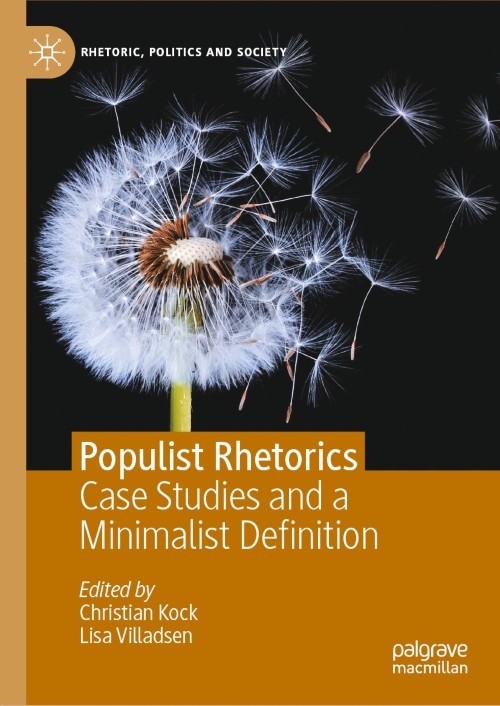
Populist Rhetorics [electronic resource] : Case Studies and a Minimalist Definition / edited by Christian Kock, Lisa Villadsen.
Erişim Adresi
ISBN
9783030873516
Dil Kodu
İngilizce
Yer Numarası
DK/18883
Basım Bildirimi
1st ed. 2022.
Yayın Bilgisi
Cham : Springer International Publishing : Imprint: Palgrave Macmillan, 2022.
Fiziksel Niteleme
XI, 247 p. 3 illus., 2 illus. in color. online resource.
Dizi
Rhetoric, Politics and Society, 2947-5155
İçindekiler Notu
Chapter 1: Introduction -- Chapter 2: Populist Melancholy -- Chapter 3: Voltagabbana Rhetorics. Salvini Unmasked: Turncoating as a Populist Strategy in Pandemic Times -- Chapter 4: Populist Rhetoric and Digital Communication: The Case of Brexit -- Chapter 5: Populism and the Rise of the AfD in Germany -- Chapter 6: The Rhetorical Strategy of Moralisation: A Lesson from Greece -- Chapter 7: Victorious Victimization. Viktor Orbán the Orator: Deep Securitization in Hungary’s Propaganda State -- Chapter 8: The Voice and Message of Hugo Chávez: A Rhetorical Analysis -- Chapter 9: Afterword: Afterword: A Definition Sought and Tested -- Index. .
Özet, vb.
This book proposes a unified approach to populism that sees it as a primarily rhetorical concept. Populism is on the rise worldwide with both populist leaders and movements gaining power, and the term “populism” resounds in political debate, journalism, and scholarship. Populism as a phenomenon seems to instantiate perennial issues besetting rhetoric (e.g., the charges of manipulation, exclusive reliance on opinion over knowledge, and abuse of emotional appeals), yet relatively little research on populism has emerged from the discipline of rhetoric. This volume investigates the theory and practice of populism under the heading of rhetoric but as an interdisciplinary effort involving scholars in rhetoric as well as neighbouring disciplines such as political science and sociology. Seven case studies covering Germany, Greece, Hungary, Italy, UK, USA, and Venezuela offer conceptual discussions as well as close analyses applying both historical and theoretical approaches. In the introduction, the editors outline the problem of populism and their project, presenting the book’s wide-spanning case-based explorations. In an afterword they seek to distil a “minimal” rhetorical definition of populism. The claim or pretense to speak for “the people” emerges as the feature that connects the highly diverse instances studied in the book—and populisms in general, the editors hypothesize. They argue that this prevalent rhetorical move, often glossed over as unremarkable and banal, is in principle more debatable and deserving of more vigilant scrutiny than usually assumed. Christian Kock is Emeritus Professor of Rhetoric at the University of Copenhagen, Denmark. He has published in Philosophy and Rhetoric, Argumentation, Political Communication, Rhetorica, Rhetorica Scandinavica, Paradigmi, Informal Logic, Controversia and many other journals and has authored and edited several books in Danish and English on political rhetoric, argumentation, and public debate, most recently his Deliberative Rhetoric: Arguing about Doing (2017). Lisa Villadsen is Professor and Head of the Section of Rhetoric at the University of Copenhagen, Denmark. She has published in Rhetoric Society Quarterly, Quarterly Journal of Speech, Javnost, Rhetorica Scandinavica, and other journals on official apologies, political rhetoric, dissent, and populism, most recently “Low Style the High Way: Rhetorical Mainstreaming of Populism” in the edited volume Vox Populi: Populism as a Rhetorical and Democratic Challenge (2020).
Konu
Political science.
Communication in politics.
Communication.
Political Science.
Political Communication.
Media and Communication.
Political Theory.
Communication in politics.
Communication.
Political Science.
Political Communication.
Media and Communication.
Political Theory.
Diğer Yazarlar
Kurum Adı
Eseri Alıntıla
Referansları kullanmadan önce gözden geçirmeniz ve varsa gerekli düzeltmeleri yapmanız önerilir.
Dijital Kaynak
MARC Görünümü
LEADER 05282nam a22005415i 4500
001 817672
003 TR_AnAIT
005 20260130184915
007 cr nn 008mamaa
008 220123s2022 sz | s |||| 0|eng d
020 |a9783030873516|9978-3-030-87351-6
024 7 |a10.1007/978-3-030-87351-6|2doi
041 |aeng
049 |aTürk Tarih Kurumu Kütüphanesi
050 4|aJA1-92
072 7|aJPA|2bicssc
072 7|aPOL000000|2bisacsh
072 7|aJPA|2thema
082 04|a320|223
090 |aDK/18883
245 10|aPopulist Rhetorics|h[electronic resource] :|bCase Studies and a Minimalist Definition /|cedited by Christian Kock, Lisa Villadsen.
250 |a1st ed. 2022.
264 1|aCham :|bSpringer International Publishing :|bImprint: Palgrave Macmillan,|c2022.
300 |aXI, 247 p. 3 illus., 2 illus. in color.|bonline resource.
336 |atext|btxt|2rdacontent
337 |acomputer|bc|2rdamedia
338 |aonline resource|bcr|2rdacarrier
347 |atext file|bPDF|2rda
490 1 |aRhetoric, Politics and Society,|x2947-5155
505 0 |aChapter 1: Introduction -- Chapter 2: Populist Melancholy -- Chapter 3: Voltagabbana Rhetorics. Salvini Unmasked: Turncoating as a Populist Strategy in Pandemic Times -- Chapter 4: Populist Rhetoric and Digital Communication: The Case of Brexit -- Chapter 5: Populism and the Rise of the AfD in Germany -- Chapter 6: The Rhetorical Strategy of Moralisation: A Lesson from Greece -- Chapter 7: Victorious Victimization. Viktor Orbán the Orator: Deep Securitization in Hungary’s Propaganda State -- Chapter 8: The Voice and Message of Hugo Chávez: A Rhetorical Analysis -- Chapter 9: Afterword: Afterword: A Definition Sought and Tested -- Index. .
520 |aThis book proposes a unified approach to populism that sees it as a primarily rhetorical concept. Populism is on the rise worldwide with both populist leaders and movements gaining power, and the term “populism” resounds in political debate, journalism, and scholarship. Populism as a phenomenon seems to instantiate perennial issues besetting rhetoric (e.g., the charges of manipulation, exclusive reliance on opinion over knowledge, and abuse of emotional appeals), yet relatively little research on populism has emerged from the discipline of rhetoric. This volume investigates the theory and practice of populism under the heading of rhetoric but as an interdisciplinary effort involving scholars in rhetoric as well as neighbouring disciplines such as political science and sociology. Seven case studies covering Germany, Greece, Hungary, Italy, UK, USA, and Venezuela offer conceptual discussions as well as close analyses applying both historical and theoretical approaches. In the introduction, the editors outline the problem of populism and their project, presenting the book’s wide-spanning case-based explorations. In an afterword they seek to distil a “minimal” rhetorical definition of populism. The claim or pretense to speak for “the people” emerges as the feature that connects the highly diverse instances studied in the book—and populisms in general, the editors hypothesize. They argue that this prevalent rhetorical move, often glossed over as unremarkable and banal, is in principle more debatable and deserving of more vigilant scrutiny than usually assumed. Christian Kock is Emeritus Professor of Rhetoric at the University of Copenhagen, Denmark. He has published in Philosophy and Rhetoric, Argumentation, Political Communication, Rhetorica, Rhetorica Scandinavica, Paradigmi, Informal Logic, Controversia and many other journals and has authored and edited several books in Danish and English on political rhetoric, argumentation, and public debate, most recently his Deliberative Rhetoric: Arguing about Doing (2017). Lisa Villadsen is Professor and Head of the Section of Rhetoric at the University of Copenhagen, Denmark. She has published in Rhetoric Society Quarterly, Quarterly Journal of Speech, Javnost, Rhetorica Scandinavica, and other journals on official apologies, political rhetoric, dissent, and populism, most recently “Low Style the High Way: Rhetorical Mainstreaming of Populism” in the edited volume Vox Populi: Populism as a Rhetorical and Democratic Challenge (2020).
650 0|aPolitical science.
650 0|aCommunication in politics.
650 0|aCommunication.
650 14|aPolitical Science.
650 24|aPolitical Communication.
650 24|aMedia and Communication.
650 24|aPolitical Theory.
700 1 |aKock, Christian.|eeditor.|4edt|4http://id.loc.gov/vocabulary/relators/edt
700 1 |aVilladsen, Lisa.|eeditor.|0(orcid)0000-0003-2467-0570|1https://orcid.org/0000-0003-2467-0570|4edt|4http://id.loc.gov/vocabulary/relators/edt
710 2 |aSpringerLink (Online service)
773 0 |tSpringer Nature eBook
776 08|iPrinted edition:|z9783030873509
776 08|iPrinted edition:|z9783030873523
776 08|iPrinted edition:|z9783030873530
830 0|aRhetoric, Politics and Society,|x2947-5155
856 40|uhttps://doi.org/10.1007/978-3-030-87351-6
912 |aZDB-2-POS
912 |aZDB-2-SXPI
950 |aPolitical Science and International Studies (SpringerNature-41174)
950 |aPolitical Science and International Studies (R0) (SpringerNature-43724)
001 817672
003 TR_AnAIT
005 20260130184915
007 cr nn 008mamaa
008 220123s2022 sz | s |||| 0|eng d
020 |a9783030873516|9978-3-030-87351-6
024 7 |a10.1007/978-3-030-87351-6|2doi
041 |aeng
049 |aTürk Tarih Kurumu Kütüphanesi
050 4|aJA1-92
072 7|aJPA|2bicssc
072 7|aPOL000000|2bisacsh
072 7|aJPA|2thema
082 04|a320|223
090 |aDK/18883
245 10|aPopulist Rhetorics|h[electronic resource] :|bCase Studies and a Minimalist Definition /|cedited by Christian Kock, Lisa Villadsen.
250 |a1st ed. 2022.
264 1|aCham :|bSpringer International Publishing :|bImprint: Palgrave Macmillan,|c2022.
300 |aXI, 247 p. 3 illus., 2 illus. in color.|bonline resource.
336 |atext|btxt|2rdacontent
337 |acomputer|bc|2rdamedia
338 |aonline resource|bcr|2rdacarrier
347 |atext file|bPDF|2rda
490 1 |aRhetoric, Politics and Society,|x2947-5155
505 0 |aChapter 1: Introduction -- Chapter 2: Populist Melancholy -- Chapter 3: Voltagabbana Rhetorics. Salvini Unmasked: Turncoating as a Populist Strategy in Pandemic Times -- Chapter 4: Populist Rhetoric and Digital Communication: The Case of Brexit -- Chapter 5: Populism and the Rise of the AfD in Germany -- Chapter 6: The Rhetorical Strategy of Moralisation: A Lesson from Greece -- Chapter 7: Victorious Victimization. Viktor Orbán the Orator: Deep Securitization in Hungary’s Propaganda State -- Chapter 8: The Voice and Message of Hugo Chávez: A Rhetorical Analysis -- Chapter 9: Afterword: Afterword: A Definition Sought and Tested -- Index. .
520 |aThis book proposes a unified approach to populism that sees it as a primarily rhetorical concept. Populism is on the rise worldwide with both populist leaders and movements gaining power, and the term “populism” resounds in political debate, journalism, and scholarship. Populism as a phenomenon seems to instantiate perennial issues besetting rhetoric (e.g., the charges of manipulation, exclusive reliance on opinion over knowledge, and abuse of emotional appeals), yet relatively little research on populism has emerged from the discipline of rhetoric. This volume investigates the theory and practice of populism under the heading of rhetoric but as an interdisciplinary effort involving scholars in rhetoric as well as neighbouring disciplines such as political science and sociology. Seven case studies covering Germany, Greece, Hungary, Italy, UK, USA, and Venezuela offer conceptual discussions as well as close analyses applying both historical and theoretical approaches. In the introduction, the editors outline the problem of populism and their project, presenting the book’s wide-spanning case-based explorations. In an afterword they seek to distil a “minimal” rhetorical definition of populism. The claim or pretense to speak for “the people” emerges as the feature that connects the highly diverse instances studied in the book—and populisms in general, the editors hypothesize. They argue that this prevalent rhetorical move, often glossed over as unremarkable and banal, is in principle more debatable and deserving of more vigilant scrutiny than usually assumed. Christian Kock is Emeritus Professor of Rhetoric at the University of Copenhagen, Denmark. He has published in Philosophy and Rhetoric, Argumentation, Political Communication, Rhetorica, Rhetorica Scandinavica, Paradigmi, Informal Logic, Controversia and many other journals and has authored and edited several books in Danish and English on political rhetoric, argumentation, and public debate, most recently his Deliberative Rhetoric: Arguing about Doing (2017). Lisa Villadsen is Professor and Head of the Section of Rhetoric at the University of Copenhagen, Denmark. She has published in Rhetoric Society Quarterly, Quarterly Journal of Speech, Javnost, Rhetorica Scandinavica, and other journals on official apologies, political rhetoric, dissent, and populism, most recently “Low Style the High Way: Rhetorical Mainstreaming of Populism” in the edited volume Vox Populi: Populism as a Rhetorical and Democratic Challenge (2020).
650 0|aPolitical science.
650 0|aCommunication in politics.
650 0|aCommunication.
650 14|aPolitical Science.
650 24|aPolitical Communication.
650 24|aMedia and Communication.
650 24|aPolitical Theory.
700 1 |aKock, Christian.|eeditor.|4edt|4http://id.loc.gov/vocabulary/relators/edt
700 1 |aVilladsen, Lisa.|eeditor.|0(orcid)0000-0003-2467-0570|1https://orcid.org/0000-0003-2467-0570|4edt|4http://id.loc.gov/vocabulary/relators/edt
710 2 |aSpringerLink (Online service)
773 0 |tSpringer Nature eBook
776 08|iPrinted edition:|z9783030873509
776 08|iPrinted edition:|z9783030873523
776 08|iPrinted edition:|z9783030873530
830 0|aRhetoric, Politics and Society,|x2947-5155
856 40|uhttps://doi.org/10.1007/978-3-030-87351-6
912 |aZDB-2-POS
912 |aZDB-2-SXPI
950 |aPolitical Science and International Studies (SpringerNature-41174)
950 |aPolitical Science and International Studies (R0) (SpringerNature-43724)
Materyaller
Depodan talep edilen materyal sadece kütüphane içerisinde kullanılmaktadır.
Materyal dışarıya ödünç verilmemektedir.
Materyal dışarıya ödünç verilmemektedir.
