

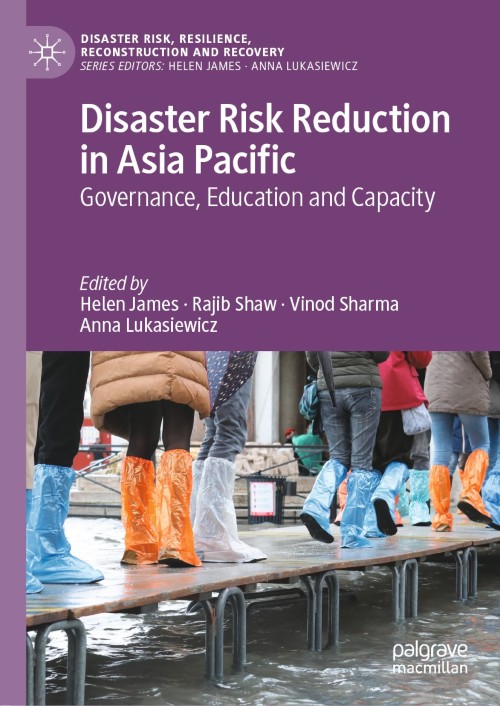
Disaster Risk Reduction in Asia Pacific [electronic resource] : Governance, Education and Capacity / edited by Helen James, Rajib Shaw, Vinod Sharma, Anna Lukasiewicz.
Erişim Adresi
ISBN
9789811648113
Dil Kodu
İngilizce
Yer Numarası
DK/18905
Basım Bildirimi
1st ed. 2022.
Yayın Bilgisi
Singapore : Springer Nature Singapore : Imprint: Palgrave Macmillan, 2022.
Fiziksel Niteleme
XIX, 382 p. 34 illus., 28 illus. in color. online resource.
Dizi
Disaster Risk, Resilience, Reconstruction and Recovery, 2662-5679
İçindekiler Notu
Chapter 1. Disaster risk reduction and resilience: Practices and challenges in Asia Pacific (by Rajib Shaw, Helen James, Vinod Sharma and Anna Lukasiewicz) -- Part 1. Governance -- Chapter 2. Policy learning for disaster risk reduction (by Stephen Dovers) -- Chapter 3. Na ara ahurea: Envisioning collaborative governance in disaster risk reduction in Aotearoa (by Christine M Kenney) -- Chapter 4. Improving multi-agency governance arrangements for preparedness, planning and response: implementing the integrated approach in Australia (by Alan Ryan) -- Chapter 5. Blackfella way, our way of managing fires and disasters bin ignored but ‘Im still here’: Australian Aboriginal governance structures for emergency management (by Bev Sithole, Dave Campbell, Steve Sutton, with contributions from Campion O., Brown C., Daniels G., Daniels A., Brian C, Campion J., Yibarbuk, D, Phillips E., Daniels G., Daniels K., Hedley B., Radford M., Campion A., Hunter-Xenie H; Sutton I., and Pickering S) -- Part 2. Education and Capacity -- Chapter 6. Facilitating effective disaster risk reduction education and human survival: intentionally engaging the transformative education – paradigm shift spiral (by Petra Buergelt and Douglas Paton) -- Chapter 7. All singing from the same song sheet: DRR and the visual and performing Arts (by Douglas Paton, Petra Buergelt, Etan Pavavalung, Kirby Clark, Li-Ju Jang and Grace Kuo) -- Chapter 8. High expectations, low recognition: the role of principals and teachers in disaster response and recovery in the Asia-Pacific (by Carol Mutch) -- Chapter 9. Planning and capability requirements for catastrophic and cascading events (Andrew Gissing, Michael Eburn and John McAneney) -- Chapter 10. Development and Implementation of Disaster Risk Management Specialization Program: Philippine School of Business Administration-Manila and Quezon City Government Collaboration towards Sustainable Development Solutions (by Tabassam Raza, Jose F. Peralta, Thess Khaz S. Razaand Carmelita R.E.U. Liwag) -- Part 3. Science Technology, Risk Assessment, Communities -- Chapter 11. Vulnerability and Resilience Science: Concepts, Tools, and Practice (by Susan L. Cutter) -- Chapter 12. Flood hazards and disciplinary silos (by Robert J. Wasson and Daryl Lam) -- Chapter 13. Theorizing Disaster Communitas (by Steve Matthewman and Shinya Uekusa) -- Chapter 14. Use of Scientific Knowledge and Public Participation in Disaster Risk Reduction and Response in the State of Sikkim, India (by Vinod K. Sharma). - Part 4: Recovery -- Chapter 15. Post-disaster Recoveries in Indonesia and Japan: Building Back Better ( by Minako Sakai) -- Chapter 16. Housing continuum: Key determinants linking post-disaster reconstruction to resilience in the long term (by Mittul Vahanvati) -- Chapter 17. Disaster Risk Reduction and Recovery in Samoa (by Tautala Mauala) -- Chapter 18. Towards a resilient Asia Pacific region ( Vinod Sharma, Helen James, Rajib Shaw and Anna Lukasiewicz).
Özet, vb.
This book brings together interdisciplinary perspectives from across the Asia Pacific region, covering four main sections: 1) Governance, 2) Education and Capacity, 3) Science, Technology, Risk Assessment and Communities, and 4) Recovery. The chapters address different dimensions of Sendai Framework of Disaster Risk Reduction (SFDRR), which are linked to Sustainable Development Goals, as well as Paris Agreement on Climate Change. Helen James was a specialist in Mainland Southeast Asia, especially Thailand and Myanmar (Burma). In 1997 she was awarded the order of Benchamabhorn, Member of the Most Noble Order of the Kingdom of Thailand by H.M. King Bhumibol Adulyadej for services to Thai history, language, education and culture. Helen passed away in April 2020. Rajib Shaw is the professor in Graduate School of Media and Governance in Keio University’s Shonan Fujisawa Campus (SFC). Earlier, he was the Executive Director of the Integrated Research on Disaster Risk (IRDR), a decade-long research program co-sponsored by the International Science Council (ISC) and the United Nations Office for Disaster Reduction (UNDRR). He is a Senior Fellow of Institute of Global Environmental Strategies (IGES) Japan, and the Chairperson of SEEDS Asia and CWS Japan, two Japanese NGOs. Vinod Sharma is the First Professor of Disaster Management in India, and one of the pioneers in DRR in South Asia. He is also the Founder Coordinator of National Centre of Disaster Management (now National Institute of Disaster Management). He is well versed with the national, state and local disaster management legislation, institutions and systems through work as Vice-Chair, Sikkim State Disaster Management Authority with a diverse education that includes international development, sustainability and water governance. Anna Lukasiewicz researches topics around the distribution of natural resources (including how decision-making processes are structured and stakeholder-decision maker interactions); water governance (including water management, climate change adaptation and stakeholder engagement); and natural hazard management (especially policy around disaster resilience). She works mainly at the interface of justice and natural resource management. .
Konu
Economic development.
Development Studies.
Development Studies.
Diğer Yazarlar
Kurum Adı
Eseri Alıntıla
Referansları kullanmadan önce gözden geçirmeniz ve varsa gerekli düzeltmeleri yapmanız önerilir.
Dijital Kaynak
MARC Görünümü
LEADER 07428nam a22005055i 4500
001 817694
003 TR_AnAIT
005 20260130184816
007 cr nn 008mamaa
008 220419s2022 si | s |||| 0|eng d
020 |a9789811648113|9978-981-16-4811-3
024 7 |a10.1007/978-981-16-4811-3|2doi
041 |aeng
049 |aTürk Tarih Kurumu Kütüphanesi
050 4|aHD72-88
072 7|aGTF|2bicssc
072 7|aSOC042000|2bisacsh
072 7|aGTP|2thema
082 04|a338.9|223
090 |aDK/18905
245 10|aDisaster Risk Reduction in Asia Pacific|h[electronic resource] :|bGovernance, Education and Capacity /|cedited by Helen James, Rajib Shaw, Vinod Sharma, Anna Lukasiewicz.
250 |a1st ed. 2022.
264 1|aSingapore :|bSpringer Nature Singapore :|bImprint: Palgrave Macmillan,|c2022.
300 |aXIX, 382 p. 34 illus., 28 illus. in color.|bonline resource.
336 |atext|btxt|2rdacontent
337 |acomputer|bc|2rdamedia
338 |aonline resource|bcr|2rdacarrier
347 |atext file|bPDF|2rda
490 1 |aDisaster Risk, Resilience, Reconstruction and Recovery,|x2662-5679
505 0 |aChapter 1. Disaster risk reduction and resilience: Practices and challenges in Asia Pacific (by Rajib Shaw, Helen James, Vinod Sharma and Anna Lukasiewicz) -- Part 1. Governance -- Chapter 2. Policy learning for disaster risk reduction (by Stephen Dovers) -- Chapter 3. Na ara ahurea: Envisioning collaborative governance in disaster risk reduction in Aotearoa (by Christine M Kenney) -- Chapter 4. Improving multi-agency governance arrangements for preparedness, planning and response: implementing the integrated approach in Australia (by Alan Ryan) -- Chapter 5. Blackfella way, our way of managing fires and disasters bin ignored but ‘Im still here’: Australian Aboriginal governance structures for emergency management (by Bev Sithole, Dave Campbell, Steve Sutton, with contributions from Campion O., Brown C., Daniels G., Daniels A., Brian C, Campion J., Yibarbuk, D, Phillips E., Daniels G., Daniels K., Hedley B., Radford M., Campion A., Hunter-Xenie H; Sutton I., and Pickering S) -- Part 2. Education and Capacity -- Chapter 6. Facilitating effective disaster risk reduction education and human survival: intentionally engaging the transformative education – paradigm shift spiral (by Petra Buergelt and Douglas Paton) -- Chapter 7. All singing from the same song sheet: DRR and the visual and performing Arts (by Douglas Paton, Petra Buergelt, Etan Pavavalung, Kirby Clark, Li-Ju Jang and Grace Kuo) -- Chapter 8. High expectations, low recognition: the role of principals and teachers in disaster response and recovery in the Asia-Pacific (by Carol Mutch) -- Chapter 9. Planning and capability requirements for catastrophic and cascading events (Andrew Gissing, Michael Eburn and John McAneney) -- Chapter 10. Development and Implementation of Disaster Risk Management Specialization Program: Philippine School of Business Administration-Manila and Quezon City Government Collaboration towards Sustainable Development Solutions (by Tabassam Raza, Jose F. Peralta, Thess Khaz S. Razaand Carmelita R.E.U. Liwag) -- Part 3. Science Technology, Risk Assessment, Communities -- Chapter 11. Vulnerability and Resilience Science: Concepts, Tools, and Practice (by Susan L. Cutter) -- Chapter 12. Flood hazards and disciplinary silos (by Robert J. Wasson and Daryl Lam) -- Chapter 13. Theorizing Disaster Communitas (by Steve Matthewman and Shinya Uekusa) -- Chapter 14. Use of Scientific Knowledge and Public Participation in Disaster Risk Reduction and Response in the State of Sikkim, India (by Vinod K. Sharma). - Part 4: Recovery -- Chapter 15. Post-disaster Recoveries in Indonesia and Japan: Building Back Better ( by Minako Sakai) -- Chapter 16. Housing continuum: Key determinants linking post-disaster reconstruction to resilience in the long term (by Mittul Vahanvati) -- Chapter 17. Disaster Risk Reduction and Recovery in Samoa (by Tautala Mauala) -- Chapter 18. Towards a resilient Asia Pacific region ( Vinod Sharma, Helen James, Rajib Shaw and Anna Lukasiewicz).
520 |aThis book brings together interdisciplinary perspectives from across the Asia Pacific region, covering four main sections: 1) Governance, 2) Education and Capacity, 3) Science, Technology, Risk Assessment and Communities, and 4) Recovery. The chapters address different dimensions of Sendai Framework of Disaster Risk Reduction (SFDRR), which are linked to Sustainable Development Goals, as well as Paris Agreement on Climate Change. Helen James was a specialist in Mainland Southeast Asia, especially Thailand and Myanmar (Burma). In 1997 she was awarded the order of Benchamabhorn, Member of the Most Noble Order of the Kingdom of Thailand by H.M. King Bhumibol Adulyadej for services to Thai history, language, education and culture. Helen passed away in April 2020. Rajib Shaw is the professor in Graduate School of Media and Governance in Keio University’s Shonan Fujisawa Campus (SFC). Earlier, he was the Executive Director of the Integrated Research on Disaster Risk (IRDR), a decade-long research program co-sponsored by the International Science Council (ISC) and the United Nations Office for Disaster Reduction (UNDRR). He is a Senior Fellow of Institute of Global Environmental Strategies (IGES) Japan, and the Chairperson of SEEDS Asia and CWS Japan, two Japanese NGOs. Vinod Sharma is the First Professor of Disaster Management in India, and one of the pioneers in DRR in South Asia. He is also the Founder Coordinator of National Centre of Disaster Management (now National Institute of Disaster Management). He is well versed with the national, state and local disaster management legislation, institutions and systems through work as Vice-Chair, Sikkim State Disaster Management Authority with a diverse education that includes international development, sustainability and water governance. Anna Lukasiewicz researches topics around the distribution of natural resources (including how decision-making processes are structured and stakeholder-decision maker interactions); water governance (including water management, climate change adaptation and stakeholder engagement); and natural hazard management (especially policy around disaster resilience). She works mainly at the interface of justice and natural resource management. .
650 0|aEconomic development.
650 14|aDevelopment Studies.
700 1 |aJames, Helen.|eeditor.|4edt|4http://id.loc.gov/vocabulary/relators/edt
700 1 |aShaw, Rajib.|eeditor.|0(orcid)0000-0003-3153-1800|1https://orcid.org/0000-0003-3153-1800|4edt|4http://id.loc.gov/vocabulary/relators/edt
700 1 |aSharma, Vinod.|eeditor.|4edt|4http://id.loc.gov/vocabulary/relators/edt
700 1 |aLukasiewicz, Anna.|eeditor.|4edt|4http://id.loc.gov/vocabulary/relators/edt
710 2 |aSpringerLink (Online service)
773 0 |tSpringer Nature eBook
776 08|iPrinted edition:|z9789811648106
776 08|iPrinted edition:|z9789811648120
776 08|iPrinted edition:|z9789811648137
830 0|aDisaster Risk, Resilience, Reconstruction and Recovery,|x2662-5679
856 40|uhttps://doi.org/10.1007/978-981-16-4811-3
912 |aZDB-2-POS
912 |aZDB-2-SXPI
950 |aPolitical Science and International Studies (SpringerNature-41174)
950 |aPolitical Science and International Studies (R0) (SpringerNature-43724)
001 817694
003 TR_AnAIT
005 20260130184816
007 cr nn 008mamaa
008 220419s2022 si | s |||| 0|eng d
020 |a9789811648113|9978-981-16-4811-3
024 7 |a10.1007/978-981-16-4811-3|2doi
041 |aeng
049 |aTürk Tarih Kurumu Kütüphanesi
050 4|aHD72-88
072 7|aGTF|2bicssc
072 7|aSOC042000|2bisacsh
072 7|aGTP|2thema
082 04|a338.9|223
090 |aDK/18905
245 10|aDisaster Risk Reduction in Asia Pacific|h[electronic resource] :|bGovernance, Education and Capacity /|cedited by Helen James, Rajib Shaw, Vinod Sharma, Anna Lukasiewicz.
250 |a1st ed. 2022.
264 1|aSingapore :|bSpringer Nature Singapore :|bImprint: Palgrave Macmillan,|c2022.
300 |aXIX, 382 p. 34 illus., 28 illus. in color.|bonline resource.
336 |atext|btxt|2rdacontent
337 |acomputer|bc|2rdamedia
338 |aonline resource|bcr|2rdacarrier
347 |atext file|bPDF|2rda
490 1 |aDisaster Risk, Resilience, Reconstruction and Recovery,|x2662-5679
505 0 |aChapter 1. Disaster risk reduction and resilience: Practices and challenges in Asia Pacific (by Rajib Shaw, Helen James, Vinod Sharma and Anna Lukasiewicz) -- Part 1. Governance -- Chapter 2. Policy learning for disaster risk reduction (by Stephen Dovers) -- Chapter 3. Na ara ahurea: Envisioning collaborative governance in disaster risk reduction in Aotearoa (by Christine M Kenney) -- Chapter 4. Improving multi-agency governance arrangements for preparedness, planning and response: implementing the integrated approach in Australia (by Alan Ryan) -- Chapter 5. Blackfella way, our way of managing fires and disasters bin ignored but ‘Im still here’: Australian Aboriginal governance structures for emergency management (by Bev Sithole, Dave Campbell, Steve Sutton, with contributions from Campion O., Brown C., Daniels G., Daniels A., Brian C, Campion J., Yibarbuk, D, Phillips E., Daniels G., Daniels K., Hedley B., Radford M., Campion A., Hunter-Xenie H; Sutton I., and Pickering S) -- Part 2. Education and Capacity -- Chapter 6. Facilitating effective disaster risk reduction education and human survival: intentionally engaging the transformative education – paradigm shift spiral (by Petra Buergelt and Douglas Paton) -- Chapter 7. All singing from the same song sheet: DRR and the visual and performing Arts (by Douglas Paton, Petra Buergelt, Etan Pavavalung, Kirby Clark, Li-Ju Jang and Grace Kuo) -- Chapter 8. High expectations, low recognition: the role of principals and teachers in disaster response and recovery in the Asia-Pacific (by Carol Mutch) -- Chapter 9. Planning and capability requirements for catastrophic and cascading events (Andrew Gissing, Michael Eburn and John McAneney) -- Chapter 10. Development and Implementation of Disaster Risk Management Specialization Program: Philippine School of Business Administration-Manila and Quezon City Government Collaboration towards Sustainable Development Solutions (by Tabassam Raza, Jose F. Peralta, Thess Khaz S. Razaand Carmelita R.E.U. Liwag) -- Part 3. Science Technology, Risk Assessment, Communities -- Chapter 11. Vulnerability and Resilience Science: Concepts, Tools, and Practice (by Susan L. Cutter) -- Chapter 12. Flood hazards and disciplinary silos (by Robert J. Wasson and Daryl Lam) -- Chapter 13. Theorizing Disaster Communitas (by Steve Matthewman and Shinya Uekusa) -- Chapter 14. Use of Scientific Knowledge and Public Participation in Disaster Risk Reduction and Response in the State of Sikkim, India (by Vinod K. Sharma). - Part 4: Recovery -- Chapter 15. Post-disaster Recoveries in Indonesia and Japan: Building Back Better ( by Minako Sakai) -- Chapter 16. Housing continuum: Key determinants linking post-disaster reconstruction to resilience in the long term (by Mittul Vahanvati) -- Chapter 17. Disaster Risk Reduction and Recovery in Samoa (by Tautala Mauala) -- Chapter 18. Towards a resilient Asia Pacific region ( Vinod Sharma, Helen James, Rajib Shaw and Anna Lukasiewicz).
520 |aThis book brings together interdisciplinary perspectives from across the Asia Pacific region, covering four main sections: 1) Governance, 2) Education and Capacity, 3) Science, Technology, Risk Assessment and Communities, and 4) Recovery. The chapters address different dimensions of Sendai Framework of Disaster Risk Reduction (SFDRR), which are linked to Sustainable Development Goals, as well as Paris Agreement on Climate Change. Helen James was a specialist in Mainland Southeast Asia, especially Thailand and Myanmar (Burma). In 1997 she was awarded the order of Benchamabhorn, Member of the Most Noble Order of the Kingdom of Thailand by H.M. King Bhumibol Adulyadej for services to Thai history, language, education and culture. Helen passed away in April 2020. Rajib Shaw is the professor in Graduate School of Media and Governance in Keio University’s Shonan Fujisawa Campus (SFC). Earlier, he was the Executive Director of the Integrated Research on Disaster Risk (IRDR), a decade-long research program co-sponsored by the International Science Council (ISC) and the United Nations Office for Disaster Reduction (UNDRR). He is a Senior Fellow of Institute of Global Environmental Strategies (IGES) Japan, and the Chairperson of SEEDS Asia and CWS Japan, two Japanese NGOs. Vinod Sharma is the First Professor of Disaster Management in India, and one of the pioneers in DRR in South Asia. He is also the Founder Coordinator of National Centre of Disaster Management (now National Institute of Disaster Management). He is well versed with the national, state and local disaster management legislation, institutions and systems through work as Vice-Chair, Sikkim State Disaster Management Authority with a diverse education that includes international development, sustainability and water governance. Anna Lukasiewicz researches topics around the distribution of natural resources (including how decision-making processes are structured and stakeholder-decision maker interactions); water governance (including water management, climate change adaptation and stakeholder engagement); and natural hazard management (especially policy around disaster resilience). She works mainly at the interface of justice and natural resource management. .
650 0|aEconomic development.
650 14|aDevelopment Studies.
700 1 |aJames, Helen.|eeditor.|4edt|4http://id.loc.gov/vocabulary/relators/edt
700 1 |aShaw, Rajib.|eeditor.|0(orcid)0000-0003-3153-1800|1https://orcid.org/0000-0003-3153-1800|4edt|4http://id.loc.gov/vocabulary/relators/edt
700 1 |aSharma, Vinod.|eeditor.|4edt|4http://id.loc.gov/vocabulary/relators/edt
700 1 |aLukasiewicz, Anna.|eeditor.|4edt|4http://id.loc.gov/vocabulary/relators/edt
710 2 |aSpringerLink (Online service)
773 0 |tSpringer Nature eBook
776 08|iPrinted edition:|z9789811648106
776 08|iPrinted edition:|z9789811648120
776 08|iPrinted edition:|z9789811648137
830 0|aDisaster Risk, Resilience, Reconstruction and Recovery,|x2662-5679
856 40|uhttps://doi.org/10.1007/978-981-16-4811-3
912 |aZDB-2-POS
912 |aZDB-2-SXPI
950 |aPolitical Science and International Studies (SpringerNature-41174)
950 |aPolitical Science and International Studies (R0) (SpringerNature-43724)
Materyaller
Depodan talep edilen materyal sadece kütüphane içerisinde kullanılmaktadır.
Materyal dışarıya ödünç verilmemektedir.
Materyal dışarıya ödünç verilmemektedir.
