

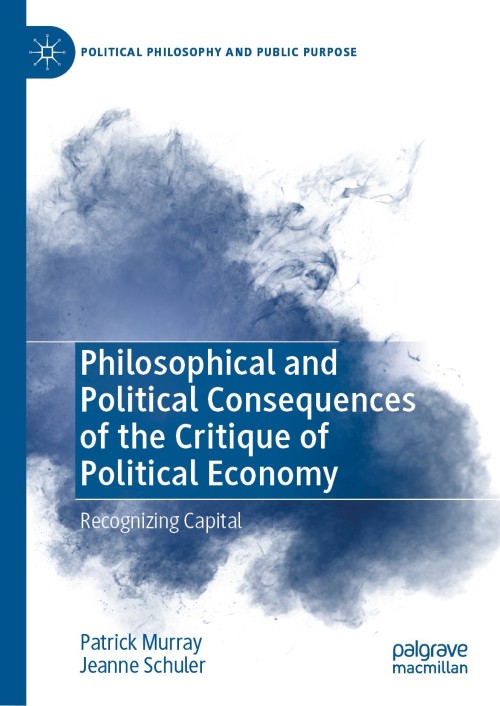
Philosophical and Political Consequences of the Critique of Political Economy [electronic resource] : Recognizing Capital / by Patrick Murray, Jeanne Schuler.
Erişim Adresi
ISBN
9783031375453
Dil Kodu
İngilizce
Yer Numarası
DK/18940
Yazar
Basım Bildirimi
1st ed. 2023.
Yayın Bilgisi
Cham : Springer International Publishing : Imprint: Palgrave Macmillan, 2023.
Fiziksel Niteleme
XIX, 341 p. 1 illus. online resource.
Dizi
Political Philosophy and Public Purpose, 2524-7158
İçindekiler Notu
1. Introduction: Philosophy and Social Theory beyond the “Bourgeois Horizon” -- 2. Recognizing Capital: Some Barriers to Public Discourse about Capital -- 3. The Legend of Hegel’s Labor Theory of Reason -- 4. Marx, Subjectivism, and Modern Moral Philosophy -- 5. Karl Marx and the Critique of Bourgeois Philosophy -- 6. Reclaiming the Concepts of Value and Capital -- 7. Social Form and the “Purely Social”: On the Kind of Sociality Involved in Value -- 8. The Commodity Spectrum -- 9. A Brilliant Failure: Hegel and Marx Assess the Enlightenment -- 10. From Hegel on Enlightenment Terror to Marx on Capital -- 11. The Poetics of Nihilism: Representing Capital’s Indifference in Dickens’ Hard Times -- 12. Rebel without a Cause: Stanley Kubrick and the Banality of the Good -- 13. Disappearing Act: The Trick Philosophy of Woody Allen. .
Özet, vb.
This book extends the approach that Murray and Schuler develop in their companion volume, False Moves in Philosophy and Social Theory: Losing Public Purpose. The chapters form a connected inquiry into consequences of capital, a far-reaching social form, through a critique of political economy and the mindset it shares with much modern philosophy and social theory. The authors call this bifurcating mentality factoring philosophy. Factoring philosophy mistakes the distinguishable for the separable. It splits the subjective and objective, form and content, and it takes the object of social theory to be an impossible economy-in-general, stripped of constitutive social forms. The critique of factoring philosophy structures the collection, which makes a wide-ranging contribution to the research field of the critique of political economy as critical social theory. Ultimately, this book solidifies Murray and Schuler’s impact on the study of political economy, political philosophy, modern philosophy, Hegel, Marx, and critical theory. Patrick Murray is John C. Kenefick Faculty Chair in the Humanities and professor of philosophy at Creighton University, Omaha, Nebraska. He is author of Marx’s Theory of Scientific Knowledge and The Mismeasure of Wealth and editor of Reflections on Commercial Life. His research interests center on capitalism and modern philosophy. Jeanne Schuler is professor of philosophy at Creighton University, Omaha, Nebraska. She has published in the history of philosophy and critical theory, including articles on Hume, Kant, Hegel, Marx, Arendt, Iris Murdoch, and Habermas. She is working on a series of articles on Hegel and modern philosophy. .
Konu
Political science __ Philosophy.
Political science.
Critical theory.
Social sciences __ Philosophy.
Marxian school of sociology.
Political Philosophy.
Political Science.
Critical Theory.
Social Theory.
Marxist Sociology.
Political science.
Critical theory.
Social sciences __ Philosophy.
Marxian school of sociology.
Political Philosophy.
Political Science.
Critical Theory.
Social Theory.
Marxist Sociology.
Diğer Yazarlar
Kurum Adı
Eseri Alıntıla
Referansları kullanmadan önce gözden geçirmeniz ve varsa gerekli düzeltmeleri yapmanız önerilir.
Dijital Kaynak
MARC Görünümü
LEADER 05840nam a22006855i 4500
001 817729
003 TR_AnAIT
005 20260130184634
007 cr nn 008mamaa
008 230829s2023 sz | s |||| 0|eng d
020 |a9783031375453|9978-3-031-37545-3
024 7 |a10.1007/978-3-031-37545-3|2doi
041 |aeng
049 |aTürk Tarih Kurumu Kütüphanesi
050 4|aB65
072 7|aHPS|2bicssc
072 7|aPHI019000|2bisacsh
072 7|aQDTS|2thema
082 04|a320.01|223
090 |aDK/18940
100 1 |aMurray, Patrick.|eauthor.|4aut|4http://id.loc.gov/vocabulary/relators/aut
245 10|aPhilosophical and Political Consequences of the Critique of Political Economy|h[electronic resource] :|bRecognizing Capital /|cby Patrick Murray, Jeanne Schuler.
250 |a1st ed. 2023.
264 1|aCham :|bSpringer International Publishing :|bImprint: Palgrave Macmillan,|c2023.
300 |aXIX, 341 p. 1 illus.|bonline resource.
336 |atext|btxt|2rdacontent
337 |acomputer|bc|2rdamedia
338 |aonline resource|bcr|2rdacarrier
341 0 |bTable of contents navigation|2onix
341 0 |bSingle logical reading order|2onix
341 0 |bUse of color is not sole means of conveying information|2onix
341 0 |bUse of high contrast between text and background color|2onix
341 0 |bNext / Previous structural navigation|2onix
341 0 |bAll non-decorative content supports reading without sight|2onix
347 |atext file|bPDF|2rda
490 1 |aPolitical Philosophy and Public Purpose,|x2524-7158
505 0 |a1. Introduction: Philosophy and Social Theory beyond the “Bourgeois Horizon” -- 2. Recognizing Capital: Some Barriers to Public Discourse about Capital -- 3. The Legend of Hegel’s Labor Theory of Reason -- 4. Marx, Subjectivism, and Modern Moral Philosophy -- 5. Karl Marx and the Critique of Bourgeois Philosophy -- 6. Reclaiming the Concepts of Value and Capital -- 7. Social Form and the “Purely Social”: On the Kind of Sociality Involved in Value -- 8. The Commodity Spectrum -- 9. A Brilliant Failure: Hegel and Marx Assess the Enlightenment -- 10. From Hegel on Enlightenment Terror to Marx on Capital -- 11. The Poetics of Nihilism: Representing Capital’s Indifference in Dickens’ Hard Times -- 12. Rebel without a Cause: Stanley Kubrick and the Banality of the Good -- 13. Disappearing Act: The Trick Philosophy of Woody Allen. .
520 |aThis book extends the approach that Murray and Schuler develop in their companion volume, False Moves in Philosophy and Social Theory: Losing Public Purpose. The chapters form a connected inquiry into consequences of capital, a far-reaching social form, through a critique of political economy and the mindset it shares with much modern philosophy and social theory. The authors call this bifurcating mentality factoring philosophy. Factoring philosophy mistakes the distinguishable for the separable. It splits the subjective and objective, form and content, and it takes the object of social theory to be an impossible economy-in-general, stripped of constitutive social forms. The critique of factoring philosophy structures the collection, which makes a wide-ranging contribution to the research field of the critique of political economy as critical social theory. Ultimately, this book solidifies Murray and Schuler’s impact on the study of political economy, political philosophy, modern philosophy, Hegel, Marx, and critical theory. Patrick Murray is John C. Kenefick Faculty Chair in the Humanities and professor of philosophy at Creighton University, Omaha, Nebraska. He is author of Marx’s Theory of Scientific Knowledge and The Mismeasure of Wealth and editor of Reflections on Commercial Life. His research interests center on capitalism and modern philosophy. Jeanne Schuler is professor of philosophy at Creighton University, Omaha, Nebraska. She has published in the history of philosophy and critical theory, including articles on Hume, Kant, Hegel, Marx, Arendt, Iris Murdoch, and Habermas. She is working on a series of articles on Hegel and modern philosophy. .
532 8 |aAccessibility summary: This PDF does not fully comply with PDF/UA standards, but does feature limited screen reader support, bookmarks for easy navigation and searchable, selectable text. Users of assistive technologies may experience difficulty navigating or interpreting content in this document. We recognize the importance of accessibility, and we welcome queries about accessibility for any of our products. If you have a question or an access need, please get in touch with us at accessibilitysupport@springernature.com.
532 8 |aNo reading system accessibility options actively disabled
532 8 |aPublisher contact for further accessibility information: accessibilitysupport@springernature.com
650 0|aPolitical science|xPhilosophy.
650 0|aPolitical science.
650 0|aCritical theory.
650 0|aSocial sciences|xPhilosophy.
650 0|aMarxian school of sociology.
650 14|aPolitical Philosophy.
650 24|aPolitical Science.
650 24|aCritical Theory.
650 24|aSocial Theory.
650 24|aMarxist Sociology.
700 1 |aSchuler, Jeanne.|eauthor.|4aut|4http://id.loc.gov/vocabulary/relators/aut
710 2 |aSpringerLink (Online service)
773 0 |tSpringer Nature eBook
776 08|iPrinted edition:|z9783031375446
776 08|iPrinted edition:|z9783031375460
776 08|iPrinted edition:|z9783031375477
830 0|aPolitical Philosophy and Public Purpose,|x2524-7158
856 40|uhttps://doi.org/10.1007/978-3-031-37545-3
912 |aZDB-2-POS
912 |aZDB-2-SXPI
950 |aPolitical Science and International Studies (SpringerNature-41174)
950 |aPolitical Science and International Studies (R0) (SpringerNature-43724)
001 817729
003 TR_AnAIT
005 20260130184634
007 cr nn 008mamaa
008 230829s2023 sz | s |||| 0|eng d
020 |a9783031375453|9978-3-031-37545-3
024 7 |a10.1007/978-3-031-37545-3|2doi
041 |aeng
049 |aTürk Tarih Kurumu Kütüphanesi
050 4|aB65
072 7|aHPS|2bicssc
072 7|aPHI019000|2bisacsh
072 7|aQDTS|2thema
082 04|a320.01|223
090 |aDK/18940
100 1 |aMurray, Patrick.|eauthor.|4aut|4http://id.loc.gov/vocabulary/relators/aut
245 10|aPhilosophical and Political Consequences of the Critique of Political Economy|h[electronic resource] :|bRecognizing Capital /|cby Patrick Murray, Jeanne Schuler.
250 |a1st ed. 2023.
264 1|aCham :|bSpringer International Publishing :|bImprint: Palgrave Macmillan,|c2023.
300 |aXIX, 341 p. 1 illus.|bonline resource.
336 |atext|btxt|2rdacontent
337 |acomputer|bc|2rdamedia
338 |aonline resource|bcr|2rdacarrier
341 0 |bTable of contents navigation|2onix
341 0 |bSingle logical reading order|2onix
341 0 |bUse of color is not sole means of conveying information|2onix
341 0 |bUse of high contrast between text and background color|2onix
341 0 |bNext / Previous structural navigation|2onix
341 0 |bAll non-decorative content supports reading without sight|2onix
347 |atext file|bPDF|2rda
490 1 |aPolitical Philosophy and Public Purpose,|x2524-7158
505 0 |a1. Introduction: Philosophy and Social Theory beyond the “Bourgeois Horizon” -- 2. Recognizing Capital: Some Barriers to Public Discourse about Capital -- 3. The Legend of Hegel’s Labor Theory of Reason -- 4. Marx, Subjectivism, and Modern Moral Philosophy -- 5. Karl Marx and the Critique of Bourgeois Philosophy -- 6. Reclaiming the Concepts of Value and Capital -- 7. Social Form and the “Purely Social”: On the Kind of Sociality Involved in Value -- 8. The Commodity Spectrum -- 9. A Brilliant Failure: Hegel and Marx Assess the Enlightenment -- 10. From Hegel on Enlightenment Terror to Marx on Capital -- 11. The Poetics of Nihilism: Representing Capital’s Indifference in Dickens’ Hard Times -- 12. Rebel without a Cause: Stanley Kubrick and the Banality of the Good -- 13. Disappearing Act: The Trick Philosophy of Woody Allen. .
520 |aThis book extends the approach that Murray and Schuler develop in their companion volume, False Moves in Philosophy and Social Theory: Losing Public Purpose. The chapters form a connected inquiry into consequences of capital, a far-reaching social form, through a critique of political economy and the mindset it shares with much modern philosophy and social theory. The authors call this bifurcating mentality factoring philosophy. Factoring philosophy mistakes the distinguishable for the separable. It splits the subjective and objective, form and content, and it takes the object of social theory to be an impossible economy-in-general, stripped of constitutive social forms. The critique of factoring philosophy structures the collection, which makes a wide-ranging contribution to the research field of the critique of political economy as critical social theory. Ultimately, this book solidifies Murray and Schuler’s impact on the study of political economy, political philosophy, modern philosophy, Hegel, Marx, and critical theory. Patrick Murray is John C. Kenefick Faculty Chair in the Humanities and professor of philosophy at Creighton University, Omaha, Nebraska. He is author of Marx’s Theory of Scientific Knowledge and The Mismeasure of Wealth and editor of Reflections on Commercial Life. His research interests center on capitalism and modern philosophy. Jeanne Schuler is professor of philosophy at Creighton University, Omaha, Nebraska. She has published in the history of philosophy and critical theory, including articles on Hume, Kant, Hegel, Marx, Arendt, Iris Murdoch, and Habermas. She is working on a series of articles on Hegel and modern philosophy. .
532 8 |aAccessibility summary: This PDF does not fully comply with PDF/UA standards, but does feature limited screen reader support, bookmarks for easy navigation and searchable, selectable text. Users of assistive technologies may experience difficulty navigating or interpreting content in this document. We recognize the importance of accessibility, and we welcome queries about accessibility for any of our products. If you have a question or an access need, please get in touch with us at accessibilitysupport@springernature.com.
532 8 |aNo reading system accessibility options actively disabled
532 8 |aPublisher contact for further accessibility information: accessibilitysupport@springernature.com
650 0|aPolitical science|xPhilosophy.
650 0|aPolitical science.
650 0|aCritical theory.
650 0|aSocial sciences|xPhilosophy.
650 0|aMarxian school of sociology.
650 14|aPolitical Philosophy.
650 24|aPolitical Science.
650 24|aCritical Theory.
650 24|aSocial Theory.
650 24|aMarxist Sociology.
700 1 |aSchuler, Jeanne.|eauthor.|4aut|4http://id.loc.gov/vocabulary/relators/aut
710 2 |aSpringerLink (Online service)
773 0 |tSpringer Nature eBook
776 08|iPrinted edition:|z9783031375446
776 08|iPrinted edition:|z9783031375460
776 08|iPrinted edition:|z9783031375477
830 0|aPolitical Philosophy and Public Purpose,|x2524-7158
856 40|uhttps://doi.org/10.1007/978-3-031-37545-3
912 |aZDB-2-POS
912 |aZDB-2-SXPI
950 |aPolitical Science and International Studies (SpringerNature-41174)
950 |aPolitical Science and International Studies (R0) (SpringerNature-43724)
Materyaller
Depodan talep edilen materyal sadece kütüphane içerisinde kullanılmaktadır.
Materyal dışarıya ödünç verilmemektedir.
Materyal dışarıya ödünç verilmemektedir.
