

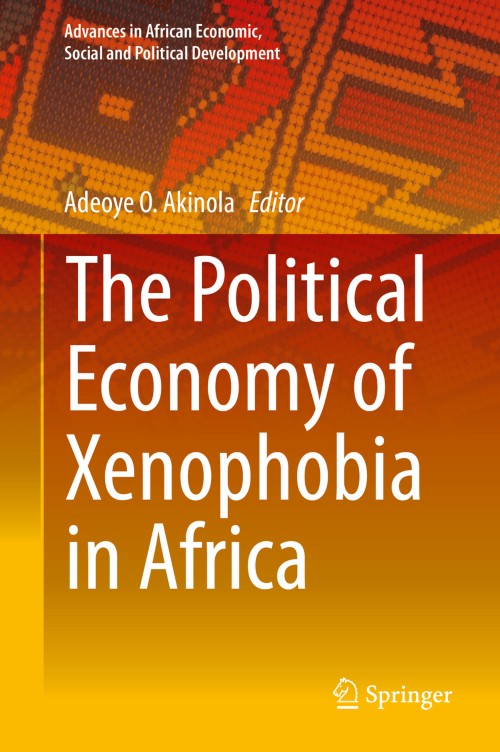
The Political Economy of Xenophobia in Africa [electronic resource] / edited by Adeoye O. Akinola.
Erişim Adresi
ISBN
9783319648972
Dil Kodu
İngilizce
Yer Numarası
DK/18975
Basım Bildirimi
1st ed. 2018.
Yayın Bilgisi
Cham : Springer International Publishing : Imprint: Springer, 2018.
Fiziksel Niteleme
VIII, 180 p. online resource.
Dizi
Advances in African Economic, Social and Political Development, 2198-7270
İçindekiler Notu
Chapter 1: Introduction -- Chapter 2: Crisis of Identity and Xenophobia in Africa: The Imperative of a Pan-African Thought Liberation -- Chapter 3: The Scourge of Xenophobia: From Botswana to Zambia -- Chapter 4: A Comparative Analysis of the Context of Xenophobia in Nigeria and South Africa -- Chapter 5: Democratization of Xenophobia in Sub-Saharan Africa: A Case of the Legitimization of Xenophobia in Ghana -- Chapter 6: South African Higher Education: The Paradox of Soft Power and Xenophobia -- Chapter 7: Frustration-Aggression, Afrophobia and the Psycho-Social Consequences of Corruption in South Africa -- Chapter 8: From Hate To Love: Black South Africans and the Xenophobia Project -- Chapter 9: Xenophobia, Racism and the Travails of 'Black' Immigrants in South Africa -- Chapter 10: Xenophobia-Coloniality Nexus: The Zimbabwean Experience -- Chapter 11: The Quest for Development in Zimbabwe: Rethinking the Xeno-Ethnophobia -- Chapter 12: Xenophobia and the Paradox of Regionalismin Africa: The ECOWAS Experience.-.
Özet, vb.
This book analyzes the phenomenon of xenophobia across African countries. With its roots in colonialism, which coercively created modern states through border delineation and the artificial merging and dividing of communities, xenophobia continues to be a barrier to post-colonial sustainable peace and security and socio-economic and political development in Africa. This volume critically assesses how xenophobia has impacted the three elements of political economy: state, economy and society. Beginning with historical and theoretical analysis to put xenophobia in context, the book moves on to country-specific case studies discussing the nature of xenophobia in Nigeria, South Africa, Zambia, Ghana and Zimbabwe. The chapters furthermore explore both violent and non-violent manifestations of xenophobia, and analyze how state responses to xenophobia affects African states, economies, and societies, especially in those cases where xenophobia has widespread institutional support. Providinga theoretical understanding of xenophobia and proffering sustainable solutions to the proliferation of xenophobia in the continent, this book is of use to researchers and students interested in political science, African politics, peace studies, security, and development economics, as well as policy-makers working to eradicate xenophobia in Africa.
Konu
Africa __ Politics and government.
International economic relations.
Regionalism.
Ethnology __ Africa.
Culture.
African Politics.
International Political Economy’.
Regionalism.
African Culture.
International economic relations.
Regionalism.
Ethnology __ Africa.
Culture.
African Politics.
International Political Economy’.
Regionalism.
African Culture.
Diğer Yazarlar
Kurum Adı
Eseri Alıntıla
Referansları kullanmadan önce gözden geçirmeniz ve varsa gerekli düzeltmeleri yapmanız önerilir.
Dijital Kaynak
MARC Görünümü
LEADER 04458nam a22005655i 4500
001 817765
003 TR_AnAIT
005 20260130184408
007 cr nn 008mamaa
008 171113s2018 sz | s |||| 0|eng d
020 |a9783319648972|9978-3-319-64897-2
024 7 |a10.1007/978-3-319-64897-2|2doi
041 |aeng
049 |aTürk Tarih Kurumu Kütüphanesi
050 4|aJQ1870-3981
072 7|aJP|2bicssc
072 7|a1H|2bicssc
072 7|aPOL053000|2bisacsh
072 7|aJP|x1H|2thema
082 04|a320.96|223
090 |aDK/18975
245 14|aThe Political Economy of Xenophobia in Africa|h[electronic resource] /|cedited by Adeoye O. Akinola.
250 |a1st ed. 2018.
264 1|aCham :|bSpringer International Publishing :|bImprint: Springer,|c2018.
300 |aVIII, 180 p.|bonline resource.
336 |atext|btxt|2rdacontent
337 |acomputer|bc|2rdamedia
338 |aonline resource|bcr|2rdacarrier
347 |atext file|bPDF|2rda
490 1 |aAdvances in African Economic, Social and Political Development,|x2198-7270
505 0 |aChapter 1: Introduction -- Chapter 2: Crisis of Identity and Xenophobia in Africa: The Imperative of a Pan-African Thought Liberation -- Chapter 3: The Scourge of Xenophobia: From Botswana to Zambia -- Chapter 4: A Comparative Analysis of the Context of Xenophobia in Nigeria and South Africa -- Chapter 5: Democratization of Xenophobia in Sub-Saharan Africa: A Case of the Legitimization of Xenophobia in Ghana -- Chapter 6: South African Higher Education: The Paradox of Soft Power and Xenophobia -- Chapter 7: Frustration-Aggression, Afrophobia and the Psycho-Social Consequences of Corruption in South Africa -- Chapter 8: From Hate To Love: Black South Africans and the Xenophobia Project -- Chapter 9: Xenophobia, Racism and the Travails of 'Black' Immigrants in South Africa -- Chapter 10: Xenophobia-Coloniality Nexus: The Zimbabwean Experience -- Chapter 11: The Quest for Development in Zimbabwe: Rethinking the Xeno-Ethnophobia -- Chapter 12: Xenophobia and the Paradox of Regionalismin Africa: The ECOWAS Experience.-.
520 |aThis book analyzes the phenomenon of xenophobia across African countries. With its roots in colonialism, which coercively created modern states through border delineation and the artificial merging and dividing of communities, xenophobia continues to be a barrier to post-colonial sustainable peace and security and socio-economic and political development in Africa. This volume critically assesses how xenophobia has impacted the three elements of political economy: state, economy and society. Beginning with historical and theoretical analysis to put xenophobia in context, the book moves on to country-specific case studies discussing the nature of xenophobia in Nigeria, South Africa, Zambia, Ghana and Zimbabwe. The chapters furthermore explore both violent and non-violent manifestations of xenophobia, and analyze how state responses to xenophobia affects African states, economies, and societies, especially in those cases where xenophobia has widespread institutional support. Providinga theoretical understanding of xenophobia and proffering sustainable solutions to the proliferation of xenophobia in the continent, this book is of use to researchers and students interested in political science, African politics, peace studies, security, and development economics, as well as policy-makers working to eradicate xenophobia in Africa.
650 0|aAfrica|xPolitics and government.
650 0|aInternational economic relations.
650 0|aRegionalism.
650 0|aEthnology|xAfrica.
650 0|aCulture.
650 14|aAfrican Politics.
650 24|aInternational Political Economy’.
650 24|aRegionalism.
650 24|aAfrican Culture.
700 1 |aAkinola, Adeoye O.|eeditor.|4edt|4http://id.loc.gov/vocabulary/relators/edt
710 2 |aSpringerLink (Online service)
773 0 |tSpringer Nature eBook
776 08|iPrinted edition:|z9783319648965
776 08|iPrinted edition:|z9783319648989
776 08|iPrinted edition:|z9783319878973
830 0|aAdvances in African Economic, Social and Political Development,|x2198-7270
856 40|uhttps://doi.org/10.1007/978-3-319-64897-2
912 |aZDB-2-POS
912 |aZDB-2-SXPI
950 |aPolitical Science and International Studies (SpringerNature-41174)
950 |aPolitical Science and International Studies (R0) (SpringerNature-43724)
001 817765
003 TR_AnAIT
005 20260130184408
007 cr nn 008mamaa
008 171113s2018 sz | s |||| 0|eng d
020 |a9783319648972|9978-3-319-64897-2
024 7 |a10.1007/978-3-319-64897-2|2doi
041 |aeng
049 |aTürk Tarih Kurumu Kütüphanesi
050 4|aJQ1870-3981
072 7|aJP|2bicssc
072 7|a1H|2bicssc
072 7|aPOL053000|2bisacsh
072 7|aJP|x1H|2thema
082 04|a320.96|223
090 |aDK/18975
245 14|aThe Political Economy of Xenophobia in Africa|h[electronic resource] /|cedited by Adeoye O. Akinola.
250 |a1st ed. 2018.
264 1|aCham :|bSpringer International Publishing :|bImprint: Springer,|c2018.
300 |aVIII, 180 p.|bonline resource.
336 |atext|btxt|2rdacontent
337 |acomputer|bc|2rdamedia
338 |aonline resource|bcr|2rdacarrier
347 |atext file|bPDF|2rda
490 1 |aAdvances in African Economic, Social and Political Development,|x2198-7270
505 0 |aChapter 1: Introduction -- Chapter 2: Crisis of Identity and Xenophobia in Africa: The Imperative of a Pan-African Thought Liberation -- Chapter 3: The Scourge of Xenophobia: From Botswana to Zambia -- Chapter 4: A Comparative Analysis of the Context of Xenophobia in Nigeria and South Africa -- Chapter 5: Democratization of Xenophobia in Sub-Saharan Africa: A Case of the Legitimization of Xenophobia in Ghana -- Chapter 6: South African Higher Education: The Paradox of Soft Power and Xenophobia -- Chapter 7: Frustration-Aggression, Afrophobia and the Psycho-Social Consequences of Corruption in South Africa -- Chapter 8: From Hate To Love: Black South Africans and the Xenophobia Project -- Chapter 9: Xenophobia, Racism and the Travails of 'Black' Immigrants in South Africa -- Chapter 10: Xenophobia-Coloniality Nexus: The Zimbabwean Experience -- Chapter 11: The Quest for Development in Zimbabwe: Rethinking the Xeno-Ethnophobia -- Chapter 12: Xenophobia and the Paradox of Regionalismin Africa: The ECOWAS Experience.-.
520 |aThis book analyzes the phenomenon of xenophobia across African countries. With its roots in colonialism, which coercively created modern states through border delineation and the artificial merging and dividing of communities, xenophobia continues to be a barrier to post-colonial sustainable peace and security and socio-economic and political development in Africa. This volume critically assesses how xenophobia has impacted the three elements of political economy: state, economy and society. Beginning with historical and theoretical analysis to put xenophobia in context, the book moves on to country-specific case studies discussing the nature of xenophobia in Nigeria, South Africa, Zambia, Ghana and Zimbabwe. The chapters furthermore explore both violent and non-violent manifestations of xenophobia, and analyze how state responses to xenophobia affects African states, economies, and societies, especially in those cases where xenophobia has widespread institutional support. Providinga theoretical understanding of xenophobia and proffering sustainable solutions to the proliferation of xenophobia in the continent, this book is of use to researchers and students interested in political science, African politics, peace studies, security, and development economics, as well as policy-makers working to eradicate xenophobia in Africa.
650 0|aAfrica|xPolitics and government.
650 0|aInternational economic relations.
650 0|aRegionalism.
650 0|aEthnology|xAfrica.
650 0|aCulture.
650 14|aAfrican Politics.
650 24|aInternational Political Economy’.
650 24|aRegionalism.
650 24|aAfrican Culture.
700 1 |aAkinola, Adeoye O.|eeditor.|4edt|4http://id.loc.gov/vocabulary/relators/edt
710 2 |aSpringerLink (Online service)
773 0 |tSpringer Nature eBook
776 08|iPrinted edition:|z9783319648965
776 08|iPrinted edition:|z9783319648989
776 08|iPrinted edition:|z9783319878973
830 0|aAdvances in African Economic, Social and Political Development,|x2198-7270
856 40|uhttps://doi.org/10.1007/978-3-319-64897-2
912 |aZDB-2-POS
912 |aZDB-2-SXPI
950 |aPolitical Science and International Studies (SpringerNature-41174)
950 |aPolitical Science and International Studies (R0) (SpringerNature-43724)
Materyaller
Depodan talep edilen materyal sadece kütüphane içerisinde kullanılmaktadır.
Materyal dışarıya ödünç verilmemektedir.
Materyal dışarıya ödünç verilmemektedir.
