

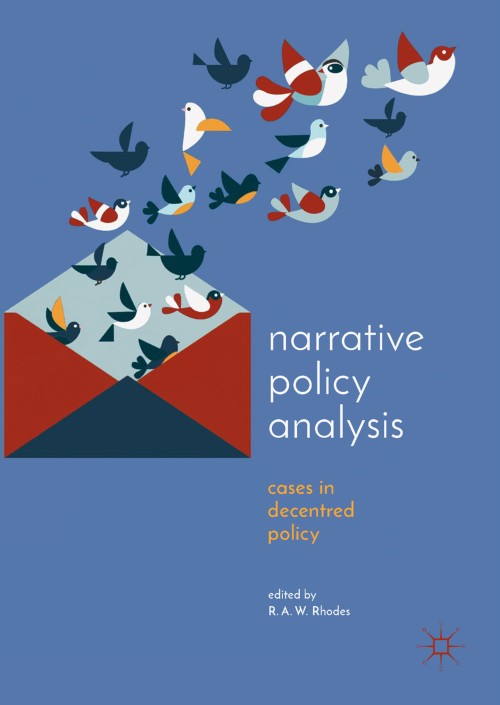
Narrative Policy Analysis [electronic resource] : Cases in Decentred Policy / edited by R.A.W Rhodes.
Erişim Adresi
ISBN
9783319766355
Dil Kodu
İngilizce
Yer Numarası
DK/19057
Basım Bildirimi
1st ed. 2018.
Yayın Bilgisi
Cham : Springer International Publishing : Imprint: Palgrave Macmillan, 2018.
Fiziksel Niteleme
XV, 273 p. 2 illus. online resource.
Dizi
Understanding Governance, 2947-423X
İçindekiler Notu
Chapter 1-What is Decentred Analysis?-R. A. W. Rhodes -- Chapter 2-What is Penal Policy? Traditions and Practices in the UK Ministry of Justice-Harry Annison -- Chapter 3-What Makes a Zero Carbon Home Zero Carbon?-Heather Lovell and Jack Corbett -- Chapter 4-What are the Hidden Dimensions to Parliamentary Scrutiny - the Ghosts in the Machine?-Tony McNulty -- Chapter 5-How Are Children’s Rights (Mis) Interpreted in Practice? The European Commission, Children’s Rights and Policy Narratives-Ingi Iusmen -- Chapter 6-How Do You Go From Demonizing Adversaries to Deliberating With Them?-John Boswell -- Chapter 7-How Have Narratives, Beliefs and Practices Shaped Pension Reform in Sweden?-Karen Anderson -- Chapter 8-What are the Consequences of Incessant Reform? Losing Trust, Policy Capacity and Institutional Memory in the Queensland Core Executive-Anne Tiernan -- Chapter 9-How do Local Government Chief Executives Engage with Policy Dilemmas?-Kevin Orr and Mike Bennett -- Chapter 10-How do the Police Respond to Evidence Based Policing?-Jenny Fleming -- Chapter 11-What do UK Citizens Understand about Austerity?-Anna Killick.
Özet, vb.
This book examine polices through the eyes of the practitioners, both top-down and bottom-up; it decentres policies and policymaking. To decentre is to unpack practices as the contingent beliefs and actions of individuals. Decentred analysis produces detailed studies of people’s beliefs and practices. It challenges the idea that inexorable or impersonal forces drive politics, focusing instead on the relevant meanings, the beliefs and preferences of the people involved. The book presents ten case studies, covering penal policy, zero-carbon homes, parliamentary scrutiny, children’s rights, obesity, pension reform, public service reform, evidence-based policing, and local economic knowledge. It introduces a different angle of vision on the policy process; it looks at it through the eyes of individual actors, not institutions. In other words, it looks at policies from the other end of the telescope. It concludes there is much to learn from a decentred approach. Itdelivers edification because it offers a novel alliance of interpretive theory with an ethnographic toolkit to explore policy and policymaking from the bottom-up. Written by members of the Department of Politics and International Relations of the University of Southampton, with their collaborators at other universities, the book’s decentred approach provides an alternative to the dominant evidence–based policy nostrums of the day. R. A. W. Rhodes is Professor of Government at the University of Southampton, UK. Previously, he was the Director of the UK Economic and Social Research Council’s ‘Whitehall Programme’ (1994-1999); Distinguished Professor of Political Science at the Australian National University (2006-11); and Director of the Research School of Social Sciences at the Australian National University (2007-8). In 2015, the ECPR awarded him its biennial Lifetime Achievement Award for his ‘outstanding contribution to allareas of political science, and the exceptional impact of his work’.
Konu
Political planning.
Political science.
Executive power.
Comparative government.
Europe __ Politics and government.
Public Policy.
Governance and Government.
Executive Politics.
Comparative Politics.
European Politics.
Political science.
Executive power.
Comparative government.
Europe __ Politics and government.
Public Policy.
Governance and Government.
Executive Politics.
Comparative Politics.
European Politics.
Diğer Yazarlar
Kurum Adı
