

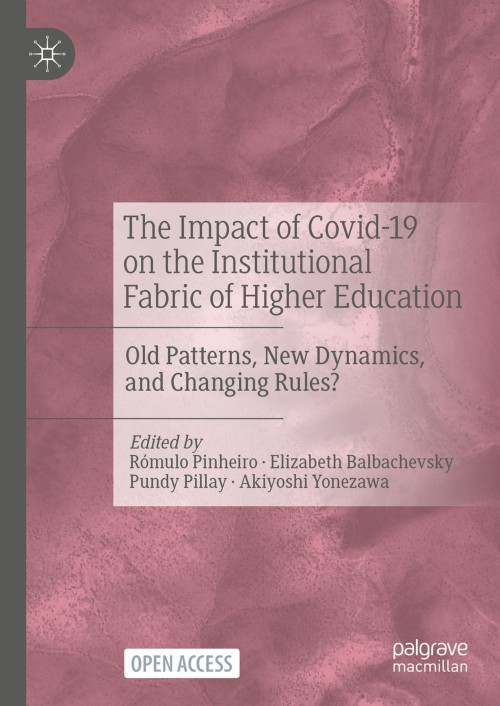
The Impact of Covid-19 on the Institutional Fabric of Higher Education [electronic resource] : Old Patterns, New Dynamics, and Changing Rules? / edited by Rómulo Pinheiro, Elizabeth Balbachevsky, Pundy Pillay, Akiyoshi Yonezawa.
Erişim Adresi
ISBN
9783031263934
Dil Kodu
İngilizce
Yer Numarası
DK/19134
Basım Bildirimi
1st ed. 2023.
Yayın Bilgisi
Cham : Springer International Publishing : Imprint: Palgrave Macmillan, 2023.
Fiziksel Niteleme
XXIX, 439 p. 22 illus. online resource.
İçindekiler Notu
Section 1: Setting the Stage -- Chapter 1: Assessing the impact of COVID-19 on the institutional fabric of Higher Education -- Section 2: The System's Responses to COVID-19 -- Chapter 2: Evidence, stakeholders and decision making: managing COVID-19 in Irish Higher education -- Chapter 3: New actors, administrative measures and conflicting agendas: The impact of the pandemic on internationalisation of higher education in Poland and Russia -- Chapter 4: Highlighting systemic inequalities: The impact of the COVID-19 pandemic on French Higher Education -- Chapter 5: Higher education institutions responses to COVID-19 in Uganda: Regulatory tools and adaptive institutions -- Section 3: Higher Education Institutions' Responses to COVID-19 -- Chapter 6: Higher Education in Brazil: Institutional actions for the retention of students in public and private sectors -- Chapter 7: Higher Education in Brazil: Institutional actions for the retention of students in public and private sectors -- Chapter 8: Internationalization of higher education in Argentina upon the arrival of Covid-19: Reactions and lessons from the perspective of International Relations Office -- Chapter 9: University-civic engagement in the time of the pandemic -- Chapter 10: Public Service Resilience in a post-COVID-19 world: The Case of Digital Transformation in Higher Education -- Chapter 11: Entrepreneurial universities: From research groups to spin-off companies in a time of COVID-19 -- Section 4: Actors' Responses to COVID-19 -- Chapter 12: Challenges, Opportunities, and Coping Strategies when Faced with the COVID-19 Pandemic: A Qualitative Study of Academics in Mainland China and Hong Kong -- Chapter 13: “We shouldn’t let academia exhaust ourselves anymore!”: Pandemic practices and the changing psychological contract in twenty-first century academia -- Chapter 14: Moving beyond policy on digital transformation: Perceptions of digital transformation of teaching by academic staff and students -- Chapter 15: Remote Universities? Impacts of COVID-19 as experienced by academic leaders in Finland between March 2020 and April 2021 -- Chapter 16: Post-COVID-19: Renegotiating the scope, role, and function of support and development for students in higher education across the globe -- Section 5: Taking Stock and Moving Forward -- Chapter 17: Epilogue: COVID-19 and the institutional fabric of higher education.
Özet, vb.
This open access book assesses how the Covid-19 pandemic caught higher education systems throughout the world by surprise. It maps out the responses of higher education institutions to the challenges and strategic opportunities brought about by the pandemic, and examines the effects such responses may have. Bringing together scholars and case studies from Europe, Asia, Africa and the Americas, the book is both comparative and global in nature. It also brings together researchers from a variety of disciplinary fields, including political scientists, historians, economists, sociologist, and anthropologists. In doing so, the book fosters an inter-disciplinary dialogue and inclusive methodological approach for unpacking the complexities associated with modern higher education systems and institutions. Rómulo Pinheiro is Professor of Public Policy and Administration at the University of Agder, Norway. Elizabeth Balbachevsky is Associate Professor in the Department of Political Science at the University of São Paulo, Brazil. Pundy Pillay is Professor of Economics and Public Finance at Wits University, South Africa. Akiyoshi Yonezawa is Professor and Vice-Director at the International Strategy Office, Tohoku University, Japan.
Konu
Political planning.
Education, Higher.
Social policy.
Public Policy.
Higher Education.
Social Policy.
Education, Higher.
Social policy.
Public Policy.
Higher Education.
Social Policy.
Diğer Yazarlar
Kurum Adı
Eseri Alıntıla
Referansları kullanmadan önce gözden geçirmeniz ve varsa gerekli düzeltmeleri yapmanız önerilir.
Dijital Kaynak
MARC Görünümü
LEADER 07133nam a22006735i 4500
001 817925
003 TR_AnAIT
005 20260130183251
007 cr nn 008mamaa
008 230719s2023 sz | s |||| 0|eng d
020 |a9783031263934|9978-3-031-26393-4
024 7 |a10.1007/978-3-031-26393-4|2doi
041 |aeng
049 |aTürk Tarih Kurumu Kütüphanesi
050 4|aJF1525.P6
072 7|aJPP|2bicssc
072 7|aPOL028000|2bisacsh
072 7|aJPP|2thema
082 04|a320.6|223
090 |aDK/19134
245 14|aThe Impact of Covid-19 on the Institutional Fabric of Higher Education|h[electronic resource] :|bOld Patterns, New Dynamics, and Changing Rules? /|cedited by Rómulo Pinheiro, Elizabeth Balbachevsky, Pundy Pillay, Akiyoshi Yonezawa.
250 |a1st ed. 2023.
264 1|aCham :|bSpringer International Publishing :|bImprint: Palgrave Macmillan,|c2023.
300 |aXXIX, 439 p. 22 illus.|bonline resource.
336 |atext|btxt|2rdacontent
337 |acomputer|bc|2rdamedia
338 |aonline resource|bcr|2rdacarrier
341 0 |bTable of contents navigation|2onix
341 0 |bSingle logical reading order|2onix
341 0 |bShort alternative textual descriptions|2onix
341 0 |bUse of color is not sole means of conveying information|2onix
341 0 |bUse of high contrast between text and background color|2onix
341 0 |bNext / Previous structural navigation|2onix
341 0 |bAll non-decorative content supports reading without sight|2onix
347 |atext file|bPDF|2rda
505 0 |aSection 1: Setting the Stage -- Chapter 1: Assessing the impact of COVID-19 on the institutional fabric of Higher Education -- Section 2: The System's Responses to COVID-19 -- Chapter 2: Evidence, stakeholders and decision making: managing COVID-19 in Irish Higher education -- Chapter 3: New actors, administrative measures and conflicting agendas: The impact of the pandemic on internationalisation of higher education in Poland and Russia -- Chapter 4: Highlighting systemic inequalities: The impact of the COVID-19 pandemic on French Higher Education -- Chapter 5: Higher education institutions responses to COVID-19 in Uganda: Regulatory tools and adaptive institutions -- Section 3: Higher Education Institutions' Responses to COVID-19 -- Chapter 6: Higher Education in Brazil: Institutional actions for the retention of students in public and private sectors -- Chapter 7: Higher Education in Brazil: Institutional actions for the retention of students in public and private sectors -- Chapter 8: Internationalization of higher education in Argentina upon the arrival of Covid-19: Reactions and lessons from the perspective of International Relations Office -- Chapter 9: University-civic engagement in the time of the pandemic -- Chapter 10: Public Service Resilience in a post-COVID-19 world: The Case of Digital Transformation in Higher Education -- Chapter 11: Entrepreneurial universities: From research groups to spin-off companies in a time of COVID-19 -- Section 4: Actors' Responses to COVID-19 -- Chapter 12: Challenges, Opportunities, and Coping Strategies when Faced with the COVID-19 Pandemic: A Qualitative Study of Academics in Mainland China and Hong Kong -- Chapter 13: “We shouldn’t let academia exhaust ourselves anymore!”: Pandemic practices and the changing psychological contract in twenty-first century academia -- Chapter 14: Moving beyond policy on digital transformation: Perceptions of digital transformation of teaching by academic staff and students -- Chapter 15: Remote Universities? Impacts of COVID-19 as experienced by academic leaders in Finland between March 2020 and April 2021 -- Chapter 16: Post-COVID-19: Renegotiating the scope, role, and function of support and development for students in higher education across the globe -- Section 5: Taking Stock and Moving Forward -- Chapter 17: Epilogue: COVID-19 and the institutional fabric of higher education.
506 0 |aOpen Access
520 |aThis open access book assesses how the Covid-19 pandemic caught higher education systems throughout the world by surprise. It maps out the responses of higher education institutions to the challenges and strategic opportunities brought about by the pandemic, and examines the effects such responses may have. Bringing together scholars and case studies from Europe, Asia, Africa and the Americas, the book is both comparative and global in nature. It also brings together researchers from a variety of disciplinary fields, including political scientists, historians, economists, sociologist, and anthropologists. In doing so, the book fosters an inter-disciplinary dialogue and inclusive methodological approach for unpacking the complexities associated with modern higher education systems and institutions. Rómulo Pinheiro is Professor of Public Policy and Administration at the University of Agder, Norway. Elizabeth Balbachevsky is Associate Professor in the Department of Political Science at the University of São Paulo, Brazil. Pundy Pillay is Professor of Economics and Public Finance at Wits University, South Africa. Akiyoshi Yonezawa is Professor and Vice-Director at the International Strategy Office, Tohoku University, Japan.
532 8 |aAccessibility summary: This PDF does not fully comply with PDF/UA standards, but does feature limited screen reader support, described non-text content (images, graphs), bookmarks for easy navigation and searchable, selectable text. Users of assistive technologies may experience difficulty navigating or interpreting content in this document. We recognize the importance of accessibility, and we welcome queries about accessibility for any of our products. If you have a question or an access need, please get in touch with us at accessibilitysupport@springernature.com.
532 8 |aNo reading system accessibility options actively disabled
532 8 |aPublisher contact for further accessibility information: accessibilitysupport@springernature.com
650 0|aPolitical planning.
650 0|aEducation, Higher.
650 0|aSocial policy.
650 14|aPublic Policy.
650 24|aHigher Education.
650 24|aSocial Policy.
700 1 |aPinheiro, Rómulo.|eeditor.|0(orcid)0000-0002-6627-9644|1https://orcid.org/0000-0002-6627-9644|4edt|4http://id.loc.gov/vocabulary/relators/edt
700 1 |aBalbachevsky, Elizabeth.|eeditor.|4edt|4http://id.loc.gov/vocabulary/relators/edt
700 1 |aPillay, Pundy.|eeditor.|4edt|4http://id.loc.gov/vocabulary/relators/edt
700 1 |aYonezawa, Akiyoshi.|eeditor.|4edt|4http://id.loc.gov/vocabulary/relators/edt
710 2 |aSpringerLink (Online service)
773 0 |tSpringer Nature eBook
776 08|iPrinted edition:|z9783031263927
776 08|iPrinted edition:|z9783031263941
776 08|iPrinted edition:|z9783031263958
856 40|uhttps://doi.org/10.1007/978-3-031-26393-4
912 |aZDB-2-POS
912 |aZDB-2-SXPI
912 |aZDB-2-SOB
950 |aPolitical Science and International Studies (SpringerNature-41174)
950 |aPolitical Science and International Studies (R0) (SpringerNature-43724)
001 817925
003 TR_AnAIT
005 20260130183251
007 cr nn 008mamaa
008 230719s2023 sz | s |||| 0|eng d
020 |a9783031263934|9978-3-031-26393-4
024 7 |a10.1007/978-3-031-26393-4|2doi
041 |aeng
049 |aTürk Tarih Kurumu Kütüphanesi
050 4|aJF1525.P6
072 7|aJPP|2bicssc
072 7|aPOL028000|2bisacsh
072 7|aJPP|2thema
082 04|a320.6|223
090 |aDK/19134
245 14|aThe Impact of Covid-19 on the Institutional Fabric of Higher Education|h[electronic resource] :|bOld Patterns, New Dynamics, and Changing Rules? /|cedited by Rómulo Pinheiro, Elizabeth Balbachevsky, Pundy Pillay, Akiyoshi Yonezawa.
250 |a1st ed. 2023.
264 1|aCham :|bSpringer International Publishing :|bImprint: Palgrave Macmillan,|c2023.
300 |aXXIX, 439 p. 22 illus.|bonline resource.
336 |atext|btxt|2rdacontent
337 |acomputer|bc|2rdamedia
338 |aonline resource|bcr|2rdacarrier
341 0 |bTable of contents navigation|2onix
341 0 |bSingle logical reading order|2onix
341 0 |bShort alternative textual descriptions|2onix
341 0 |bUse of color is not sole means of conveying information|2onix
341 0 |bUse of high contrast between text and background color|2onix
341 0 |bNext / Previous structural navigation|2onix
341 0 |bAll non-decorative content supports reading without sight|2onix
347 |atext file|bPDF|2rda
505 0 |aSection 1: Setting the Stage -- Chapter 1: Assessing the impact of COVID-19 on the institutional fabric of Higher Education -- Section 2: The System's Responses to COVID-19 -- Chapter 2: Evidence, stakeholders and decision making: managing COVID-19 in Irish Higher education -- Chapter 3: New actors, administrative measures and conflicting agendas: The impact of the pandemic on internationalisation of higher education in Poland and Russia -- Chapter 4: Highlighting systemic inequalities: The impact of the COVID-19 pandemic on French Higher Education -- Chapter 5: Higher education institutions responses to COVID-19 in Uganda: Regulatory tools and adaptive institutions -- Section 3: Higher Education Institutions' Responses to COVID-19 -- Chapter 6: Higher Education in Brazil: Institutional actions for the retention of students in public and private sectors -- Chapter 7: Higher Education in Brazil: Institutional actions for the retention of students in public and private sectors -- Chapter 8: Internationalization of higher education in Argentina upon the arrival of Covid-19: Reactions and lessons from the perspective of International Relations Office -- Chapter 9: University-civic engagement in the time of the pandemic -- Chapter 10: Public Service Resilience in a post-COVID-19 world: The Case of Digital Transformation in Higher Education -- Chapter 11: Entrepreneurial universities: From research groups to spin-off companies in a time of COVID-19 -- Section 4: Actors' Responses to COVID-19 -- Chapter 12: Challenges, Opportunities, and Coping Strategies when Faced with the COVID-19 Pandemic: A Qualitative Study of Academics in Mainland China and Hong Kong -- Chapter 13: “We shouldn’t let academia exhaust ourselves anymore!”: Pandemic practices and the changing psychological contract in twenty-first century academia -- Chapter 14: Moving beyond policy on digital transformation: Perceptions of digital transformation of teaching by academic staff and students -- Chapter 15: Remote Universities? Impacts of COVID-19 as experienced by academic leaders in Finland between March 2020 and April 2021 -- Chapter 16: Post-COVID-19: Renegotiating the scope, role, and function of support and development for students in higher education across the globe -- Section 5: Taking Stock and Moving Forward -- Chapter 17: Epilogue: COVID-19 and the institutional fabric of higher education.
506 0 |aOpen Access
520 |aThis open access book assesses how the Covid-19 pandemic caught higher education systems throughout the world by surprise. It maps out the responses of higher education institutions to the challenges and strategic opportunities brought about by the pandemic, and examines the effects such responses may have. Bringing together scholars and case studies from Europe, Asia, Africa and the Americas, the book is both comparative and global in nature. It also brings together researchers from a variety of disciplinary fields, including political scientists, historians, economists, sociologist, and anthropologists. In doing so, the book fosters an inter-disciplinary dialogue and inclusive methodological approach for unpacking the complexities associated with modern higher education systems and institutions. Rómulo Pinheiro is Professor of Public Policy and Administration at the University of Agder, Norway. Elizabeth Balbachevsky is Associate Professor in the Department of Political Science at the University of São Paulo, Brazil. Pundy Pillay is Professor of Economics and Public Finance at Wits University, South Africa. Akiyoshi Yonezawa is Professor and Vice-Director at the International Strategy Office, Tohoku University, Japan.
532 8 |aAccessibility summary: This PDF does not fully comply with PDF/UA standards, but does feature limited screen reader support, described non-text content (images, graphs), bookmarks for easy navigation and searchable, selectable text. Users of assistive technologies may experience difficulty navigating or interpreting content in this document. We recognize the importance of accessibility, and we welcome queries about accessibility for any of our products. If you have a question or an access need, please get in touch with us at accessibilitysupport@springernature.com.
532 8 |aNo reading system accessibility options actively disabled
532 8 |aPublisher contact for further accessibility information: accessibilitysupport@springernature.com
650 0|aPolitical planning.
650 0|aEducation, Higher.
650 0|aSocial policy.
650 14|aPublic Policy.
650 24|aHigher Education.
650 24|aSocial Policy.
700 1 |aPinheiro, Rómulo.|eeditor.|0(orcid)0000-0002-6627-9644|1https://orcid.org/0000-0002-6627-9644|4edt|4http://id.loc.gov/vocabulary/relators/edt
700 1 |aBalbachevsky, Elizabeth.|eeditor.|4edt|4http://id.loc.gov/vocabulary/relators/edt
700 1 |aPillay, Pundy.|eeditor.|4edt|4http://id.loc.gov/vocabulary/relators/edt
700 1 |aYonezawa, Akiyoshi.|eeditor.|4edt|4http://id.loc.gov/vocabulary/relators/edt
710 2 |aSpringerLink (Online service)
773 0 |tSpringer Nature eBook
776 08|iPrinted edition:|z9783031263927
776 08|iPrinted edition:|z9783031263941
776 08|iPrinted edition:|z9783031263958
856 40|uhttps://doi.org/10.1007/978-3-031-26393-4
912 |aZDB-2-POS
912 |aZDB-2-SXPI
912 |aZDB-2-SOB
950 |aPolitical Science and International Studies (SpringerNature-41174)
950 |aPolitical Science and International Studies (R0) (SpringerNature-43724)
Materyaller
Depodan talep edilen materyal sadece kütüphane içerisinde kullanılmaktadır.
Materyal dışarıya ödünç verilmemektedir.
Materyal dışarıya ödünç verilmemektedir.
