LEADER 04382nam a22005775i 4500
001 817950
003 TR_AnAIT
005 20260130183129
007 cr nn 008mamaa
008 161029s2017 sz | s |||| 0|eng d
020 |a9783319350806|9978-3-319-35080-6
024 7 |a10.1007/978-3-319-35080-6|2doi
041 |aeng
049 |aTürk Tarih Kurumu Kütüphanesi
050 4|aJZ1252
072 7|aJPS|2bicssc
072 7|aKCP|2bicssc
072 7|aPOL011020|2bisacsh
072 7|aJPS|2thema
072 7|aKCP|2thema
082 04|a327.111|223
090 |aDK/19159
100 1 |aDella Porta, Donatella.|eauthor.|4aut|4http://id.loc.gov/vocabulary/relators/aut
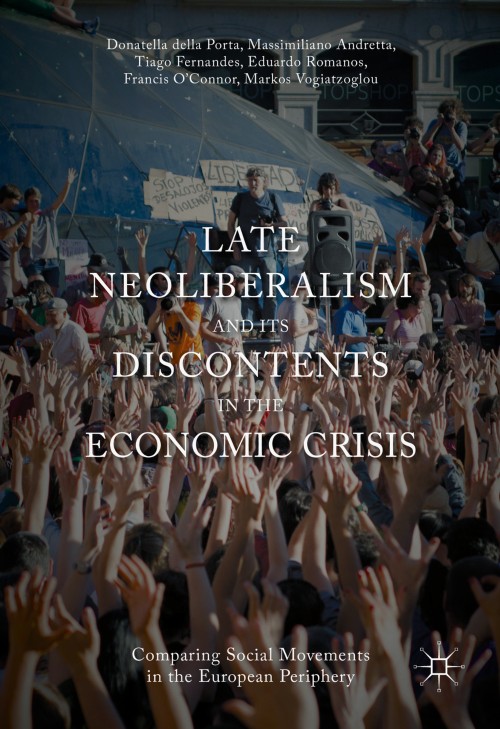
245 10|aLate Neoliberalism and its Discontents in the Economic Crisis|h[electronic resource] :|bComparing Social Movements in the European Periphery /|cby Donatella Della Porta, Massimiliano Andretta, Tiago Fernandes, Francis O'Connor, Eduardo Romanos, Markos Vogiatzoglou.
250 |a1st ed. 2017.
264 1|aCham :|bSpringer International Publishing :|bImprint: Palgrave Macmillan,|c2017.
300 |aXV, 307 p. 19 illus., 2 illus. in color.|bonline resource.
336 |atext|btxt|2rdacontent
337 |acomputer|bc|2rdamedia
338 |aonline resource|bcr|2rdacarrier
347 |atext file|bPDF|2rda
505 0 |aAbout the Authors -- Chapter 1. Late neoliberalism and its discontents: An introduction -- Chapter 2. Iceland’s mobilization in the financial crisis -- Chapter 3. The presence and absence of protest in austerity Ireland -- Chapter 4. Turbulent flow: Anti-austerity mobilization in Greece -- Chapter 5. Late neoliberalism and its Indignados: Contention in austerity Spain -- Chapter 6. Building alliances: Successful anti-austerity mobilization in Portugal. Chapter 7. Late neoliberalism and its discontents in Italy: protests without movement? -- Chapter 8. Cyprus’ explosion: financial crisis and anti-austerity mobilization -- Chapter 9. Late neoliberalism and its discontents: A comparative conclusion -- Index.
520 |aThis book analyses protests against the Great Recession in the European periphery. While social movements have long been considered as children of affluent times - or at least of times of opening opportunities - these protests defy such expectations, developing instead in moments of diminishing opportunities in both the economic and the political realms. Can social movement studies still be useful to understanding these movements of troubled times? The authors offer a positive answer to this question, although specify the need to bridge contentious politics with other fields, including political economy. They highlight differences in the social movements’ strength and breadth and attempt to understand them in terms of three sets of dimensions: a) the specific characteristics of the socio-economic crisis and its consequences in terms of mobilization potential; b) the political reactions to it, in what we can define as political opportunities and threats; and c) the social movement cultures and structures that characterize each country. The book discusses these topics through a contextualized analysis of anti-austerity protest in the European periphery.
650 0|aInternational economic relations.
650 0|aEurope|xPolitics and government.
650 0|aComparative government.
650 14|aInternational Political Economy’.
650 24|aEuropean Politics.
650 24|aComparative Politics.
700 1 |aAndretta, Massimiliano.|eauthor.|4aut|4http://id.loc.gov/vocabulary/relators/aut
700 1 |aFernandes, Tiago.|eauthor.|4aut|4http://id.loc.gov/vocabulary/relators/aut
700 1 |aO'Connor, Francis.|eauthor.|4aut|4http://id.loc.gov/vocabulary/relators/aut
700 1 |aRomanos, Eduardo.|eauthor.|4aut|4http://id.loc.gov/vocabulary/relators/aut
700 1 |aVogiatzoglou, Markos.|eauthor.|4aut|4http://id.loc.gov/vocabulary/relators/aut
710 2 |aSpringerLink (Online service)
773 0 |tSpringer Nature eBook
776 08|iPrinted edition:|z9783319350790
776 08|iPrinted edition:|z9783319350813
776 08|iPrinted edition:|z9783319817187
856 40|uhttps://doi.org/10.1007/978-3-319-35080-6
912 |aZDB-2-POS
912 |aZDB-2-SXPI
950 |aPolitical Science and International Studies (SpringerNature-41174)
950 |aPolitical Science and International Studies (R0) (SpringerNature-43724)