

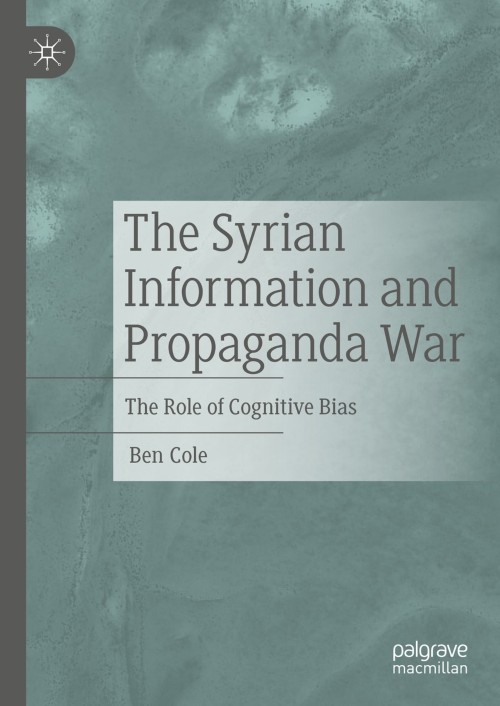
The Syrian Information and Propaganda War [electronic resource] : The Role of Cognitive Bias / by Ben Cole.
Erişim Adresi
ISBN
9783030932824
Dil Kodu
İngilizce
Yer Numarası
DK/19324
Yazar
Basım Bildirimi
1st ed. 2022.
Yayın Bilgisi
Cham : Springer International Publishing : Imprint: Palgrave Macmillan, 2022.
Fiziksel Niteleme
XVI, 414 p. online resource.
İçindekiler Notu
Chapter 1. Propaganda, Power and Bias -- Chapter 2. The Pre-uprising Propaganda War -- Chapter 3. Establishing The Dominant Discourse -- Chapter 4. Assad is Sectarian -- Chapter 5. Assad Is Killing His Own People -- Chapter 6. Assad Is Using Chemical Weapons -- Chapter 7. Assad Protector Of The Nation -- Chapter 8. Syria Is Secular -- Chapter 9. The Rebels Are Extremists -- Chapter 10. Business As Usual -- Chapter 11. Limited Effects -- Chapter 12. Conclusion - Decoding The Propaganda War.
Özet, vb.
This book focuses on the propaganda war between the Syrian government and the opposition movement, which excludes the Islamic State and the Kurdish-led SDF. Drawing on international relations, psychology, and media studies, the book encourages readers to question the dominant discourse on the war. The core of the book outlines the propaganda battles over the main paradigms and narratives that framed the war, exploring the shortcomings of those paradigms and narratives, identifying who won the propaganda war and why, and assessing what impact it had on the military side of the war. In particular, it focuses on the role of cognitive bias amongst primary and secondary sources in determining the outcome of the propaganda war, and whether the influence of this propaganda is best explained by effects or limited effects theory. Through explaining the dynamics of the propaganda war, the book encourages readers to critically question the dominant discourse on the war, assists them in understanding primary and secondary reporting on the war, and shows that the impact of the propaganda war is best understood in terms of limited effects theory. The book's main findings are that: 1) the opposition won the international propaganda war but failed to win the propaganda war inside Syria; 2) propaganda had relatively little effect on shaping attitudes either inside Syria or internationally (instead, its main effect was to reinforce attitudes that had already been shaped by other factors); and 3) the reality of the war lies between the conflicting paradigms and narratives being promoted by each side. Ben Cole is Honorary Lecturer at the School of Psychology, University of Liverpool, UK. He currently specializes in the process by which individuals become radicalized into violent extremism; terrorist decision making with regard to CBRN weapons; real-time monitoring and analysis of conflicts and terrorist movements using online media; and the war in Syria. .
Konu
International relations.
Communication in politics.
Peace.
Journalism.
Middle East __ Politics and government.
International Relations.
Political Communication.
Peace and Conflict Studies.
Journalism.
Middle Eastern Politics.
Communication in politics.
Peace.
Journalism.
Middle East __ Politics and government.
International Relations.
Political Communication.
Peace and Conflict Studies.
Journalism.
Middle Eastern Politics.
Kurum Adı
Eseri Alıntıla
Referansları kullanmadan önce gözden geçirmeniz ve varsa gerekli düzeltmeleri yapmanız önerilir.
Dijital Kaynak
MARC Görünümü
LEADER 04357nam a22005415i 4500
001 818115
003 TR_AnAIT
005 20260130182404
007 cr nn 008mamaa
008 220222s2022 sz | s |||| 0|eng d
020 |a9783030932824|9978-3-030-93282-4
024 7 |a10.1007/978-3-030-93282-4|2doi
041 |aeng
049 |aTürk Tarih Kurumu Kütüphanesi
050 4|aJZ2-6530
072 7|aJPS|2bicssc
072 7|aPOL011000|2bisacsh
072 7|aJPS|2thema
082 04|a327|223
090 |aDK/19324
100 1 |aCole, Ben.|eauthor.|4aut|4http://id.loc.gov/vocabulary/relators/aut
245 14|aThe Syrian Information and Propaganda War|h[electronic resource] :|bThe Role of Cognitive Bias /|cby Ben Cole.
250 |a1st ed. 2022.
264 1|aCham :|bSpringer International Publishing :|bImprint: Palgrave Macmillan,|c2022.
300 |aXVI, 414 p.|bonline resource.
336 |atext|btxt|2rdacontent
337 |acomputer|bc|2rdamedia
338 |aonline resource|bcr|2rdacarrier
347 |atext file|bPDF|2rda
505 0 |aChapter 1. Propaganda, Power and Bias -- Chapter 2. The Pre-uprising Propaganda War -- Chapter 3. Establishing The Dominant Discourse -- Chapter 4. Assad is Sectarian -- Chapter 5. Assad Is Killing His Own People -- Chapter 6. Assad Is Using Chemical Weapons -- Chapter 7. Assad Protector Of The Nation -- Chapter 8. Syria Is Secular -- Chapter 9. The Rebels Are Extremists -- Chapter 10. Business As Usual -- Chapter 11. Limited Effects -- Chapter 12. Conclusion - Decoding The Propaganda War.
520 |aThis book focuses on the propaganda war between the Syrian government and the opposition movement, which excludes the Islamic State and the Kurdish-led SDF. Drawing on international relations, psychology, and media studies, the book encourages readers to question the dominant discourse on the war. The core of the book outlines the propaganda battles over the main paradigms and narratives that framed the war, exploring the shortcomings of those paradigms and narratives, identifying who won the propaganda war and why, and assessing what impact it had on the military side of the war. In particular, it focuses on the role of cognitive bias amongst primary and secondary sources in determining the outcome of the propaganda war, and whether the influence of this propaganda is best explained by effects or limited effects theory. Through explaining the dynamics of the propaganda war, the book encourages readers to critically question the dominant discourse on the war, assists them in understanding primary and secondary reporting on the war, and shows that the impact of the propaganda war is best understood in terms of limited effects theory. The book's main findings are that: 1) the opposition won the international propaganda war but failed to win the propaganda war inside Syria; 2) propaganda had relatively little effect on shaping attitudes either inside Syria or internationally (instead, its main effect was to reinforce attitudes that had already been shaped by other factors); and 3) the reality of the war lies between the conflicting paradigms and narratives being promoted by each side. Ben Cole is Honorary Lecturer at the School of Psychology, University of Liverpool, UK. He currently specializes in the process by which individuals become radicalized into violent extremism; terrorist decision making with regard to CBRN weapons; real-time monitoring and analysis of conflicts and terrorist movements using online media; and the war in Syria. .
650 0|aInternational relations.
650 0|aCommunication in politics.
650 0|aPeace.
650 0|aJournalism.
650 0|aMiddle East|xPolitics and government.
650 14|aInternational Relations.
650 24|aPolitical Communication.
650 24|aPeace and Conflict Studies.
650 24|aJournalism.
650 24|aMiddle Eastern Politics.
710 2 |aSpringerLink (Online service)
773 0 |tSpringer Nature eBook
776 08|iPrinted edition:|z9783030932817
776 08|iPrinted edition:|z9783030932831
776 08|iPrinted edition:|z9783030932848
856 40|uhttps://doi.org/10.1007/978-3-030-93282-4
912 |aZDB-2-POS
912 |aZDB-2-SXPI
950 |aPolitical Science and International Studies (SpringerNature-41174)
950 |aPolitical Science and International Studies (R0) (SpringerNature-43724)
001 818115
003 TR_AnAIT
005 20260130182404
007 cr nn 008mamaa
008 220222s2022 sz | s |||| 0|eng d
020 |a9783030932824|9978-3-030-93282-4
024 7 |a10.1007/978-3-030-93282-4|2doi
041 |aeng
049 |aTürk Tarih Kurumu Kütüphanesi
050 4|aJZ2-6530
072 7|aJPS|2bicssc
072 7|aPOL011000|2bisacsh
072 7|aJPS|2thema
082 04|a327|223
090 |aDK/19324
100 1 |aCole, Ben.|eauthor.|4aut|4http://id.loc.gov/vocabulary/relators/aut
245 14|aThe Syrian Information and Propaganda War|h[electronic resource] :|bThe Role of Cognitive Bias /|cby Ben Cole.
250 |a1st ed. 2022.
264 1|aCham :|bSpringer International Publishing :|bImprint: Palgrave Macmillan,|c2022.
300 |aXVI, 414 p.|bonline resource.
336 |atext|btxt|2rdacontent
337 |acomputer|bc|2rdamedia
338 |aonline resource|bcr|2rdacarrier
347 |atext file|bPDF|2rda
505 0 |aChapter 1. Propaganda, Power and Bias -- Chapter 2. The Pre-uprising Propaganda War -- Chapter 3. Establishing The Dominant Discourse -- Chapter 4. Assad is Sectarian -- Chapter 5. Assad Is Killing His Own People -- Chapter 6. Assad Is Using Chemical Weapons -- Chapter 7. Assad Protector Of The Nation -- Chapter 8. Syria Is Secular -- Chapter 9. The Rebels Are Extremists -- Chapter 10. Business As Usual -- Chapter 11. Limited Effects -- Chapter 12. Conclusion - Decoding The Propaganda War.
520 |aThis book focuses on the propaganda war between the Syrian government and the opposition movement, which excludes the Islamic State and the Kurdish-led SDF. Drawing on international relations, psychology, and media studies, the book encourages readers to question the dominant discourse on the war. The core of the book outlines the propaganda battles over the main paradigms and narratives that framed the war, exploring the shortcomings of those paradigms and narratives, identifying who won the propaganda war and why, and assessing what impact it had on the military side of the war. In particular, it focuses on the role of cognitive bias amongst primary and secondary sources in determining the outcome of the propaganda war, and whether the influence of this propaganda is best explained by effects or limited effects theory. Through explaining the dynamics of the propaganda war, the book encourages readers to critically question the dominant discourse on the war, assists them in understanding primary and secondary reporting on the war, and shows that the impact of the propaganda war is best understood in terms of limited effects theory. The book's main findings are that: 1) the opposition won the international propaganda war but failed to win the propaganda war inside Syria; 2) propaganda had relatively little effect on shaping attitudes either inside Syria or internationally (instead, its main effect was to reinforce attitudes that had already been shaped by other factors); and 3) the reality of the war lies between the conflicting paradigms and narratives being promoted by each side. Ben Cole is Honorary Lecturer at the School of Psychology, University of Liverpool, UK. He currently specializes in the process by which individuals become radicalized into violent extremism; terrorist decision making with regard to CBRN weapons; real-time monitoring and analysis of conflicts and terrorist movements using online media; and the war in Syria. .
650 0|aInternational relations.
650 0|aCommunication in politics.
650 0|aPeace.
650 0|aJournalism.
650 0|aMiddle East|xPolitics and government.
650 14|aInternational Relations.
650 24|aPolitical Communication.
650 24|aPeace and Conflict Studies.
650 24|aJournalism.
650 24|aMiddle Eastern Politics.
710 2 |aSpringerLink (Online service)
773 0 |tSpringer Nature eBook
776 08|iPrinted edition:|z9783030932817
776 08|iPrinted edition:|z9783030932831
776 08|iPrinted edition:|z9783030932848
856 40|uhttps://doi.org/10.1007/978-3-030-93282-4
912 |aZDB-2-POS
912 |aZDB-2-SXPI
950 |aPolitical Science and International Studies (SpringerNature-41174)
950 |aPolitical Science and International Studies (R0) (SpringerNature-43724)
Materyaller
Depodan talep edilen materyal sadece kütüphane içerisinde kullanılmaktadır.
Materyal dışarıya ödünç verilmemektedir.
Materyal dışarıya ödünç verilmemektedir.
