

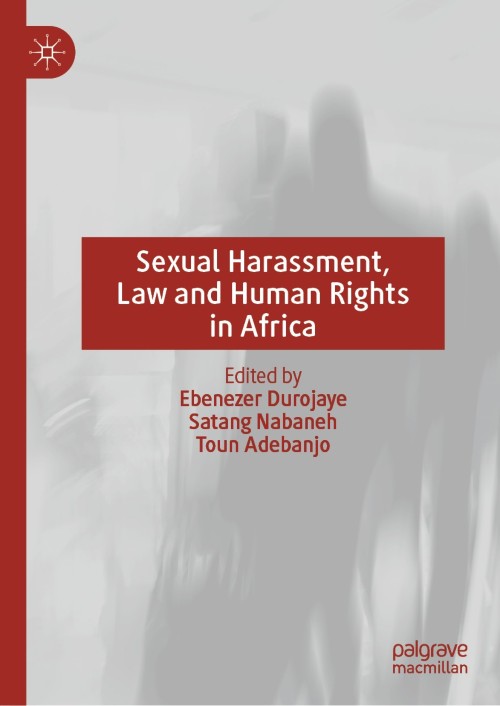
Sexual Harassment, Law and Human Rights in Africa [electronic resource] / edited by Ebenezer Durojaye, Satang Nabaneh, Toun Adebanjo.
Erişim Adresi
ISBN
9783031323676
Dil Kodu
İngilizce
Yer Numarası
DK/19335
Basım Bildirimi
1st ed. 2023.
Yayın Bilgisi
Cham : Springer International Publishing : Imprint: Palgrave Macmillan, 2023.
Fiziksel Niteleme
XXVIII, 363 p. 1 illus. online resource.
İçindekiler Notu
1. Sexual harassment, human rights and feminism -- 2. Towards a woman-centered approach in addressing sexual harassment in Africa -- 3. Protecting women with disabilities from sexual harassment in africa -- 4. Nowhere is safe for women: adopting a rights-based approach in addressing in-flight sexual harassment -- 5. The dynamics of sexual harassment against women and access to protection for victims in zimbabwe’s informal sector -- 6. Addressing the epidemic of sexual harassment in idp camps in Nigeria -- 7. Sexual harassment: vulnerability of domestic workers in Nigeria -- 8. The legal framework on sexual harassment in eswatini – a critical review in light of the maputo protocol -- 9. Sexual harassment in the workplace in the gambia: an analysis of recent developments from a feminist perspective -- 10. Sexual harassment in the university workplace: the place of section 35(5) of south africa’s constitution -- 11. The role of the courts in addressing sexual harassment in Nigeria.
Özet, vb.
“The book is unique and somewhat first of its kind, providing extensive analysis on how sexual and gender- based violence affect marginalised communities...” ––Dr Abiola Akiyode-Afolabi, University of Lagos & Executive Director, Women Advocate Research & Documentation Centre, Nigeria “This book takes an intersectional approach to human rights by exploring the intersection of gender, disability, refugee status, and social class, and in so doing, offers an invaluable contribution to the literature on women’s human rights in Africa.” ––Prof Johanna Bond, Dean Faculty of Law Rutgers University, USA “It adopts a very unique-multidisciplinary perspective to sexual harassment by analysing it using the human rights based approach, something that has been lacking from the Global South!” ––Dr Linet Sithole, Law Lecturer at Africa University, Zimbabwe This book delves into the endemic and pervasive issue of sexual harassment in Africa, examining it as a gendered expression of power and a gross violation of human rights. It explores sexual harassment in various sectors, including domestic work, academia, and the informal economy, across a range of African countries. The book also highlights the sexual harassment experienced by vulnerable populations, such as internally displaced people, people with disabilities, and women and girls traveling by air. With a keen focus on the intersection of law, feminism, and human rights, the book analyzes the role of the courts and national human rights institutions in addressing sexual harassment, drawing lessons from other jurisdictions. This book is a must-read for researchers, policymakers, and civil society organizations interested in gender power relations and women‘s rights in Africa and beyond. Ebenezer Durojaye is Professor and Head of the Socio-Economic Rights Project at the Dullah Omar Institute, University of the Western Cape, South Africa. Satang Nabaneh is Research Professor of Law at the University of Dayton School of Law and the Human Rights Center’s Director of Programs. Adetoun Adebanjo is Legal Researcher and Consultant in Queensland, Australia.
Konu
International relations.
Human rights.
International Relations Theory.
Politics and Human Rights.
Human rights.
International Relations Theory.
Politics and Human Rights.
Diğer Yazarlar
Kurum Adı
Eseri Alıntıla
Referansları kullanmadan önce gözden geçirmeniz ve varsa gerekli düzeltmeleri yapmanız önerilir.
Dijital Kaynak
MARC Görünümü
LEADER 06179nam a22006015i 4500
001 818126
003 TR_AnAIT
005 20260130182335
007 cr nn 008mamaa
008 230717s2023 sz | s |||| 0|eng d
020 |a9783031323676|9978-3-031-32367-6
024 7 |a10.1007/978-3-031-32367-6|2doi
041 |aeng
049 |aTürk Tarih Kurumu Kütüphanesi
050 4|aJZ2-6530
072 7|aJPS|2bicssc
072 7|aPOL011000|2bisacsh
072 7|aJPS|2thema
082 04|a327.101|223
090 |aDK/19335
245 10|aSexual Harassment, Law and Human Rights in Africa|h[electronic resource] /|cedited by Ebenezer Durojaye, Satang Nabaneh, Toun Adebanjo.
250 |a1st ed. 2023.
264 1|aCham :|bSpringer International Publishing :|bImprint: Palgrave Macmillan,|c2023.
300 |aXXVIII, 363 p. 1 illus.|bonline resource.
336 |atext|btxt|2rdacontent
337 |acomputer|bc|2rdamedia
338 |aonline resource|bcr|2rdacarrier
341 0 |bTable of contents navigation|2onix
341 0 |bSingle logical reading order|2onix
341 0 |bUse of color is not sole means of conveying information|2onix
341 0 |bUse of high contrast between text and background color|2onix
341 0 |bNext / Previous structural navigation|2onix
341 0 |bAll non-decorative content supports reading without sight|2onix
347 |atext file|bPDF|2rda
505 0 |a1. Sexual harassment, human rights and feminism -- 2. Towards a woman-centered approach in addressing sexual harassment in Africa -- 3. Protecting women with disabilities from sexual harassment in africa -- 4. Nowhere is safe for women: adopting a rights-based approach in addressing in-flight sexual harassment -- 5. The dynamics of sexual harassment against women and access to protection for victims in zimbabwe’s informal sector -- 6. Addressing the epidemic of sexual harassment in idp camps in Nigeria -- 7. Sexual harassment: vulnerability of domestic workers in Nigeria -- 8. The legal framework on sexual harassment in eswatini – a critical review in light of the maputo protocol -- 9. Sexual harassment in the workplace in the gambia: an analysis of recent developments from a feminist perspective -- 10. Sexual harassment in the university workplace: the place of section 35(5) of south africa’s constitution -- 11. The role of the courts in addressing sexual harassment in Nigeria.
520 |a“The book is unique and somewhat first of its kind, providing extensive analysis on how sexual and gender- based violence affect marginalised communities...” ––Dr Abiola Akiyode-Afolabi, University of Lagos & Executive Director, Women Advocate Research & Documentation Centre, Nigeria “This book takes an intersectional approach to human rights by exploring the intersection of gender, disability, refugee status, and social class, and in so doing, offers an invaluable contribution to the literature on women’s human rights in Africa.” ––Prof Johanna Bond, Dean Faculty of Law Rutgers University, USA “It adopts a very unique-multidisciplinary perspective to sexual harassment by analysing it using the human rights based approach, something that has been lacking from the Global South!” ––Dr Linet Sithole, Law Lecturer at Africa University, Zimbabwe This book delves into the endemic and pervasive issue of sexual harassment in Africa, examining it as a gendered expression of power and a gross violation of human rights. It explores sexual harassment in various sectors, including domestic work, academia, and the informal economy, across a range of African countries. The book also highlights the sexual harassment experienced by vulnerable populations, such as internally displaced people, people with disabilities, and women and girls traveling by air. With a keen focus on the intersection of law, feminism, and human rights, the book analyzes the role of the courts and national human rights institutions in addressing sexual harassment, drawing lessons from other jurisdictions. This book is a must-read for researchers, policymakers, and civil society organizations interested in gender power relations and women‘s rights in Africa and beyond. Ebenezer Durojaye is Professor and Head of the Socio-Economic Rights Project at the Dullah Omar Institute, University of the Western Cape, South Africa. Satang Nabaneh is Research Professor of Law at the University of Dayton School of Law and the Human Rights Center’s Director of Programs. Adetoun Adebanjo is Legal Researcher and Consultant in Queensland, Australia.
532 8 |aAccessibility summary: This PDF does not fully comply with PDF/UA standards, but does feature limited screen reader support, bookmarks for easy navigation and searchable, selectable text. Users of assistive technologies may experience difficulty navigating or interpreting content in this document. We recognize the importance of accessibility, and we welcome queries about accessibility for any of our products. If you have a question or an access need, please get in touch with us at accessibilitysupport@springernature.com.
532 8 |aNo reading system accessibility options actively disabled
532 8 |aPublisher contact for further accessibility information: accessibilitysupport@springernature.com
650 0|aInternational relations.
650 0|aHuman rights.
650 14|aInternational Relations Theory.
650 24|aPolitics and Human Rights.
700 1 |aDurojaye, Ebenezer.|eeditor.|4edt|4http://id.loc.gov/vocabulary/relators/edt
700 1 |aNabaneh, Satang.|eeditor.|4edt|4http://id.loc.gov/vocabulary/relators/edt
700 1 |aAdebanjo, Toun.|eeditor.|4edt|4http://id.loc.gov/vocabulary/relators/edt
710 2 |aSpringerLink (Online service)
773 0 |tSpringer Nature eBook
776 08|iPrinted edition:|z9783031323669
776 08|iPrinted edition:|z9783031323683
776 08|iPrinted edition:|z9783031323690
856 40|uhttps://doi.org/10.1007/978-3-031-32367-6
912 |aZDB-2-POS
912 |aZDB-2-SXPI
950 |aPolitical Science and International Studies (SpringerNature-41174)
950 |aPolitical Science and International Studies (R0) (SpringerNature-43724)
001 818126
003 TR_AnAIT
005 20260130182335
007 cr nn 008mamaa
008 230717s2023 sz | s |||| 0|eng d
020 |a9783031323676|9978-3-031-32367-6
024 7 |a10.1007/978-3-031-32367-6|2doi
041 |aeng
049 |aTürk Tarih Kurumu Kütüphanesi
050 4|aJZ2-6530
072 7|aJPS|2bicssc
072 7|aPOL011000|2bisacsh
072 7|aJPS|2thema
082 04|a327.101|223
090 |aDK/19335
245 10|aSexual Harassment, Law and Human Rights in Africa|h[electronic resource] /|cedited by Ebenezer Durojaye, Satang Nabaneh, Toun Adebanjo.
250 |a1st ed. 2023.
264 1|aCham :|bSpringer International Publishing :|bImprint: Palgrave Macmillan,|c2023.
300 |aXXVIII, 363 p. 1 illus.|bonline resource.
336 |atext|btxt|2rdacontent
337 |acomputer|bc|2rdamedia
338 |aonline resource|bcr|2rdacarrier
341 0 |bTable of contents navigation|2onix
341 0 |bSingle logical reading order|2onix
341 0 |bUse of color is not sole means of conveying information|2onix
341 0 |bUse of high contrast between text and background color|2onix
341 0 |bNext / Previous structural navigation|2onix
341 0 |bAll non-decorative content supports reading without sight|2onix
347 |atext file|bPDF|2rda
505 0 |a1. Sexual harassment, human rights and feminism -- 2. Towards a woman-centered approach in addressing sexual harassment in Africa -- 3. Protecting women with disabilities from sexual harassment in africa -- 4. Nowhere is safe for women: adopting a rights-based approach in addressing in-flight sexual harassment -- 5. The dynamics of sexual harassment against women and access to protection for victims in zimbabwe’s informal sector -- 6. Addressing the epidemic of sexual harassment in idp camps in Nigeria -- 7. Sexual harassment: vulnerability of domestic workers in Nigeria -- 8. The legal framework on sexual harassment in eswatini – a critical review in light of the maputo protocol -- 9. Sexual harassment in the workplace in the gambia: an analysis of recent developments from a feminist perspective -- 10. Sexual harassment in the university workplace: the place of section 35(5) of south africa’s constitution -- 11. The role of the courts in addressing sexual harassment in Nigeria.
520 |a“The book is unique and somewhat first of its kind, providing extensive analysis on how sexual and gender- based violence affect marginalised communities...” ––Dr Abiola Akiyode-Afolabi, University of Lagos & Executive Director, Women Advocate Research & Documentation Centre, Nigeria “This book takes an intersectional approach to human rights by exploring the intersection of gender, disability, refugee status, and social class, and in so doing, offers an invaluable contribution to the literature on women’s human rights in Africa.” ––Prof Johanna Bond, Dean Faculty of Law Rutgers University, USA “It adopts a very unique-multidisciplinary perspective to sexual harassment by analysing it using the human rights based approach, something that has been lacking from the Global South!” ––Dr Linet Sithole, Law Lecturer at Africa University, Zimbabwe This book delves into the endemic and pervasive issue of sexual harassment in Africa, examining it as a gendered expression of power and a gross violation of human rights. It explores sexual harassment in various sectors, including domestic work, academia, and the informal economy, across a range of African countries. The book also highlights the sexual harassment experienced by vulnerable populations, such as internally displaced people, people with disabilities, and women and girls traveling by air. With a keen focus on the intersection of law, feminism, and human rights, the book analyzes the role of the courts and national human rights institutions in addressing sexual harassment, drawing lessons from other jurisdictions. This book is a must-read for researchers, policymakers, and civil society organizations interested in gender power relations and women‘s rights in Africa and beyond. Ebenezer Durojaye is Professor and Head of the Socio-Economic Rights Project at the Dullah Omar Institute, University of the Western Cape, South Africa. Satang Nabaneh is Research Professor of Law at the University of Dayton School of Law and the Human Rights Center’s Director of Programs. Adetoun Adebanjo is Legal Researcher and Consultant in Queensland, Australia.
532 8 |aAccessibility summary: This PDF does not fully comply with PDF/UA standards, but does feature limited screen reader support, bookmarks for easy navigation and searchable, selectable text. Users of assistive technologies may experience difficulty navigating or interpreting content in this document. We recognize the importance of accessibility, and we welcome queries about accessibility for any of our products. If you have a question or an access need, please get in touch with us at accessibilitysupport@springernature.com.
532 8 |aNo reading system accessibility options actively disabled
532 8 |aPublisher contact for further accessibility information: accessibilitysupport@springernature.com
650 0|aInternational relations.
650 0|aHuman rights.
650 14|aInternational Relations Theory.
650 24|aPolitics and Human Rights.
700 1 |aDurojaye, Ebenezer.|eeditor.|4edt|4http://id.loc.gov/vocabulary/relators/edt
700 1 |aNabaneh, Satang.|eeditor.|4edt|4http://id.loc.gov/vocabulary/relators/edt
700 1 |aAdebanjo, Toun.|eeditor.|4edt|4http://id.loc.gov/vocabulary/relators/edt
710 2 |aSpringerLink (Online service)
773 0 |tSpringer Nature eBook
776 08|iPrinted edition:|z9783031323669
776 08|iPrinted edition:|z9783031323683
776 08|iPrinted edition:|z9783031323690
856 40|uhttps://doi.org/10.1007/978-3-031-32367-6
912 |aZDB-2-POS
912 |aZDB-2-SXPI
950 |aPolitical Science and International Studies (SpringerNature-41174)
950 |aPolitical Science and International Studies (R0) (SpringerNature-43724)
Materyaller
Depodan talep edilen materyal sadece kütüphane içerisinde kullanılmaktadır.
Materyal dışarıya ödünç verilmemektedir.
Materyal dışarıya ödünç verilmemektedir.
