

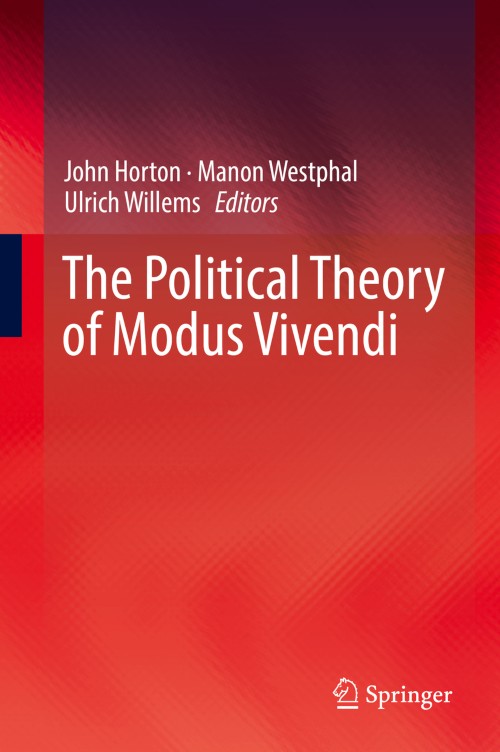
The Political Theory of Modus Vivendi [electronic resource] / edited by John Horton, Manon Westphal, Ulrich Willems.
Erişim Adresi
ISBN
9783319790787
Dil Kodu
İngilizce
Yer Numarası
DK/19439
Basım Bildirimi
1st ed. 2019.
Yayın Bilgisi
Cham : Springer International Publishing : Imprint: Springer, 2019.
Fiziksel Niteleme
X, 272 p. online resource.
İçindekiler Notu
Chapter 1: Theorising Modus Vivendi -- Part 1: Modus Vivendi, Liberalism and Realism -- Chapter 2: Why Theorize Modus Vivendi? -- Chapter 3: Liberal Moralism and Modus Vivendi Politics -- Chapter 4: Modus Vivendi and the Motivations for Compliance -- Chapter 5: Modus Vivendi in a Liberal Framework -- Chapter 6: Can Modus Vivendi Save Liberalism from Moralism? A Critical Assessment of John Gray’s Political Realism -- Chapter 7: Modus Vivendi Beyond the Social Contract: Peace, Justice, and Survival in Realist Political Theory -- Part 2: Modus Vivendi and Legitimacy -- Chapter 8: Modus Vivendi and Political Legitimacy -- Chapter 9: Modus Vivendi as a Global Political Morality -- Chapter 10: Legitimacy and Modus Vivendi Theory -- Chapter 11: Modus Vivendi and Legitimacy: Some Sceptical Thoughts -- Part 3: Modus Vivendi and Political Practice -- Chpater 12: Political Thought between Finality and Indeterminacy -- Chapter 13: Motives and Modus Vivendi -- Chapter 14: Modus Vivendi and Toleration.-Chapter 15: Institutions of Modus Vivendi Politics.
Özet, vb.
This book focuses on the idea of a modus vivendi as a way of governing political life and addressing problems characterized by pluralism or deep-rooted diversity. The individual essays illustrate both the merits and the limitations of a political theory of modus vivendi; how it might be interpreted and developed; specific challenges entailed by articulating it in a convincing form; what its institutional implications might be; and how it relates to other seminal issues and concepts in political theory; such as legitimacy, toleration, the social contract, etc. The book makes a significant contribution to the discussion on the scope and limits of liberal political theory, and on how to deal politically with deep-rooted diversity.
Konu
Political science.
Political science __ Philosophy.
Political Theory.
Political Philosophy.
Political Science.
Political science __ Philosophy.
Political Theory.
Political Philosophy.
Political Science.
Diğer Yazarlar
Kurum Adı
