LEADER 04095nam a22005415i 4500
001 818263
003 TR_AnAIT
005 20260130181739
007 cr nn 008mamaa
008 170424s2017 sz | s |||| 0|eng d
020 |a9783319541426|9978-3-319-54142-6
024 7 |a10.1007/978-3-319-54142-6|2doi
041 |aeng
049 |aTürk Tarih Kurumu Kütüphanesi
050 4|aJF1525.P6
072 7|aJPP|2bicssc
072 7|aPOL028000|2bisacsh
072 7|aJPP|2thema
082 04|a320.6|223
090 |aDK/19472
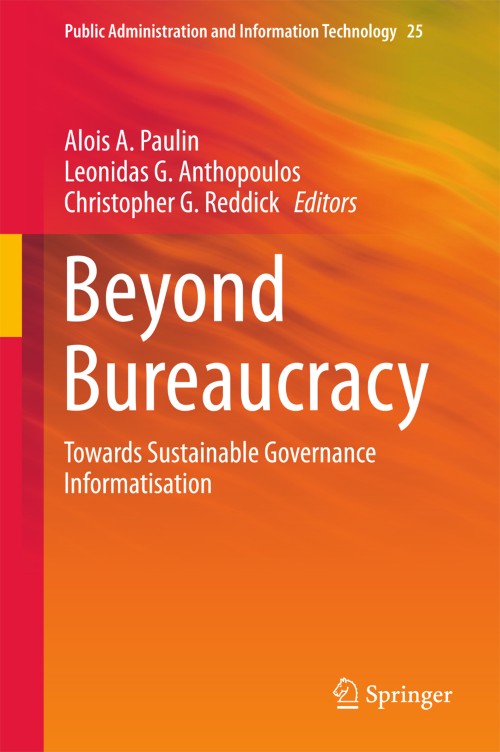
245 10|aBeyond Bureaucracy|h[electronic resource] :|bTowards Sustainable Governance Informatisation /|cedited by Alois A. Paulin, Leonidas G. Anthopoulos, Christopher G. Reddick.
250 |a1st ed. 2017.
264 1|aCham :|bSpringer International Publishing :|bImprint: Springer,|c2017.
300 |aIX, 375 p. 44 illus., 26 illus. in color.|bonline resource.
336 |atext|btxt|2rdacontent
337 |acomputer|bc|2rdamedia
338 |aonline resource|bcr|2rdacarrier
347 |atext file|bPDF|2rda
490 1 |aPublic Administration and Information Technology,|x2512-1839 ;|v25
505 0 |aPart A: Informating Governance -- Part B: Withering of the Bureaucracy? -- Part C: Beyond Bureaucracy -- Part D: Aligning the Consumer Edge -- Part E: Outlook and Research Challenges.
520 |aThis book examines the role of bureaucracy in modern technologically advanced societies, the traditional models of governance, and the potential of information technology to fundamentally change and improve governance. In the area of public-domain governance, information and communication technologies (ICTs) have empowered public agencies to improve their activities and to strengthen the efficiency of their operations. Technology has enabled optimized transfer of knowledge and information between government agencies, more efficient supervision and control of relationships with citizens, and higher efficiency in law enforcement through better access to information. Throughout the last decades, technology has been used to strengthen the role of state bureaucracies and the relationship between the civil service and the citizens. We have witnessed the transformative powers of ICTs in private-sector enterprises in well-structured technological landscapes, which has produced new ecosystems comprised of software developers, providers, and consumers who provide and consume new products and services in ecosystems that are based on clear technological standards and shared modular generic artefacts, which allow for distributed peer production. ICTs will shape cultural and civic discourse and create products, services and tools, relying on the open toolsets, technologies and exchange of knowledge between peers. This book will be of particular interest to government CIOs, IT/IS managers, researchers, students, and practitioners in technical sciences, public administration, business management, public policy and IS management. .
650 0|aPolitical planning.
650 0|aPublic administration.
650 0|aEconomic development.
650 14|aPublic Policy.
650 24|aPublic Administration.
650 24|aEconomic Development, Innovation and Growth.
700 1 |aPaulin, Alois A.|eeditor.|4edt|4http://id.loc.gov/vocabulary/relators/edt
700 1 |aAnthopoulos, Leonidas G.|eeditor.|0(orcid)0000-0002-7731-4716|1https://orcid.org/0000-0002-7731-4716|4edt|4http://id.loc.gov/vocabulary/relators/edt
700 1 |aReddick, Christopher G.|eeditor.|4edt|4http://id.loc.gov/vocabulary/relators/edt
710 2 |aSpringerLink (Online service)
773 0 |tSpringer Nature eBook
776 08|iPrinted edition:|z9783319541419
776 08|iPrinted edition:|z9783319541433
776 08|iPrinted edition:|z9783319853307
830 0|aPublic Administration and Information Technology,|x2512-1839 ;|v25
856 40|uhttps://doi.org/10.1007/978-3-319-54142-6
912 |aZDB-2-POS
912 |aZDB-2-SXPI
950 |aPolitical Science and International Studies (SpringerNature-41174)
950 |aPolitical Science and International Studies (R0) (SpringerNature-43724)