

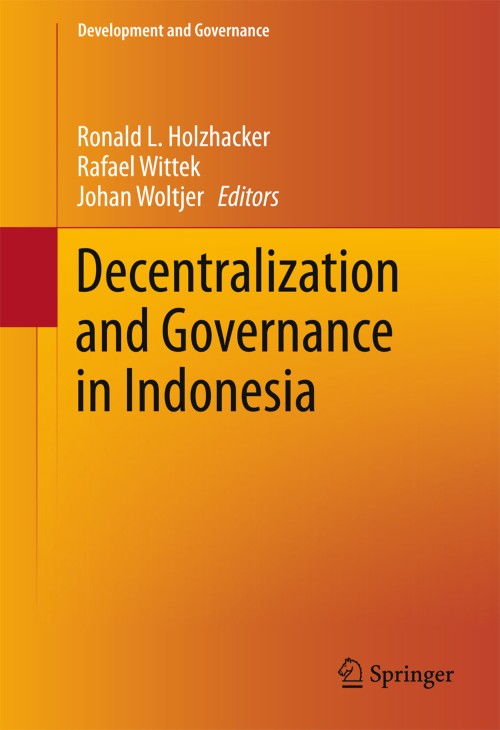
Decentralization and Governance in Indonesia [electronic resource] / edited by Ronald L. Holzhacker, Rafael Wittek, Johan Woltjer.
Erişim Adresi
ISBN
9783319224343
Dil Kodu
İngilizce
Yer Numarası
DK/19475
Basım Bildirimi
1st ed. 2016.
Yayın Bilgisi
Cham : Springer International Publishing : Imprint: Springer, 2016.
Fiziksel Niteleme
XIV, 298 p. 16 illus., 8 illus. in color. online resource.
Dizi
Development and Governance, 2567-5354 ; 2
Özet, vb.
Indonesia over the past two decades has embarked on decentralization as part of a broader process of democratization across the archipelago. The purpose of this book is to explore the connections between governance and sustainable society in a wide variety of policy fields, and how reforming governance structures may contribute to societal benefits and the creation of a long-term sustainable society in Indonesia. This book bridges important theoretical debates related to governance and sustainable society and provides empirical research from Indonesia in important policy areas related to this debate. By placing research in various policy areas in a single volume, the link to the broader concepts of governance, decentralization, and societal outcomes is strengthened. The book builds on the recent interest that has focused on Indonesia and the continued development of democracy in the country. The chapters in the book show a rich variety of decentralized governance arrangements and capacity building at the local level in particular. Central standards (for example for social sustainability, anti-corruption arrangements, and for dealing with direct foreign investment), combined with local innovation (for example for municipal coordination of primary health care or metropolitan transport), are key to Indonesia as a country in a continuing process of transformation. We identify three key trends in the on-going process of decentralization and governance in Indonesia. First, we find that formal governance, the relation between the national and local government, is characterized by a system of ‘variable geometry multi-level governance’ depending on the policy area. The challenge ahead is strengthening accountability mechanisms to assure national standards while preserving and encouraging local innovation. Secondly, informal governance mechanisms are evolving to move from ‘hierarchical to network’ forms of governance. Here the challenge is to insure democratic input by citizens and civil society organizations. Finally, we identify a trend toward ‘shared value creation and sustainable cooperation.’ Indonesia is beginning to move from a rather singular policy focus on economic growth to a more complex and developing notion of policymaking for inclusive growth and the creation of a sustainable society for present and future generations. Here the challenge is sound implementation and an increase in the effectiveness of governance mechanisms.
Konu
Political planning.
Development economics.
Economic policy.
Public Policy.
Development Economics.
Economic Policy.
Development economics.
Economic policy.
Public Policy.
Development Economics.
Economic Policy.
Diğer Yazarlar
Kurum Adı
Eseri Alıntıla
Referansları kullanmadan önce gözden geçirmeniz ve varsa gerekli düzeltmeleri yapmanız önerilir.
Dijital Kaynak
MARC Görünümü
LEADER 04542nam a22005295i 4500
001 818266
003 TR_AnAIT
005 20260130181718
007 cr nn 008mamaa
008 150911s2016 sz | s |||| 0|eng d
020 |a9783319224343|9978-3-319-22434-3
024 7 |a10.1007/978-3-319-22434-3|2doi
041 |aeng
049 |aTürk Tarih Kurumu Kütüphanesi
050 4|aJF1525.P6
072 7|aJPP|2bicssc
072 7|aPOL028000|2bisacsh
072 7|aJPP|2thema
082 04|a320.6|223
090 |aDK/19475
245 10|aDecentralization and Governance in Indonesia|h[electronic resource] /|cedited by Ronald L. Holzhacker, Rafael Wittek, Johan Woltjer.
250 |a1st ed. 2016.
264 1|aCham :|bSpringer International Publishing :|bImprint: Springer,|c2016.
300 |aXIV, 298 p. 16 illus., 8 illus. in color.|bonline resource.
336 |atext|btxt|2rdacontent
337 |acomputer|bc|2rdamedia
338 |aonline resource|bcr|2rdacarrier
347 |atext file|bPDF|2rda
490 1 |aDevelopment and Governance,|x2567-5354 ;|v2
520 |aIndonesia over the past two decades has embarked on decentralization as part of a broader process of democratization across the archipelago. The purpose of this book is to explore the connections between governance and sustainable society in a wide variety of policy fields, and how reforming governance structures may contribute to societal benefits and the creation of a long-term sustainable society in Indonesia. This book bridges important theoretical debates related to governance and sustainable society and provides empirical research from Indonesia in important policy areas related to this debate. By placing research in various policy areas in a single volume, the link to the broader concepts of governance, decentralization, and societal outcomes is strengthened. The book builds on the recent interest that has focused on Indonesia and the continued development of democracy in the country. The chapters in the book show a rich variety of decentralized governance arrangements and capacity building at the local level in particular. Central standards (for example for social sustainability, anti-corruption arrangements, and for dealing with direct foreign investment), combined with local innovation (for example for municipal coordination of primary health care or metropolitan transport), are key to Indonesia as a country in a continuing process of transformation. We identify three key trends in the on-going process of decentralization and governance in Indonesia. First, we find that formal governance, the relation between the national and local government, is characterized by a system of ‘variable geometry multi-level governance’ depending on the policy area. The challenge ahead is strengthening accountability mechanisms to assure national standards while preserving and encouraging local innovation. Secondly, informal governance mechanisms are evolving to move from ‘hierarchical to network’ forms of governance. Here the challenge is to insure democratic input by citizens and civil society organizations. Finally, we identify a trend toward ‘shared value creation and sustainable cooperation.’ Indonesia is beginning to move from a rather singular policy focus on economic growth to a more complex and developing notion of policymaking for inclusive growth and the creation of a sustainable society for present and future generations. Here the challenge is sound implementation and an increase in the effectiveness of governance mechanisms.
650 0|aPolitical planning.
650 0|aDevelopment economics.
650 0|aEconomic policy.
650 14|aPublic Policy.
650 24|aDevelopment Economics.
650 24|aEconomic Policy.
700 1 |aHolzhacker, Ronald L.|eeditor.|4edt|4http://id.loc.gov/vocabulary/relators/edt
700 1 |aWittek, Rafael.|eeditor.|4edt|4http://id.loc.gov/vocabulary/relators/edt
700 1 |aWoltjer, Johan.|eeditor.|4edt|4http://id.loc.gov/vocabulary/relators/edt
710 2 |aSpringerLink (Online service)
773 0 |tSpringer Nature eBook
776 08|iPrinted edition:|z9783319224336
776 08|iPrinted edition:|z9783319224350
776 08|iPrinted edition:|z9783319369952
830 0|aDevelopment and Governance,|x2567-5354 ;|v2
856 40|uhttps://doi.org/10.1007/978-3-319-22434-3
912 |aZDB-2-POS
912 |aZDB-2-SXPI
950 |aPolitical Science and International Studies (SpringerNature-41174)
950 |aPolitical Science and International Studies (R0) (SpringerNature-43724)
001 818266
003 TR_AnAIT
005 20260130181718
007 cr nn 008mamaa
008 150911s2016 sz | s |||| 0|eng d
020 |a9783319224343|9978-3-319-22434-3
024 7 |a10.1007/978-3-319-22434-3|2doi
041 |aeng
049 |aTürk Tarih Kurumu Kütüphanesi
050 4|aJF1525.P6
072 7|aJPP|2bicssc
072 7|aPOL028000|2bisacsh
072 7|aJPP|2thema
082 04|a320.6|223
090 |aDK/19475
245 10|aDecentralization and Governance in Indonesia|h[electronic resource] /|cedited by Ronald L. Holzhacker, Rafael Wittek, Johan Woltjer.
250 |a1st ed. 2016.
264 1|aCham :|bSpringer International Publishing :|bImprint: Springer,|c2016.
300 |aXIV, 298 p. 16 illus., 8 illus. in color.|bonline resource.
336 |atext|btxt|2rdacontent
337 |acomputer|bc|2rdamedia
338 |aonline resource|bcr|2rdacarrier
347 |atext file|bPDF|2rda
490 1 |aDevelopment and Governance,|x2567-5354 ;|v2
520 |aIndonesia over the past two decades has embarked on decentralization as part of a broader process of democratization across the archipelago. The purpose of this book is to explore the connections between governance and sustainable society in a wide variety of policy fields, and how reforming governance structures may contribute to societal benefits and the creation of a long-term sustainable society in Indonesia. This book bridges important theoretical debates related to governance and sustainable society and provides empirical research from Indonesia in important policy areas related to this debate. By placing research in various policy areas in a single volume, the link to the broader concepts of governance, decentralization, and societal outcomes is strengthened. The book builds on the recent interest that has focused on Indonesia and the continued development of democracy in the country. The chapters in the book show a rich variety of decentralized governance arrangements and capacity building at the local level in particular. Central standards (for example for social sustainability, anti-corruption arrangements, and for dealing with direct foreign investment), combined with local innovation (for example for municipal coordination of primary health care or metropolitan transport), are key to Indonesia as a country in a continuing process of transformation. We identify three key trends in the on-going process of decentralization and governance in Indonesia. First, we find that formal governance, the relation between the national and local government, is characterized by a system of ‘variable geometry multi-level governance’ depending on the policy area. The challenge ahead is strengthening accountability mechanisms to assure national standards while preserving and encouraging local innovation. Secondly, informal governance mechanisms are evolving to move from ‘hierarchical to network’ forms of governance. Here the challenge is to insure democratic input by citizens and civil society organizations. Finally, we identify a trend toward ‘shared value creation and sustainable cooperation.’ Indonesia is beginning to move from a rather singular policy focus on economic growth to a more complex and developing notion of policymaking for inclusive growth and the creation of a sustainable society for present and future generations. Here the challenge is sound implementation and an increase in the effectiveness of governance mechanisms.
650 0|aPolitical planning.
650 0|aDevelopment economics.
650 0|aEconomic policy.
650 14|aPublic Policy.
650 24|aDevelopment Economics.
650 24|aEconomic Policy.
700 1 |aHolzhacker, Ronald L.|eeditor.|4edt|4http://id.loc.gov/vocabulary/relators/edt
700 1 |aWittek, Rafael.|eeditor.|4edt|4http://id.loc.gov/vocabulary/relators/edt
700 1 |aWoltjer, Johan.|eeditor.|4edt|4http://id.loc.gov/vocabulary/relators/edt
710 2 |aSpringerLink (Online service)
773 0 |tSpringer Nature eBook
776 08|iPrinted edition:|z9783319224336
776 08|iPrinted edition:|z9783319224350
776 08|iPrinted edition:|z9783319369952
830 0|aDevelopment and Governance,|x2567-5354 ;|v2
856 40|uhttps://doi.org/10.1007/978-3-319-22434-3
912 |aZDB-2-POS
912 |aZDB-2-SXPI
950 |aPolitical Science and International Studies (SpringerNature-41174)
950 |aPolitical Science and International Studies (R0) (SpringerNature-43724)
Materyaller
Depodan talep edilen materyal sadece kütüphane içerisinde kullanılmaktadır.
Materyal dışarıya ödünç verilmemektedir.
Materyal dışarıya ödünç verilmemektedir.
