LEADER 03066nam a22005655i 4500
001 818303
003 TR_AnAIT
005 20260130181537
007 cr nn 008mamaa
008 170706s2017 sz | s |||| 0|eng d
020 |a9783319560267|9978-3-319-56026-7
024 7 |a10.1007/978-3-319-56026-7|2doi
041 |aeng
049 |aTürk Tarih Kurumu Kütüphanesi
050 4|aBL65.P7
072 7|aHRAM2|2bicssc
072 7|aREL084000|2bisacsh
072 7|aQRAM2|2thema
082 04|a322.1|223
090 |aDK/19511
100 1 |aAskari, Hossein.|eauthor.|4aut|4http://id.loc.gov/vocabulary/relators/aut
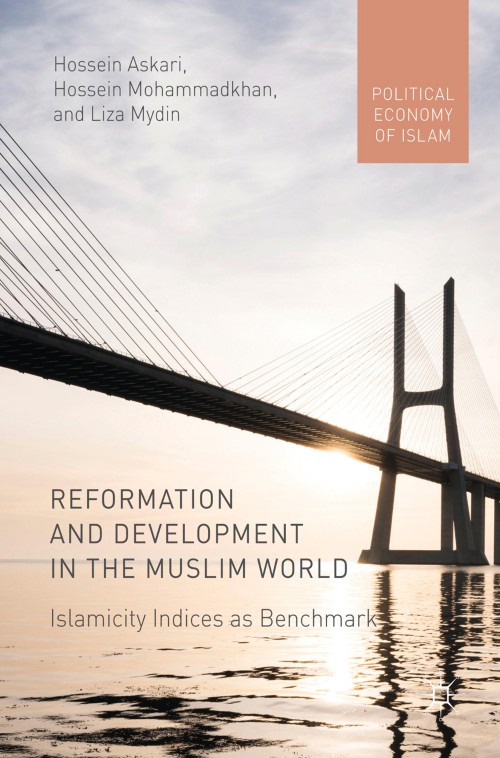
245 10|aReformation and Development in the Muslim World|h[electronic resource] :|bIslamicity Indices as Benchmark /|cby Hossein Askari, Hossein Mohammadkhan, Liza Mydin.
250 |a1st ed. 2017.
264 1|aCham :|bSpringer International Publishing :|bImprint: Palgrave Macmillan,|c2017.
300 |aXVII, 194 p.|bonline resource.
336 |atext|btxt|2rdacontent
337 |acomputer|bc|2rdamedia
338 |aonline resource|bcr|2rdacarrier
347 |atext file|bPDF|2rda
490 1 |aPolitical Economy of Islam,|x2945-6487
505 0 |aChapter 1: Introduction.- Chapter 2: Islamic Teachings and Institutional Structure -- Chapter 3: The Indices -- Chapter 4: The Broad Results -- Chapter 5: Muslim Country Indices and Attribution -- Chapter 6: Islamicity Indices as the Benchmark for Reforms -- Chapter 7: Muslim Immigrants to Western Countries as Ambassadors.- Chapter 8: Support from Western Countries.- Chapter 9: Conclusions.
520 |aThis book explores how the recent development of Muslim countries as a group has fallen far short of non-Muslim countries, which, some have concluded, may be a result of Islamic teachings. The authors examine Muslim countries over time, viewing their progression on the Islamicity scale. They assess why some countries have done better than others, and to derive useful policy recommendations to improve political, social, human, governance and economic performance. .
650 0|aReligion and politics.
650 0|aEconomic development.
650 0|aFinancial services industry.
650 0|aInternational economic relations.
650 14|aPolitics and Religion.
650 24|aDevelopment Studies.
650 24|aFinancial Services.
650 24|aInternational Political Economy’.
700 1 |aMohammadkhan, Hossein.|eauthor.|4aut|4http://id.loc.gov/vocabulary/relators/aut
700 1 |aMydin, Liza.|eauthor.|4aut|4http://id.loc.gov/vocabulary/relators/aut
710 2 |aSpringerLink (Online service)
773 0 |tSpringer Nature eBook
776 08|iPrinted edition:|z9783319560250
776 08|iPrinted edition:|z9783319560274
776 08|iPrinted edition:|z9783319858067
830 0|aPolitical Economy of Islam,|x2945-6487
856 40|uhttps://doi.org/10.1007/978-3-319-56026-7
912 |aZDB-2-POS
912 |aZDB-2-SXPI
950 |aPolitical Science and International Studies (SpringerNature-41174)
950 |aPolitical Science and International Studies (R0) (SpringerNature-43724)