LEADER 03393nam a22005535i 4500
001 818352
003 TR_AnAIT
005 20260130181423
007 cr nn 008mamaa
008 170518s2017 sz | s |||| 0|eng d
020 |a9783319535265|9978-3-319-53526-5
024 7 |a10.1007/978-3-319-53526-5|2doi
041 |aeng
049 |aTürk Tarih Kurumu Kütüphanesi
050 4|aJZ6378-6405
072 7|aJW|2bicssc
072 7|aPOL069000|2bisacsh
072 7|aJW|2thema
082 04|a355|223
090 |aDK/19560
100 1 |aMaurer, Daniel.|eauthor.|4aut|4http://id.loc.gov/vocabulary/relators/aut
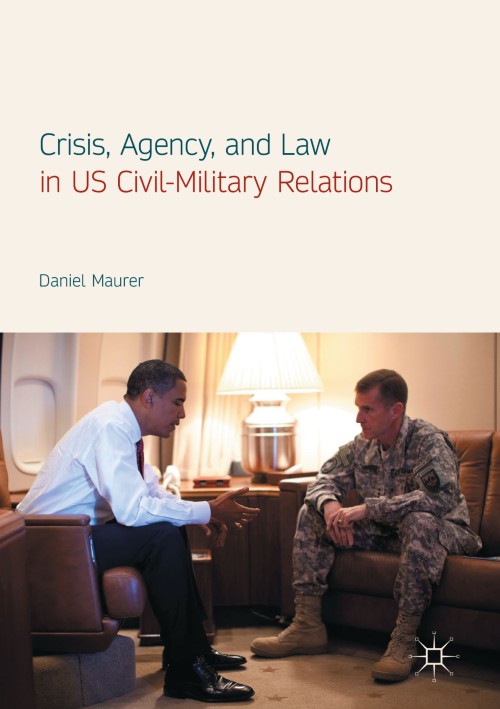
245 10|aCrisis, Agency, and Law in US Civil-Military Relations|h[electronic resource] /|cby Daniel Maurer.
250 |a1st ed. 2017.
264 1|aCham :|bSpringer International Publishing :|bImprint: Palgrave Macmillan,|c2017.
300 |aIX, 227 p.|bonline resource.
336 |atext|btxt|2rdacontent
337 |acomputer|bc|2rdamedia
338 |aonline resource|bcr|2rdacarrier
347 |atext file|bPDF|2rda
505 0 |a1. Introduction -- 2. The Opening Statement -- 3. The Case-in-Chief: What the Law Does (Not) Say -- 4. The Expert Witnesses: A Cross-Examination -- 5. The Expert Witnesses: Fingerprints of Agency -- 6. The Rebuttal Witnesses: From Agency to Norms to Diagnosis -- 7. Exhibit A: Scope of Responsibility and Authority -- 8. Boundaries, or A “Poverty of Useful and Unambiguous Authority?” -- 9. Exhibit B: When Fidelity and Frankness Conflict -- 10. Exhibit C: Amending the Goldwater-Nichols Act -- 11. Exhibit D: The Future Fallacy, A Civ-Mil Dialogue -- 12. Closing Argument.
520 |aThis book develops a responsible and practical method for evaluating the success, failure, or “crisis” of American civil-military relations among its political and uniformed elite. The author’s premise is that currently there is no objectively fair way for the public at large or the strategic-level elites to assess whether the critical and often obscured relationships between Generals, Admirals, and Statesmen function as they ought to under the US constitutional system. By treating these relationships—in form and practice—as part of a wider principal (civilian)-agency (military) dynamic, the book tracks the “duties”—care, competence, diligence, confidentiality, scope of responsibility—and perceived shortcomings in the interactions between US civilian political authorities and their military advisors in both peacetime and in war.
650 0|aPolitics and war.
650 0|aAmerica|xPolitics and government.
650 0|aLaw and the social sciences.
650 0|aLaw|xPhilosophy.
650 0|aLaw|xHistory.
650 0|aMilitary history.
650 14|aMilitary and Defence Studies.
650 24|aAmerican Politics.
650 24|aSocio-Legal Studies.
650 24|aTheories of Law, Philosophy of Law, Legal History.
650 24|aMilitary History.
710 2 |aSpringerLink (Online service)
773 0 |tSpringer Nature eBook
776 08|iPrinted edition:|z9783319535258
776 08|iPrinted edition:|z9783319535272
776 08|iPrinted edition:|z9783319851747
856 40|uhttps://doi.org/10.1007/978-3-319-53526-5
912 |aZDB-2-POS
912 |aZDB-2-SXPI
950 |aPolitical Science and International Studies (SpringerNature-41174)
950 |aPolitical Science and International Studies (R0) (SpringerNature-43724)