LEADER 04049nam a22006015i 4500
001 818372
003 TR_AnAIT
005 20260130181342
007 cr nn 008mamaa
008 160502s2016 sz | s |||| 0|eng d
020 |a9783319295954|9978-3-319-29595-4
024 7 |a10.1007/978-3-319-29595-4|2doi
041 |aeng
049 |aTürk Tarih Kurumu Kütüphanesi
050 4|aJK1-9993
050 4|aJL1-3899
072 7|aJP|2bicssc
072 7|a1K|2bicssc
072 7|aPOL040000|2bisacsh
072 7|aJP|x1K|2thema
082 04|a320.9|223
090 |aDK/19580
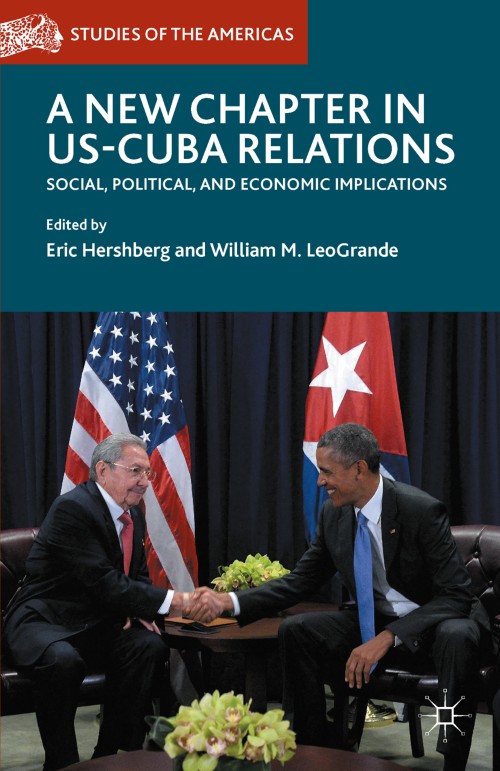
245 12|aA New Chapter in US-Cuba Relations|h[electronic resource] :|bSocial, Political, and Economic Implications /|cedited by Eric Hershberg, William M. LeoGrande.
250 |a1st ed. 2016.
264 1|aCham :|bSpringer International Publishing :|bImprint: Palgrave Macmillan,|c2016.
300 |aXV, 205 p.|bonline resource.
336 |atext|btxt|2rdacontent
337 |acomputer|bc|2rdamedia
338 |aonline resource|bcr|2rdacarrier
347 |atext file|bPDF|2rda
490 1 |aStudies of the Americas
505 0 |a1. Introduction: U.S -- Cuba Diplomatic Rapprochement and Washington’s Relations with Latin America -- 2. Establishing, Not Restoring, Normal Relations between the United States and Cuba -- 3. Cuba-U.S.: The December 17 Arrangement in the Rationale of Asymmetric Relations -- 4. A Südpolitik from Washington: How Much of Europe’s Ostpolitik Is There in the Current U.S.-Cuban Détente -- 5. The End of the Bogeyman: The Political Repercussions of the U.S -- Cuban Rapprochement -- 6. Beyond Revolutionary Chic: How U.S -- Cuba Rapprochement May Affect Cuban Arts -- 7. Post-D17 and Processes of Cuban National Reconciliation -- 8. Cuban Exceptionalism -- 9. How Will U.S -- Cuban Normalization Affect Economic Policy in Cuba? -- 10. Cuban Economic Reforms and Rapprochement with the United States: A Comparative Perspective -- 11. Foreign Direct Investment in Cuba: A Necessity and a Challenge -- 12. Entrepreneurial Reform, Market Expansion, and Political Engagement: Risks and Opportunities for Cuba Today -- 13. Onstage or Backstage? Latin America and U.S -- Cuban Relations -- 14. Conclusion.
520 |aThis book explores the diverse consequences of Presidents Obama and Castro brokering a rapprochement between the United States and Cuba after more than half a century of estrangement. Economic, political, social, and cultural dynamics are analyzed in accessible fashion by leading experts from Cuba, the United States, Europe, and Latin America. What opportunities arise through the opening of diplomatic relations, and what issues may be obstacles to normalization? What are the implications for the Cuban economy, for its political system, and for ties with members of the Cuban diaspora? What are the implications for US relations elsewhere in Latin America? This up-to-date account addresses these and other questions about this new direction in US-Cuban relations.
650 0|aAmerica|xPolitics and government.
650 0|aDiplomacy.
650 0|aInternational relations.
650 0|aInternational economic relations.
650 0|aPolitical sociology.
650 14|aAmerican Politics.
650 24|aDiplomacy.
650 24|aForeign Policy.
650 24|aInternational Political Economy’.
650 24|aPolitical Sociology.
700 1 |aHershberg, Eric.|eeditor.|4edt|4http://id.loc.gov/vocabulary/relators/edt
700 1 |aLeoGrande, William M.|eeditor.|4edt|4http://id.loc.gov/vocabulary/relators/edt
710 2 |aSpringerLink (Online service)
773 0 |tSpringer Nature eBook
776 08|iPrinted edition:|z9783319295947
776 08|iPrinted edition:|z9783319295961
776 08|iPrinted edition:|z9783319311517
830 0|aStudies of the Americas
856 40|uhttps://doi.org/10.1007/978-3-319-29595-4
912 |aZDB-2-POS
912 |aZDB-2-SXPI
950 |aPolitical Science and International Studies (SpringerNature-41174)
950 |aPolitical Science and International Studies (R0) (SpringerNature-43724)