

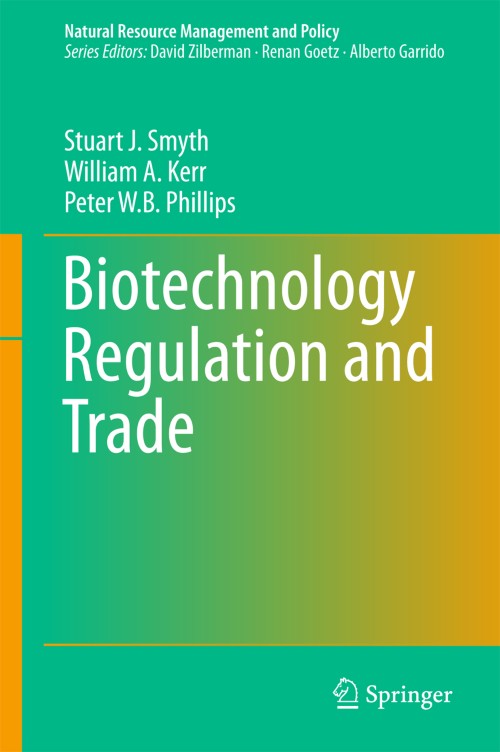
Biotechnology Regulation and Trade [electronic resource] / by Stuart J. Smyth, William A. Kerr, Peter W. B Phillips.
Erişim Adresi
ISBN
9783319532950
Dil Kodu
İngilizce
Yer Numarası
DK/19604
Yazar
Basım Bildirimi
1st ed. 2017.
Yayın Bilgisi
Cham : Springer International Publishing : Imprint: Springer, 2017.
Fiziksel Niteleme
XXI, 275 p. 18 illus. online resource.
Dizi
Natural Resource Management and Policy, 2511-8560 ; 51
İçindekiler Notu
Section I: The Changing Dynamics of Institutional Architecture -- 1. International Governance in the 21st Century -- 2. Governance Challenges from Transformative Technologies -- 3. Barriers to Trade and Investment Impacts -- 4. Managing Trade in Products of Biotechnology -- 5. International Treaty Precedence -- Section II: Present Pulse of the International Market -- 6. Benefits of Genetically Modified Crops -- 7. The Regulation of Genetically Modified Crops in Canada -- 8. Canadian Canola: A Case Study in Profitable Genetic Innovation -- 9. Coexistence and International Commodity Trade -- 10. Global Trade Impacts from Low Level Presence -- 11. The World Trade Organization and Low Level Presence -- 12. Food Security and the Evaluation of Risk -- 13. Innovation and Utility: The Challenges of Winners and Losers -- Section III: Breaking the Gridlock -- 14. Accelerating Genetically Modified Crop -- 15. Governance Constraints on Improving Food Security -- 16. The Cost of Socio-Economic Biosafety Assessments -- 17. Institutions, Trade and Food Security -- 18. The Future of Food Security.
Özet, vb.
This book discusses the regulatory and trade challenges facing the global adoption of biotechnological products and offers strategies for overcoming these obstacles and moving towards greater global food security. The first section of the book establishes the context of the conflict, discussing the challenges of global governance, international trade, and the history of regulation of genetically modified (GM) crops. In this section, the authors emphasize the shift from exclusively science-based regulation to the more socio-economically focused framework established by the Cartagena Protocol on Biosafety, which was adopted in 2000. The second section of the book provides a snapshot of the current state of international GM crop adoption and regulation, highlighting the US, Canada, and the EU. The final section of the book identifies options for breaking the gridlock of regulation and trade that presently exist. This book adds to the current literature by providing new information about innovative agricultural technologies and encouraging debate by providing an alternative to the narratives espoused by environmental non-governmental organizations. This book will appeal to students of economics, political science, and policy analysis, as well as members of regulatory agencies and agricultural industry firms. .
Konu
Political planning.
Economic policy.
Agriculture __ Economic aspects.
Environmental economics.
Public Policy.
Economic Policy.
Agricultural Economics.
Environmental Economics.
Economic policy.
Agriculture __ Economic aspects.
Environmental economics.
Public Policy.
Economic Policy.
Agricultural Economics.
Environmental Economics.
Diğer Yazarlar
Kurum Adı
Eseri Alıntıla
Referansları kullanmadan önce gözden geçirmeniz ve varsa gerekli düzeltmeleri yapmanız önerilir.
Dijital Kaynak
MARC Görünümü
LEADER 04584nam a22005655i 4500
001 818396
003 TR_AnAIT
005 20260130181242
007 cr nn 008mamaa
008 170302s2017 sz | s |||| 0|eng d
020 |a9783319532950|9978-3-319-53295-0
024 7 |a10.1007/978-3-319-53295-0|2doi
041 |aeng
049 |aTürk Tarih Kurumu Kütüphanesi
050 4|aJF1525.P6
072 7|aJPP|2bicssc
072 7|aPOL028000|2bisacsh
072 7|aJPP|2thema
082 04|a320.6|223
090 |aDK/19604
100 1 |aSmyth, Stuart J.|eauthor.|4aut|4http://id.loc.gov/vocabulary/relators/aut
245 10|aBiotechnology Regulation and Trade|h[electronic resource] /|cby Stuart J. Smyth, William A. Kerr, Peter W. B Phillips.
250 |a1st ed. 2017.
264 1|aCham :|bSpringer International Publishing :|bImprint: Springer,|c2017.
300 |aXXI, 275 p. 18 illus.|bonline resource.
336 |atext|btxt|2rdacontent
337 |acomputer|bc|2rdamedia
338 |aonline resource|bcr|2rdacarrier
347 |atext file|bPDF|2rda
490 1 |aNatural Resource Management and Policy,|x2511-8560 ;|v51
505 0 |aSection I: The Changing Dynamics of Institutional Architecture -- 1. International Governance in the 21st Century -- 2. Governance Challenges from Transformative Technologies -- 3. Barriers to Trade and Investment Impacts -- 4. Managing Trade in Products of Biotechnology -- 5. International Treaty Precedence -- Section II: Present Pulse of the International Market -- 6. Benefits of Genetically Modified Crops -- 7. The Regulation of Genetically Modified Crops in Canada -- 8. Canadian Canola: A Case Study in Profitable Genetic Innovation -- 9. Coexistence and International Commodity Trade -- 10. Global Trade Impacts from Low Level Presence -- 11. The World Trade Organization and Low Level Presence -- 12. Food Security and the Evaluation of Risk -- 13. Innovation and Utility: The Challenges of Winners and Losers -- Section III: Breaking the Gridlock -- 14. Accelerating Genetically Modified Crop -- 15. Governance Constraints on Improving Food Security -- 16. The Cost of Socio-Economic Biosafety Assessments -- 17. Institutions, Trade and Food Security -- 18. The Future of Food Security.
520 |aThis book discusses the regulatory and trade challenges facing the global adoption of biotechnological products and offers strategies for overcoming these obstacles and moving towards greater global food security. The first section of the book establishes the context of the conflict, discussing the challenges of global governance, international trade, and the history of regulation of genetically modified (GM) crops. In this section, the authors emphasize the shift from exclusively science-based regulation to the more socio-economically focused framework established by the Cartagena Protocol on Biosafety, which was adopted in 2000. The second section of the book provides a snapshot of the current state of international GM crop adoption and regulation, highlighting the US, Canada, and the EU. The final section of the book identifies options for breaking the gridlock of regulation and trade that presently exist. This book adds to the current literature by providing new information about innovative agricultural technologies and encouraging debate by providing an alternative to the narratives espoused by environmental non-governmental organizations. This book will appeal to students of economics, political science, and policy analysis, as well as members of regulatory agencies and agricultural industry firms. .
650 0|aPolitical planning.
650 0|aEconomic policy.
650 0|aAgriculture|xEconomic aspects.
650 0|aEnvironmental economics.
650 14|aPublic Policy.
650 24|aEconomic Policy.
650 24|aAgricultural Economics.
650 24|aEnvironmental Economics.
700 1 |aKerr, William A.|eauthor.|4aut|4http://id.loc.gov/vocabulary/relators/aut
700 1 |aPhillips, Peter W. B.|eauthor.|4aut|4http://id.loc.gov/vocabulary/relators/aut
710 2 |aSpringerLink (Online service)
773 0 |tSpringer Nature eBook
776 08|iPrinted edition:|z9783319532936
776 08|iPrinted edition:|z9783319532943
776 08|iPrinted edition:|z9783319851181
830 0|aNatural Resource Management and Policy,|x2511-8560 ;|v51
856 40|uhttps://doi.org/10.1007/978-3-319-53295-0
912 |aZDB-2-POS
912 |aZDB-2-SXPI
950 |aPolitical Science and International Studies (SpringerNature-41174)
950 |aPolitical Science and International Studies (R0) (SpringerNature-43724)
001 818396
003 TR_AnAIT
005 20260130181242
007 cr nn 008mamaa
008 170302s2017 sz | s |||| 0|eng d
020 |a9783319532950|9978-3-319-53295-0
024 7 |a10.1007/978-3-319-53295-0|2doi
041 |aeng
049 |aTürk Tarih Kurumu Kütüphanesi
050 4|aJF1525.P6
072 7|aJPP|2bicssc
072 7|aPOL028000|2bisacsh
072 7|aJPP|2thema
082 04|a320.6|223
090 |aDK/19604
100 1 |aSmyth, Stuart J.|eauthor.|4aut|4http://id.loc.gov/vocabulary/relators/aut
245 10|aBiotechnology Regulation and Trade|h[electronic resource] /|cby Stuart J. Smyth, William A. Kerr, Peter W. B Phillips.
250 |a1st ed. 2017.
264 1|aCham :|bSpringer International Publishing :|bImprint: Springer,|c2017.
300 |aXXI, 275 p. 18 illus.|bonline resource.
336 |atext|btxt|2rdacontent
337 |acomputer|bc|2rdamedia
338 |aonline resource|bcr|2rdacarrier
347 |atext file|bPDF|2rda
490 1 |aNatural Resource Management and Policy,|x2511-8560 ;|v51
505 0 |aSection I: The Changing Dynamics of Institutional Architecture -- 1. International Governance in the 21st Century -- 2. Governance Challenges from Transformative Technologies -- 3. Barriers to Trade and Investment Impacts -- 4. Managing Trade in Products of Biotechnology -- 5. International Treaty Precedence -- Section II: Present Pulse of the International Market -- 6. Benefits of Genetically Modified Crops -- 7. The Regulation of Genetically Modified Crops in Canada -- 8. Canadian Canola: A Case Study in Profitable Genetic Innovation -- 9. Coexistence and International Commodity Trade -- 10. Global Trade Impacts from Low Level Presence -- 11. The World Trade Organization and Low Level Presence -- 12. Food Security and the Evaluation of Risk -- 13. Innovation and Utility: The Challenges of Winners and Losers -- Section III: Breaking the Gridlock -- 14. Accelerating Genetically Modified Crop -- 15. Governance Constraints on Improving Food Security -- 16. The Cost of Socio-Economic Biosafety Assessments -- 17. Institutions, Trade and Food Security -- 18. The Future of Food Security.
520 |aThis book discusses the regulatory and trade challenges facing the global adoption of biotechnological products and offers strategies for overcoming these obstacles and moving towards greater global food security. The first section of the book establishes the context of the conflict, discussing the challenges of global governance, international trade, and the history of regulation of genetically modified (GM) crops. In this section, the authors emphasize the shift from exclusively science-based regulation to the more socio-economically focused framework established by the Cartagena Protocol on Biosafety, which was adopted in 2000. The second section of the book provides a snapshot of the current state of international GM crop adoption and regulation, highlighting the US, Canada, and the EU. The final section of the book identifies options for breaking the gridlock of regulation and trade that presently exist. This book adds to the current literature by providing new information about innovative agricultural technologies and encouraging debate by providing an alternative to the narratives espoused by environmental non-governmental organizations. This book will appeal to students of economics, political science, and policy analysis, as well as members of regulatory agencies and agricultural industry firms. .
650 0|aPolitical planning.
650 0|aEconomic policy.
650 0|aAgriculture|xEconomic aspects.
650 0|aEnvironmental economics.
650 14|aPublic Policy.
650 24|aEconomic Policy.
650 24|aAgricultural Economics.
650 24|aEnvironmental Economics.
700 1 |aKerr, William A.|eauthor.|4aut|4http://id.loc.gov/vocabulary/relators/aut
700 1 |aPhillips, Peter W. B.|eauthor.|4aut|4http://id.loc.gov/vocabulary/relators/aut
710 2 |aSpringerLink (Online service)
773 0 |tSpringer Nature eBook
776 08|iPrinted edition:|z9783319532936
776 08|iPrinted edition:|z9783319532943
776 08|iPrinted edition:|z9783319851181
830 0|aNatural Resource Management and Policy,|x2511-8560 ;|v51
856 40|uhttps://doi.org/10.1007/978-3-319-53295-0
912 |aZDB-2-POS
912 |aZDB-2-SXPI
950 |aPolitical Science and International Studies (SpringerNature-41174)
950 |aPolitical Science and International Studies (R0) (SpringerNature-43724)
Materyaller
Depodan talep edilen materyal sadece kütüphane içerisinde kullanılmaktadır.
Materyal dışarıya ödünç verilmemektedir.
Materyal dışarıya ödünç verilmemektedir.
